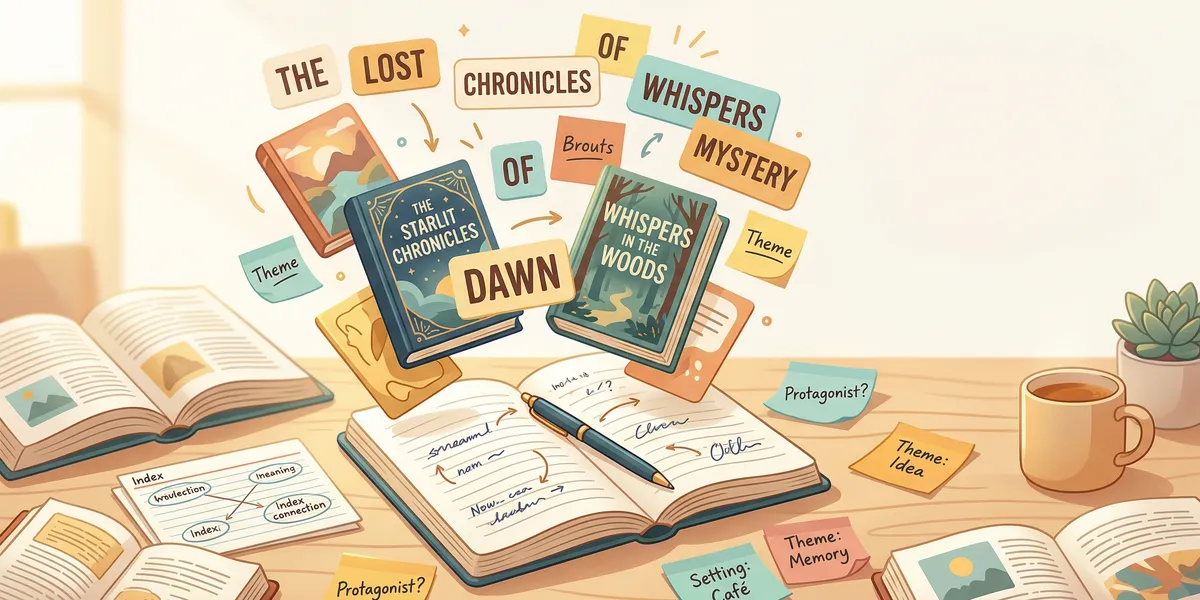
A random book title generator gives you dozens of creative title options in seconds — no staring at a blank page required. Whether you’re naming a fantasy epic, a self-help book, or a romance novel, these tools break through creative blocks by combining words, genres, and patterns you might never think of on your own.
This guide covers the best free random book title generators available right now, how to use them effectively, and the principles behind titles that actually sell books.
How random book title generators work
Most random book title generators use one of two approaches. Template-based generators pull from databases of pre-built title structures and swap in genre-appropriate words — think “[The] + [Adjective] + [Noun]” patterns. AI-powered generators take your book’s description, genre, and tone as inputs, then produce original titles using language models trained on millions of published works.
Neither approach gives you a finished title straight out of the box. What they give you is raw material — a starting point that sparks ideas you would not have reached through brainstorming alone.
The average self-published book sells around 250 copies in its lifetime. In a market where over three million books are published each year, your title is the first and sometimes only chance to stand out. A random title generator helps you explore more options faster, increasing the odds you land on something that grabs attention.
Best free random book title generators
Here are the tools worth trying, organized by what they do best.
Our Pick — Chapter
Chapter’s AI writing platform generates book titles as part of its full book creation workflow. Instead of producing titles in isolation, it considers your outline, audience, and genre to suggest titles that fit your actual book — not just random word combinations.
Best for: Authors who want title generation built into a complete writing tool Pricing: $97 one-time (nonfiction) | Varies (fiction) Why we built it: Title brainstorming should happen alongside your book’s structure, not in a separate tool
Reedsy Book Title Generator
Reedsy offers a bank of over 10,000 pre-built titles across fantasy, crime, mystery, romance, and sci-fi. Select your genre, hit generate, and browse through options. The titles lean toward fiction and follow recognizable genre conventions.
Best for: Fiction writers wanting genre-specific inspiration Pricing: Free Try it: reedsy.com/resources/book-title-generator
Capitalize My Title — Book Title Generator
A straightforward generator that produces title ideas based on your selected options. Clean interface, no sign-up required. It also includes a title capitalization tool, which is useful once you have settled on your final title.
Best for: Quick, no-fuss title brainstorming Pricing: Free Try it: capitalizemytitle.com/book-title-generator
Fantasy Name Generators — Book Titles
This generator produces 10 random titles at a time across 10 genre categories. It includes custom input fields so you can add specific words or themes you want reflected in the output. The results skew toward fiction, particularly fantasy and adventure.
Best for: Genre fiction writers, especially fantasy and sci-fi Pricing: Free Try it: fantasynamegenerators.com/book-title-generator.php
QuillBot AI Book Title Generator
QuillBot’s tool uses AI to generate titles based on your book description, genre, and target keywords. The more detail you provide about your book’s theme, plot, and mood, the more tailored the suggestions become. Results tend to be polished and publication-ready.
Best for: Authors who want AI-generated titles from a detailed prompt Pricing: Free Try it: quillbot.com/ai-writing-tools/ai-book-title-generator
Canva AI Book Title Generator
Canva’s generator uses its Magic Write AI to produce title ideas from your book description. It supports 20 languages for generation and 100+ for translation. Since it lives inside Canva, you can immediately jump into cover design once you have a title you like.
Best for: Authors who also need cover design tools Pricing: Free (limited generations) Try it: canva.com/book-title-generator
For a deeper comparison of AI-powered options specifically, see our best AI book title generators roundup where we tested 10 tools with the same prompt.
How to use a random title generator effectively
Generating random titles is easy. Turning those random outputs into a title worth printing on a cover takes a bit more strategy.
Generate in bulk, then filter
Run the generator at least five times. Collect 30 to 50 titles before you start evaluating. You are looking for patterns — words, rhythms, or structures that keep catching your eye. A single generation rarely produces a winner, but patterns across many generations reveal what resonates.
Mix and match components
The best title you find might be a combination of two mediocre ones. Take the first half of one generated title and pair it with the subtitle structure of another. Generators are idea engines, not finished-product machines.
Test against genre conventions
Book genres have distinct titling patterns. Romance titles often use emotional or sensory language (“The Last Letter,” “Whisper of Dawn”). Thrillers favor short, punchy phrases (“Gone Girl,” “The Silent Patient”). Nonfiction tends toward promise-driven titles with clarifying subtitles.
Compare your generated titles against the top 20 books in your genre on Amazon. If your title would look out of place among them, keep generating.
Check for uniqueness
Before you fall in love with a generated title, search for it on Amazon and Google. Titles cannot be copyrighted in most cases, but sharing a title with an existing popular book creates confusion and makes discoverability harder. A unique title gives you a clean lane in search results.
Proven formulas for strong book titles
Random generators are useful, but understanding what makes a title work gives you the ability to evaluate and improve whatever they produce. These formulas have driven bestsellers across every genre.
The [Adjective] + [Noun] formula
Simple, vivid, and immediately evocative. Silent Spring. Brave New World. Dark Places. This structure works because it creates a mental image in two or three words.
How to use it: Pick an unexpected adjective. “The Quiet Garden” is forgettable. “The Violent Garden” makes you want to know more.
The question formula
Questions create an open loop that the reader’s brain wants to close. Where the Crawdads Sing. Do Androids Dream of Electric Sheep? This formula works especially well for nonfiction where the title promises an answer.
How to use it: Ask a question your target reader is already wondering about. The book becomes the answer.
The [Character/Thing] + [Preposition] + [Place] formula
The Girl on the Train. The Woman in the Window. The Catcher in the Rye. This structure places a person in a specific context, creating instant intrigue about why they are there and what happens next.
How to use it: Combine a character descriptor with a setting that creates tension or curiosity. “The Surgeon in the Garden” is more interesting than “The Surgeon at the Hospital.”
The subtitle clarifier (nonfiction)
Nonfiction titles often pair a catchy hook with a clarifying subtitle. Atomic Habits: An Easy & Proven Way to Build Good Habits & Break Bad Ones. The title grabs attention; the subtitle tells the reader exactly what they will learn.
How to use it: Write a title that sounds interesting and a subtitle that sells the benefit. If you need help structuring your nonfiction content, a book outline can clarify what your subtitle should promise.
Title tips by genre
Different genres reward different approaches. Here is what works for the most popular categories.
| Genre | What works | Example pattern |
|---|---|---|
| Romance | Emotional, sensory language | ”The [Emotion] of [Season/Place]“ |
| Thriller | Short, punchy, ominous | ”The [Noun]” or “[Verb] + [Object]“ |
| Fantasy | Invented words, epic scope | ”The [Noun] of [Mythical Thing]“ |
| Sci-fi | Tech or concept-driven | ”[Concept] + [Number/Place]“ |
| Memoir | Personal, evocative | ”[Metaphor]: A [Type] of [Theme]“ |
| Self-help | Promise + mechanism | ”[Desired Outcome]: How to [Method]“ |
| Business | Authority + clarity | ”[Bold Claim]: [Subtitle with specifics]” |
For a deeper library of title ideas organized by genre, check out our book name generator with 150+ ready-made titles, or our book title generator guide with formulas you can apply to any genre.
Common mistakes to avoid
- Being too clever. A title that requires explanation does not work on a bookshelf or in search results. Clarity beats cleverness every time.
- Ignoring searchability. Your title needs to be easy to spell, remember, and type into a search bar. Unusual spellings or made-up words (outside of fantasy) hurt discoverability.
- Copying a bestseller’s title. Sharing a title with a mega-bestseller means competing with their SEO, their reviews, and their brand recognition. You will lose.
- Forgetting the subtitle. For nonfiction especially, the subtitle does the heavy lifting of explaining what the book delivers. A vague title with no subtitle loses potential readers.
- Settling too early. Professional authors and publishers often test 20 to 50 title options before choosing. If you have only considered three, you have not explored enough.
FAQ
Can I use a title generated by a random book title generator?
Yes. Book titles generally cannot be copyrighted in the United States. You can use a generated title as-is or modify it. The only exception is if a title has been trademarked as part of a series brand, which is rare.
How many titles should I generate before choosing one?
Generate at least 30 to 50 options across multiple sessions. Professional publishers routinely test dozens of title variations. The more options you explore, the more likely you are to find one that is both original and compelling.
Do book titles affect sales?
Absolutely. Your title is the first piece of marketing copy a potential reader encounters. It appears in search results, on recommendation lists, in bookstore displays, and in word-of-mouth conversations. A strong title makes every other marketing effort more effective because it gives people something memorable to repeat and search for.
What makes a book title SEO-friendly?
A title that includes words readers actually search for will show up more often in Amazon and Google results. For nonfiction, this often means including the core topic in the title or subtitle. For fiction, memorable and unique titles build brand searchability over time — readers searching for your exact title should find your book first.
Should I use AI or template-based generators?
Both have value. Template generators are faster and produce genre-conventional results that fit established patterns. AI generators produce more varied and original options but require more detailed input to get useful results. Start with template generators for quick inspiration, then use AI generators when you have a clearer sense of your book’s description and target audience.