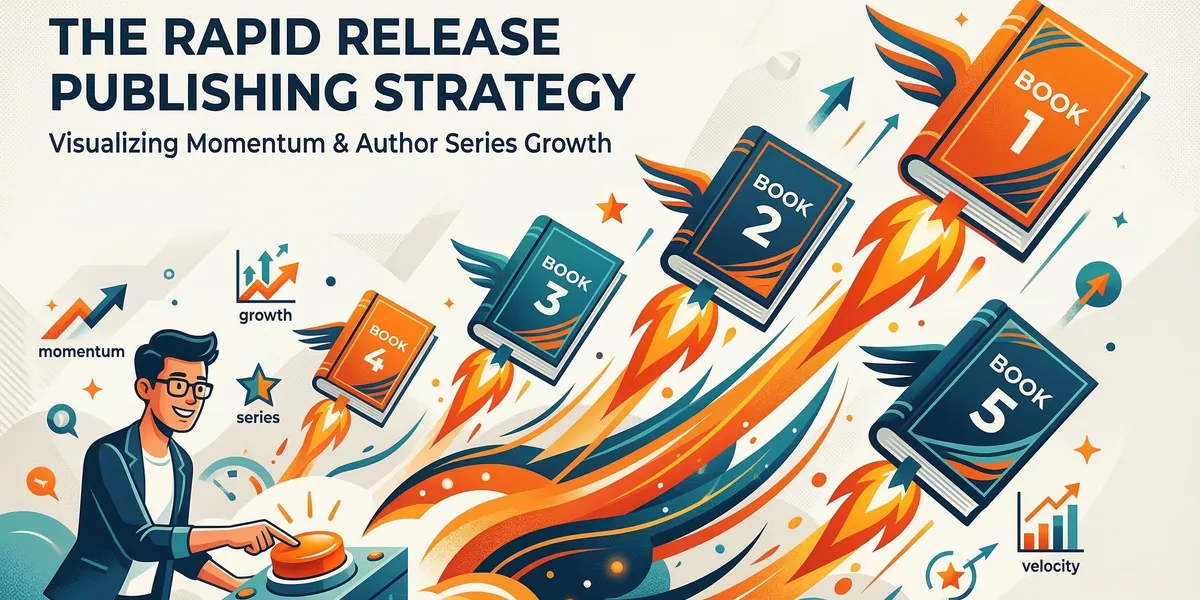
Rapid release means publishing books 30 to 90 days apart instead of once a year. It is the strategy behind nearly every breakout self-published author in the last decade, and it works because of how the Amazon algorithm and reader behavior both reward publishing velocity.
This guide covers why rapid release works, how to plan it, how to write fast enough to sustain it, and the mistakes that derail most authors who try.
Why rapid release works
The Amazon algorithm rewards velocity
Amazon’s recommendation engine tracks sales velocity: how many copies sell in a compressed time window. When you release a new book, you get a temporary visibility boost. The algorithm pushes your book into “also bought” recommendations, “new releases” lists, and category placements.
If you release another book before that momentum fades, the second launch amplifies the first. Readers who discover book two go back and buy book one. Now both books are generating sales velocity simultaneously.
A single book launch gives you one spike. A rapid release series gives you compounding spikes.
Readers binge series
Reader behavior has shifted toward binge consumption. Netflix trained an entire generation to consume content in marathon sessions, and book readers are no different. Kindle Unlimited readers in particular tear through series.
When a reader finishes book one and book two is not available yet, the odds of them remembering to come back in six months are low. When book two is already listed on your Amazon page, they click “Read Now” immediately. This is called read-through, and it is the primary revenue multiplier in self-publishing.
The math of rapid release
Consider two authors writing in the same genre, each publishing four books per year.
Author A publishes one book every three months, each a standalone in a different genre.
Author B publishes one book every three months, all in the same series using a rapid release strategy.
After one year, Author A has four unrelated books. Each launch starts from zero because there is no read-through between them.
Author B has a four-book series. Each new launch drives sales of all previous books. By book four, every new reader who starts book one potentially generates four sales instead of one. With a 70 percent read-through rate (strong but achievable), every new reader of book one generates an average of 2.8 book sales.
According to Written Word Media’s author survey, authors who publish four or more books per year earn significantly more than those who publish one or two.
Planning your rapid release series
Choose a series-friendly genre
Rapid release works best in genres where readers consume series. Romance, thriller, mystery, fantasy, sci-fi, and LitRPG are the strongest candidates. Literary fiction and standalone nonfiction are harder to apply this strategy to.
If you are writing nonfiction, you can adapt the strategy by publishing related books that cross-promote. A book on productivity, followed by a book on time management, followed by a book on habits creates a natural reading sequence.
Outline all books before writing book one
The biggest rapid release failure is writing book one, publishing it, and then having no idea what book two is about. By the time you figure it out, your momentum is gone.
Before you write a single word of book one, outline the full series arc. You need to know:
- How many books the series will be (3 to 5 is the sweet spot for a first rapid release)
- The overarching series conflict and resolution
- Each book’s main plot and how it connects to the series arc
- Recurring characters and their development across books
- The ending of each book that makes readers need the next one
Set a realistic publication schedule
Rapid release does not mean rushing. It means planning ahead so you have manuscripts ready before the previous book launches.
A strong approach: write books one through three before publishing book one. This gives you a 90-day buffer between each release while your fourth book gets written.
| Timeline | Action |
|---|---|
| Months 1-6 | Write books 1, 2, and 3 |
| Month 7 | Publish book 1 |
| Month 8 | Write book 4, edit book 2 |
| Month 9 | Publish book 2 (60-90 days after book 1) |
| Month 10 | Write book 5, edit book 3 |
| Month 11 | Publish book 3 |
| Month 12 | Publish book 4, plan next series |
Writing faster without sacrificing quality
Use AI tools to accelerate drafting
AI writing tools can cut your first draft time significantly. Chapter helps fiction authors generate manuscripts quickly by handling the labor-intensive first draft, which you then revise and polish into your voice.
The goal is not to publish AI-generated text. The goal is to move through the drafting phase faster so you spend more time on revision, character development, and the creative choices that make your writing distinctive.
Authors using AI-assisted drafting often report cutting their first draft time from three months to three to four weeks, leaving more time for the editing passes that actually determine quality.
Establish a daily word count habit
Rapid release requires consistency. Whether your target is 1,000 or 3,000 words per day, the habit matters more than the number.
At 1,500 words per day, five days a week, you produce a 60,000-word first draft in eight weeks. That pace supports publishing a book every two to three months with time built in for editing.
Batch your editing
Instead of editing each chapter as you go (which slows drafting and often leads to rewriting the same chapters repeatedly), complete the full first draft and then edit in focused passes:
- Structural edit: Fix plot holes, pacing, and character arcs
- Line edit: Improve prose, dialogue, and description
- Copy edit: Catch grammar, continuity, and formatting errors
- Proofread: Final pass for typos
Marketing each release
Pre-orders
Set up pre-orders for each book in the series as soon as you have a cover and description. This lets readers who finish one book immediately pre-order the next, capturing that impulse while their excitement is highest.
Amazon allows pre-orders up to 90 days in advance for KDP titles.
Email your list on launch day
If you have built a reader list through a reader magnet or newsletter, email them on every launch day. Your existing readers are the engine that drives early sales velocity, which triggers the algorithm to show your book to new readers.
Stack promotions across the series
When book three or four launches, run a price promotion on book one. Drop it to $0.99 or free. New readers enter the series at a discount, and the read-through to full-priced later books generates profit even if book one earns nothing.
This is where Amazon ads and promotional services like BookBub become powerful. Advertising book one at a discount when three or four sequels are available turns advertising spend into a multiple-book revenue stream.
Common mistakes to avoid
- Publishing before the next book is ready. If you launch book one and then spend six months writing book two, you have lost the rapid release advantage. Have at least two books completed before launching.
- Sacrificing quality for speed. Rapid release with mediocre books builds a reputation for mediocre books. Write faster, but edit thoroughly.
- Ignoring series arc planning. Each book needs to be satisfying on its own while creating a need for the next installment. Cliffhangers without resolution frustrate readers. Hooks with resolution and new questions keep them coming back.
- Not writing in a series-friendly genre. Rapid release is a series strategy. If your genre does not support series (most literary fiction, memoirs), this approach will not deliver the compounding returns.
- Burning out. Rapid release is a sprint strategy applied over 6 to 12 months, not a permanent lifestyle. Plan a break after your initial series run. Many authors rapid-release a series, then take two to three months off before starting the next one.
FAQ
How many books should I write before starting rapid release?
Write at least three books before publishing the first. This ensures you can maintain a 30 to 90 day release schedule without gaps. Some authors write the entire series (4 to 5 books) before publishing any, which gives maximum scheduling flexibility.
Does rapid release work in Kindle Unlimited?
Rapid release is arguably more powerful in KU than anywhere else. KU readers consume series voraciously, and KU’s page-read royalty system rewards authors whose readers finish multiple books. A five-book series with strong read-through can generate substantial KU income.
Can I do rapid release with nonfiction?
Yes, but it looks different. Instead of a fiction series, publish related nonfiction books that cross-promote. A book about starting a business, followed by a book about marketing that business, followed by a book about scaling it. Each book’s back matter promotes the next.
What if I cannot write fast enough?
Use tools that accelerate your process. AI writing assistants like Chapter can help you produce first drafts faster, and hiring freelance editors rather than self-editing saves weeks per book. The investment in speed pays for itself through the compounding returns of rapid release.