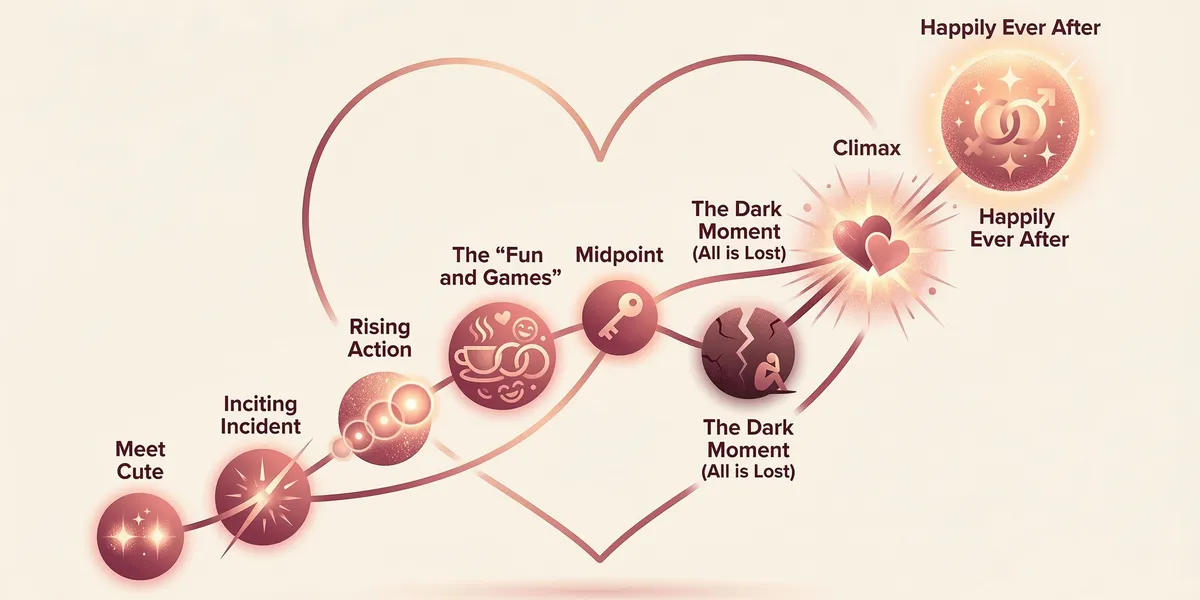
Every romance novel follows the same emotional arc. The tropes change, the settings change, the heat levels change — but the underlying structure that makes a love story satisfying is consistent across the genre. These are the eight beats that bestselling romance novels hit, the approximate timing for each, and how to execute them.
If your romance is stalling, dragging, or falling flat at the end, the problem is almost certainly a missed or misplaced beat.
The 8 Essential Romance Beats
Beat 1: The Meet (0-10% of the book)
The leads meet or reconnect. This is the first impression — the reader’s first glimpse of how these two people exist in each other’s presence. The meet doesn’t need to be dramatic, but it needs to be specific. How the characters react to each other establishes the dynamic that the rest of the book will develop.
What it accomplishes: Establishes the initial dynamic (antagonistic, curious, uncomfortable, electric), shows the reader who each character is before the romance changes them, and plants the seed of attraction — even if neither character recognizes it yet.
Timing: Within the first 10% of the manuscript. Readers picked up a romance novel. They want to meet both leads quickly.
Variations by trope:
- Enemies to lovers: The meet is adversarial. Immediate friction, but the reader should sense chemistry beneath the hostility.
- Second chance: The meet is a re-meet. The tension comes from history — what happened last time and what has changed.
- Fake dating: The meet might precede the arrangement. The characters know each other, and the romantic tension begins when they agree to pretend.
- Forced proximity: The meet might be the moment they realize they’re stuck together.
Example: In The Hating Game, Lucy and Joshua’s first scene establishes their antagonism through a staring contest across shared office space. It’s petty, specific, and immediately tells the reader these two people are obsessed with each other — even if they’d call it hatred.
Beat 2: The Spark (5-15%)
The first moment of genuine attraction or emotional connection that one or both characters feel — and resist. The spark is the reader’s confirmation that this romance is going to happen. It’s not a full realization of feelings. It’s a crack in the armor.
What it accomplishes: Creates the first emotional hook beyond premise. Tells the reader “these two people are going to fall in love” even if the characters don’t know it yet. Shifts the story from setup to romantic tension.
Timing: Shortly after the meet, sometimes within the same scene. The spark can be simultaneous with the meet in tropes where attraction is immediate (billionaire romance, paranormal mate bonds), or delayed in tropes where the characters start in conflict.
What the spark looks like:
- A physical awareness that surprises the character (“I noticed his hands and didn’t know why that mattered”)
- An unexpected moment of humor or vulnerability that shifts perception
- A competence moment — watching the other person be excellent at something
- A touch that lingers a half-second too long
Example: In Beach Read, January watches Gus work with intense focus and realizes the grumpy literary writer next door is more interesting than she expected. The spark is intellectual attraction disguised as professional curiosity.
Beat 3: The Deepening (15-35%)
The characters spend time together and the connection builds. This is the longest pre-midpoint beat and the most important for reader investment. The deepening is where the relationship moves from attraction to something more — shared experiences, revealed vulnerabilities, growing trust.
What it accomplishes: Builds the emotional foundation that makes the later beats land. Without sufficient deepening, the crisis feels arbitrary and the resolution feels unearned. This is where readers fall in love with the couple.
Timing: The bulk of the first third. This beat should not be rushed. If your romance feels thin, it’s usually because the deepening didn’t get enough pages.
How to build it:
- Shared experiences that create inside jokes, memories, and private references only they understand
- Vulnerability exchanges where each character reveals something they guard
- Growing conflict with the outside world — other people noticing the connection, external pressures that push the characters together or threaten to pull them apart
- The slow erosion of boundaries they set for themselves (“I won’t fall for them” becomes harder to maintain)
Example: In People We Meet on Vacation, the flashback vacations show Alex and Poppy building a decade of shared experiences. Each trip deepens the reader’s understanding of why these two people are inevitable.
Beat 4: First Intimacy (30-45%)
The first significant physical or emotional milestone. This might be a first kiss, a first night together, or a moment of emotional intimacy so raw it functions as the relationship’s point of no return. What counts as “first intimacy” depends on the heat level and the trope.
What it accomplishes: Crosses a line. After this beat, the characters can’t pretend the connection isn’t real. It changes their dynamic — now they’re navigating what this means, not whether it exists.
Timing: Around the 30-45% mark, before the midpoint. This beat often coincides with or immediately precedes the midpoint shift.
Variations by heat level:
- Sweet/clean romance: The first intimacy is emotional — a confession, a moment of trust, a declaration that shifts the relationship’s terms
- Warm romance: A first kiss that’s charged with meaning
- Steamy romance: A first sexual encounter that reveals character (how they are in intimate moments tells the reader who they really are)
- Spicy/explicit: The physical scene is detailed and the emotional content is integrated — the intimacy reveals vulnerability
Example: In The Wall of Winnipeg and Me, the first intimacy isn’t physical — it’s the moment Vanessa realizes Aiden trusts her in a way he trusts no one else. In a slow-burn romance, emotional intimacy can hit harder than physical.
Beat 5: The Complication (40-60%)
An obstacle emerges or escalates that threatens the relationship. This can be external (a secret revealed, a career opportunity in another city, a rival, family interference) or internal (fear, mistrust, conflicting goals). The midpoint complication raises the stakes — now there’s something real to lose.
What it accomplishes: Prevents the romance from resolving too easily. Tests the connection that’s been building. Reveals what the characters value when forced to choose. Shifts the emotional tone from “this is wonderful” to “this might not work.”
Timing: Around the midpoint (45-55%). The complication can build gradually through the middle third or arrive as a single revelatory event.
Strong complications:
- Force a genuine choice (career vs. relationship, loyalty vs. love)
- Reveal information that recontextualizes the relationship (a secret, a misunderstanding, a betrayal)
- Stem from the characters’ actual flaws, not external coincidence
- Are difficult enough that the reader genuinely worries
Weak complications:
- Could be resolved with a single honest conversation
- Come from a third party who appears solely to create drama
- Feel like delay tactics rather than genuine obstacles
Example: In The Unhoneymooners, the complication arrives when the deception that enabled the fake relationship threatens to unravel publicly. The external crisis (being discovered) triggers the internal one (acknowledging real feelings would make the deception worse).
Beat 6: The Black Moment (70-80%)
The lowest point. The relationship appears to be over. The characters separate — physically, emotionally, or both. Whatever progress they’ve made seems destroyed. The black moment should feel devastating, not just inconvenient.
What it accomplishes: Creates the emotional contrast that makes the resolution powerful. Without a genuine low point, the happy ending feels easy rather than earned. The black moment also forces each character to confront what they’ve lost and decide what they’re willing to do about it.
Timing: Around 75% of the book. This is the emotional nadir — everything after this beat moves toward resolution.
What makes a strong black moment:
- The breakup/separation feels justified from both characters’ perspectives (not just a misunderstanding)
- The characters are each forced to face their central flaw or fear alone
- The reader believes, even briefly, that the relationship might not recover
- It connects to the characters’ established wounds and fears
What makes a weak black moment:
- A misunderstanding that could be resolved in one conversation
- External interference that has nothing to do with the characters’ actual issues
- A breakup that feels manufactured to fit the structure rather than earned by the story
Example: In It Ends with Us, the black moment carries genuine weight because the obstacle isn’t a misunderstanding — it’s a fundamental question about what love requires. The reader can’t see an easy path forward, which makes the resolution meaningful.
Beat 7: The Grand Gesture / Realization (80-90%)
One or both characters realize what they must change, sacrifice, or declare to fix the relationship. This often involves confronting their central fear — the thing that’s been preventing them from committing fully. The grand gesture doesn’t need to be public or dramatic. It needs to be specific and vulnerable.
What it accomplishes: Demonstrates growth. The character who does something they couldn’t have done at the start of the book — being vulnerable, making a sacrifice, choosing love over safety — proves that the romance has changed them. The gesture answers the question the whole book has been asking.
Timing: After the black moment, before the resolution. This beat can be a single scene or a sequence.
Effective grand gestures:
- Address the specific wound or fear the character has been carrying
- Require vulnerability or sacrifice that costs something real
- Reference earlier moments in the story (callback to the deepening phase)
- Aren’t about money or spectacle — they’re about emotional courage
Example: In The Hating Game, Joshua’s gestures are specific to things he learned about Lucy during their deepening — details that show he was paying attention when she thought he wasn’t. The gesture proves the love by proving the attention.
Beat 8: The HEA / HFN (90-100%)
Happily Ever After or Happy For Now. The couple reunites and the reader sees them together, stable, and facing the future as a unit. This isn’t just “they got back together.” It’s confirmation that the obstacles have been overcome, the characters have grown, and the love is real and lasting.
What it accomplishes: Fulfills the genre’s promise. Romance readers read for the HEA. It’s not optional. But it needs to feel earned by everything that came before — not just declared.
Timing: The final 10% of the book. Some romances deliver the HEA in a single scene; others use an epilogue to show the couple’s future.
HEA vs. HFN:
- HEA (Happily Ever After): The couple is clearly committed. Marriage, living together, or a declaration that signals permanence. Traditional and expected in most romance subgenres.
- HFN (Happy For Now): The couple is together and happy, but the future is open. More common in new adult, contemporary, and literary-leaning romance. The promise is “they’re choosing each other right now” rather than “they’ll be together forever.”
What makes a strong ending:
- Specific to this couple’s journey (not a generic declaration of love)
- Shows how both characters have changed
- Gives the reader a final moment of the chemistry that drew them to the couple
- Answers any remaining questions about the external conflict
Example: In Beach Read, the resolution addresses both the romantic relationship and each character’s professional/personal arc. The HEA feels earned because both characters grew independently as well as together.
Using the Beat Sheet as a Diagnostic Tool
The beat sheet isn’t a formula — it’s a framework for diagnosing problems.
If the first third feels slow: Your meet, spark, or deepening may be dragging. Check whether you have unnecessary setup before the leads interact.
If the middle sags: Your complication may not be strong enough, or the deepening phase hasn’t created enough emotional investment for the complication to land.
If the ending feels flat: Your black moment wasn’t devastating enough, your grand gesture wasn’t specific enough, or the resolution wasn’t earned by sufficient character growth.
If the romance feels thin: The deepening phase needs more page time. This is the most common structural issue — writers who rush to the complication without building sufficient emotional foundation.
The Beat Sheet Across Subgenres
The eight beats apply universally, but each subgenre emphasizes different ones.
| Subgenre | Emphasized Beats | Notes |
|---|---|---|
| Contemporary | Deepening, Black Moment | Internal conflict drives these beats |
| Historical | Meet, Complication | Social conventions shape both |
| Paranormal | Spark (mate bond), First Intimacy | Supernatural elements intensify both |
| Romantic Suspense | Complication, Black Moment | External danger raises stakes |
| Slow Burn | Deepening | This beat gets the most pages |
| Romcom | Meet, Grand Gesture | Comedy shapes how both play out |
Writing With the Beat Sheet in Chapter
The romance beat sheet is built directly into Chapter’s fiction software. When you create a romance novel, Chapter maps all eight beats across your manuscript’s structure — positioning the meet, the spark, the deepening, the complication, the black moment, and the HEA at the exact narrative percentages where they land hardest. You choose your tropes, set your heat level, and the beat sheet adapts to your specific story. No more guessing whether your black moment comes too early or your deepening phase needs more room. Sarah M. used Chapter’s beat sheet structure to hit #12 in Romance Contemporary in five days — the beats were in the right places from the start.