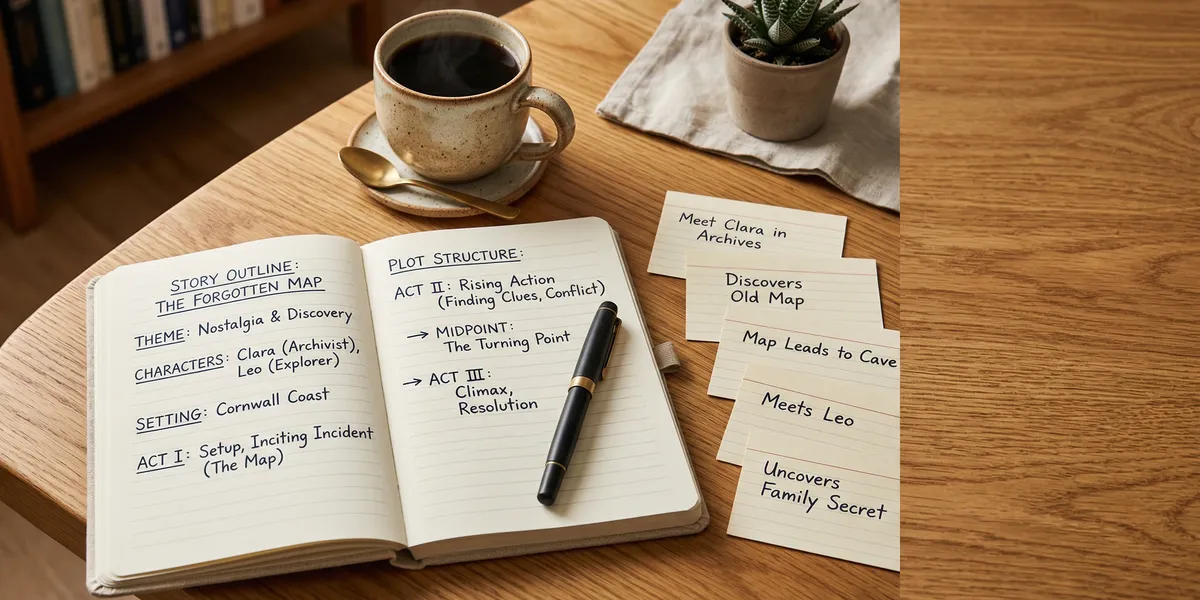
A short story outline is a structured plan that maps your story’s characters, conflict, and arc before you write a single scene. You do not need a complicated system. You need five elements on one page, and this guide gives you the template to build one in under thirty minutes.
Whether you are writing literary fiction, genre stories, or flash pieces for submission, outlining first prevents the two biggest problems short story writers face: stories that wander without a point, and drafts that collapse in the middle because you never figured out the ending.
Why outline a short story
Outlining a short story is not the same as outlining a novel. A novel outline might span dozens of pages. A short story outline fits on a single sheet because the form itself is compressed — typically 1,000 to 7,500 words with a single character arc and one central conflict.
The point of a short story outline is constraint. You decide in advance what the one change is, who it happens to, and how it resolves. This keeps you from writing fifteen pages of beautiful prose that never arrives anywhere.
Outlining also cuts revision time. When you know where you are headed, your first draft tends to be structurally sound even if the sentences need polishing. Writers who draft without a plan often spend more time rearranging scenes than they do writing new material.
If you have never outlined a short story before, start here. If you have tried and found it too rigid, the template below is flexible enough to leave room for discovery.
The five elements every short story outline needs
Before you fill in a template, you need to understand the five building blocks. Every complete short story — from a 1,000-word flash piece to a 7,500-word literary submission — contains these elements.
1. Character
Your short story needs one protagonist with a clear want. Not three characters, not an ensemble cast. One person who wants something specific.
The want should be concrete enough to drive action. “Sarah wants to feel happy” is too vague. “Sarah wants to convince her estranged sister to come to their mother’s funeral” is a story.
In your outline, write one sentence for each:
- Who is the protagonist?
- What do they want?
- Why can’t they have it easily?
2. Conflict
Conflict is the obstacle between your character and what they want. Without it, you have a character sketch, not a story.
Short stories work best with a single, focused conflict. You do not have the word count for subplots. The conflict can be external (another person, a situation, the environment) or internal (fear, guilt, a moral dilemma), but it needs to create real tension.
The conflict should appear early. In a short story, the reader should understand what is at stake within the first few paragraphs. The inciting incident is the moment conflict enters the story and the protagonist’s situation shifts.
3. Setting
Setting in a short story does double duty. It establishes where and when the story happens, and it creates mood. A divorce negotiation in a fluorescent-lit conference room feels different than one at a kitchen table at midnight.
Keep your outline’s setting notes brief. One location is ideal. Two is workable. More than two and you are probably writing a novel outline instead of a short story outline.
In your outline, note:
- Where does the story take place?
- When does it happen? (time of day, season, era)
- What mood does the setting create?
4. Arc
The arc is the shape of your story — how it moves from beginning to end. The most common structure for short fiction follows Freytag’s Pyramid: exposition, rising action, climax, falling action, and resolution.
For a short story, think of the arc in three beats:
- Setup: Introduce the character, the want, and the conflict.
- Escalation: The conflict intensifies. Something forces the character to act.
- Resolution: The character succeeds, fails, or is changed by the attempt.
That is the entire arc. You do not need act breaks, pinch points, or midpoint reversals. Those belong to longer forms.
5. Theme
Theme is what your story is about beneath the surface. It is the question the story asks or the observation it makes about being human.
You do not need to state the theme explicitly in your outline. But knowing it helps you make decisions. If your story is about the cost of loyalty, every scene should test that idea. If a scene does not connect to the theme, it probably does not belong in a short story where every paragraph earns its place.
Write one sentence in your outline: “This story is about ___.”
Short story outline template
Copy this template and fill in each section. The entire outline should fit on one page.
Title (working): [Your working title]
Premise: [One sentence — who wants what and what stands in their way]
Character:
- Name:
- Want:
- Flaw or limitation:
- How they change by the end:
Setting:
- Location:
- Time:
- Mood:
Conflict:
- Type (internal/external):
- Source:
- Stakes (what happens if the character fails):
Arc:
- Opening scene: [What is the character doing when we meet them? What do we learn about their situation?]
- Inciting incident: [What disrupts the status quo and forces the character to act?]
- Rising tension: [How does the conflict escalate? What obstacles appear? 2-3 key beats.]
- Climax: [The moment of highest tension. What decision does the character face?]
- Resolution: [How does the story end? What has changed?]
Theme: [One sentence — what is this story really about?]
Short story outline example
Here is the template filled in for a literary fiction short story:
Title (working): The Last Lesson
Premise: A retired piano teacher must decide whether to take on one final student — her estranged granddaughter — knowing the girl only wants free lessons, not reconciliation.
Character:
- Name: Margaret Chen
- Want: To reconnect with her granddaughter
- Flaw: Pride — she refuses to acknowledge her role in the family rift
- How she changes: She admits fault, not through words, but by teaching the one piece her granddaughter’s mother loved
Setting:
- Location: Margaret’s home studio, a room untouched since her daughter left
- Time: Late autumn, late afternoon lessons as the light fades early
- Mood: Quiet, strained, gradually warming
Conflict:
- Type: Internal (pride vs. love) with external pressure (granddaughter’s indifference)
- Source: Margaret drove her daughter away by being controlling; the granddaughter carries that resentment
- Stakes: This is likely her last chance at family connection
Arc:
- Opening scene: Margaret hears from her granddaughter for the first time in four years. The request is transactional — free piano lessons for a school recital.
- Inciting incident: Margaret agrees, but the first lesson reveals the girl has real talent. Margaret starts teaching seriously, not just running through recital pieces.
- Rising tension: The granddaughter resists anything beyond the recital repertoire. Margaret pushes. They argue. The granddaughter threatens to stop coming. Margaret notices the girl plays exactly like her mother did — same hand position, same instinct for phrasing.
- Climax: During what might be the final lesson, Margaret places her daughter’s favorite piece on the music stand instead of the recital music. The granddaughter recognizes it.
- Resolution: They play it together. Nothing is said about the past. The music says it. The granddaughter comes back the following week — not for the recital.
Theme: Forgiveness does not always require words.
Adapting the template by genre
The template works for any genre, but your emphasis shifts depending on what you are writing.
| Genre | Outline emphasis | Key question |
|---|---|---|
| Literary fiction | Character arc and theme | What changes internally? |
| Thriller/suspense | Plot beats and pacing | What is the ticking clock? |
| Science fiction | World rules and concept | What one “what if” drives the story? |
| Romance | Relationship arc | What keeps the characters apart? |
| Horror | Atmosphere and escalation | What is the source of dread? |
| Mystery | Clues and reveal structure | What does the reader learn and when? |
For genre fiction, you may want to add a line to your outline for genre-specific elements — the world rule in sci-fi, the red herrings in mystery, or the meet-cute in romance. But the core five elements (character, conflict, setting, arc, theme) stay the same regardless.
Common outlining methods for short stories
The template above follows a linear approach, but other methods work well depending on how your mind organizes information.
The snowflake method starts with a single sentence (your premise) and expands outward — one sentence becomes a paragraph, a paragraph becomes a page. This works well if you discover your story through elaboration rather than top-down planning. The Snowflake Method was originally designed for novels but scales down effectively for short fiction.
The scene list skips structure labels entirely. You write a numbered list of scenes in order, one sentence per scene. This is fast, concrete, and useful when you already know your story but need to verify the order works.
Mind mapping puts the central conflict in the middle and branches outward to characters, settings, scenes, and themes. This is a good starting point if you have scattered ideas that need connecting.
The “what if” method starts with a single question and builds the outline by answering it. “What if a retired teacher’s estranged granddaughter asks for lessons?” leads to character, conflict, and arc naturally.
Pick the method that matches how you think. The goal is the same — a clear plan before you draft.
Common mistakes to avoid
- Over-outlining. If your outline is longer than one page for a short story, you are probably writing the draft in outline form. Keep it skeletal.
- Skipping the ending. The number one reason short story drafts stall is that the writer does not know where the story is going. Decide the resolution before you write the opening.
- Multiple POV characters. Short stories work best with a single point of view. If your outline has two protagonists, you may need to choose one or write two separate stories.
- Vague conflict. “Character faces challenges” is not conflict. Name the specific obstacle and what happens if the character fails.
- Ignoring word count. A short story is not a condensed novel. If your outline has more than five or six scenes, you are likely planning something that will run past 7,500 words. Most literary magazines accept submissions under 5,000 words as the sweet spot.
FAQ
How long should a short story outline be?
One page or less. A short story outline should contain your premise, character, conflict, setting, arc (five to six beats), and theme. If you are writing more than a page, you are either over-detailing individual scenes or planning a story that is too complex for the short form.
Should I outline every scene?
No. Outline the key beats — the opening, the inciting incident, two or three escalation points, the climax, and the resolution. Leave room between beats for discovery during drafting. Over-prescribing every moment can make the writing feel mechanical.
Can I change the outline while writing?
Yes, and you should when the story demands it. An outline is a map, not a contract. If a better ending reveals itself mid-draft, follow it. Then update your outline so you can check the rest of the story still holds together with the new direction.
What is the difference between a short story outline and a novel outline?
Scale and complexity. A novel outline covers multiple character arcs, subplots, and dozens of scenes across three or more acts. A short story outline covers one character, one conflict, and a handful of scenes within a single arc. The short story version fits on one page. The novel version might span ten. If you need the longer format, see our book outline template.
Do published authors outline short stories?
Some do, some do not. Writers like Kurt Vonnegut charted the shapes of stories before writing them. Others write from a single image or feeling. But even writers who claim they do not outline usually know their ending before they start — that knowledge functions as an outline, even if it is never written down.