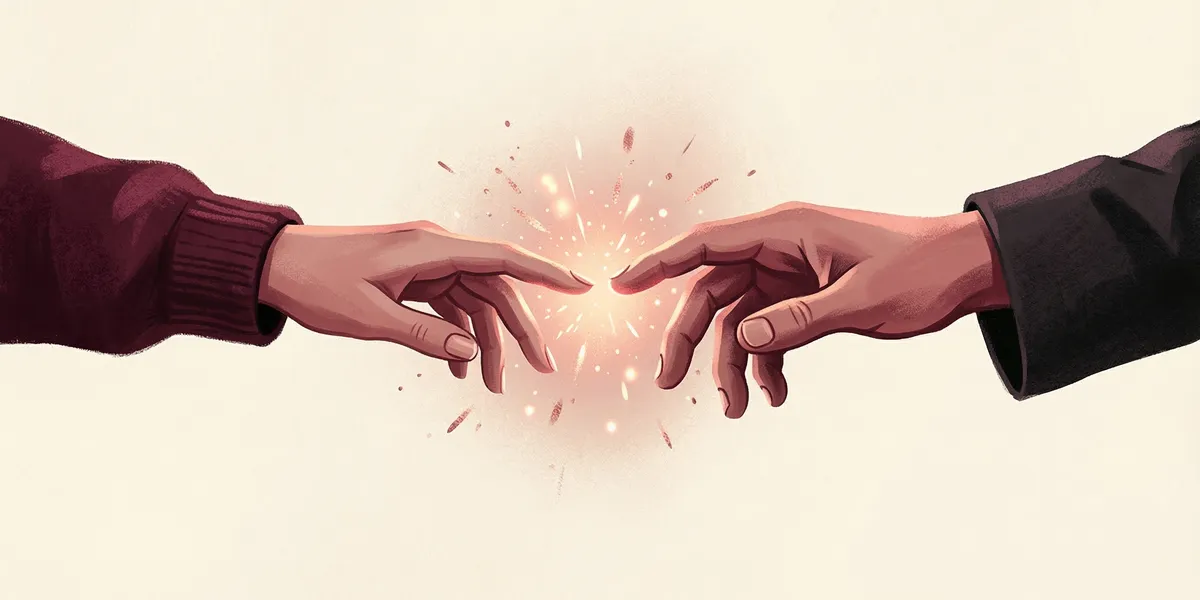
Slow burn romance is a pacing strategy where romantic tension builds gradually over a long stretch of the story before the characters act on their feelings. The longing accumulates chapter by chapter — lingering glances, loaded silences, almost-touches — until the eventual payoff hits with the force of something that has been building pressure behind a closed door.
It is not about withholding. It is about making the reader want something so badly that when it finally happens, the satisfaction is physical.
What Slow Burn Actually Means
A slow burn is defined by the gap between when the reader knows the characters belong together and when the characters admit it to themselves. That gap is where the entire trope lives. The wider you stretch it — without breaking it — the more powerful the payoff.
This is different from a story where the characters simply take a long time to meet. In a slow burn, the characters are already in each other’s orbit. They interact constantly. The attraction simmers underneath every conversation, every accidental touch, every scene where one of them watches the other and looks away a half-second too late.
Slow burn can layer on top of nearly any other romance trope. Enemies to lovers with a slow burn means the hate-to-love transition unfolds across many chapters. Friends to lovers with a slow burn means the awareness builds so gradually that the characters do not recognize it as romantic until they are already in too deep.
Why Readers Are Obsessed with It
Slow burn romance is one of the most requested tropes in the genre, and the psychology behind it is straightforward.
Anticipation is its own pleasure. Neuroscience confirms what romance readers already know: wanting something activates the same reward circuits as getting it. The dopamine is in the chase. A slow burn extends the chase across the entire book, keeping readers in a state of pleasurable tension.
Emotional investment compounds. Every chapter the characters spend not-quite-together is a chapter where the reader’s investment deepens. By the time the first kiss happens on page 280 instead of page 30, the reader has been waiting for it, imagining it, needing it. The payoff is proportional to the buildup.
It mirrors real falling in love. People do not generally meet someone and immediately declare their feelings. Real attraction builds through accumulation — small moments that add up until you cannot ignore the sum. Slow burn feels true because it follows the actual rhythm of how people fall.
Techniques for Building the Burn
This is a craft of suggestion. You are not writing scenes where characters talk about their feelings. You are writing scenes where their feelings leak through despite their best efforts to contain them.
Lingering Glances
The character looks at the other person a beat too long. Notices the way their collar sits against their neck. Watches them across a room and then snaps their attention back when someone speaks to them. The key is specificity — what exactly do they notice? The detail they fixate on reveals the nature of their attraction.
Almost-Touches
Hands that brush reaching for the same object. A steadying grip on an elbow that lingers one second past functional. Sitting close enough on a couch that their knees are almost touching, and both of them are aware of the gap. The almost-touch is more charged than an actual touch because it exists in the space of possibility.
Loaded Dialogue
Conversations that are about one thing on the surface and something else entirely underneath. Two characters discussing a book, but really discussing whether love can survive betrayal — because that is the question of their own relationship. Banter that sounds casual but carries undercurrents of want. The reader should be able to read between every line.
Proximity Without Contact
They end up close to each other — in a car, in a kitchen, in a hallway that is too narrow. They are aware of each other’s breathing. Neither moves away. Neither closes the distance. The scene exists entirely in the tension of that static distance.
The “They Do Not Know Yet” Moment
The character does something for the other person — remembers their coffee order, defends them without thinking, cancels plans because the other person needs them — and does not realize the significance of what they have done. But the reader does. This dramatic irony is one of the most satisfying tools in the slow burn toolkit.
Small Rewards
A slow burn is not an endless withholding. You need to give the reader breadcrumbs — moments of micro-intimacy that suggest the dam will eventually break. A forehead touch. A whispered name. A moment where one character falls asleep on the other’s shoulder and the other stays perfectly still, afraid to wake them.
These small rewards serve two purposes: they satisfy the reader enough to keep them invested, and they escalate the tension by proving the feelings are real and growing.
Pacing the Burn
The First Third
Establish the dynamic. Show the characters in each other’s presence with no romantic awareness — or with only the faintest flicker. The reader should start to see it before the characters do. Plant small details that will gain weight later.
The Middle
This is where the burn intensifies. The almost-moments accumulate. The characters start to realize something is happening but resist naming it. Internal monologue becomes unreliable — they tell themselves they do not feel what they clearly feel. Introduce a catalyst (jealousy, proximity, danger) that forces the feelings closer to the surface.
The Final Third
The tension becomes unsustainable. The characters are aware of their feelings and actively fighting them or struggling to express them. The dam breaks — and when it does, give the reader a payoff that matches the buildup. Do not write 250 pages of longing and then summarize the first kiss in a single sentence.
Famous Examples Worth Studying
Pride and Prejudice by Jane Austen — The original slow burn. Elizabeth and Darcy’s entire arc is a study in gradual recognition, denial, and eventual surrender. The pacing across misunderstandings, the letter as turning point, and the second proposal as payoff are structurally perfect.
Outlander (early chapters) by Diana Gabaldon — The Jamie and Claire dynamic builds slowly through forced proximity and mutual respect before becoming romantic. Gabaldon uses historical danger as an external pressure that intensifies internal feelings.
The Cruel Prince by Holly Black — A fantasy slow burn layered over enemies to lovers. The tension builds across an entire trilogy, with small moments of vulnerability scattered between scenes of genuine danger and hostility.
The Kiss Quotient by Helen Hoang — A contemporary romance that uses a professional arrangement as the framework for a slow emotional burn. The physical relationship starts early, but the emotional intimacy builds gradually — proving that slow burn is about emotional pacing, not just physical withholding.
Common Mistakes
Going too slow with no payoff moments. If you withhold every form of intimacy for 300 pages, you are not building tension — you are testing patience. Readers need breadcrumbs. Small moments of connection that prove the feelings are mutual and growing.
Rushing the ending after a long buildup. This is the most common slow burn failure. The writer spends 80 percent of the book building tension and then resolves the romance in twenty pages. The payoff should be proportional to the buildup. Give the reader time to enjoy the characters finally being together.
Artificial obstacles. The tension should come from internal resistance — fear, denial, self-protection — not from contrived misunderstandings that could be resolved with a single conversation. If your characters could solve the problem by talking for five minutes, the obstacle is not real.
Losing the thread. In a slow burn, the romantic tension needs to be present in nearly every scene where both characters appear, even when the scene is about something else. If chapters go by without any romantic undercurrent, the burn goes cold and is hard to reignite.
Writing Slow Burn with Intention
Slow burn is fundamentally a pacing challenge, which means structure matters more than inspiration. You need to plan your escalation — map out which chapters contain which moments of closeness, and make sure the trajectory moves consistently upward with no extended plateaus.
If you are building a slow burn romance and want structural guidance, Chapter’s fiction software includes a romance beat sheet that maps emotional turning points across your manuscript. The trope library and heat-level controls let you calibrate exactly when the tension escalates and when it breaks — so the longing lands exactly where it should.