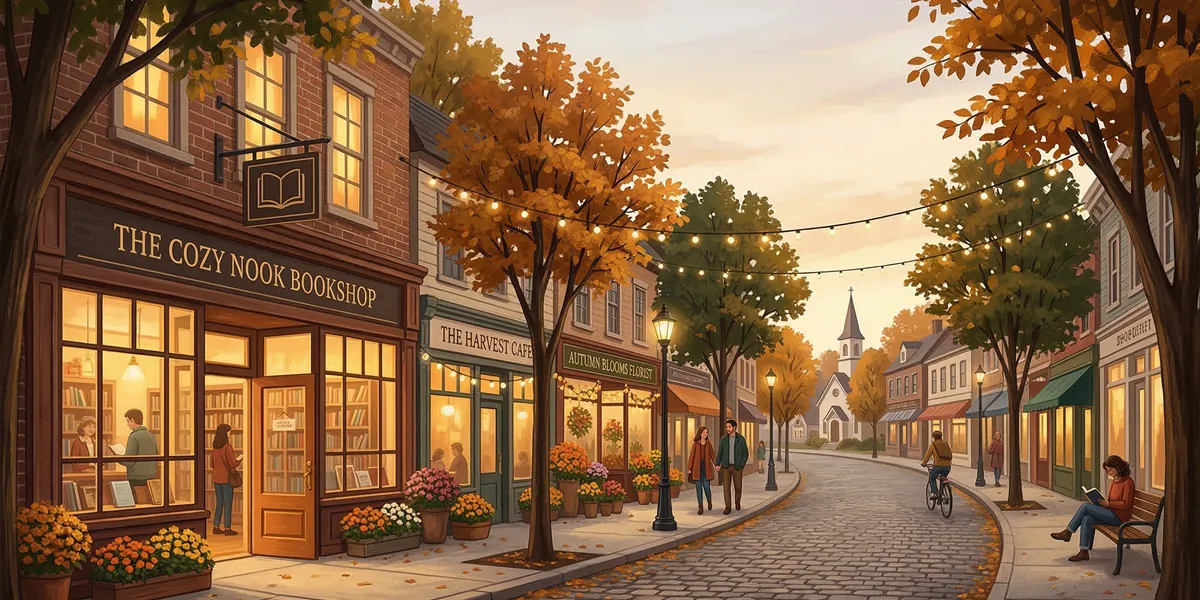
Small town romance uses a tight-knit community as both setting and character. The town isn’t just where the love story happens — it’s why the love story happens the way it does. Everyone knows everyone, secrets don’t stay secret, and there’s nowhere to hide from your feelings or your past.
The subgenre consistently dominates romance bestseller lists because readers return to these towns like visiting a place they love.
What Makes the Setting Work
A city romance can happen in relative anonymity. A small town romance can’t. That difference shapes everything.
Everyone knows everyone. When two characters start spending time together, the whole town notices. The local diner owner has opinions. The postmaster saw them walking together. Three people have already texted the protagonist’s mother. This fishbowl effect creates external pressure that accelerates the romantic tension without the author needing to manufacture artificial obstacles.
Nowhere to hide. After a fight, the characters can’t retreat to opposite sides of a metropolis. They’ll run into each other at the grocery store, the gas station, the one coffee shop in town. The forced proximity isn’t a contrivance — it’s the reality of small-town geography.
Community as character. The town itself has personality, history, and a collective opinion about how things should be. A small town that rallies around a struggling bakery, gossips about the newcomer, and throws a festival that somehow changes everything isn’t just a backdrop. It’s participating in the story.
History is inescapable. In a small town, your past lives next door. The high school sweetheart who never left, the family reputation that precedes every introduction, the tree where someone carved their initials fifteen years ago — small towns are built on accumulated memory.
The Essential Character Types
Most small town romances feature one of two setups, each creating different dynamics.
The Newcomer
An outsider arrives in town. Maybe they’re escaping city life, inheriting property, taking a job, or hiding from something. The newcomer provides the reader’s point of entry — they’re discovering the town alongside us.
The tension: they don’t know the rules, the history, or the people. They’re conspicuous. The town is curious, welcoming, or suspicious (often all three). And they’re drawn to someone who represents everything about this place that’s different from where they came from.
The Returning Local
Someone who left comes back. The prodigal daughter who went to the big city. The person who swore they’d never return. The one who left after a scandal, a heartbreak, or a death. They know the town — but the town has changed, and so have they.
The tension: unfinished business. The person they left behind. The reputation they couldn’t shake. The family obligations that pulled them back. They’re navigating who they were versus who they’ve become, and the town remembers every version.
The One Who Stayed
Often paired with the returning local, this character never left. They built a life in the town — a business, a role in the community, roots. They watched the other person leave and had feelings about it.
The tension: they chose this life and made peace with it. The returning local threatens that peace. There’s often resentment (“you left, I stayed”) mixed with unresolved attraction, and the staying character must confront whether their contentment is genuine or resignation.
Key Elements That Define the Subgenre
The Local Business
Nearly every small town romance features a character-defining business. A bookshop, a bakery, a farm, a bar, a veterinary practice, a hardware store. The business serves multiple functions: it grounds the character in the community, provides daily scenes of competence and routine, and creates a location where other characters naturally gather.
The best small town businesses are specific. Not just “a bakery” but a bakery that’s been in the family for three generations, that makes the cinnamon rolls the entire town structures their Saturday mornings around, that’s in danger of closing because the building needs a new roof.
Small-Town Gossip
The gossip network is a small town romance’s secret weapon. Information moves faster than the characters can control it. A single witnessed moment — a lingering look, an after-hours visit, a shared laugh in the produce aisle — becomes town knowledge by morning.
Use gossip as both comedy and pressure. It’s funny when the protagonist’s mom calls to ask about someone they barely know. It’s pressure when the town has decided they’re a couple before they’ve had a first date.
Seasonal Events
Festivals, fairs, holiday celebrations, harvest events — small towns organize their calendar around communal occasions. These events function as set pieces in the romance. The Fourth of July fireworks where someone almost confesses. The fall festival where the whole town watches them together. The Christmas tree lighting that becomes a turning point.
One major seasonal event per book gives you a ready-made climactic scene with built-in atmosphere and community witness.
The Physical Setting
Describe the town with sensory specificity. The smell of the bakery at 5 AM. The sound of the church bells that mark the hour. The way Main Street looks in autumn with leaves covering the brick sidewalks. The lake where teenagers swim and adults pretend they don’t remember swimming.
Readers of small town romance are looking for a place they want to inhabit. Give them specific, vivid details that make the town feel real enough to visit.
Series Potential
Small town romance is one of the most series-friendly subgenres in fiction, and this is a major reason for its commercial success.
Interconnected standalones. Each book features a different couple, but the same town and recurring characters. The reader who fell in love with the town in book one comes back for book two’s couple — and buys every subsequent book because the town itself is the draw.
The friend group model. Introduce a group of friends or siblings in book one, give each one their own love story in subsequent books. Readers invest in the whole group and eagerly anticipate who’s next.
The community arc. Across the series, the town itself changes. A struggling downtown revitalizes. A threat to the community is overcome. New businesses open as characters settle down. This macro-arc gives the series forward momentum beyond individual love stories.
Recurring secondary characters. The diner owner who dispenses wisdom. The gossipy neighbor. The gruff-but-lovable mayor. These characters become reader favorites and provide continuity across the series. Give them distinctive voices and consistent quirks.
Famous Examples
Virgin River by Robyn Carr. The series that defined modern small town romance. A nurse practitioner moves to a remote Northern California town, and across twenty-plus books, the entire community’s love stories unfold. The Netflix adaptation proved the setting is as much a draw as any individual couple.
Schitt’s Creek (adaptation reference). While a TV show, its small-town-transforms-the-characters arc is a masterclass in the subgenre’s emotional core. The town’s limitations become its gifts.
Blue Moon series by Lucy Score. Small town romantic comedies with strong community dynamics and humor. The interconnected nature of the series — each book deepening the reader’s connection to the town — demonstrates the subgenre’s series potential.
Mitford series by Jan Karon. On the gentler end of the spectrum, this series shows how a small town’s rhythms and characters can sustain reader interest across many books. The town is the protagonist as much as any individual.
Tips for Building Your Small Town
Draw a map. Even a rough sketch helps you maintain spatial consistency. Where is the diner relative to the bookshop? How far is the ranch from town? Can characters walk to each other’s houses or do they need to drive? Geographic consistency makes the town feel real.
Give the town a personality. Is it progressive or traditional? Touristy or insular? Thriving or struggling? The town’s collective character should create specific pressure on the romance. A progressive town reacts differently to the new couple than a traditional one.
Limit the population deliberately. The smaller the town, the more intense the fishbowl effect. A town of 500 where everyone knows your business is different from a town of 15,000 where anonymity is possible. Choose the size that serves your level of community involvement.
Create a forced proximity within the proximity. The characters already live in the same small town, but give them an additional reason to be in each other’s space. Neighboring properties. A shared project. Sitting on the same town council. The town-level proximity sets the stage; the specific proximity sparks the romance.
Name your secondary characters. Even minor characters — the cashier at the general store, the man who’s always fishing at the pier — should have names and consistent details. They’re the fabric of the community, and named characters feel like people, not props.
Writing Small Town Romance With Chapter
Small town romance lives in the details — the community dynamics, the recurring characters, the setting that readers want to revisit. Chapter’s fiction software shines here with its series management feature, which tracks character details, town locations, and relationship dynamics across up to nine books so your small town stays consistent from the first book to the last. The romance trope library includes small town setups that pair naturally with other tropes like forced proximity, second chance, and grumpy-sunshine. Sarah M. hit #12 in Romance Contemporary in five days using Chapter — and the series tools mean book two can start the day book one publishes.