Southern gothic is a literary genre rooted in the American South that uses grotesque characters, decaying settings, and dark humor to expose uncomfortable truths about race, class, religion, and moral corruption. If you have ever read a story where the Spanish moss feels suffocating, the family secrets run generations deep, and the town itself seems to be rotting from the inside out — that is southern gothic.
This guide covers everything you need to know about the genre: what defines it, where it came from, the essential authors and works, and how to write southern gothic fiction yourself.
What Is Southern Gothic
Southern gothic is a subgenre of gothic fiction that trades European castles and supernatural horrors for crumbling plantations, sweltering heat, and the very real horrors embedded in Southern American history. Where traditional gothic fiction leans on the supernatural, southern gothic makes the grotesque painfully human.
The genre emerged in the early twentieth century as Southern writers began using gothic conventions — isolation, decay, buried secrets — to examine the region’s complex relationship with slavery, reconstruction, poverty, and religious extremism. Rather than ghosts haunting a manor, southern gothic gives you a town haunting itself.
Flannery O’Connor, one of the genre’s defining voices, described her characters as people in whom “the reader will be willing to recognize the image at the bottom of his own soul.” That impulse — holding up a darkly honest mirror — is at the heart of every southern gothic story.
Key Characteristics of Southern Gothic Fiction
Southern gothic is not defined by a single element but by how several elements work together. Here are the features that separate it from standard gothic fiction, horror, or literary fiction set in the South.
Grotesque Characters
The characters in southern gothic fiction are rarely ordinary. They carry physical, psychological, or moral distortions that reflect the brokenness of the world around them. These are not villains in the traditional sense — they are people warped by their environment.
Think of the Compson family in Faulkner’s The Sound and the Fury, each member deteriorating in a different way. Or the Misfit in O’Connor’s “A Good Man Is Hard to Find,” a killer who articulates a twisted but internally consistent worldview. Southern gothic characters are complex rather than cartoonish — their flaws expose the society that made them.
Decaying Settings
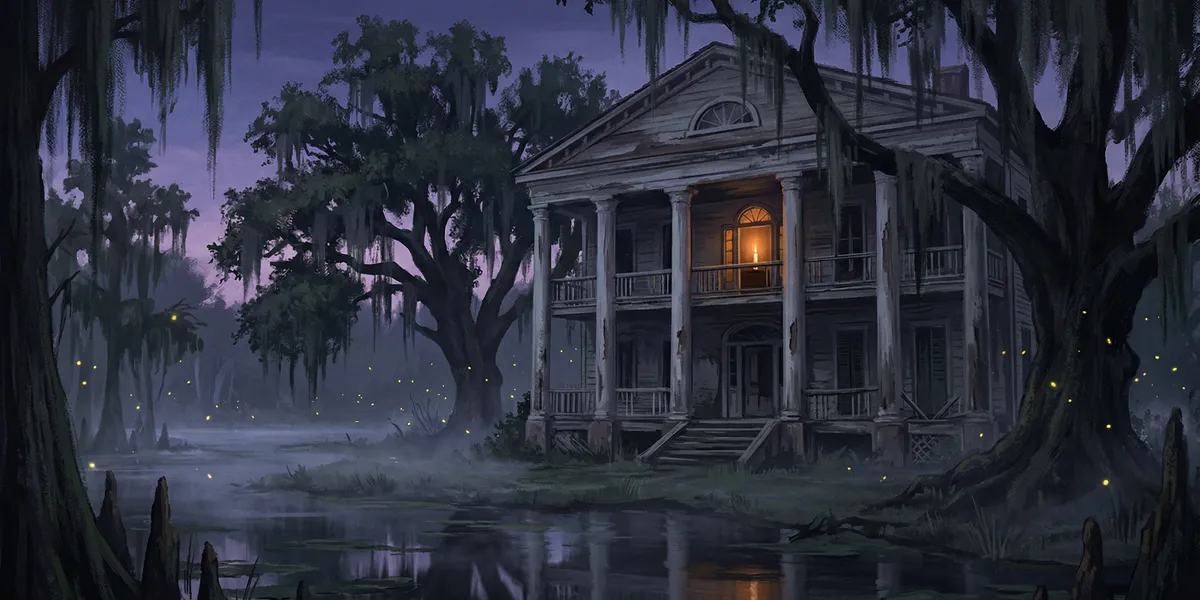
The physical landscape in southern gothic is never just a backdrop. It functions as a character. Crumbling plantation houses, abandoned churches, swamps choked with vegetation, small towns where nothing has changed in fifty years — these settings externalize the internal rot of the community.
This is a direct evolution from traditional gothic architecture. Where European gothic used castles and abbeys, southern gothic uses the ruins of the antebellum South. The decay is not accidental. It is the physical evidence of a culture that refuses to confront its own history.
Dark Humor
Southern gothic does not wallow in despair. It laughs at it. The humor is dry, uncomfortable, and often arrives at the worst possible moment. A funeral becomes a farce. A con man charms an entire town. A grandmother chatters about manners while being driven to her own murder.
This tonal balance — horror and comedy existing in the same sentence — is one of the hardest elements to execute and one of the most distinctive features of the genre. It prevents the darkness from becoming melodramatic.
Social Critique
Every southern gothic story is fundamentally about what is wrong with the social order. The genre uses gothic tools not for suspense alone but to examine systemic racism, religious hypocrisy, class rigidity, and the lingering consequences of slavery.
Where a horror novel asks “will the character survive?” a southern gothic novel asks “how did this place become so broken, and why does nobody admit it?”
The Tension Between Realism and the Supernatural
Southern gothic occupies an uneasy middle ground. Ghosts may appear, but you are never sure whether they are literal spirits or manifestations of guilt and trauma. Prophetic visions may be divine revelation or mental illness. The genre leaves this ambiguity intact, forcing the reader to sit with uncertainty.
This tension separates southern gothic from fantasy and horror. The supernatural is not the point — it is a lens for examining what people refuse to see clearly.
Essential Southern Gothic Authors and Works
Understanding the genre means knowing the writers who built it. Here are the foundational and contemporary voices.
The Founders
William Faulkner created the template. His fictional Yoknapatawpha County in Mississippi became the model for southern gothic settings — a complete world with its own history of violence, racial injustice, and moral compromise. The Sound and the Fury (1929), As I Lay Dying (1930), and Absalom, Absalom! (1936) are essential reading. His short story “A Rose for Emily” remains one of the most frequently taught examples of the genre.
Flannery O’Connor refined southern gothic into something sharper and stranger. Her stories are shorter, more violent, and shot through with a fierce Catholic theology that makes grace look terrifying. Wise Blood (1952) and the story collection A Good Man Is Hard to Find (1955) are where most readers start.
Carson McCullers brought loneliness to the center of the genre. The Heart Is a Lonely Hunter (1940) and The Member of the Wedding (1946) focus on isolated, misfit characters in small Southern towns — people who ache for connection in places designed to deny it.
Mid-Century Masters
Tennessee Williams translated southern gothic to the stage. A Streetcar Named Desire (1947) and Cat on a Hot Tin Roof (1955) use crumbling Southern families to explore desire, delusion, and the performance of respectability.
Truman Capote moved between southern gothic and other modes, but Other Voices, Other Rooms (1948) is a pure example — a boy searching for his father in a decaying Louisiana mansion filled with eccentric, damaged people.
Harper Lee’s To Kill a Mockingbird (1960) applies southern gothic conventions to a story about racial injustice in Alabama. The Radley house, the trial, and the town’s willful blindness all fit the genre’s framework.
Contemporary Voices
Cormac McCarthy pushed the genre into bleaker territory. Child of God (1973) and Outer Dark (1968) strip away the genteel surface entirely, leaving only violence, isolation, and a landscape that seems to punish everyone in it.
Jesmyn Ward is the most important contemporary southern gothic writer. Her novels Salvage the Bones (2011) and Sing, Unburied, Sing (2017) center Black Southern experience — poverty, environmental disaster, mass incarceration, and literal ghosts. Ward made history as the first woman and first Black American to win two National Book Awards for Fiction.
Other contemporary writers expanding the genre include Daniel Woodrell (Winter’s Bone), Donald Ray Pollock (The Devil All the Time), and Lauren Groff (The Vaster Wilds).
Southern Gothic vs Gothic Fiction
If you are deciding which genre fits your story, here is how they differ.
| Element | Gothic Fiction | Southern Gothic |
|---|---|---|
| Setting | European castles, abbeys, moors | American South — plantations, swamps, small towns |
| Era | Often historical (18th-19th century) | 19th century through present day |
| Supernatural | Central to the story | Ambiguous — may be psychological |
| Tone | Dread, suspense, terror | Dark humor mixed with dread |
| Characters | Aristocrats, maidens, villains | Outcasts, eccentrics, morally compromised ordinary people |
| Purpose | Explore fear and the unknown | Expose social dysfunction and moral failure |
| Source of horror | The supernatural or monstrous | Human cruelty, systemic injustice, and willful ignorance |
The key distinction: gothic fiction uses darkness for atmosphere. Southern gothic uses darkness for argument.
For a deeper dive into the parent genre, see our guide on how to write a gothic novel.
How to Write Southern Gothic Fiction
If you want to write in this genre, here is what actually matters — beyond just setting your story in the South.
Start with the Place
Southern gothic settings are not interchangeable. A story set in the Mississippi Delta reads differently from one set in the Appalachian hollows or the Florida Everglades. Research the specific geography, climate, dialect, and history of your chosen location. The setting should feel like it could not exist anywhere else.
Use sensory details that go beyond the visual. The sound of cicadas. The smell of red clay after rain. The weight of humidity. The genre’s best writers make readers feel the place physically.
Build Characters Who Embody the Conflict
Your characters should not just live in the setting — they should be shaped by it. A character’s flaws, beliefs, and contradictions should reflect the specific social pressures of their community. The Bible-quoting grandmother who is also casually racist. The war veteran who cannot reconcile what he did with what his town celebrates. The young woman who loves her home and is being destroyed by it.
Southern gothic characters are defined by internal contradiction. They are sympathetic and repellent at the same time. If your characters are simply “weird Southerners,” you are writing caricature, not southern gothic.
Use the Past as a Living Force
In southern gothic, history is not backstory — it is a character. The Civil War, slavery, reconstruction, Jim Crow, and their ongoing consequences press down on every scene. Characters inherit trauma, guilt, land, grudges, and myths from previous generations.
This does not mean every story needs a flashback to 1863. It means the present should feel haunted by decisions made long before the characters were born.
Master Tone
The signature tone of southern gothic is uncomfortable humor sitting next to genuine menace. Practice writing scenes where something is simultaneously funny and disturbing. Read O’Connor and McCarthy to study how they manage this balance.
Avoid two common traps: melodrama (taking the darkness so seriously it becomes absurd unintentionally) and parody (leaning so hard into eccentricity that the characters become jokes).
Let Morality Be Complex
Southern gothic does not have clean heroes and villains. The characters who commit terrible acts often have understandable — even sympathetic — motivations. The characters who seem righteous often harbor their own moral rot.
Resist the urge to pass judgment on your characters. Present their choices, their reasoning, and their consequences. Let the reader do the moral accounting.
Common Mistakes to Avoid
-
Treating “Southern” as the whole genre. Setting a story in the South does not make it southern gothic. The genre requires the thematic machinery — decay, social critique, moral complexity, the grotesque. A romance set in Georgia is not southern gothic just because there is a magnolia tree.
-
Relying on stereotypes instead of specificity. Generic “creepy rednecks” and “spooky bayous” are lazy shortcuts. The best southern gothic is precise about place, dialect, culture, and class. Specificity creates authenticity.
-
Making it all misery. Southern gothic without humor is just bleak literary fiction. The dark comedy is structural, not optional. If your readers never laugh uncomfortably, something is missing.
-
Ignoring race. The American South’s history of slavery and racial violence is foundational to the region and to the genre. A southern gothic story that pretends race does not exist is not being neutral — it is being incomplete. Contemporary writers like Jesmyn Ward have shown how to center these themes with power and nuance.
-
Confusing atmosphere with plot. A thick, moody setting is necessary but not sufficient. Your story still needs forward momentum, stakes, and characters who change. Atmosphere without narrative is just a description of a swamp.
FAQ
Is southern gothic the same as gothic fiction?
No. Southern gothic is a subgenre of gothic fiction specifically set in the American South. It shares gothic fiction’s interest in decay, secrets, and psychological unease but adds dark humor, social critique, and a focus on the region’s specific history of racism and class conflict. See the comparison table above for a detailed breakdown.
What is the best southern gothic book for beginners?
Flannery O’Connor’s short story collection A Good Man Is Hard to Find is the most accessible entry point. The stories are short, sharp, and demonstrate every core element of the genre — grotesque characters, dark humor, moral ambiguity, and violent grace — in concentrated form.
Can southern gothic be set in the modern South?
Absolutely. Jesmyn Ward’s Sing, Unburied, Sing (2017) is set in contemporary Mississippi and is one of the genre’s most important recent works. The modern South has its own version of the same tensions — poverty, mass incarceration, environmental injustice, and the weight of unresolved history. The genre is not a period piece.
How is southern gothic different from horror?
Horror aims to scare the reader. Southern gothic aims to unsettle them while making a point about society. Horror can have any setting and any characters. Southern gothic is specifically tied to the American South and uses its elements — the grotesque, the decaying setting, the dark humor — as tools for social criticism rather than pure suspense. Some overlap exists, but the intent and function are different.
Can I write southern gothic if I am not from the South?
You can, but it requires serious research and sensitivity. The genre is deeply tied to specific places, dialects, histories, and cultural dynamics. Writers who get southern gothic wrong usually fail because they rely on surface-level stereotypes rather than understanding the lived texture of Southern life. Read widely in the genre, research your specific setting thoroughly, and consider having Southern readers review your work for authenticity.