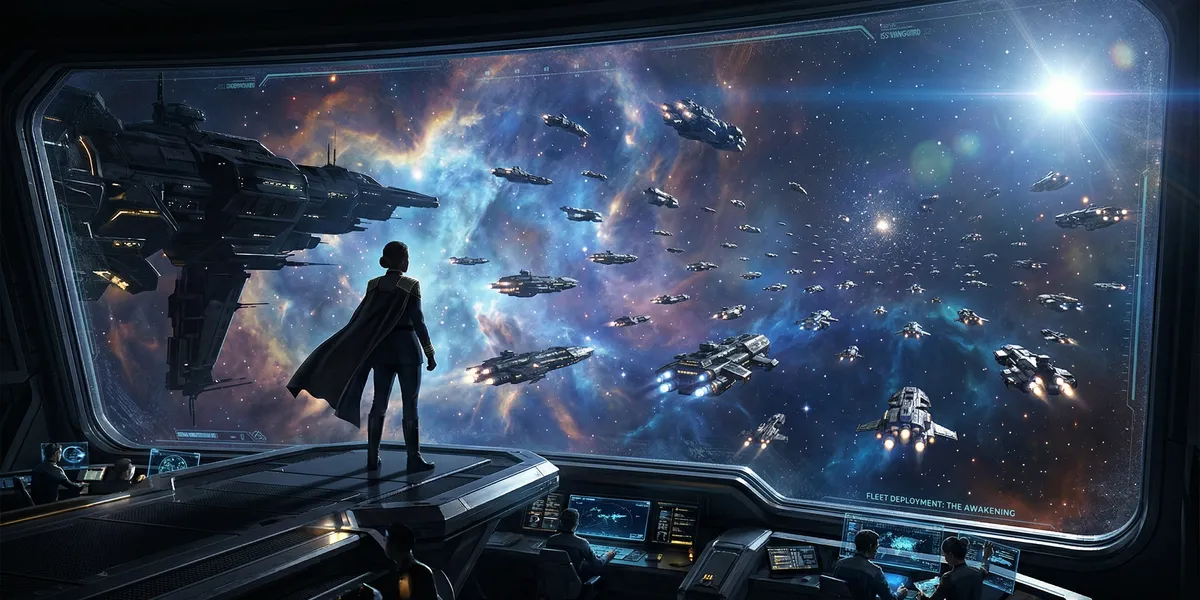
Space opera is science fiction at its biggest and most emotionally charged. It trades the laboratory for the galaxy, swapping controlled experiments for sprawling empires, interstellar warfare, and characters whose personal stakes mirror the fate of entire civilizations.
If you have ever watched Star Wars, read Dune, or binged The Expanse, you already know the genre’s pull. This guide breaks down what makes a space opera work, traces its history from pulp magazines to award-winning modern novels, and walks you through writing one of your own.
What Is Space Opera?
Space opera is a subgenre of science fiction defined by epic scope, high emotional stakes, and adventure set among the stars. The Science Fiction and Fantasy Writers Association (SFWA) recognizes it as one of the most enduring and commercially successful branches of speculative fiction.
The name borrows its structure from “soap opera” and “horse opera” — terms coined in the 1930s to describe formulaic, melodramatic stories in their respective mediums. Writer Wilson Tucker applied “space opera” to science fiction in 1941, originally as a pejorative for hackwork adventure stories. The genre long ago shed that stigma.
Today, space opera encompasses everything from military sagas to political thrillers to love stories, all set against an interstellar backdrop. What unifies them is scale: the canvas is always bigger than a single planet, and the consequences always reach beyond a single life.
Core Characteristics of Space Opera
Not every story set in space qualifies. Space opera has specific traits that separate it from hard science fiction, military sci-fi, and space westerns.
Vast Settings
The story spans star systems, galaxies, or entire civilizations. A single planet is usually just a starting point. Think of how Frank Herbert’s Dune moves from Caladan to Arrakis to imperial courts spanning the known universe, or how Becky Chambers’ Wayfarers series makes the ship itself a crossing point between dozens of alien worlds.
High-Stakes Conflict
The central conflict operates at a civilizational level — galactic war, political uprising, existential threats to an entire species. Even when the story follows one character, their choices ripple outward. In Ann Leckie’s Ancillary Justice, a single AI’s quest for revenge exposes the cracks in a galaxy-spanning empire.
Emotional Intensity
This is the “opera” in space opera. Relationships, betrayals, sacrifices, and moral dilemmas drive the story as much as any battle. The genre thrives on characters who feel deeply, even as they navigate worlds that dwarf them.
Loosely Treated Science
Space opera leans on faster-than-light travel, artificial gravity, and energy weapons without stopping to justify the physics. The science serves the story, not the other way around. If you want rigorously accurate orbital mechanics, you want hard science fiction. If you want a rebel fleet jumping to lightspeed to ambush an imperial armada, you want space opera.
Larger-Than-Life Characters
Heroes and villains tend toward the archetypal. Not flat, but operating at a scale where personal charisma, moral conviction, or ruthless ambition shapes the destiny of worlds. Character archetypes are the foundation — space opera amplifies them to galactic proportions.
Space Opera vs. Other Sci-Fi Subgenres
Understanding what space opera is not helps clarify the genre.
| Subgenre | Focus | Science Rigor | Scope | Tone |
|---|---|---|---|---|
| Space Opera | Adventure, politics, emotion | Loose | Galactic | Epic, dramatic |
| Hard Sci-Fi | Scientific accuracy | Strict | Varies | Intellectual |
| Military Sci-Fi | Combat, chain of command | Moderate | Often single theater | Gritty |
| Cyberpunk | Technology, social decay | Moderate | Urban, planetary | Dark, noir |
| Space Western | Frontier survival | Loose | Single system or planet | Rugged |
Space opera can overlap with military sci-fi (the Honor Harrington series) or blend with space western elements (Firefly). The defining difference is always scope and emotional register.
Classic Space Opera: Where It All Started
The genre’s roots go back to the 1920s and 1930s pulp magazine era, when writers like E.E. “Doc” Smith created the Lensman series — stories with planet-smashing weapons, psychic powers, and galactic civilizations locked in eternal conflict. They were pure adventure, light on nuance but heavy on spectacle.
Foundational Works
Isaac Asimov’s Foundation (1951): A mathematician predicts the fall of a galactic empire and engineers a plan to shorten the ensuing dark age. Foundation proved space opera could be cerebral, trading blaster fights for political maneuvering.
Frank Herbert’s Dune (1965): Politics, ecology, religion, and empire collide on a desert planet. Dune elevated space opera into literary fiction and remains the best-selling science fiction novel of all time.
Ursula K. Le Guin’s The Left Hand of Darkness (1969): Pushed the genre toward cultural anthropology and gender politics while maintaining the interstellar diplomatic stakes that define space opera.
Star Wars (1977): George Lucas brought space opera to the screen and into mainstream culture permanently. The original trilogy is a textbook example of the genre’s emotional core — a coming-of-age story wrapped in galactic rebellion.
Modern Space Opera: The Genre Today
Contemporary space opera has expanded in every direction — more diverse voices, more complex politics, more literary ambition. The Hugo Awards and Nebula Awards regularly honor space opera novels, confirming the genre’s critical standing.
Writers Redefining the Genre
Ann Leckie shattered conventions with Ancillary Justice (2013), using a singular pronoun for all characters to explore identity and imperialism. It won the Hugo, Nebula, and Arthur C. Clarke awards in the same year.
Arkady Martine brought literary prose and Mesoamerican-inspired worldbuilding to A Memory Called Empire (2019), a story about a diplomat navigating the politics of a conquering empire. It explores colonialism, cultural assimilation, and the cost of survival.
Becky Chambers took space opera in a quieter, character-focused direction with The Long Way to a Small, Angry Planet (2014). Her Wayfarers series proves that space opera does not require war — found family, cultural exchange, and personal growth can carry the genre.
James S.A. Corey (the pen name for Daniel Abraham and Ty Franck) grounded space opera in realistic solar-system politics with The Expanse series. The nine-book saga and its television adaptation became a modern benchmark for the genre.
Themes in Modern Space Opera
Today’s space opera wrestles with questions the pulp era never asked:
- Imperialism and colonialism — Who benefits when civilizations expand? (A Memory Called Empire, Ancillary Justice)
- Identity and consciousness — What makes a person? (Ancillary Justice, the Murderbot Diaries by Martha Wells)
- Found family — Crews that become families under pressure (Wayfarers, The Expanse)
- Environmental responsibility — How civilizations relate to the planets they inhabit (Dune, The Ministry for the Future intersecting with space opera themes)
How to Write a Space Opera
If you are ready to write your own, here is the practical framework. Space opera is one of the most ambitious genres to tackle, but the fundamentals of story structure still apply — you are just scaling them up.
Build the World in Layers
Start with the conflict, not the encyclopedia. Your galaxy needs just enough detail to make the story feel real. Build outward from what your protagonist touches.
Layer 1 — The immediate world: Your character’s ship, planet, or station. What does daily life feel like? What are the textures, the smells, the routines?
Layer 2 — The political landscape: Who holds power? What factions exist? What tensions are about to break? A galactic empire, a fragile alliance, a cold war between two species — pick a power structure and stress-test it.
Layer 3 — The deeper history: What happened before the story starts that shapes everything now? A fallen civilization, a forgotten war, a technological breakthrough that changed the balance of power. You do not need to explain all of this to the reader. You need to know it so the world feels lived-in.
For detailed guidance on building believable settings, see our worldbuilding tips guide. If you want AI tools to accelerate the process, our roundup of AI worldbuilding tools covers the best options.
Create Characters Worth Following Across a Galaxy
Space opera characters need to carry emotional weight across vast distances. The reader should feel the stakes personally, even when the conflict involves billions of lives.
Give your protagonist a personal motivation that connects to the larger conflict. Luke Skywalker does not join the rebellion because galactic freedom is abstractly important — he joins because the Empire killed his family. Paul Atreides does not care about desert ecology until Arrakis becomes his home.
Strong character arcs matter more in space opera than in almost any other genre, because the scale of the story can easily dwarf your characters if their internal journey does not keep pace. A protagonist who starts as a minor smuggler and ends as the person who brokers peace between two civilizations needs a believable emotional path between those points.
Build a crew, not a cast. Space opera thrives on ensemble dynamics — the bridge crew, the rebel cell, the political court. Each member should bring a distinct perspective and a distinct source of conflict.
Scale the Conflict Properly
The most common mistake in space opera is making the conflict too large too soon. If you open with a galaxy at war, the reader has no sense of what normal looked like. If you open with a single smuggler hearing a distant rumor about border skirmishes, you have room to escalate.
Use the rising action structure deliberately. Let the stakes build through personal encounters before the galactic consequences become clear. A bar fight on a space station can foreshadow an interstellar conflict if the people fighting represent larger factions.
Your climax should merge the personal and the political. The protagonist’s individual choice resolves (or fails to resolve) the larger conflict. This is what separates great space opera from stories that simply happen to be set in space.
Handle Exposition Without Info-Dumping
Space operas demand more worldbuilding context than almost any other genre. The temptation is to front-load it. Resist.
Show the world through action and consequence. Do not explain that the Hegemony taxes hyperspace lanes — show your protagonist getting pulled over by a customs frigate. Do not describe the alien species’ biology in a paragraph — reveal it through how they move, eat, communicate, and argue.
Scatter terminology naturally. If characters use a word casually, readers will absorb its meaning from context. The Expanse never stops to define “Belter” or “inner” — the social dynamics make the terms self-explanatory within a few pages.
Choose Your Science Level
Decide early how much science you want to justify and stick with it. Space opera gives you permission to wave away physics, but consistency matters more than accuracy.
Pick your rules:
- Faster-than-light travel: How does it work? Jump gates, warp drives, folding space? The mechanism does not need to be real, but it needs to be consistent.
- Communication: Can people talk across star systems instantly, or are there delays? This single choice shapes your entire plot structure.
- Weapons and defense: Energy shields, kinetic weapons, planet-killers? Establish the ceiling of destructive power early so your climax can push past it.
The golden rule: if a piece of technology would solve your plot problem too easily, add a limitation. Hyperdrives need fuel. Shields fail under sustained fire. Planet-killers take time to charge. Constraints create drama.
Write With a Tool That Matches the Scale
Space opera manuscripts run long. Tracking characters across multiple planets, managing faction politics, and maintaining consistency across a 100,000-word novel requires a tool that handles complexity without slowing you down.
Our Pick — Chapter
Chapter.pub is built for fiction writers tackling ambitious projects. Its AI assists with maintaining continuity across long manuscripts, generating scene drafts when you know what needs to happen but need momentum, and organizing complex storylines with multiple POV characters.
Best for: Fiction writers building large-scale, multi-thread narratives Why it fits space opera: The genre demands consistency across massive scope — Chapter keeps your worldbuilding, character details, and plot threads organized in one place.
Common Mistakes to Avoid
- All world, no story. A detailed galaxy means nothing without characters the reader cares about. Build only what the story needs.
- Stakes that are too abstract. “The galaxy is in danger” is not a stake. “This character will lose everyone they love if the fleet falls” is a stake. Ground every large-scale threat in personal consequence.
- Uniform cultures. Every planet should not feel the same. Vary language patterns, values, architecture, and daily customs. A mining colony and a pleasure world should read as different places, not reskinned versions of the same setting.
- Exposition dumps in Chapter 1. Start with a character in motion. Let the world reveal itself through what happens, not through what the narrator explains.
- Neglecting the “opera.” If your space opera reads like a military logistics report, you have lost the genre’s emotional core. Let characters feel things. Let relationships get complicated. Let betrayals sting.
FAQ
What is the difference between space opera and science fiction?
Space opera is a subgenre of science fiction. All space opera is science fiction, but not all science fiction is space opera. The distinguishing features are galactic scope, high emotional stakes, and adventure-driven plotting. Science fiction as a whole includes subgenres focused on hard science, social commentary, near-future extrapolation, and many other concerns that do not require interstellar settings.
Can space opera be literary fiction?
Yes. Works like A Memory Called Empire by Arkady Martine and Ancillary Justice by Ann Leckie are widely regarded as literary achievements. The genre’s history of pulp origins does not limit its ceiling. Modern space opera regularly wins the Nebula Award, the Hugo Award, and other major literary prizes.
How long should a space opera novel be?
Most published space operas fall between 90,000 and 150,000 words. The genre tends toward longer works because of its worldbuilding demands, but there is no minimum. Becky Chambers’ The Long Way to a Small, Angry Planet is around 100,000 words, while some Expanse novels exceed 150,000. Write the story at the length it needs.
Do I need to know real science to write space opera?
No. Space opera is the most forgiving science fiction subgenre when it comes to scientific accuracy. You should understand the basics of how space works — vacuum, distance, gravity — but you are not expected to solve equations. Consistency in your invented science matters far more than accuracy.
What are the best space opera books to read before writing one?
Start with the works that define the genre’s range: Dune by Frank Herbert for political depth, Ancillary Justice by Ann Leckie for structural innovation, The Expanse series by James S.A. Corey for grounded realism, and Wayfarers by Becky Chambers for character-driven warmth. TV Tropes’ space opera page maintains a comprehensive list of examples across all media.