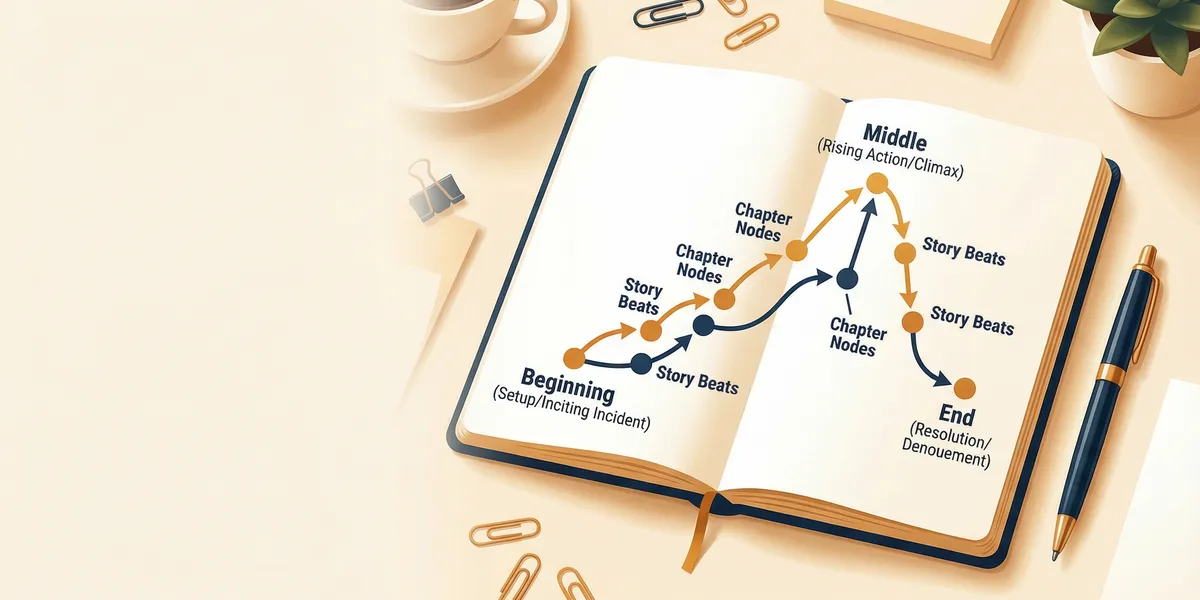
A story outline template is a pre-built framework that maps your narrative from beginning to end so you can organize characters, conflict, and plot points before you start writing.
In this guide, you’ll find:
- Free copy-and-paste story outline templates for every major structure
- Step-by-step instructions for filling in each template
- A breakdown of which outline method works best for your story type
Pick the template that fits your project, fill in the blanks, and start writing with a clear roadmap.
What Is a Story Outline?
A story outline is a structured plan that maps the major events, turning points, and character arcs in your narrative before you write the full draft. Think of it as the skeleton of your story — the bones that hold everything together while you add the flesh.
Your outline doesn’t need to be rigid. Some writers create detailed scene-by-scene breakdowns. Others sketch loose bullet points for major plot beats. Both approaches work as long as you’ve identified your protagonist, central conflict, and resolution before you start drafting.
Writers who outline consistently finish their manuscripts faster and spend less time on structural rewrites. The outline catches plot holes, pacing problems, and missing character motivation before you’ve written thousands of words around them.
Free Story Outline Template (Three Act Structure)
The three act structure is the most popular story outline method in Western storytelling. It divides your narrative into setup (25%), confrontation (50%), and resolution (25%).
Copy this template and fill in each section:
Act 1 — Setup (first 25%)
- Opening scene: Where does your story begin? What is the protagonist’s ordinary world?
- Protagonist introduction: Who is your main character? What do they want? What’s their flaw?
- Inciting incident: What event disrupts their ordinary world and forces them to act?
- First plot point / point of no return: What decision or event locks the protagonist into the central conflict?
Act 2 — Confrontation (middle 50%)
- Rising action: What obstacles does your protagonist face? List 3-5 escalating challenges.
- Midpoint twist: What revelation or reversal changes the protagonist’s understanding of the conflict?
- Pinch point 1: How does the antagonist demonstrate their power or raise the stakes?
- Pinch point 2: What setback makes the protagonist’s situation feel hopeless?
- All is lost moment: What’s the lowest point? What does your protagonist lose?
Act 3 — Resolution (final 25%)
- Climax: How does the protagonist confront the central conflict head-on?
- Climax decision: What choice defines who the protagonist has become?
- Falling action: What loose ends get tied up?
- Resolution: How has your protagonist changed? What’s the new normal?
This template works for short stories, novels, screenplays, and memoirs. Adjust the detail level based on your story’s length — a short story might have one sentence per beat, while a novel outline might have full paragraphs.
Story Outline Template: The Hero’s Journey
The Hero’s Journey (Joseph Campbell’s monomyth) is ideal for adventure, fantasy, sci-fi, and coming-of-age stories. It maps a protagonist’s transformation through 12 stages.
Copy this template:
The Departure
- Ordinary World: Describe your hero’s everyday life before the story begins.
- Call to Adventure: What invitation, challenge, or threat pulls them out of their comfort zone?
- Refusal of the Call: Why does the hero hesitate? What are they afraid of?
- Meeting the Mentor: Who or what gives the hero the tools, knowledge, or confidence to proceed?
- Crossing the Threshold: What moment marks the hero’s departure from the known into the unknown?
The Initiation
- Tests, Allies, and Enemies: What challenges does the hero face? Who helps them? Who opposes them?
- Approach to the Inmost Cave: What preparation or journey leads to the story’s biggest challenge?
- The Ordeal: What is the hero’s greatest test? What do they face that could destroy them?
- The Reward: What does the hero gain from surviving the ordeal? (knowledge, treasure, ability, truth)
The Return
- The Road Back: How does the hero begin their return? What final obstacles appear?
- The Resurrection: How is the hero tested one last time? How have they transformed?
- Return with the Elixir: What does the hero bring back to their ordinary world? How have they changed it?
This framework works especially well for fantasy stories, quest narratives, and stories about personal transformation.
Story Outline Template: Save the Cat Beat Sheet
Blake Snyder’s Save the Cat beat sheet is the most detailed pre-built story structure. Originally designed for screenwriting, it works brilliantly for fiction because it maps specific emotional and narrative beats to exact page percentages.
Copy this template:
| Beat | % of Story | Your Story |
|---|---|---|
| Opening Image | 0-1% | What visual or moment establishes the tone and your protagonist’s starting point? |
| Theme Stated | 5% | What sentence hints at the story’s central lesson? |
| Setup | 1-10% | What does the protagonist’s world look like? Who matters to them? What’s missing? |
| Catalyst | 10% | What event kicks the story into motion? |
| Debate | 10-20% | What internal conflict does the protagonist wrestle with before committing? |
| Break into Two | 20% | What choice launches the protagonist into the story’s main action? |
| B Story | 22% | What secondary relationship or subplot begins? (often the love interest or mentor) |
| Fun and Games | 20-50% | What are the scenes that “promise of the premise” delivers? |
| Midpoint | 50% | What raises the stakes? False victory or false defeat? |
| Bad Guys Close In | 50-75% | How do external and internal pressures intensify? |
| All Is Lost | 75% | What’s the protagonist’s lowest moment? What “death” (literal or metaphorical) occurs? |
| Dark Night of the Soul | 75-80% | How does the protagonist sit with their loss before finding new resolve? |
| Break into Three | 80% | What insight or decision gives the protagonist a new plan? |
| Finale | 80-99% | How does the protagonist execute their plan and face the final confrontation? |
| Final Image | 99-100% | What visual or moment shows how much has changed since the opening? |
The Save the Cat structure gives you 15 specific story beats to fill in. If you struggle with sagging middles, this template solves that problem by giving you defined checkpoints throughout Act 2.
Story Outline Template: Seven-Point Structure
The seven-point structure condenses your story into its most essential beats. This is the ideal template for short stories or writers who want a minimal outline that still provides direction.
Copy this template:
- Hook: What is the starting state of your protagonist? (This should be the opposite of the resolution.)
- Plot Turn 1: What event sets the story in motion and introduces the central conflict?
- Pinch Point 1: What applies pressure and reminds the reader what’s at stake?
- Midpoint: What shifts the protagonist from reacting to acting? What changes their approach?
- Pinch Point 2: What makes the situation worse? What loss or setback forces the protagonist to dig deeper?
- Plot Turn 2: What final piece of information or event gives the protagonist what they need to resolve the conflict?
- Resolution: How does the protagonist resolve the central conflict? How have they changed?
This template is excellent for short stories, novellas, and writers who prefer discovery writing but want guardrails. You can expand any of these seven points into sub-beats as your draft develops.
Story Outline Template: The Snowflake Method
The Snowflake Method takes a different approach — instead of filling in a pre-built framework, you expand your story from a single sentence into a full outline through iterative steps.
Copy this template:
Step 1 — One-Sentence Summary
Write your entire story in one sentence (15-25 words). No character names. Focus on the big picture.
Example: A timid librarian must decode her grandmother’s secret journal to prevent an ancient curse from destroying her hometown.
Step 2 — One-Paragraph Summary
Expand that sentence into a full paragraph with five sentences:
- Sentence 1: Setup and backdrop
- Sentence 2: First quarter events through first disaster
- Sentence 3: Second quarter events through second disaster
- Sentence 4: Third quarter events through third disaster
- Sentence 5: Climax and resolution
Step 3 — Character Summaries
For each major character, write:
- Name:
- One-sentence storyline:
- Motivation (what they want):
- Goal (what they’re trying to achieve):
- Conflict (what prevents them):
- Epiphany (what they learn):
Step 4 — Expand Each Sentence
Take each sentence from your one-paragraph summary and expand it into a full paragraph. You now have a five-paragraph story summary.
Step 5 — Scene List
Break those paragraphs into individual scenes. For each scene, note:
- POV character:
- What happens:
- What changes:
The Snowflake Method is particularly effective for complex plots with multiple POV characters, series fiction, and writers who think better in layers than in linear sequences.
How to Choose the Right Story Outline Template
Not every template suits every writer or every story. Here’s a quick comparison to help you pick:
| Template | Best For | Complexity | Ideal Length |
|---|---|---|---|
| Three Act Structure | Any genre, any length | Low | Short stories to novels |
| Hero’s Journey | Adventure, fantasy, coming-of-age | Medium | Novellas to novels |
| Save the Cat | Commercial fiction, screenplays | High | Novels and screenplays |
| Seven-Point | Short stories, minimal outliners | Low | Short stories to novellas |
| Snowflake Method | Complex plots, series fiction | High | Novels and series |
If you’re a new writer: Start with the Three Act Structure or Seven-Point template. They’re simple enough to follow without feeling constrained.
If you’re writing genre fiction: The Hero’s Journey maps perfectly to fantasy, sci-fi, and adventure. Save the Cat works well for romance, thriller, and mystery.
If you write by discovery: The Snowflake Method lets you start small and expand incrementally — you never have to plan the whole story before you understand it.
Step-by-Step: How to Fill In a Story Outline Template
Having a template is only half the equation. Here’s how to actually fill one in without getting stuck.
1. Start with your premise
Write a one-sentence premise that answers: Who is your protagonist, what do they want, and what stands in their way?
You don’t need a perfect sentence. Something like “A retired detective investigates the murder of the one case she could never solve” gives you enough to start filling in any template above.
2. Define your protagonist’s arc
Your character arc drives the outline. Ask yourself:
- Who is your protagonist at the beginning?
- Who are they at the end?
- What needs to happen to force that transformation?
The difference between those two versions of your character creates the emotional engine of your story.
3. Identify the central conflict
Every scene in your outline should connect to the central conflict. If a scene doesn’t advance, complicate, or resolve that conflict, cut it from the outline.
Your conflict needs an external dimension (what the protagonist does) and an internal dimension (what the protagonist feels). The best stories resolve both at the climax.
4. Map your major plot points
Place the major turning points first — inciting incident, midpoint, climax. Then fill in the scenes that connect them.
Think of it like driving directions. You mark the major intersections before worrying about the side streets. The big turns give you structure. The scenes between them give you story.
5. Add complications and subplots
Once your main plot spine is in place, layer in subplots that intersect with or complicate the central storyline. Each subplot should either:
- Reinforce the theme
- Challenge the protagonist’s internal flaw
- Raise the external stakes
6. Check your pacing
Read through your completed outline and check for:
- Sagging middle: Does Act 2 have enough conflict and reversals?
- Rushed ending: Did you give the climax and resolution enough space?
- Missing motivation: Does each character decision feel earned?
If a section feels thin, add a complication. If it feels bloated, combine or cut scenes.
Using AI to Build Your Story Outline
AI writing tools can accelerate the outlining process significantly. Instead of staring at blank template fields, you can use AI to generate a starting outline that you then refine and personalize.
Our Pick — Chapter
Chapter generates complete story outlines from your premise, then lets you expand each section into full prose. You control the creative direction while AI handles the structural heavy lifting.
Best for: Fiction writers who want to outline and draft in the same workspace Why we built it: Outlining and writing shouldn’t be separate tools — Chapter keeps your outline connected to your manuscript so changes flow through automatically.
When using AI for outlining, follow these principles:
- Provide a strong premise. The better your starting prompt, the more useful the generated outline will be.
- Treat AI output as a first draft. Always customize character details, plot specifics, and thematic elements to match your vision.
- Use AI for brainstorming, not final decisions. Let it suggest plot complications or subplot ideas, then choose the ones that serve your story.
Tools like Chapter have helped over 2,147 authors create more than 5,000 books, and many of those started with AI-assisted outlines.
Common Mistakes to Avoid When Outlining
- Over-outlining: Writing a 20-page outline for a 5,000-word short story kills creative momentum. Match your outline’s detail to your story’s length.
- Outlining dialogue: Don’t write actual dialogue in your outline. Note what each scene needs to accomplish — the words come during drafting.
- Ignoring character motivation: Plot events without character motivation read as arbitrary. Every beat in your outline should answer “why does this character do this?”
- Treating the outline as sacred: Your outline is a tool, not a contract. Change it when the writing leads somewhere better.
- Skipping the internal arc: An outline that’s all external events (fight, chase, discovery) without internal change (fear, growth, understanding) produces a flat story.
How Long Should a Story Outline Be?
A story outline should be 5-10% of your target word count. A short story outline might be half a page. A novel outline might run 3,000-5,000 words.
Here’s a rough guide:
| Story Length | Target Word Count | Outline Length |
|---|---|---|
| Flash fiction | Under 1,000 words | A few bullet points |
| Short story | 1,000-7,500 words | 0.5-1 page |
| Novella | 17,500-40,000 words | 2-4 pages |
| Novel | 50,000-100,000 words | 5-15 pages |
The point is to write enough to guide yourself without writing so much that you’ve exhausted the story’s creative energy before you start the actual draft.
Can You Write a Good Story Without an Outline?
Yes — many successful authors are “pantsers” (write by the seat of their pants) rather than plotters. Stephen King famously writes without outlines.
However, most pantsers still use a loose framework. They might know the ending, or the midpoint, or the protagonist’s arc — they just don’t write it down formally.
If you’ve tried outlining and it kills your creative energy, try a hybrid approach:
- Write three sentences: opening situation, midpoint reversal, ending resolution
- Draft freely between those anchor points
- Outline retroactively after the first draft to plan your revision
There’s no single correct way to write a story. The best method is the one that gets you to a finished draft.
Story Outline Template for Different Genres
Different genres have specific reader expectations that your outline should account for:
Romance: Your outline needs two character arcs that converge. Map both the external plot (what brings them together and pulls them apart) and the emotional arc (why they resist and ultimately accept love). Include the meet-cute, midpoint intimacy shift, dark moment, and grand gesture.
Mystery/Thriller: Outline your mystery backward. Start with the solution, then work backward to plant clues, red herrings, and reveals at strategic points. Your reader should be able to re-read the outline and see every clue was fair.
Fantasy/Sci-Fi: Add a worldbuilding layer to your outline. For each major story beat, note what worldbuilding element the reader needs to understand. Front-load world setup in Act 1 and avoid info-dumps by connecting exposition to character action.
Literary Fiction: Your outline focuses more on the internal arc than external events. Map emotional states, thematic revelations, and relationship shifts rather than plot twists.
FAQ
What is a story outline template?
A story outline template is a pre-built framework that organizes the major plot points, character arcs, and structural beats of your narrative. You fill in story-specific details — characters, settings, conflicts — while the template provides the sequence and pacing. Popular templates include the three act structure, Hero’s Journey, and Save the Cat beat sheet.
What are the 5 parts of a story outline?
The five essential parts of a story outline are the exposition (setup and character introduction), rising action (escalating conflict and complications), climax (the turning point where the central conflict peaks), falling action (consequences of the climax), and resolution (the new normal after the conflict is resolved). Every outline template maps these five elements, though they use different terminology.
How do you write a story outline for beginners?
To write a story outline as a beginner, start with one sentence describing your story’s central conflict. Then identify your protagonist, what they want, and what prevents them from getting it. Place these elements into a three act structure: setup (introduce the problem), confrontation (escalate the problem), resolution (solve the problem). Fill in 3-5 major events and you have a working outline.
What’s the difference between a story outline and a book outline?
A story outline focuses on narrative structure — plot points, character arcs, and scene sequences for any story length. A book outline includes additional elements like chapter breakdowns, word count targets, and structural considerations specific to book-length works. Short stories need story outlines. Novels benefit from both.
Can AI help me create a story outline?
Yes — AI tools like Chapter can generate complete story outlines from a premise or set of characters. AI is most effective for brainstorming and drafting initial structures, which you then customize with your creative vision. Over 2,147 authors have used Chapter to create more than 5,000 books, many starting from AI-generated outlines.