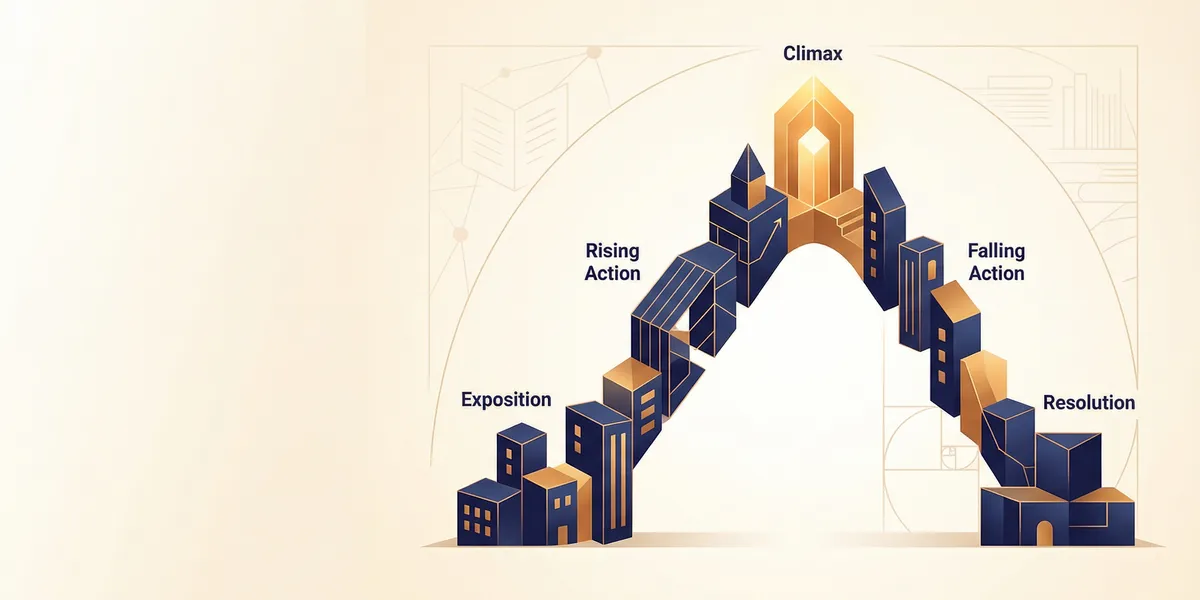
Story structure is the arrangement of events, turning points, and emotional beats that gives a narrative shape and momentum. Every published novel, screenplay, and memoir uses one, whether the author chose it deliberately or stumbled into it by instinct. Understanding structure gives you control over pacing, tension, and reader satisfaction from the first page to the last.
This guide breaks down the major story structure frameworks, explains what each one does best, and helps you pick the right one for whatever you are writing.
What Story Structure Actually Is
Story structure is the skeleton underneath your plot. It determines where your story begins, how tension escalates, where the emotional peak lands, and how everything resolves. Without it, even beautiful prose feels aimless.
Think of structure as architecture. A building needs load-bearing walls in the right places or it collapses. A story needs turning points, escalation, and resolution at the right intervals or readers lose interest. Research from the University of Vermont’s Computational Story Lab analyzed over 1,700 stories and found they follow just six core emotional arcs, all defined by structural patterns.
Structure is not a formula that kills creativity. It is the invisible framework that makes creativity land. The most experimental literary fiction still has structure. It just bends the conventions rather than ignoring them.
Structure vs. Plot vs. Narrative
These three terms overlap but mean different things:
| Term | What It Means | Example |
|---|---|---|
| Plot | The specific events that happen | A detective finds a body, interviews suspects, catches the killer |
| Story structure | The pattern those events follow | Three acts: setup, confrontation, resolution |
| Narrative structure | How and when the reader experiences those events | Chronological, reverse chronological, nonlinear |
Plot is what happens. Story structure is the shape of what happens. Narrative structure is the order in which the reader encounters it. You can tell the same plot using different structures and different narrative orders, and each version will feel like a different story.
The Five Elements Every Structure Shares
Before diving into specific frameworks, know that virtually all story structures contain these five building blocks. Freytag’s Pyramid identified them in 1863, and they still hold:
- Exposition - Introduce the protagonist, setting, and status quo
- Rising action - Escalate conflict through obstacles, complications, and stakes
- Climax - The highest point of tension where the central conflict reaches a head
- Falling action - Consequences unfold, loose ends begin tying up
- Denouement - Resolution and the new normal
Every framework below rearranges, expands, or compresses these five elements. The three-act structure groups them into three acts. The Hero’s Journey breaks them into twelve stages. The Fichtean Curve nearly eliminates exposition. But the underlying DNA is the same.
Major Story Structure Frameworks
Three-Act Structure
The three-act structure is the most widely used framework in Western storytelling. Aristotle described it in Poetics as beginning, middle, and end. Modern writers typically break it down as:
- Act 1 (Setup, ~25%): Establish the protagonist, world, and stakes. End with an inciting incident that launches the central conflict.
- Act 2 (Confrontation, ~50%): The protagonist pursues their goal against escalating obstacles. A midpoint reversal raises the stakes. Things get progressively harder until the darkest moment.
- Act 3 (Resolution, ~25%): The climax resolves the central conflict, followed by falling action and denouement.
Best for: Commercial fiction, screenplays, most genre novels. If you have never used a structure before, start here. Its simplicity is its strength.
Example: In The Hunger Games, Act 1 establishes Katniss’s world and the Reaping. Act 2 is the arena, escalating from survival to rebellion. Act 3 is the final confrontation and its aftermath.
The Hero’s Journey
Joseph Campbell’s Hero’s Journey identifies a mythic pattern across cultures. Christopher Vogler later adapted it into twelve practical stages for writers in The Writer’s Journey:
- Ordinary World
- Call to Adventure
- Refusal of the Call
- Meeting the Mentor
- Crossing the Threshold
- Tests, Allies, Enemies
- Approach to the Inmost Cave
- The Ordeal
- Reward
- The Road Back
- Resurrection
- Return with the Elixir
Best for: Epic fantasy, sci-fi, coming-of-age stories, and any narrative centered on personal transformation. The framework excels when your protagonist undergoes deep internal change alongside external conflict.
Example: The Lord of the Rings follows the Hero’s Journey almost beat for beat, from Frodo’s Ordinary World in the Shire through his Ordeal at Mount Doom to his bittersweet Return.
Save the Cat Beat Sheet
Blake Snyder’s Save the Cat framework, refined for novelists by Jessica Brody in Save the Cat! Writes a Novel, breaks a story into fifteen specific beats with target page percentages:
| Beat | Timing | Purpose |
|---|---|---|
| Opening Image | 0-1% | Snapshot of the protagonist’s starting state |
| Theme Stated | 5% | Someone hints at the story’s central lesson |
| Setup | 1-10% | Establish the protagonist’s flawed world |
| Catalyst | 10% | The inciting incident |
| Debate | 10-20% | Protagonist hesitates about the journey |
| Break into Two | 20% | Protagonist commits to the new path |
| B-Story | 22% | A subplot (often romantic) that carries the theme |
| Fun and Games | 20-50% | The “promise of the premise” delivered |
| Midpoint | 50% | False victory or false defeat that raises stakes |
| Bad Guys Close In | 50-75% | External and internal pressures mount |
| All Is Lost | 75% | The lowest point |
| Dark Night of the Soul | 75-80% | Protagonist processes the loss |
| Break into Three | 80% | A new idea or plan emerges |
| Finale | 80-99% | Protagonist applies lessons and wins (or doesn’t) |
| Final Image | 99-100% | Snapshot showing how the protagonist has changed |
Best for: Commercial and genre fiction, especially romance, thriller, mystery, and YA. Its specificity makes it ideal for writers who want guardrails.
Example: Most successful romance novels hit these beats precisely. The “Fun and Games” section is where the couple’s chemistry plays out, and the “All Is Lost” moment is typically the breakup or misunderstanding that threatens everything.
Freytag’s Pyramid (Five-Act Structure)
Gustav Freytag analyzed Greek and Shakespearean drama and identified a five-part structure: exposition, rising action, climax, falling action, and denouement. The result is a pyramid shape with the climax at the peak.
Best for: Literary fiction, classical drama, and stories where the aftermath of the climax matters as much as the climax itself. Freytag’s Pyramid gives more space to falling action than the three-act structure does.
Where it differs from three-act: Three-act structure places the climax near the end (around 75-90%). Freytag places it at the midpoint, giving equal weight to the descent. This creates a more symmetrical, contemplative story shape.
The Fichtean Curve
The Fichtean Curve throws out extended exposition. It opens with the protagonist already in crisis and escalates through a series of smaller crises, each one raising the stakes until the climax. Only then does backstory and context emerge, woven in through flashback, dialogue, or reflection.
Best for: Thrillers, horror, action, and any story where you want the reader’s heart rate elevated from page one. In medias res openings are a hallmark of this structure.
Example: Gone Girl drops the reader into a crisis immediately. The exposition is parceled out through alternating timelines, keeping tension constant.
Seven-Point Story Structure
Dan Wells’ Seven-Point Structure focuses on the contrast between where a character begins and where they end:
- Hook - The protagonist’s starting state (opposite of the resolution)
- Plot Turn 1 - The event that sets the story in motion
- Pinch Point 1 - Pressure that forces the protagonist to act
- Midpoint - The protagonist shifts from reactive to proactive
- Pinch Point 2 - Maximum pressure, things look hopeless
- Plot Turn 2 - The protagonist gains the final piece they need
- Resolution - The protagonist succeeds or fails
Best for: Writers who like to plot backward from the ending. Wells recommends starting with your resolution, then your hook, then filling in the middle. This ensures every beat serves the final destination.
Dan Harmon’s Story Circle
Dan Harmon (creator of Community and Rick and Morty) distilled the Hero’s Journey into eight steps arranged in a circle:
- A character is in a zone of comfort
- But they want something
- They enter an unfamiliar situation
- They adapt to it
- They get what they wanted
- But pay a heavy price
- They return to their familiar situation
- Having changed
Best for: Television episodes, short stories, and serialized fiction. Its simplicity makes it easy to apply to self-contained narratives that still need a full emotional arc.
Kishotenketsu
This four-part structure from East Asian storytelling tradition does not require conflict as a driving force:
- Ki (Introduction) - Establish the characters and setting
- Sho (Development) - Develop the situation without major conflict
- Ten (Twist) - Introduce an unexpected element that recontextualizes everything
- Ketsu (Conclusion) - Reconcile the twist with the established elements
Best for: Literary fiction, slice-of-life stories, and narratives that explore theme through juxtaposition rather than conflict. It is common in manga, Studio Ghibli films, and certain forms of poetry.
How to Choose the Right Structure
Picking a framework depends on your genre, your protagonist’s arc, and how you want the reader to feel. Here is a decision guide:
| If You’re Writing… | Start With |
|---|---|
| Commercial fiction (any genre) | Three-act structure or Save the Cat |
| Epic fantasy or sci-fi | Hero’s Journey |
| Thriller or horror | Fichtean Curve |
| Literary fiction | Freytag’s Pyramid or Kishotenketsu |
| Romance | Save the Cat (romance beat sheets are built on it) |
| Short stories or episodes | Story Circle |
| Character-driven drama | Seven-Point Structure |
| A first novel | Three-act structure (simplest to learn) |
No framework is a cage. Most published novels blend elements from multiple structures. A thriller might use the Fichtean Curve’s tension-first opening while following the three-act structure’s overall shape. A fantasy might combine the Hero’s Journey with Save the Cat’s beat sheet for tighter pacing.
The goal is not rigid adherence. It is having a map you can consult when you are lost in the middle of your draft.
Applying Structure to Your Writing
Start with the end
The most reliable way to use structure is to decide your climax and resolution first, then work backward. Every structural beat exists to set up or pay off the ending. If you know where you are going, you can reverse-engineer what needs to happen at the midpoint, the inciting incident, and the opening.
Map your story beats
Once you pick a framework, translate its beats into actual scenes. A beat like “All Is Lost” is abstract until you decide what is lost, why it matters, and how your protagonist reacts. Write a one-sentence description for each beat before you draft.
Use the midpoint as your compass
The midpoint is where most drafts stall. In nearly every framework, something significant shifts at the 50% mark: a false victory, a revelation, or a change from reactive to proactive. If your middle feels saggy, check whether you have a real midpoint event. If you don’t, add one. Your story arc depends on it.
Revise with structure in mind
Structure is even more useful in revision than in drafting. If a section feels slow, check its structural function. Is your Act 2 too long? Is your rising action flat because the stakes did not escalate? Diagnosing problems by structure is faster than rewriting blind.
Tools like Chapter.pub can help you organize and restructure your manuscript by chapters and scenes, making it easier to see whether your beats land where they should.
Common Mistakes to Avoid
-
Starting with too much exposition. Modern readers expect the story to move. Get to the inciting incident within the first 10-15% of the manuscript. The Fichtean Curve exists precisely because backstory can wait.
-
Sagging middles. If Act 2 drags, you probably lack a strong midpoint reversal. The midpoint should change the game, not just continue it. Look at how your chosen framework handles the middle and make sure something genuinely shifts.
-
Climax too early or too late. A climax at the 50% mark (Freytag style) needs substantial falling action. A climax at the 95% mark leaves no room for resolution. Match your climax placement to your chosen structure.
-
Confusing structure with formula. Structure tells you where your turning points go. It does not tell you what those turning points are. Two thrillers can use identical structures and feel completely different. The creativity lives in the content, not the container.
-
Ignoring character arc. Plot structure and character development must move together. Every structural turning point should also be a moment of internal change for the protagonist. If your plot advances but your character stays the same, the story feels hollow.
FAQ
What is the most common story structure?
The three-act structure is the most widely used story structure in Western fiction, film, and television. It divides a story into setup, confrontation, and resolution, and its proportions (roughly 25/50/25) appear in the vast majority of commercially successful novels and screenplays.
Can I combine multiple story structures?
Yes, and most professional authors do. A common approach is to use the three-act structure as your overall shape while mapping Save the Cat beats within each act for more granular pacing. The frameworks are tools, not rules. Use whichever combination helps you tell the best version of your story.
Do pantsers need story structure?
Even if you write without an outline, structure matters during revision. Many pantsers draft intuitively, then use a framework to diagnose problems in their second draft. Understanding story structure gives you a vocabulary for fixing what feels wrong, even if you never outline a single scene in advance.
What is the best structure for a first novel?
Start with the three-act structure. It is the simplest to learn, the most forgiving of mistakes, and the most widely applicable across genres. Once you are comfortable with three acts, you can layer in elements from Save the Cat, the Hero’s Journey, or other frameworks as your craft develops.
How is story structure different from plot structure?
Plot structure refers specifically to the sequence of events in your story. Story structure is broader: it includes plot structure but also encompasses pacing, emotional arcs, turning point placement, and the overall shape of the narrative. Think of plot structure as the events and story structure as the pattern those events follow.