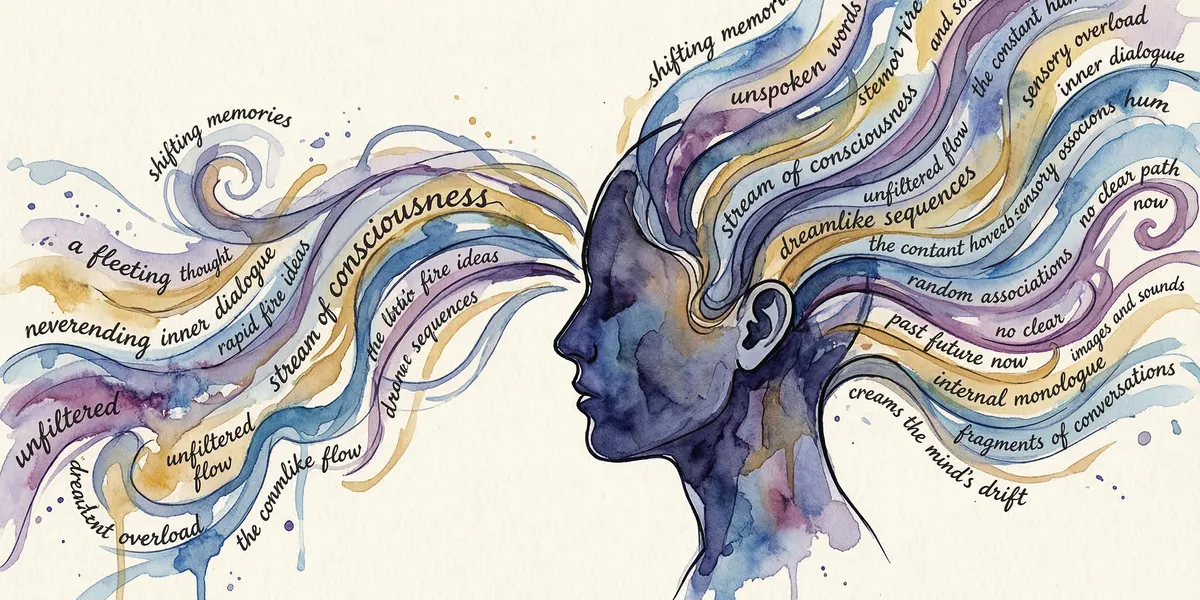
Stream of consciousness is a narrative technique that presents a character’s continuous flow of thoughts, feelings, and associations as they occur, without the tidy structure of conventional prose. The term itself comes from psychologist William James, who described human thought not as a chain of discrete ideas but as a river — always moving, always shifting direction. Writers borrowed the concept and turned it into one of the most distinctive tools in fiction.
How Stream of Consciousness Differs from Interior Monologue
The two terms get tangled constantly, so let’s untangle them. Interior monologue gives you a character’s private thoughts in relatively coherent, grammatical language. Think of it as overhearing someone talk to themselves in complete sentences. Stream of consciousness goes further. It mimics the actual texture of thought — fragmented, associative, leaping from a smell to a memory to a half-formed worry without pausing to explain the connections.
Interior monologue: I need to remember to call David about dinner. I wonder if he’s still upset about last weekend.
Stream of consciousness: David, dinner, have to — that restaurant with the red awnings, no, the other one, where was it raining and his coat smelled like wet wool and he said something about the dog, the dog is probably fine, everything is probably fine, the napkins were red too.
The difference is structural. Interior monologue respects the conventions of language. Stream of consciousness lets them dissolve.
Famous Examples
A handful of novels define this technique, and they’re worth reading even in small doses to understand what stream of consciousness can accomplish.
James Joyce, Ulysses (1922) — The final chapter, Molly Bloom’s soliloquy, is perhaps the most famous passage of stream of consciousness ever written. It runs for roughly 24,000 words with almost no punctuation. Thoughts cascade into one another with no paragraph breaks, no periods, nothing to slow the current. Joyce wasn’t showing off. He was trying to capture how a mind actually works when it’s left alone in the dark.
Virginia Woolf, Mrs Dalloway (1925) — Woolf moves between characters’ inner lives without warning, flowing from Clarissa Dalloway’s thoughts about flowers to Septimus Warren Smith’s fractured perception of London. Her sentences are long and musical, held together by rhythm more than grammar. Where Joyce’s stream feels raw, Woolf’s feels orchestrated — a different flavor of the same technique.
William Faulkner, The Sound and the Fury (1929) — The opening section is narrated by Benjy Compson, a man with an intellectual disability whose thoughts move freely between past and present without marking the transitions. Faulkner forces the reader to piece together what’s happening from sensory fragments. Time collapses. The effect is disorienting by design.
Jack Kerouac, On the Road (1957) — Kerouac called his approach “spontaneous prose,” and while it’s more structured than Joyce or Woolf, the breathless momentum of his sentences owes a clear debt to stream of consciousness. He typed the first draft on a continuous scroll of paper, and you can feel that urgency in every paragraph.
A Brief Demonstration
Here’s what the technique looks like in practice:
The coffee’s gone cold again, always cold, like the kitchen in that apartment on Hillside where the radiator clanked all night and Margaret said it sounded like someone trapped in the walls, Margaret with her theories about everything, her hands always moving, I should call her, I won’t call her, the sugar bowl is almost empty and the light through the window is doing that thing again where it hits the counter and makes a stripe and I used to think that stripe was magic when I was seven, magic, what a word, what a useless hopeful word.
Notice how it moves: from coffee to a past apartment, to a person, to an impulse, to a sugar bowl, to childhood, to a single word. Each jump follows an associative logic that feels natural even though no transition is signaled. That’s the engine of stream of consciousness — thought following thought, connected by feeling rather than argument.
When to Use It
Stream of consciousness earns its place when you need to pull a reader deep inside a character’s experience. It works particularly well for:
Psychological depth. When a character’s inner life is more interesting or important than the external action, this technique puts the reader directly inside that complexity. You don’t describe what someone is feeling — you reproduce the feeling itself.
Disorientation. If your character is confused, overwhelmed, or losing grip on reality, stream of consciousness can make the reader share that state. Faulkner’s Benjy sections work precisely because the fragmented narration mirrors Benjy’s fragmented understanding. The form becomes the content.
Emotional intensity. Grief, desire, panic, joy — these states don’t arrive in tidy sentences. Stream of consciousness lets you match the shape of the prose to the shape of the emotion. When a character’s inner world is in turmoil, conventional narration can feel too calm by comparison.
When to Avoid It
Not every moment benefits from this level of interiority. Some situations call for clarity, pace, or restraint.
Action sequences. When things are happening fast externally, readers need to track physical events. Stream of consciousness turns attention inward, which can drain momentum from a chase, a fight, or a crisis that depends on external movement.
Dialogue-heavy scenes. Conversation has its own rhythm. If you interrupt exchanges with long interior passages, the dialogue loses its snap. Better to let the words spoken carry the weight, with only brief dips into thought.
Genre fiction pacing. Thrillers, mysteries, and romance novels rely on forward motion. Extended stream of consciousness slows things down. That doesn’t mean genre writers can’t use the technique — a short burst during a revelation can be devastating — but sustained passages will fight the pacing that genre readers expect.
Early in a story. If readers don’t yet know your character, a wall of unfiltered thought can feel alienating rather than intimate. Consider building familiarity first. A strong opening grounds the reader before you dissolve the guardrails.
Tips for Writing Stream of Consciousness
Let punctuation loosen. You don’t have to abandon it entirely — Woolf used plenty of commas and semicolons — but let yourself break the rules where thought would break them. A period is a full stop. Thought rarely stops fully. Dashes, ellipses, and run-on sentences can better capture the way one idea bleeds into the next.
Follow associative logic. In real thought, a blue curtain might lead to a memory of the ocean, which leads to a fear of drowning, which leads to an ex-girlfriend who was a lifeguard. Train yourself to notice those connections. The leaps don’t need to be logical — they need to feel inevitable.
Anchor the reader periodically. Even Joyce gives you occasional landmarks. A sensory detail, a return to the physical present, a named character — these small anchors prevent the reader from getting permanently lost. Stream of consciousness should be immersive, not incomprehensible.
Use sensory detail as a trigger. Thought rarely starts from abstraction. It starts from what you see, hear, smell, taste, or touch. Ground your character’s stream in the physical world and let the associations spiral outward from there.
Read it aloud. More than any other narrative technique, stream of consciousness depends on rhythm. If a passage doesn’t flow when spoken, it won’t flow on the page. Listen for the music. Adjust the sentence lengths until the cadence feels like breathing.
Know your character’s obsessions. A stream of consciousness passage reveals what a mind returns to involuntarily — the worries, desires, and memories that surface unbidden. Before you write, know what your character can’t stop thinking about. Those recurring threads give the passage shape even when the surface seems chaotic.
Stream of consciousness is not a technique for every story or every scene. But when a first-person narrator — or a close third — needs to feel absolutely real, when you want the reader to forget they’re reading and feel instead that they’re thinking, this is the tool that makes it possible. Use it with intention, and it will reward you with passages that feel less like writing and more like being alive inside someone else’s mind.