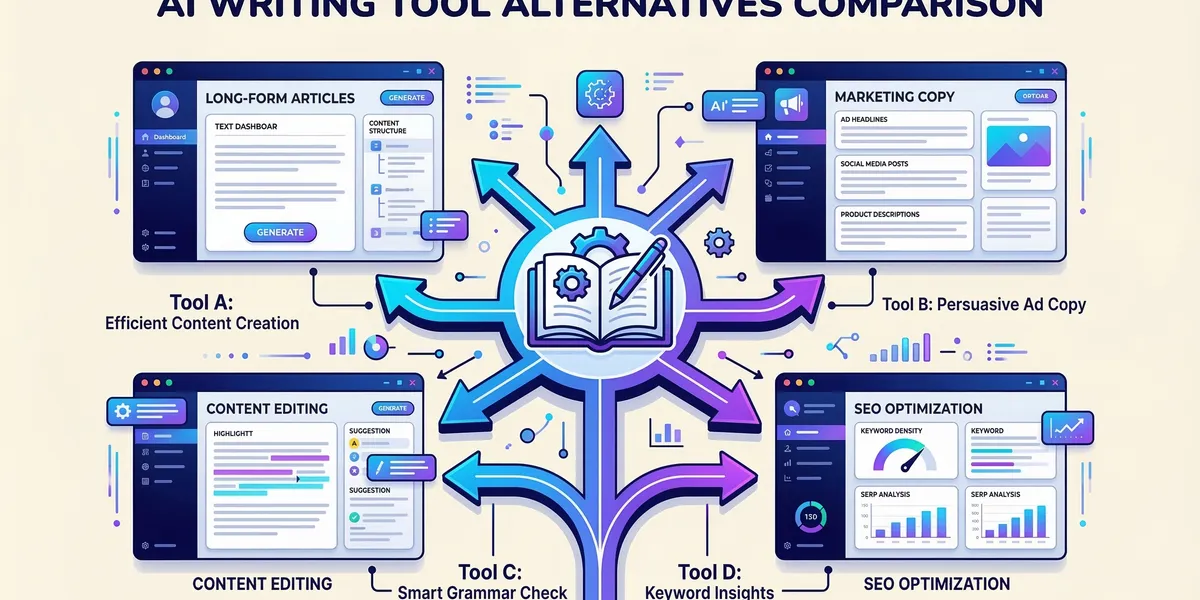
Sudowrite is a solid AI fiction writing tool, but it’s not for everyone. The subscription pricing adds up fast — $228 to $708 per year depending on your plan — and the credit system makes it hard to predict what a novel actually costs. If you’ve hit a wall with Sudowrite’s approach or you’re shopping before committing, there are real alternatives worth considering.
This guide compares seven Sudowrite alternatives for fiction writers in 2026. Some generate complete manuscripts. Others work as brainstorming partners or co-writing tools. The right choice depends on what frustrated you about Sudowrite — or what you need that it doesn’t offer.
Quick Comparison
| Tool | Best For | Full Manuscript Generation | Pricing | vs Sudowrite |
|---|---|---|---|---|
| Chapter | Complete novel generation | Yes — genre frameworks | $97 one-time | No subscription, full books |
| NovelAI | Creative co-writing | Interactive — you guide it | From $10/mo | More creative freedom |
| ChatGPT | Free brainstorming | No — prompt-based | Free / $20/mo | Free option, flexible |
| Claude | Long-form fiction | No — conversational | Free / $20/mo | Better voice consistency |
| AI Dungeon | Interactive story exploration | Game-style narrative | Free / $10/mo | Discovery-based writing |
| Squibler | Beginners | Yes — template-based | Free / $16/mo | Simpler interface |
| Rytr | Budget writing assistant | Partial — short-form | Free / $9/mo | Cheapest paid option |
1. Chapter — Best Overall Sudowrite Alternative
Our Pick — Chapter
Chapter solves the two biggest complaints about Sudowrite: subscription pricing and the gap between outlining and a finished manuscript.
Where Sudowrite helps you write scene by scene — generating prose expansions, rewrites, and brainstorms within its Story Engine — Chapter generates complete fiction manuscripts from end to end. You pick a story structure (Save the Cat, Three Act, Romance Beat Sheet, Hero’s Journey), define your characters and world, and the AI builds a full narrative arc before writing a single chapter. The output is a cohesive 20,000 to 120,000+ word manuscript, not a collection of individually generated scenes that you stitch together.
The structural approach is what makes the difference. Sudowrite’s Story Engine creates beat sheets and expands them, but the connection between beats can feel mechanical. Chapter’s framework-first method means the AI understands that your thriller needs escalating stakes by chapter eight and a false victory before the final act. A romance hits the “dark moment” at the right point because the structure demands it, not because you manually prompted for it.
Style training lets you feed in writing samples — your own work or published authors in your genre — so the output matches a specific voice. Genre-specific trope libraries for romance, thriller, fantasy, and sci-fi help the AI hit reader expectations without defaulting to generic prose. For series writers, the continuity tracker keeps character details, world rules, and plot threads consistent across multiple books.
Why switch from Sudowrite: $97 one-time versus $19-59/month. No credits to manage. Full manuscript generation instead of scene-level assistance. Over 2,147 authors have used Chapter to create 5,000+ books.
Limitations: Chapter is a manuscript generator, not a prose polishing tool. If you write every word yourself and just want AI suggestions for rewording or expanding existing text, Sudowrite’s Write modes are more appropriate. Chapter commits you to a story framework upfront — less improvisation, more structure.
2. NovelAI — Best for Creative Freedom
NovelAI works as an interactive co-writer rather than an automated generator. You write, the AI continues — matching your tone, pacing, and style. There are no content filters, which makes it the go-to for horror, dark fiction, and genres where Sudowrite’s safety guardrails get in the way.
The Lorebook system is NovelAI’s standout feature. You define characters, locations, and plot rules with keyword triggers, and the AI injects that context only when relevant. Your antagonist’s backstory surfaces in scenes involving that character. A magic system’s rules apply only when magic appears on the page. This selective injection produces more natural storytelling than tools that dump all context into every generation.
The 128K token context window means the AI can reference roughly 100,000 words while generating — enough to remember a setup from chapter one while writing chapter thirty.
Why switch from Sudowrite: More creative freedom, no content restrictions, better for writers who want to co-write rather than automate. NovelAI encrypts all content and never trains on your writing.
Pricing: Free tier with 50 generations/month. Tablet at $10/month for unlimited text. Scroll at $15/month adds the Erato 70b model. Opus at $25/month for early access features.
Limitations: No structured story generation — no beat sheets, no “generate an outline” button. You build the plot through interactive writing. Steeper learning curve than Sudowrite for optimizing Lorebook entries and prompts.
3. ChatGPT — Best Free Sudowrite Alternative
If Sudowrite’s pricing is your main complaint, ChatGPT handles story brainstorming and outlining at no cost. The free tier includes GPT-4o, which is surprisingly capable at fiction when you know how to prompt it.
The technique that works: start with genre and tone, ask for a three-act structure, drill into each act for chapter beats, then expand individual beats into scenes. This top-down approach produces far better results than “write me a story.” ChatGPT can apply Save the Cat beats to your premise, generate multiple plot structures for comparison, and brainstorm solutions for plot holes.
ChatGPT also works well paired with a dedicated fiction tool. Use it for brainstorming and outlining, then move to Chapter for structured drafting. Many productive fiction writers use this two-tool approach.
Why switch from Sudowrite: Free. Flexible. No credit system. Good enough for brainstorming and outlining without paying $19-59/month.
Pricing: Free tier with GPT-4o. ChatGPT Plus at $20/month for faster responses and longer outputs.
Limitations: No story bible, no character tracking, no manuscript management. Every conversation starts from zero unless you manually paste context. Outputs max out at a few thousand words per response, making full manuscript generation impractical.
4. Claude — Best for Maintaining Voice and Tone
Claude brings the largest context window of any general-purpose AI to fiction writing — up to 200K tokens, roughly 150,000 words. You can paste an entire novella into a conversation and ask Claude to continue the story, analyze plot holes, or rewrite chapters while maintaining consistency with everything before it.
Where Claude beats Sudowrite for certain writers is nuance. It handles complex character motivations, unreliable narrators, and thematic subtlety better than most AI models. Ask it to write a scene where a character says one thing but means another, and Claude captures the subtext consistently. It’s also less prone to the moralizing tendencies that make some AI fiction feel sanitized.
The Projects feature stores character sheets, world-building documents, and plot outlines as persistent context — partially solving the “starts from zero” problem that plagues other general-purpose tools.
Why switch from Sudowrite: Better at maintaining voice across long stories. Superior handling of literary fiction, complex characters, and subtle themes. Same $20/month as Sudowrite’s mid-tier.
Pricing: Free tier with limited usage. Claude Pro at $20/month.
Limitations: Not a dedicated fiction tool. No story structure templates, no beat sheets, no manuscript workflow. Output length per response is limited, making full novel generation a manual process.
5. AI Dungeon — Best for Discovery-Based Writing
AI Dungeon takes a completely different approach: interactive fiction. You start a scenario and the AI generates the story in real-time based on your choices. It’s closer to a choose-your-own-adventure engine than a manuscript generator, but the value for fiction writers is in the discovery.
AI Dungeon forces you into situations your plotting mind wouldn’t choose. Start with a standard fantasy setup and end up with a political thriller because the AI introduced a conspiracy you hadn’t planned. These unexpected turns break creative ruts and generate ideas you’d never reach through outlining. The custom scenario builder lets you define worlds, characters, and rules before starting, and thousands of community-created scenarios work as templates.
Why switch from Sudowrite: Better for writers who discover stories by exploring them. Useful for testing “what if” scenarios — drop your characters into a situation and see what happens.
Pricing: Free tier with limited actions. Adventurer at $10/month. Hero at $15/month. Legend at $30/month with premium models.
Limitations: Generates interactive fiction, not polished prose. Output needs significant rewriting before it’s publishable. Story coherence degrades over long sessions. It’s a brainstorming tool, not a manuscript generator.
6. Squibler — Best for Beginners
Squibler aims to be the simplest path from idea to finished story. Give it a concept, pick a genre, define characters using the Elements system, and it generates a full book. No complex setup, no learning curve.
The Elements system maintains basic consistency — your protagonist keeps the same name and traits, settings stay described consistently. For writers who find Sudowrite overwhelming, Squibler’s streamlined approach has genuine appeal. It includes AI image generation and multilingual support for translation into 80+ languages.
The trade-off is output quality. Squibler’s prose tends toward generic AI writing that requires more editing than what Chapter or Sudowrite produce. The app itself can be slow. But for a first-time author testing whether AI fiction writing works for them, it’s a reasonable starting point.
Why switch from Sudowrite: Lower learning curve. Simpler interface. Better for writers who want fewer options, not more.
Pricing: Free plan with 6,000 AI words/month. Pro at $16/month (annual) for unlimited generation.
Limitations: Prose quality doesn’t match Chapter or Sudowrite. The app is noticeably slow. At $16/month ($192/year), the cost exceeds Chapter’s one-time $97 while delivering less genre-specific sophistication.
7. Rytr — Best Budget Option
Rytr is a general-purpose AI writing assistant with a free tier that includes story generation templates. It works best for story starters, flash fiction, and short creative pieces — not full manuscripts.
The Story Plot generator produces brief story concepts with characters and a basic arc. The Creative Story template generates short narratives from a premise. Multiple tone options (dramatic, humorous, casual) adjust the output style. These work well for writing prompts, social media fiction, and quick creative exercises.
Why switch from Sudowrite: Cheapest paid option at $9/month. Generous free tier. Good enough if you only need short creative content.
Pricing: Free plan with 10,000 characters/month. Saver at $9/month for 100,000 characters. Unlimited at $29/month.
Limitations: Not a serious fiction tool. No story structure, no character tracking, no manuscript generation. Output quality for fiction is well below every other tool on this list. Rytr is a content writing tool that happens to offer creative templates.
Why Writers Leave Sudowrite
The most common reasons writers look for Sudowrite alternatives:
Subscription cost compounds. The Professional tier at $22/month (annual) costs $264/year. Over two years, that’s $528 — enough to buy Chapter’s lifetime access five times over. For writers producing one or two novels a year, the ongoing cost is hard to justify against one-time pricing.
The credit system is unpredictable. Sudowrite’s credit consumption varies by feature and output length. Writers frequently report running out mid-project and needing to upgrade or wait for the next billing cycle. Credit anxiety interrupts the creative flow.
Scene-level assistance has a ceiling. Sudowrite excels at expanding, rewriting, and brainstorming within individual scenes. But it doesn’t generate a cohesive manuscript the way Chapter does. Writers who want a complete first draft — not polished fragments — eventually hit a wall.
Content restrictions limit genres. Sudowrite’s content policies prevent generation of certain fiction types. Writers in horror, dark romance, and edgy literary fiction sometimes find their creative choices blocked. NovelAI has no such restrictions.
How to Choose the Right Sudowrite Alternative
You want a finished novel from a single tool. Chapter generates complete manuscripts from proven story frameworks. One-time $97 payment, no subscription. It’s the most direct replacement for writers who want more than Sudowrite offers.
You want maximum creative freedom. NovelAI lets you co-write with no content restrictions. Best for writers who want a partner, not an automation tool.
You want a free option. ChatGPT handles brainstorming and outlining well enough to show you whether AI fiction writing fits your process.
You’re writing literary or character-driven fiction. Claude’s nuance and large context window make it the best general-purpose AI for complex stories.
You’re a beginner testing the waters. Squibler offers the lowest learning curve. Start there and upgrade once you know what you need.
You just need short creative content. Rytr’s free tier covers story starters and flash fiction.
For a deeper look at Sudowrite’s strengths and weaknesses, see our full Sudowrite review. For more AI fiction tools, check out our guide to the best AI story generators and best novel writing software.