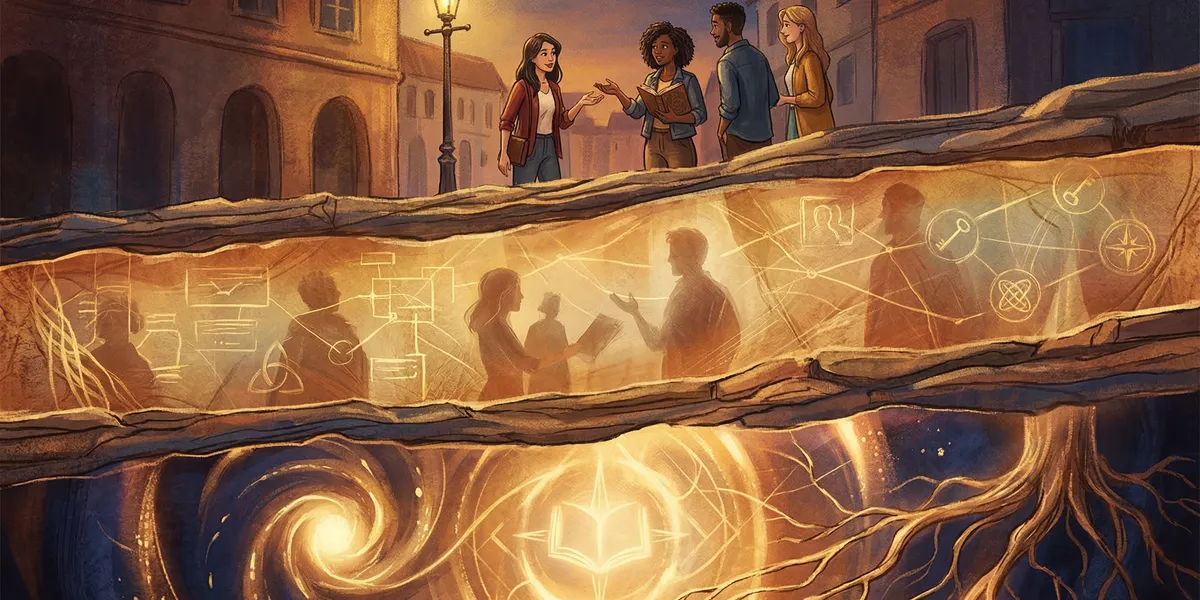
Theme is the underlying truth, argument, or question a story explores. It is not what the story is about on the surface — it is what the story means beneath the surface.
A story about a man chasing a whale is about whaling. Its theme is obsession, the unknowable, and the cost of single-minded pursuit. The subject is the plot. The theme is the point.
Theme vs. subject
This distinction trips up more writers than almost any other concept.
Subject is the topic. It can be stated in one or two words: love, war, family, revenge, ambition.
Theme is a statement about that topic. It is the story’s position — what it argues or reveals through its events and characters.
| Subject | Theme |
|---|---|
| Love | Love demands sacrifice, and sacrifice does not guarantee reciprocation |
| Power | Power corrupts not because it changes people, but because it reveals who they always were |
| Identity | The self is not fixed — it is constructed and reconstructed through every choice |
| Family | Family bonds can be both the source of deepest pain and the only true shelter |
| Justice | Legal justice and moral justice are often incompatible |
Notice that themes are debatable. They are not facts. They are the story’s argument, and reasonable readers might disagree — which is exactly what makes literature worth discussing.
How to find your theme
Most writers do not start with a theme. They start with a character, a situation, or an image. The theme reveals itself during the writing.
Write first. Theme will follow. If you begin with a theme and try to illustrate it, you get a sermon. If you begin with a story and let the theme emerge, you get fiction. Theme is not the blueprint — it is the pattern you discover in the finished building.
Ask: What does my protagonist learn? The character arc often is the theme. If your character learns that trust requires vulnerability, the theme is about trust and vulnerability. If they learn nothing — if the world breaks them — the theme might be about indifference or futility.
Look at what repeats. Images, situations, and conflicts that keep recurring in your draft are usually circling the theme. If you notice your characters keep lying to each other, your theme is probably about deception, self-protection, or truth.
Ask: What does the ending argue? The resolution of a story is its final statement about its theme. A happy ending argues that the world rewards certain behavior. A tragic ending argues the opposite. An ambiguous ending argues that the question itself matters more than any answer.
Showing theme vs. stating theme
This is the critical skill. Beginning writers tend to state their themes. Experienced writers show them.
Stating theme (heavy-handed): “And in that moment, she understood that freedom was not the absence of responsibility but the willingness to choose it.”
This is the author stepping in front of the story to deliver a thesis statement. It reads like an essay, not fiction.
Showing theme (embedded): She signed the lease. The apartment was too small, the neighborhood too loud, and the rent would eat half her paycheck. She walked through the empty rooms, touching the walls, and laughed — not because anything was funny, but because every surface belonged to no one but her.
Same theme. But the reader discovers it through action and detail rather than being told. The signing of the lease, the too-small rooms, the laughter that is not humor — these concrete details carry the abstract idea of freedom-as-chosen-responsibility without ever naming it.
10 common themes with novel examples
1. The corruption of innocence Lord of the Flies — Boys stranded without adults reveal the savagery beneath civilized behavior. Innocence is not lost; it was never as stable as it appeared.
2. The impossibility of the American Dream The Great Gatsby — Gatsby’s reinvention of himself is both the dream’s greatest expression and its ultimate failure. You cannot purchase a new identity with money.
3. The cost of obsession Moby-Dick — Ahab’s pursuit of the whale destroys everything and everyone around him. The obsession is not about the whale. It is about the refusal to accept what cannot be controlled.
4. Appearance vs. reality Othello — Iago appears honest while being the play’s greatest deceiver. Othello sees betrayal where there is loyalty and loyalty where there is betrayal. Nothing is what it seems — and the inability to see clearly is lethal.
5. The struggle for identity Invisible Man — Ellison’s narrator searches for selfhood in a society that refuses to see him. Identity is not something you find. It is something you assert against a world determined to erase it.
6. The tension between freedom and belonging Adventures of Huckleberry Finn — Huck must choose between the freedom of the river and the rules of society on shore. Belonging requires conformity. Freedom requires loneliness.
7. Memory and the past Beloved — The past is not behind you. It lives in your body, your house, your children. Morrison argues that memory is not something you recall — it is something that recurs.
8. The absurdity of existence The Stranger — Meursault’s indifference to the social scripts everyone else follows exposes those scripts as arbitrary. Life does not have inherent meaning, and the demand that it should is the real source of suffering.
9. Power and resistance 1984 — Orwell argues that totalitarian power works not through physical force alone but through the control of language, memory, and truth. Resistance begins — and may end — in the mind.
10. Love as both salvation and destruction Wuthering Heights — Heathcliff and Catherine’s love is the most powerful force in the novel and also the most destructive. Love that consumes everything, including the lovers, is not redemptive. It is annihilating.
Practical tips for working with theme
Do not start by choosing a theme. Start with characters and conflict. Let the theme find you.
Test your theme against your ending. Your ending should resonate with your theme without restating it. If you can remove the last paragraph and the theme still comes through, your story has done its job.
Use symbols to reinforce, not replace. Symbols can deepen theme — the green light, the mockingbird, the conch shell. But they should support the theme that already lives in the plot and characters, not substitute for it. See symbolism in literature for how this works.
Let characters disagree with the theme. A story where every character reinforces the same message is propaganda. In strong fiction, characters hold opposing views about the theme, and the story’s events — not the author’s voice — determine which view prevails.
Revise with theme in mind. Once you know your theme, go back through the draft and look for scenes that accidentally contradict it or moments where you could deepen it. This is where motifs become useful — recurring images or situations that echo the theme without spelling it out. See motif in literature for more on this technique.
For the relationship between theme and character transformation, see character arc.