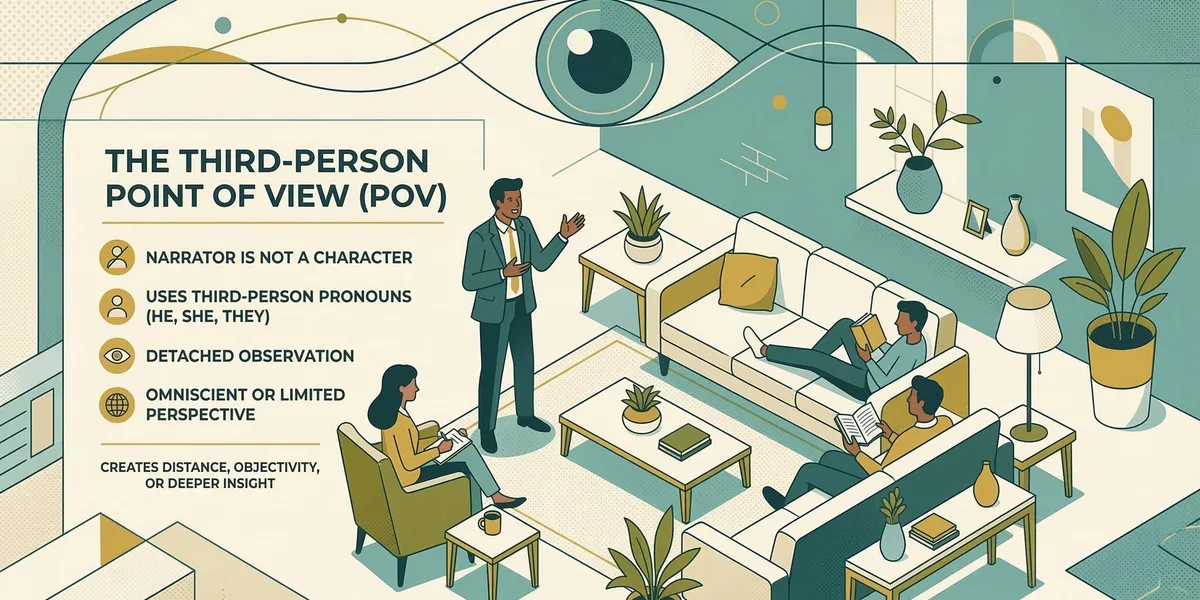
Third person point of view is a narrative perspective where the narrator refers to all characters using pronouns like he, she, they, or it rather than I or you. It is the most common point of view in published fiction, and for good reason: it gives writers extraordinary flexibility in how they control information, emotional distance, and reader access to characters’ inner lives.
But third person is not one thing. It splits into three distinct types, each with its own rules and effects. Understanding these differences is the single most useful thing you can learn about narrative perspective.
The Three Types of Third Person Point of View
Third Person Limited
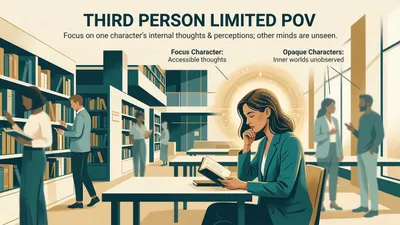
In third person limited, the narrator follows one character at a time and only has access to that character’s thoughts, feelings, and perceptions. The reader knows what the focal character knows and nothing more.
This creates a tight bond between reader and character. You get the intimacy of first person point of view with the grammatical flexibility of third person.
Here is the key rule: the narrator cannot report what other characters are thinking. If your focal character cannot see it, hear it, or feel it, the narrator cannot describe it.
Example from Harry Potter and the Sorcerer’s Stone by J.K. Rowling:
Mr. and Mrs. Dursley, of number four, Privet Drive, were proud to say that they were perfectly normal, thank you very much. They were the last people you’d expect to be involved in anything strange or mysterious, because they just didn’t hold with such nonsense.
This opening follows Mr. Dursley’s perspective. We learn his opinions and attitudes, but the narrator does not jump into other characters’ heads in the same scene. Throughout the series, Rowling stays locked to Harry’s perspective in nearly every chapter — we discover the wizarding world as Harry discovers it.
Third person limited is the default choice for most contemporary novels. It works especially well for mysteries, thrillers, and any story where controlling what the reader knows matters to the plot.
Third Person Omniscient
In third person omniscient, the narrator knows everything. Every character’s thoughts, the past and future, events happening simultaneously in different locations — the omniscient narrator has unrestricted access to the entire story world.
This does not mean the narrator dumps all information at once. A skilled omniscient narrator chooses what to reveal and when, pulling back to show the wide view or zooming in to a single character’s private thoughts within the same paragraph.
Example from The Lord of the Rings by J.R.R. Tolkien:
Frodo was now safe in the Last Homely House east of the Sea. That house was, as Bilbo had long ago reported, ‘a perfect house, whether you like food or sleep or story-telling or singing, or just sitting and thinking best, or a pleasant mixture of them all.’ Merely to be there was a cure for weariness, fear, and sadness.
Tolkien’s narrator moves freely. He tells us what Frodo feels, what Bilbo said long ago, and what the house itself is like as a universal truth. The narrator speaks with an authority that transcends any single character’s knowledge.
The omniscient narrator was the dominant mode in nineteenth-century fiction — Tolstoy, Dickens, George Eliot, Austen. It remains powerful when you need to cover a large cast, a sweeping timeline, or themes that exceed any one character’s understanding.
Third Person Objective
In third person objective, the narrator reports only what can be observed from the outside: actions, dialogue, and physical details. The narrator never enters any character’s thoughts or feelings. Readers must infer everything from behavior and speech alone.
Think of it as a camera. The camera records what happens but cannot tell you what anyone is thinking.
Example from “Hills Like White Elephants” by Ernest Hemingway:
The American and the girl with him sat at a table in the shade, outside the building. It was very hot and the express from Barcelona would come in forty minutes. It stopped at this junction for two minutes and went on to Madrid.
Hemingway gives us physical facts — a table, shade, heat, a train schedule. The two characters are having one of the most tension-filled conversations in American fiction, but the narrator never once tells us what either person feels. Every emotion must be read between the lines of dialogue.
Third person objective is the hardest mode to sustain over a long work, but it creates tremendous dramatic tension. The reader becomes an active participant, interpreting gestures and silences the way you would in real life.
How to Choose Your Third Person Type
The choice between limited, omniscient, and objective depends on what your story needs from the reader.
Choose third person limited when:
- Your story depends on the reader sharing one character’s emotional journey
- You need to withhold information for suspense or surprise
- Your plot has twists that work best when the reader only sees what the protagonist sees
- You are writing genre fiction (thriller, romance, fantasy) where reader identification with the hero drives engagement
Choose third person omniscient when:
- You have a large cast and the reader needs access to multiple characters’ inner worlds
- Your story spans significant time or geography
- Your themes are bigger than any single character — war, societal change, fate
- You want the narrator to have a distinct voice or personality of its own (as in Terry Pratchett or Lemony Snicket)
Choose third person objective when:
- You want readers to draw their own conclusions about characters’ motivations
- Your story is driven by dialogue and action rather than internal reflection
- You are writing short fiction where restraint creates density
- You want the emotional impact to come from what is not said
Many novels combine these approaches. A book might use third person limited for most chapters but shift to omniscient for a prologue or interlude. The key is to be deliberate. Know which mode you are in and why.
Third Person vs. First Person
First person (I walked into the room) and third person (She walked into the room) are the two most common narrative choices. Here is how they differ in practice.
Narrative distance. First person point of view collapses the distance between narrator and character to zero. Third person, even in limited mode, maintains a slight separation. That gap lets you describe the character from the outside when useful — their appearance, their habits, how others perceive them.
Reliability. A first person narrator is always potentially unreliable because the reader only has that character’s word. Third person limited can also be unreliable, but third person omniscient carries an implied authority that first person cannot.
Flexibility. Third person makes it easier to switch between multiple viewpoint characters. First person can do this (many novels alternate first person narrators by chapter), but each switch requires a fully distinct voice. Third person lets you move between characters while maintaining a consistent narrative tone.
Intimacy. First person wins on raw immediacy. If you need the reader to feel like they are the character, first person delivers that more directly. Third person limited comes close but never fully erases the distance.
Neither is better. The choice is about what serves your specific story. If you are debating, try writing your opening scene both ways. The right perspective usually announces itself within a page.
For a full breakdown of each alternative, see our guides on first person point of view and second person point of view.
Common Mistakes in Third Person Writing
Head-Hopping
Head-hopping is the most common third person error. It happens when the narrator jumps between characters’ thoughts within a single scene without a clear transition.
Head-hopping example:
Sarah thought the meeting was going well. Across the table, Mark wondered why she seemed so nervous. The intern sitting by the door wished he had brought his lunch.
Three different characters’ internal thoughts in three sentences. The reader has no stable perspective to anchor to.
The fix: in third person limited, stay in one character’s head per scene or chapter. If you need to switch, use a scene break (a line break or new chapter). In omniscient, you can access multiple characters’ thoughts, but the narrator’s voice should feel like a unified presence guiding the reader, not a camera bouncing between heads.
Inconsistent Narrative Distance
Narrative distance is how close the narrator feels to the character’s consciousness. Compare these two sentences:
She felt a wave of sadness wash over her.
The sadness was everywhere now, thick and heavy and filling up the room.
The first is distant — the narrator reports what the character feels. The second is close — the narration mirrors the character’s experience so tightly that it almost reads as the character’s own thought.
Both distances work. The mistake is shifting between them without purpose. If your narrator sounds clinical and detached in one paragraph, then deeply emotional in the next, readers feel the inconsistency even if they cannot name it.
Pick a default distance for your story and treat departures from it as deliberate moves. Pulling closer creates intensity. Pulling back creates perspective. Use both, but use them on purpose.
Accidentally Slipping Into First or Second Person
This happens more than writers expect, especially in close third person limited:
She walked into the room and — oh no, there was David.
That oh no belongs to first person. In close third, you might get away with it as free indirect discourse, but it needs to be a conscious choice, not an accident.
Similarly, watch for accidental second person:
When you lose someone, you never really get over it. She knew that now.
The you pulls the reader out of the third person frame. Unless this is a deliberate stylistic move, replace it with she or rephrase entirely.
Quick Reference: Third Person at a Glance
| Feature | Limited | Omniscient | Objective |
|---|---|---|---|
| Access to thoughts | One character at a time | All characters | No characters |
| Narrator knowledge | Restricted | Unlimited | External only |
| Reader experience | Intimate, aligned with one character | Broad, panoramic | Detached, interpretive |
| Best for | Character-driven plots, suspense | Epic scope, large casts | Dialogue-driven stories, short fiction |
| Famous example | Harry Potter | Lord of the Rings | ”Hills Like White Elephants” |
Third person point of view is the most versatile narrative tool available to fiction writers. Whether you choose limited, omniscient, or objective, the decision shapes everything — how readers bond with your characters, how much they know about the plot, and how actively they participate in building meaning from your story. Choose deliberately, stay consistent within scenes, and let the perspective serve the story you are telling.
For more on building the characters your chosen perspective will follow, see our guide on character development.