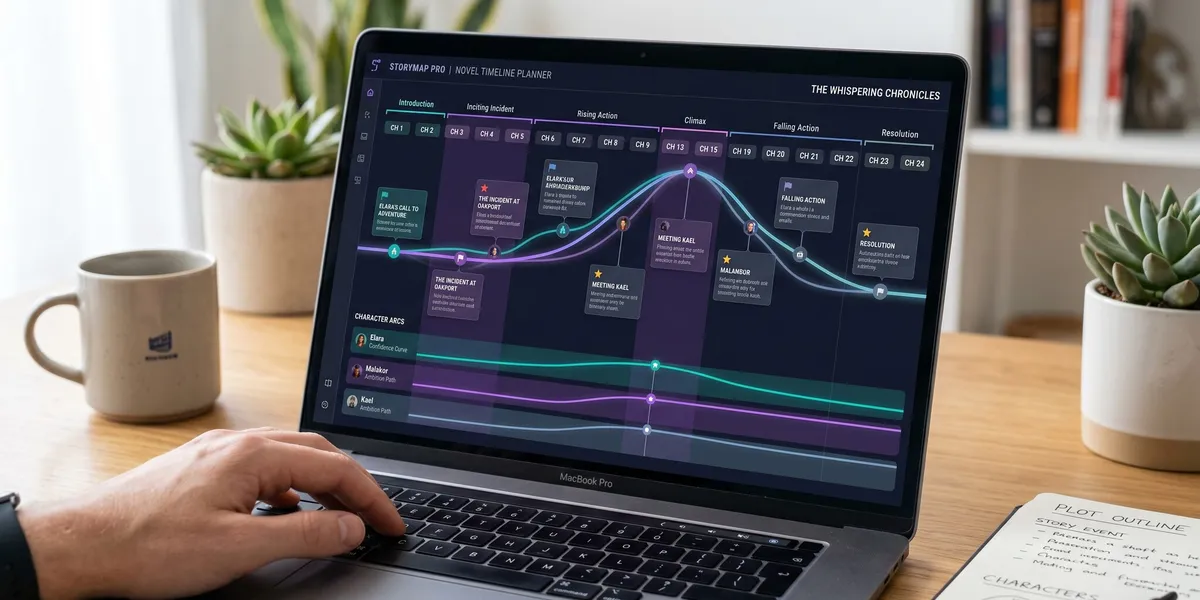
Keeping track of events, character arcs, and plot threads across a 300-page novel gets complicated fast — especially with parallel plotlines or nonlinear narratives. A dedicated timeline tool lets you visualize your entire story structure and catch continuity errors before they reach readers.
In this guide, you’ll learn:
- The best timeline tools for fiction writers in 2026
- Which tool fits your workflow and budget
- How to use timelines for complex multi-POV stories
- Free alternatives that get the job done
Here are the top options.
1. Aeon Timeline — Best Overall for Novelists
Editor’s Choice — Best for Complex Narratives
Aeon Timeline is purpose-built for writers managing complex story timelines with multiple characters and intersecting events.
Best for: Multi-POV novels, historical fiction, and stories with intricate chronologies
Aeon Timeline lets you create custom timeline views showing character arcs, event sequences, and relationships between plot threads. You can track which characters are present at each event, set story-specific calendars (essential for fantasy worldbuilding), and sync directly with Scrivener.
The relationship view is what sets it apart — you can see at a glance which characters’ paths cross and when, making it invaluable for complex narrative structures.
Pricing: $65 one-time purchase (v3) Platforms: Mac, Windows, iOS
2. Plottr — Best for Visual Plotters
Best for: Writers who think in color-coded timelines and visual story maps
Plottr combines timeline plotting with character sheets, worldbuilding notes, and outline templates. The drag-and-drop interface makes rearranging scenes intuitive, and the color-coded storylines help you see at a glance how different plot threads weave together.
It includes genre-specific templates (romance beat sheet, hero’s journey, three-act structure) that give you a starting framework to customize.
Pricing: $25/year or $149 lifetime Platforms: Mac, Windows, Linux, iOS, Android
3. Scrivener — Best All-in-One Writing Tool With Timeline Features
Best for: Writers who want a single tool for writing, organizing, and planning
Scrivener isn’t a dedicated timeline tool, but its corkboard view, outliner, and label system can function as a basic timeline. You can color-code scenes by plotline, rearrange them freely, and use metadata to track dates and character POV.
For more advanced timeline needs, Scrivener syncs with Aeon Timeline — giving you the best of both worlds.
Pricing: $49 one-time Platforms: Mac, Windows, iOS
4. Campfire Write — Best for Worldbuilders
Best for: Fantasy and sci-fi writers who need timelines integrated with worldbuilding
Campfire Write combines timeline tools with character profiles, world maps, magic systems, and species guides. The timeline feature shows events in the context of your entire fictional world — useful when your story spans continents or centuries.
Pricing: Free tier available, modules from $9.99 each or $247.99 for everything Platforms: Web-based, desktop apps
5. Timeline JS — Best Free Option
Best for: Writers who want a free, simple timeline without downloading software
Timeline JS is an open-source tool that creates clean, visual timelines from a Google Spreadsheet. It’s not built for novelists specifically, but it’s an excellent free option for mapping story events, character arcs, and historical research.
Pricing: Free Platforms: Web-based
6. Milanote — Best for Visual/Creative Thinkers
Best for: Writers who prefer mood boards and freeform visual planning
Milanote combines visual boards with timeline-like organization. You can create columns for chapters, pin images and notes to specific story beats, and link related elements. It’s less structured than a traditional timeline but more flexible for creative exploration.
Pricing: Free tier (100 notes), Pro at $12.50/month Platforms: Web, Mac, Windows, iOS, Android
7. Google Sheets — Best DIY Solution
Best for: Writers who want full control with zero cost
A well-organized spreadsheet can serve as a powerful timeline tool. Create columns for date, chapter, POV character, event, location, and plot thread. Use conditional formatting to color-code by storyline and filter to view individual character arcs.
It’s not glamorous, but it’s free, infinitely customizable, and accessible from any device.
Pricing: Free Platforms: Web, mobile
Quick Comparison Table
| Tool | Best For | Price | Scrivener Sync | Complexity |
|---|---|---|---|---|
| Aeon Timeline | Complex timelines | $65 | Yes | High |
| Plottr | Visual plotting | $25/yr | No | Medium |
| Scrivener | All-in-one writing | $49 | N/A | Medium |
| Campfire Write | Worldbuilding | Free-$248 | No | High |
| Timeline JS | Free basic timelines | Free | No | Low |
| Milanote | Visual planning | Free-$12.50/mo | No | Low |
| Google Sheets | DIY custom | Free | No | Low |
When You Need a Timeline Tool
Not every novel needs dedicated timeline software. Here’s when it becomes essential:
- Multiple POV characters with separate storylines that intersect
- Two or more timelines (past/present, dual narrative)
- Historical fiction where real events must align with your plot
- Series writing where continuity across books matters
- Complex worldbuilding with custom calendars or non-standard time systems
For simpler novels with a single POV and linear timeline, your word processor’s outline feature is probably sufficient.
For AI-assisted help with plotting and structure, check our guides on AI plot generators and AI story generators.
Our Pick — Chapter
Chapter helps nonfiction authors organize their ideas and write structured manuscripts with AI assistance. While it’s not a timeline tool, its outlining and organization features help you plan your book’s structure before you write. Over 2,147 authors have created 5,000+ books.
Best for: Nonfiction authors organizing expertise into structured books Pricing: $97 one-time
FAQ
What is the best timeline tool for novel writing?
The best timeline tool for novel writing is Aeon Timeline for complex narratives with multiple characters and intersecting plotlines. Plottr is best for visual planners who want color-coded storylines. Scrivener works well as an all-in-one solution when combined with its corkboard view. Choose based on your story’s complexity and budget.
Do I need a timeline tool to write a novel?
You don’t need a timeline tool for every novel. Simple stories with one POV and a linear timeline work fine with basic outlining. Timeline tools become essential for multi-POV novels, dual timelines, historical fiction, and series writing where tracking character arcs, events, and continuity across chapters or books is critical.
Can I use a free tool for novel timelines?
Yes, Timeline JS (open-source), Google Sheets (DIY spreadsheet), and free tiers of Campfire Write and Milanote all work for novel timeline planning. Free tools require more manual setup but offer full functionality for organizing story events, character arcs, and plot sequences.
How do you organize a novel timeline?
Organize a novel timeline by listing all story events chronologically first, then mapping them to your narrative order. Track each event’s date, chapter, POV character, location, and plot thread. Use color coding to distinguish storylines and character arcs. Review regularly for continuity errors and pacing balance.