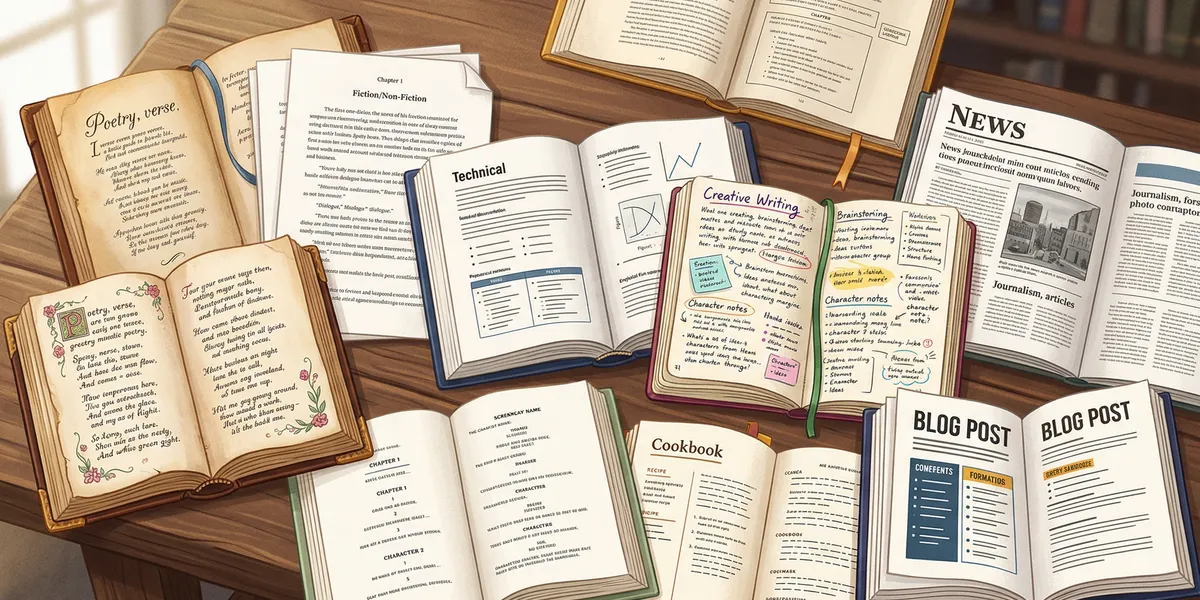
Every piece of writing falls into one of four main types of writing styles: expository, descriptive, narrative, and persuasive. Understanding these styles gives you control over how your words land on the page — whether you are crafting a novel, drafting a blog post, or writing a college essay.
Most writers naturally lean toward one or two styles. The strongest writers know all four and switch between them based on what the moment demands.
The Four Main Types of Writing Styles
The four core writing styles form the foundation of everything from journalism to fiction to academic research. Each serves a distinct purpose, follows different rules, and produces a different effect on the reader.
1. Expository Writing
Expository writing explains, informs, or clarifies. It strips away opinion and focuses on facts, definitions, and logical structure.
You encounter expository writing every day — in textbook chapters, news articles, business reports, and how-to guides. The writer’s personality takes a back seat. Clarity takes the wheel.
Key characteristics:
- Fact-based and objective
- Logical structure (often chronological or step-by-step)
- Third-person point of view
- No emotional appeals
Example:
The human brain weighs approximately three pounds and contains roughly 86 billion neurons. Each neuron connects to thousands of others through synapses, creating a network capable of processing information faster than any computer built to date.
Notice how the passage delivers information without telling you how to feel about it. There is no persuasion, no scene-setting, no plot. Just facts organized for clarity.
Where you see it: Wikipedia articles, instruction manuals, research summaries, encyclopedia entries, business memos.
2. Descriptive Writing
Descriptive writing paints a picture using sensory detail. It answers the question: what does this look, sound, smell, taste, or feel like?
This style shows up in fiction, poetry, travel writing, and food criticism. The goal is immersion. The writer wants the reader to experience a place, person, or object as if they were standing right there.
Key characteristics:
- Rich sensory language (sight, sound, touch, smell, taste)
- Figurative language (metaphor, simile, personification)
- Emphasis on specific, concrete detail
- Often uses first-person or close third-person
Example:
The kitchen smelled of burnt sugar and rosemary. Late afternoon light poured through the window above the sink, catching the steam rising from the cast-iron skillet. A crack ran down the yellow tile behind the stove — the one nobody had fixed since 1987.
Every detail serves a purpose. The burnt sugar and rosemary create a specific atmosphere. The crack in the tile suggests history and lived-in imperfection. The reader is not told that the kitchen feels warm and old. They experience it through accumulated detail.
Strong descriptive writing follows the show, don’t tell principle — letting concrete images do the work instead of abstract adjectives.
Where you see it: Novels, memoirs, poetry, travel writing, product descriptions, restaurant reviews.
3. Narrative Writing
Narrative writing tells a story. It moves through time, follows characters, and builds toward some kind of change or realization.
Narrative writing includes fiction, memoir, personal essays, and narrative journalism. The defining feature is structure: a beginning that sets up a situation, a middle that complicates it, and an ending that resolves or transforms it.
Key characteristics:
- Characters, setting, and plot
- Chronological or structured timeline
- Conflict and resolution
- A narrator with a distinct narrative voice
- Dialogue and scene-building
Example:
Marcus had not spoken to his brother in eleven years. So when the phone rang at 2 a.m. and the voice on the other end said, “It’s David — I need your help,” Marcus did the only thing that made sense. He hung up. Then he sat on the edge of the bed for forty minutes, staring at the phone, before calling back.
The passage drops you into a situation with tension already built in. You do not get a fact sheet about Marcus. You watch him make a choice, change his mind, and reveal his character through action.
If you want to dig deeper into structuring stories, the guide on how to write a story walks through the full process from concept to final draft.
Where you see it: Novels, short stories, memoirs, screenplays, narrative nonfiction, biographies.
4. Persuasive Writing
Persuasive writing argues a position. It aims to change the reader’s mind, earn their agreement, or move them to action.
This style dominates advertising, opinion columns, political speeches, cover letters, and grant proposals. The writer has a clear stance and uses evidence, emotional appeals, and logical reasoning to support it.
Key characteristics:
- Clear thesis or argument
- Evidence and supporting examples
- Emotional and logical appeals
- Call to action (implicit or explicit)
- First-person or second-person voice
Example:
Public libraries do more than store books. They provide free internet access to job seekers, safe after-school space for children, and literacy programs that reach adults who never finished high school. Cutting library funding does not save money. It shifts the cost to emergency services, unemployment offices, and a generation of readers who never get started.
The passage does not pretend to be neutral. It takes a position, supports it with specifics, and makes the opposing view look shortsighted. That is persuasive writing at work — marshaling facts in service of an argument.
Where you see it: Editorials, advertising copy, political speeches, legal briefs, opinion essays, sales pages.
Comparison Table: The Four Main Writing Styles
| Feature | Expository | Descriptive | Narrative | Persuasive |
|---|---|---|---|---|
| Purpose | Inform or explain | Create a sensory experience | Tell a story | Convince or argue |
| Tone | Neutral, objective | Vivid, immersive | Engaging, character-driven | Passionate, authoritative |
| Point of view | Third person | First or third person | First or third person | First or second person |
| Structure | Logical, sequential | Spatial or sensory | Chronological, plot-driven | Argument with evidence |
| Uses emotion | Rarely | Often (through imagery) | Yes (through characters) | Yes (as a persuasion tool) |
| Common formats | Textbooks, reports, manuals | Poetry, novels, travel writing | Fiction, memoir, journalism | Editorials, ads, speeches |
Beyond the Four: Hybrid and Specialized Styles
Real-world writing rarely stays inside one lane. The most compelling work blends styles to match the material.
Creative Nonfiction
Creative nonfiction fuses narrative structure with factual content. A long-form magazine piece about climate science might read like a thriller — following a researcher through the Arctic while weaving in expository data about ice-core samples. The narrative keeps you turning pages. The exposition gives you the facts you came for.
Lyrical Prose
Lyrical prose borrows the rhythmic, image-heavy qualities of poetry and applies them to narrative or descriptive writing. Authors like Toni Morrison and Ocean Vuong write sentences that work as both story and music. The Purdue Online Writing Lab classifies this as a subset of literary style, but in practice it crosses every boundary.
Technical Writing
Technical writing sits at the extreme end of the expository spectrum. It prioritizes precision, consistency, and usability over elegance. Software documentation, medical guidelines, and legal contracts all fall here. The audience needs accurate information, not beautiful sentences.
Journalistic Writing
Journalism blends expository and narrative elements. A hard news story is pure exposition — facts organized by importance. A feature article adds narrative structure, character, and scene. The best investigative journalism, like the work published by ProPublica, uses all four styles within a single piece.
How to Identify Your Natural Writing Style
Every writer develops tendencies. Identifying yours helps you lean into your strengths and expand your range.
Read Your Own Work
Pull up the last five things you wrote — emails count. Look for patterns. Do you default to explaining things step by step? You lean expository. Do your sentences pile up sensory detail? You lean descriptive. Do you turn everything into a mini-story? That is a narrative instinct.
Take the Sentence Test
Write a single paragraph about a cup of coffee. Then read it back.
- If you described the brewing temperature and caffeine content, you write expository.
- If you described the steam curling off the surface and the smell of roasted beans, you write descriptive.
- If you wrote about who made the coffee and why, you write narrative.
- If you argued that people should drink more (or less) coffee, you write persuasive.
Most writers find their paragraph lands in one or two camps. That is your default mode.
Study Writers You Admire
According to research from the National Council of Teachers of English, reading widely across genres is the single most effective way to expand your stylistic range. Pay attention to how your favorite authors handle transitions between styles. Mark the places where a novelist pauses the story to explain something (expository). Note where a journalist drops into scene (descriptive/narrative).
How to Develop Range Across All Four Styles
Knowing your default is the starting point. Building fluency in all four styles makes you a stronger, more versatile writer.
Practice Switching
Take a single topic — say, a thunderstorm — and write four short paragraphs, one in each style. Expository: explain how thunderstorms form. Descriptive: paint the scene of a storm hitting a beach town. Narrative: tell the story of a person caught in the storm. Persuasive: argue that cities need better storm infrastructure.
This exercise trains your brain to approach the same material from different angles. The University of North Carolina Writing Center recommends this kind of deliberate style-switching as a core development tool.
Read Outside Your Comfort Zone
If you write fiction, read business writing. If you write reports, read poetry. Cross-pollination forces you to absorb rhythms and structures your default style does not offer.
Revise With Style in Mind
During revision, ask: what style is this paragraph? Is that the right choice for what it needs to accomplish? A scene that should pull the reader in emotionally might be written in flat expository mode. A section that should deliver facts quickly might be buried under unnecessary description.
Matching style to purpose is one of the most powerful editing tools you can develop. If you are working on a book-length project, Chapter.pub helps you draft and revise across every writing style, so you can focus on the craft decisions that matter rather than staring at a blank page.
Matching Style to Format
The format you are writing in often determines which style should dominate.
Blog posts and articles: Primarily expository with descriptive and narrative elements for engagement. The introduction might tell a quick story (narrative). The body explains the topic (expository). A key section paints a vivid picture (descriptive).
Novels and short stories: Narrative as the backbone, with descriptive passages for immersion and expository sections for context. The balance depends on genre — literary fiction leans descriptive, thrillers lean narrative, and how to write a book guides cover the full spectrum.
Academic papers: Expository with persuasive elements. You present research (expository) and argue for your interpretation (persuasive). The American Psychological Association sets specific guidelines for how this blend should work in scholarly writing.
Marketing copy: Persuasive at the core, often wrapped in narrative (customer stories) and descriptive language (product imagery).
Memoir and personal essays: Narrative and descriptive in equal measure, with expository passages to provide context. The strongest memoirs, according to the Association of Writers and Writing Programs, succeed because they balance showing and telling — using all four styles in service of a single story.
Common Mistakes to Avoid
Using the Wrong Style for the Audience
A technical report written in descriptive prose frustrates engineers who need specifications. A travel article written in pure expository mode bores readers who want to feel the destination. Always ask: who is reading this, and what do they need from this writing?
Over-Describing Everything
New writers often default to heavy description because it feels like “real” writing. But description without purpose slows the pace and loses the reader. Every sensory detail should earn its place.
Confusing Persuasive With Expository
Writing that claims to be objective while subtly pushing a viewpoint erodes trust. If you are making an argument, own it. If you are informing, strip out the spin. Readers detect the mismatch even when they cannot name it.
Never Varying Your Style
A 5,000-word piece written entirely in one style becomes monotonous regardless of which style it uses. The best long-form writing shifts between styles — a narrative opening, an expository middle section, a descriptive passage that brings an abstract concept to life, a persuasive conclusion.
Ignoring Voice While Focusing on Style
Style and voice are not the same thing. Style is the type of writing (expository, descriptive, etc.). Voice is the personality behind the words — the rhythm, word choice, and attitude that make your writing sound like you. Two writers can both use narrative style and sound completely different. Develop both.
Frequently Asked Questions
What is the difference between writing style and writing voice?
Writing style refers to the category of writing — expository, descriptive, narrative, or persuasive. Writing voice is the unique personality and tone that comes through in your word choices, sentence rhythms, and perspective. Style is the vehicle. Voice is the driver. You can write a narrative piece in a dry, understated voice or a loud, dramatic one. Both are narrative style, but the voices are distinct.
Can you use more than one writing style in a single piece?
Yes — and strong writers usually do. A magazine feature might open with a narrative scene, shift to expository paragraphs that deliver background information, include descriptive passages that bring a location to life, and close with a persuasive call to action. The key is making transitions smooth so the reader does not feel jarred by the shift.
Which writing style is best for beginners?
Expository writing is the most accessible starting point because it prioritizes clarity and structure over literary technique. You focus on organizing information logically rather than crafting beautiful sentences. Once you build confidence with exposition, branching into narrative and descriptive writing becomes easier because you already have the structural foundation.
How do I know which writing style to use?
Start with purpose. Ask: what do I want this piece to accomplish? If you need to inform, use expository. If you want the reader to feel something sensory, use descriptive. If you are telling a story, use narrative. If you are making an argument, use persuasive. Most real-world writing uses a primary style with elements of the others mixed in.
Do fiction writers need to know all four styles?
Absolutely. Fiction is primarily narrative, but every novel contains expository passages (backstory, world-building), descriptive passages (setting, character appearance), and persuasive passages (a character making an argument, a narrator building a case for a theme). Understanding all four styles gives fiction writers control over pacing, immersion, and reader engagement.