Copy editing is the process of reviewing written text to correct errors in grammar, spelling, punctuation, and consistency while preserving the author’s voice. It sits between developmental editing and proofreading in the publishing workflow.
Whether you are self-publishing a novel or preparing a nonfiction manuscript, copy editing is the step that transforms a rough draft into polished, professional prose.
In this reference, you will find:
- A clear definition of copy editing and what it covers
- The three levels of copy editing (light, medium, heavy)
- How copy editing differs from proofreading and line editing
- Current rates and what to expect from the process
Here is everything you need to know.
What Does a Copy Editor Do?
A copy editor reviews your manuscript at the sentence level. Their job is to catch mistakes you have become blind to after months of writing and revising.
Specifically, a copy editor checks for:
- Grammar and syntax — subject-verb agreement, dangling modifiers, tense consistency
- Spelling and punctuation — typos, misused commas, inconsistent em dash usage
- Consistency — character name spellings, timeline accuracy, formatting choices
- Clarity — awkward phrasing, ambiguous sentences, unnecessarily complex language
- Style guide adherence — Chicago Manual of Style, AP Style, or your publisher’s house style
- Fact checking — verifying dates, proper nouns, and basic factual claims
A copy editor does not restructure your chapters or rewrite your plot. That is developmental editing. They work at the micro level, making sure every sentence is clean and correct.
The Three Levels of Copy Editing
Not every manuscript needs the same depth of editing. The publishing industry recognizes three levels of copy editing, each with a different scope and price point.
| Level | What It Covers | Best For |
|---|---|---|
| Light | Fixes clear errors in grammar, spelling, and punctuation only | Clean manuscripts that need a final polish |
| Medium | Fixes errors plus improves awkward phrasing and flags inconsistencies | Most manuscripts — the standard level |
| Heavy | Fixes errors, rewrites clunky sentences, restructures paragraphs, and fact-checks | Rough drafts or manuscripts with significant issues |
Light Copy Editing
Light copy editing corrects only indisputable errors. Your copy editor fixes misspellings, grammatical mistakes, and punctuation problems but leaves stylistic choices alone.
This level works best when your manuscript is already well-written and has been through beta readers or a developmental edit. You just need someone with fresh eyes to catch the errors you missed.
Medium Copy Editing
Medium copy editing is the industry standard. Your editor fixes all errors and also improves sentence flow, flags wordiness, queries factual inconsistencies, and ensures consistent formatting throughout.
If you are unsure which level you need, start here. Most traditionally published books go through medium copy editing before reaching the proofreading stage.
Heavy Copy Editing
Heavy copy editing borders on line editing. Your editor rewrites awkward sentences, restructures convoluted paragraphs, eliminates jargon, and does thorough fact-checking.
This level is common for manuscripts that were written quickly, translated from another language, or produced with AI writing tools. The editor does substantial rewriting while still preserving your voice and intent.
Copy Editing vs. Proofreading vs. Line Editing
These three terms get confused constantly. Here is how they differ.
| Type | Focus | When It Happens | Scope of Changes |
|---|---|---|---|
| Line editing | Sentence-level style and voice | After developmental editing | Rewrites for flow, tone, and impact |
| Copy editing | Grammar, spelling, consistency | After line editing | Corrects errors and enforces style |
| Proofreading | Final error catch | After typesetting/layout | Minimal — catches only remaining typos |
The Correct Order
The professional editing sequence is:
- Developmental editing — big-picture structure, plot, argument
- Line editing — sentence-level style and voice refinement
- Copy editing — grammar, spelling, punctuation, consistency
- Proofreading — final review of typeset pages
Skipping steps or doing them out of order wastes money. If you send a draft to a copy editor before addressing structural problems, you will pay to polish sentences that get deleted during the developmental edit.
What Does Copy Editing Look Like? Examples
Here are before-and-after examples showing what copy editing actually changes.
Example 1: Grammar and Clarity
Before: “The data shows that their is a significant amount of people that wants to self-publish there own books, however alot of them doesn’t know where to start.”
After: “The data show that a significant number of people want to self-publish their own books. However, many of them do not know where to start.”
What changed: Subject-verb agreement fixed (“data show”), homophones corrected (“their” to “there”), comma splice replaced with a period, “alot” corrected to “a lot,” and “doesn’t” fixed to “do not.”
Example 2: Consistency
Before: “In chapter 3, Sarah drove her red Toyota to the airport. […] In Chapter Seven, Sarah’s blue Honda was parked in the driveway.”
After: “In Chapter 3, Sarah drove her red Toyota to the airport. […] In Chapter 7, Sarah’s red Toyota was parked in the driveway.” (with a query to the author about the car change)
What changed: Chapter formatting made consistent (both use “Chapter” + numeral), and the car discrepancy flagged for the author to resolve.
Example 3: Style Guide Enforcement
Before: “She was born on December 5th, 1990 in New York City, New York.”
After (Chicago Style): “She was born on December 5, 1990, in New York City.”
What changed: Ordinal removed from date, comma added after year, redundant state name removed per Chicago Manual of Style conventions.
How Much Does Copy Editing Cost?
Copy editing rates vary based on the manuscript’s length, complexity, and the editor’s experience. Here are current industry benchmarks.
| Pricing Model | Typical Range | Source |
|---|---|---|
| Per word | $0.02–$0.06 | Editorial Freelancers Association |
| Per page | $5–$15 | Industry average (250 words/page) |
| Per hour | $36–$50 | EFA 2026 Rate Survey |
For a 70,000-word novel, copy editing typically costs between $1,400 and $4,200 depending on the level of editing and the editor’s experience.
Ways to reduce costs:
- Self-edit thoroughly before hiring a copy editor
- Use grammar tools like Grammarly or ProWritingAid for a first pass
- Choose light copy editing if your manuscript is already clean
- Write with AI assistance and then invest the savings in professional editing
Common Copy Editing Marks and Symbols
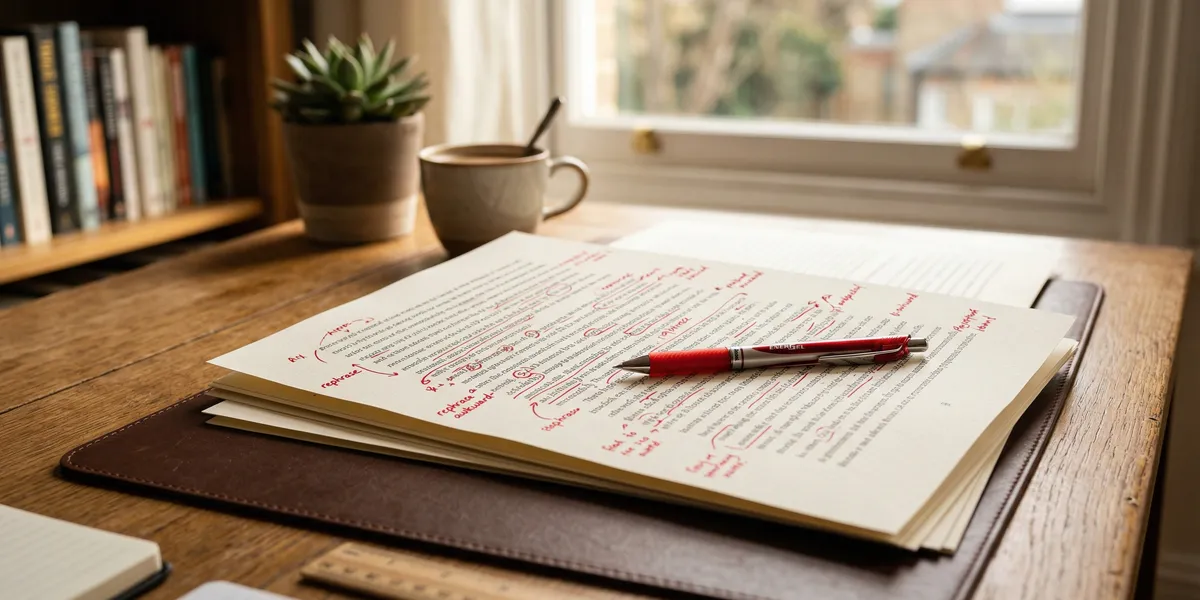
Traditional copy editing uses a standardized set of marks when working on printed manuscripts. While most editing now happens digitally with track changes, knowing these symbols is still useful.
- Delete (strikethrough line) — remove the marked text
- Caret (^) — insert text at this point
- Transpose (⤭) — swap the order of adjacent letters or words
- Close up (⌢) — remove the space between characters
- Stet (dots under text) — ignore the edit, keep the original
- Lowercase (/) — change a capital letter to lowercase
- Capitalize (triple underline) — change a lowercase letter to uppercase
- New paragraph (¶) — start a new paragraph here
The Chicago Manual of Style remains the standard reference for copy editing marks in book publishing.
How to Prepare Your Manuscript for Copy Editing
You will get better results — and spend less money — if you prepare your manuscript before sending it to a copy editor.
Before you hire a copy editor:
- Finish all content changes. Do not send a manuscript you are still rewriting. Complete your developmental and line editing passes first.
- Run spell check. This catches the easy errors so your editor can focus on the hard ones.
- Create a style sheet. List your preferred spellings, character names, unique terms, and formatting choices. This saves your editor time and prevents unnecessary queries.
- Format consistently. Use one font, standard margins, and consistent heading styles throughout.
- Number your pages. Seems basic, but it makes the editor’s job significantly easier.
When to Use AI vs. a Human Copy Editor
AI writing and editing tools have improved dramatically. Tools like Grammarly, ProWritingAid, and Chapter can catch many surface-level errors automatically.
But AI copy editing has clear limitations:
- AI misses context. It cannot tell whether “lead” should be the metal or the verb in your specific sentence.
- AI does not understand your voice. A human copy editor preserves your stylistic choices while fixing actual errors.
- AI cannot query. A good copy editor asks questions: “Did you mean this character’s name to change?” AI just guesses.
- AI struggles with fiction conventions. Intentional fragments, dialect, and unconventional punctuation get “corrected” when they should not be.
The best approach is layered: use AI tools for a first pass to catch obvious errors, then hire a human copy editor for the nuanced work. If you are writing with AI assistance through a platform like Chapter, you get cleaner first drafts that require less editing — which means lower copy editing costs when you hire a professional.
How Long Does Copy Editing Take?
Copy editing a full-length book typically takes two to four weeks for a freelance editor, depending on the manuscript’s length and condition. A 70,000-word novel in good shape might take two weeks. A 100,000-word manuscript that needs heavy editing could take four to six weeks.
Factors that affect turnaround time:
- Manuscript word count
- Level of editing needed (light vs. heavy)
- Editor’s current workload
- Whether you need a rush delivery (usually costs 50–100% more)
Plan for editing time in your publishing timeline. Rushing this step is how errors end up in your published book.
Do You Need a Copy Editor?
Yes. Every manuscript benefits from a professional copy editor — even if you have a degree in English, even if you have used grammar software, and even if five beta readers reviewed your book.
You cannot effectively copy edit your own work. Your brain auto-corrects errors because you know what the text is supposed to say. A fresh pair of trained eyes catches what yours cannot.
The only question is which level of editing you need and when to invest in it. If budget is tight, prioritize copy editing over developmental editing for manuscripts that are structurally sound. A well-copy-edited book with minor structural quirks reads better than a perfectly structured book full of typos.
FAQ
What Is Copy Editing in Simple Terms?
Copy editing is the process of fixing grammar, spelling, punctuation, and consistency errors in a written document. A copy editor reviews your text sentence by sentence to catch mistakes and ensure everything reads clearly and follows a consistent style. It is the quality control step between writing and publishing.
What Is the Difference Between Copy Editing and Proofreading?
The difference between copy editing and proofreading is scope and timing. Copy editing happens earlier in the process and involves correcting grammar, improving sentence clarity, and enforcing style consistency. Proofreading happens last — after the text is formatted and typeset — and only catches final typos or formatting errors. Copy editors make substantive changes; proofreaders make minimal ones.
How Much Does a Copy Editor Cost for a Book?
A copy editor for a book costs $1,400 to $4,200 for a 70,000-word manuscript, based on current EFA rate guidelines. Rates depend on the editing level (light, medium, or heavy), the editor’s experience, and your manuscript’s condition. Per-word rates typically range from $0.02 to $0.06.
Can AI Replace a Copy Editor?
AI cannot fully replace a human copy editor. AI tools like Grammarly catch surface errors but miss context-dependent mistakes, voice preservation, and factual inconsistencies. The best workflow uses AI for a first pass and a human editor for the nuanced work. Writing with AI-assisted tools like Chapter produces cleaner drafts, which reduces the amount of copy editing needed.