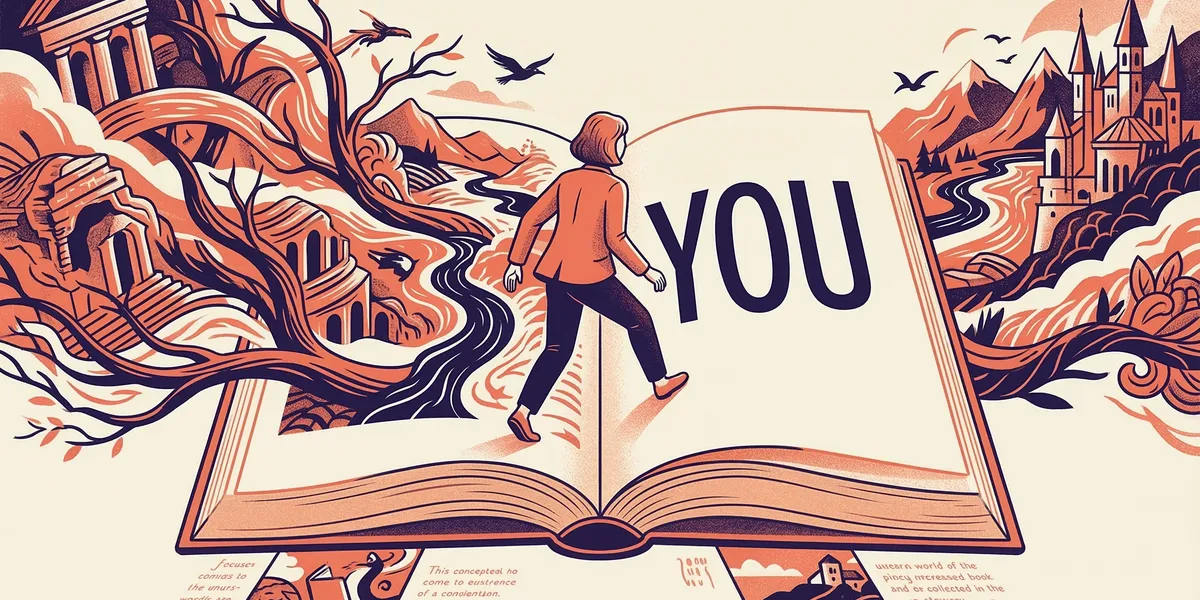
Second person point of view is the narrative perspective that uses “you” as the main pronoun, addressing the reader directly and placing them inside the experience being described.
Where first person uses “I” and third person uses “he,” “she,” or “they,” second person speaks straight to the reader. It is the rarest point of view in published fiction, but one of the most common in nonfiction, advertising, and interactive media.
Second Person Pronouns
Second person has one core set of pronouns in English. Unlike first and third person, there is no singular/plural distinction — “you” covers both.
| Pronoun | Function | Example |
|---|---|---|
| You | Subject | You open the door. |
| You | Object | The letter finds you. |
| Your | Possessive adjective | Your hands are shaking. |
| Yours | Possessive pronoun | The choice is yours. |
| Yourself | Reflexive (singular) | You remind yourself to breathe. |
| Yourselves | Reflexive (plural) | You can see for yourselves. |
What Second Person Sounds Like
A quick comparison across all three points of view makes the difference obvious.
| Point of View | Example |
|---|---|
| First person | I walk into the room and notice the broken window. |
| Second person | You walk into the room and notice the broken window. |
| Third person | She walks into the room and notices the broken window. |
Second person removes the barrier between reader and character. There is no “I” to observe and no “she” to follow — there is only “you,” living the scene in real time.
Examples in Published Fiction
Second person is rare in novels, which makes the books that succeed with it stand out.
Bright Lights, Big City by Jay McInerney (1984) is the most well-known second person novel in English. The entire book unfolds in present tense second person, following “you” through 1980s Manhattan nightlife. McInerney chose the perspective to capture the feeling of watching yourself make bad decisions from a slight remove.
If on a winter’s night a traveler by Italo Calvino (1979) opens by addressing the reader directly, collapsing the boundary between the person holding the book and the character in the story. The frame narrative sustains second person throughout.
The Choose Your Own Adventure series (1979-1998) used second person to put the reader in control of the plot. Each book addressed “you” as the protagonist and offered branching decision points. The format sold over 250 million copies and remains one of the most commercially successful uses of the perspective.
Self-help and instructional writing uses second person almost universally. Books like Dale Carnegie’s How to Win Friends and Influence People speak directly to the reader because the goal is to change your behavior, not describe someone else’s.
When Second Person Works Best
Second person is not the right choice for every project. It excels in specific contexts.
Interactive fiction and games. Text-based adventure games, visual novels, and choose-your-own-adventure formats depend on second person to make the reader feel like a participant rather than a spectator.
Self-help and how-to writing. When the goal is to instruct or motivate, second person creates immediacy. Telling the reader “you can do this” lands differently than “one can do this.”
Short fiction and experimental work. Short stories can sustain the intensity of second person more easily than novels. The compressed form keeps the perspective from wearing thin.
Advertising and copywriting. Second person dominates marketing because it speaks directly to the customer. Product descriptions, email campaigns, and landing pages almost always use “you.”
Blog posts and articles. Most online content — including this post — uses second person because it creates a conversational tone and makes information feel personally relevant.
When to Avoid Second Person
Long fiction without a clear reason. Sustaining second person across 80,000 words is difficult. Readers can start to resist being told what “you” think, feel, or do if the perspective feels like a gimmick rather than a purposeful choice.
Academic writing. Most style guides recommend avoiding second person in academic papers, theses, and formal research. The convention is to use third person or, in some fields, first person.
When the character is highly specific. If your protagonist has a distinct personality, backstory, and voice that differs sharply from the reader, second person can create friction. The reader may not accept being cast as someone very unlike themselves.
Second Person vs. Other Points of View
| Feature | First Person | Second Person | Third Person |
|---|---|---|---|
| Main pronoun | I, me, my | You, your, yours | He/she/they, his/her/their |
| Reader role | Observer of narrator | Participant in the story | Observer of characters |
| Common in fiction? | Very common | Rare | Most common |
| Common in nonfiction? | Memoir, essay | How-to, self-help, blogs | Journalism, textbooks |
| Narrative distance | Close | Closest | Varies (close to distant) |
For a deeper look at each perspective, see our guides on first person point of view, third person limited, and third person omniscient.
Related Resources
- How to Write Multiple POV — managing more than one perspective in a single work
- Writing in Deep POV — getting closer to your viewpoint character regardless of person
- What Is a Narrator? — the role of the narrator across all points of view
- Show, Don’t Tell — making any point of view more vivid and immediate