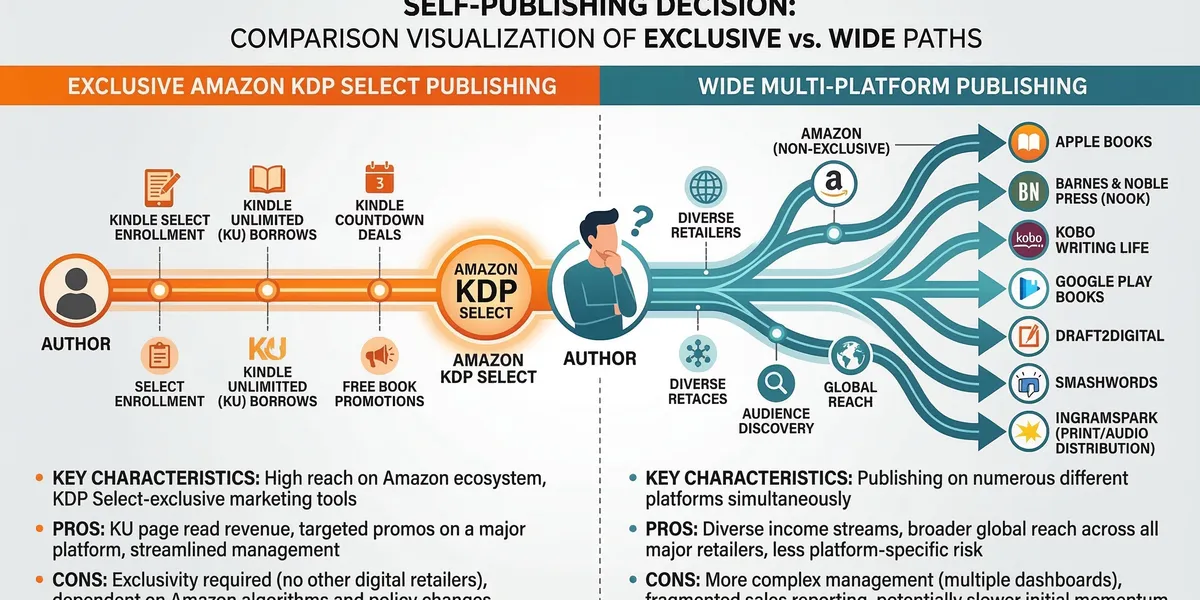
Going exclusive with Amazon through KDP Select or publishing wide across multiple platforms is the biggest distribution decision a self-published author makes. There is no universally correct answer. The right choice depends on your genre, your audience, and your long-term publishing goals.
Here is how both paths work, when each one makes sense, and how to decide.
KDP Select: the exclusive path
KDP Select is Amazon’s exclusivity program. When you enroll a book, you agree to sell the ebook version exclusively through Amazon for a 90-day term. In exchange, your book is included in Kindle Unlimited (KU), Amazon’s subscription reading service, and you gain access to promotional tools.
What you get with KDP Select
Kindle Unlimited access. Your book becomes available to KU subscribers who pay $11.99/month for unlimited reading. You earn royalties based on pages read through the KU fund, which Amazon sets monthly. In 2025, the per-page rate averaged around $0.004 to $0.005 per page, according to the KDP community forums.
For a 300-page novel, a complete read-through earns roughly $1.20 to $1.50. That may sound low per read, but KU readers consume books at a much higher rate than purchasers. A single KU reader might read your entire five-book series in a week.
Kindle Countdown Deals. A promotional tool that lets you run time-limited price drops while keeping your 70% royalty rate. This is exclusive to KDP Select books.
Free Book promotions. You can make your book free for up to 5 days per 90-day enrollment period. This drives downloads and visibility, especially useful for book one in a series.
The cost of exclusivity
The trade-off is straightforward: you cannot sell or distribute your ebook anywhere else. Not Apple Books. Not Kobo. Not Google Play. Not Barnes & Noble. Not your own website. Not libraries through OverDrive.
Your ebook exists on Amazon and only Amazon for the duration of your enrollment. Paperback and hardcover editions are not affected by KDP Select, only the ebook.
Going wide: the multi-platform path
Wide publishing means distributing your ebook across all available platforms. You sell on Amazon (without KDP Select), Apple Books, Kobo, Google Play, Barnes & Noble, and potentially dozens of smaller retailers and library systems.
How to distribute wide
Direct uploads. You can create accounts and upload directly to each platform:
- Amazon KDP (you can use KDP without enrolling in KDP Select)
- Apple Books
- Kobo Writing Life
- Google Play Books
- Barnes & Noble Press
Aggregators. Services like Draft2Digital and PublishDrive distribute to multiple platforms from a single dashboard. They take a small percentage (typically 10%) but save significant time managing multiple accounts.
What you get going wide
Platform diversification. If Amazon changes its algorithms, terms, or royalty rates, you are not entirely dependent on one company. Authors who built their entire income on KDP Select and then saw their page reads drop overnight had no fallback.
Access to different reader pools. Kobo dominates in Canada, Australia, and parts of Europe. Apple Books readers tend to spend more per purchase. Google Play reaches Android users who may never visit Amazon. Library distribution through OverDrive and Hoopla reaches readers who discover authors through their local library.
Higher per-sale royalties on some platforms. Apple Books pays 70% royalty on all prices. Amazon pays 70% only on books priced $2.99 to $9.99. Google Play is competitive on royalty rates as well.
Full pricing control. You can price your book differently on each platform, run sales independently, and offer your book for free permanently (Amazon price-matches free books on other platforms, but this is not guaranteed).
Side-by-side comparison
| Factor | KDP Select (Exclusive) | Wide Distribution |
|---|---|---|
| Platforms | Amazon only | Amazon + Apple + Kobo + Google + B&N + more |
| Kindle Unlimited | Yes | No |
| Royalty rate | 70% ($2.99-$9.99) + KU page reads | 70% on most platforms |
| Countdown Deals | Yes | No (but you can run sales manually) |
| Free promotions | 5 days per 90-day period | Free anytime, any platform |
| Lock-in period | 90 days (auto-renews) | None |
| Library access | Limited | Yes (via aggregators) |
| Platform risk | High (single point of failure) | Low (diversified) |
When to go exclusive
KDP Select tends to be the stronger choice when:
You write genre fiction with strong series potential. Romance, thriller, mystery, fantasy, and sci-fi readers are heavily represented on KU. If your genre’s readers are KU subscribers, meeting them where they read is the priority.
You are building a backlist from scratch. KU’s page-read income provides a revenue floor while you build your catalog. The visibility tools (Countdown Deals, free promotions) help new authors get initial traction. According to a survey by the Alliance of Independent Authors, many successful indie authors started exclusive and went wide later.
You are running a rapid release strategy. The rapid release model combines powerfully with KDP Select because KU readers binge series. Publishing books 30 to 90 days apart in KDP Select can create a snowball effect of page reads.
Your marketing budget is limited. When you only need to master one platform’s advertising and promotion system (Amazon Ads), your learning curve is shorter and your ad spend is more focused.
When to go wide
Wide distribution tends to be the stronger choice when:
You write nonfiction. Nonfiction readers are less concentrated on KU. They buy across platforms, use libraries, and discover books through Google searches that lead to Google Play or Apple Books.
You have an established audience. If you have an email list, a strong author platform, and readers who buy when you tell them a new book is out, you do not need KU’s discovery engine. You can drive your audience to whichever platform you prefer.
You want to reduce platform risk. Amazon can change its terms, algorithms, or KU payout at any time. Authors who derive 100% of their income from one platform are vulnerable to those changes.
Your genre performs well on non-Amazon platforms. Romance does well on Kobo. Literary fiction does well on Apple Books. Check where your genre’s readers shop.
You want library distribution. Wide distribution through aggregators like Draft2Digital gives your books access to library systems like OverDrive, Hoopla, and BorrowBox. Library readers are voracious and loyal.
The hybrid approach
Many successful authors use a hybrid strategy: they keep some books in KDP Select and publish others wide.
A common approach is to keep the first book in a series in KDP Select for maximum discoverability while the series is actively growing, then pull the entire series wide once it has enough reviews and backlist momentum to sustain sales across multiple platforms.
Another approach: keep your fiction in KDP Select and publish nonfiction wide, matching each format to its optimal distribution strategy.
Making the switch
From exclusive to wide
When your 90-day KDP Select term ends (and you have turned off auto-renewal), your ebook becomes available for wide distribution. Upload to other platforms or through an aggregator. Expect it to take 3 to 6 months to build momentum on new platforms, since you are starting with zero reviews and zero sales history on each one.
From wide to exclusive
Unpublish your ebook from all non-Amazon platforms before enrolling in KDP Select. Wait until the book is delisted everywhere (usually 24 to 72 hours) to avoid violating Amazon’s exclusivity requirement.
Common mistakes to avoid
- Going wide without marketing each platform. If you publish on five platforms but only advertise on Amazon, four platforms will generate zero sales. Wide publishing requires platform-specific marketing effort.
- Staying exclusive out of fear. Some authors remain in KDP Select forever because switching feels risky. If your KU page reads have declined and your genre performs well on other platforms, test going wide with one title.
- Going wide too early. New authors with no audience and no backlist often struggle wide because they lack the discoverability that KDP Select provides. Building an initial readership on Amazon first, then expanding wide, is a proven path.
- Ignoring the 90-day cycle. KDP Select auto-renews. If you want to go wide, uncheck auto-renewal before the enrollment period ends. Missing the window locks you in for another 90 days.
FAQ
Can I publish my paperback wide while my ebook is in KDP Select?
Yes. KDP Select’s exclusivity requirement applies only to the ebook edition. You can sell paperbacks, hardcovers, and audiobooks anywhere regardless of your KDP Select status. Many authors keep their ebook exclusive while distributing print editions through IngramSpark for wider retail placement.
How much income will I lose if I leave KDP Select?
It depends on how much of your current income comes from KU page reads. If 70% of your revenue is from page reads, expect a significant short-term drop when going wide. Most authors who switch successfully report reaching equivalent or higher income within 6 to 12 months, but the transition period is real.
Which platforms are most worth the effort for wide distribution?
Amazon, Apple Books, and Kobo are the top three by revenue for most wide authors. Google Play is growing. Barnes & Noble is smaller but still meaningful for certain genres. Start with these four and expand from there.