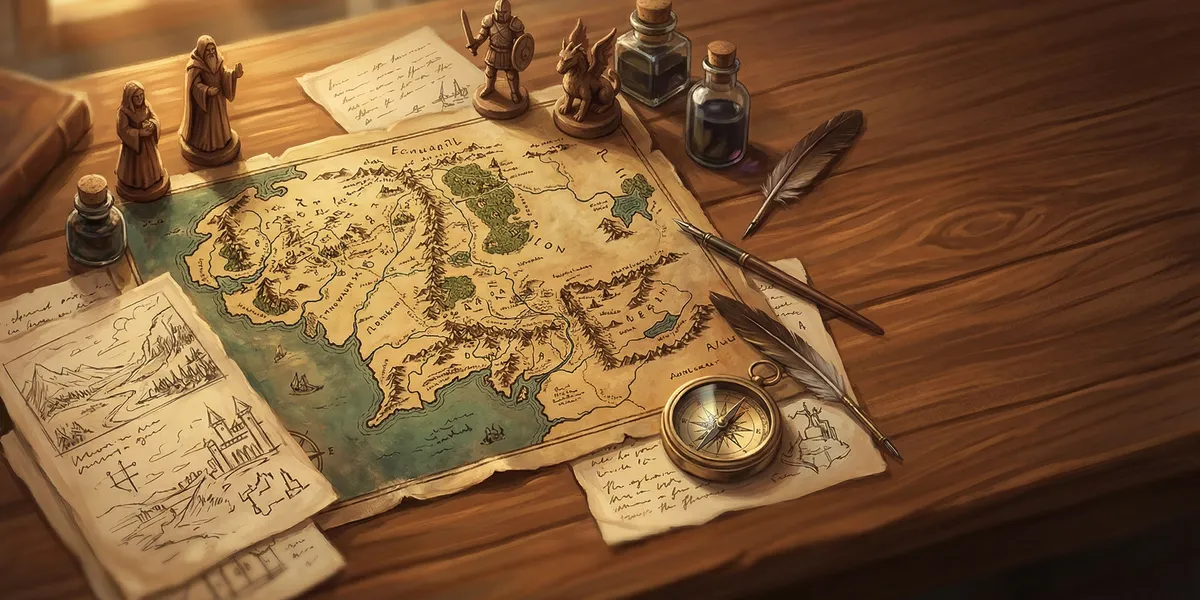
Worldbuilding tips boil down to one principle: build what the story needs, then go deeper only where it matters. You do not need an encyclopedia before you start writing. You need a world that feels real enough for readers to stop noticing the seams.
Whether you write fantasy, science fiction, or contemporary fiction set in a real city with invented subcultures, worldbuilding is how you make the setting do actual work in your story. A reader survey on worldbuilding found that 93% of respondents consumed their favorite fictional worlds across multiple formats — books, films, games — because the worldbuilding pulled them in so completely.
This guide covers the practical steps that separate flat backdrops from worlds readers want to live in.
Start With the Story, Not the Map
The most common worldbuilding mistake is building a world before knowing what story you want to tell in it. You end up with a 40-page wiki document and no novel.
Your story’s central conflict should dictate which parts of the world you develop first. Writing a political thriller set in an empire? Build the power structures. Writing a survival story on an alien planet? Build the environment. Writing a romance between a human and a fae? Build the cultural divide.
Brandon Sanderson breaks worldbuilding into three pillars: setting, character, and plot. The world exists to serve all three. If a detail does not affect the characters, raise the stakes, or deepen the conflict, it belongs in your notes — not in the manuscript.
Practical exercise: Write one sentence describing your story’s core conflict. Circle every noun. Those nouns tell you which parts of the world to build first.
Go Narrow and Deep, Not Wide and Shallow
A reader survey on fantasy worldbuilding preferences found that the qualities readers value most are history, depth, and immersion — not breadth. A world with three deeply realized cultures feels more real than one with twenty that are paper-thin.
Pick two or three worldbuilding categories that directly affect your story and develop those thoroughly. For most novels, that means some combination of:
- Geography and environment — how the physical world shapes daily life
- Culture and customs — what people believe, celebrate, and fight over
- Power structures — who rules, who rebels, and why
- Economy and trade — what people need and how they get it
- Magic or technology — the systems that make this world different
You can always expand later. Readers forgive gaps in worldbuilding they never notice. They do not forgive shallow details in areas the story keeps drawing attention to.
Build Rules and Make Them Consistent
Every fictional world runs on internal logic. Fantasy worlds have rules about magic. Science fiction worlds have rules about technology. Even realistic fiction has rules about how a specific community or institution operates.
Readers will accept almost any rule you establish, as long as you follow it. According to reader feedback collected across multiple writing communities, inconsistencies are where most people lose their sense of immersion. A character who cannot afford bread in chapter three should not throw a banquet in chapter seven without explanation.
This applies especially to magic systems. Define what your system can do, what it costs, and what it cannot do. The limitations matter more than the abilities — constraints create conflict, and conflict drives story.
Keep a worldbuilding bible. A simple document tracking names, locations, systems, timelines, and key facts prevents contradictions. It does not need to be elaborate. A spreadsheet or a running notes file works fine.
Use Sensory Details, Not Info Dumps
The biggest pitfall in worldbuilding is the info dump — paragraphs of exposition explaining how the world works before anything happens. Readers skim or skip these sections entirely.
The fix is to reveal your world through the senses and through character experience. Instead of telling the reader the climate is brutal, show a character chipping ice from a water barrel at dawn. Instead of explaining the caste system, show a character being refused service at a market stall.
Ursula K. Le Guin’s The Left Hand of Darkness is a masterclass in this technique. She never pauses to lecture about the planet’s freezing climate. Instead, every character interaction, every piece of clothing described, and every meal shared communicates the cold through lived experience.
A useful test: if you can cut a worldbuilding passage and the scene still makes sense emotionally, the passage was an info dump. If cutting it makes the scene feel empty, the detail is doing its job.
Layer Culture Through Daily Life
Culture is not a list of customs in your notes. It is visible in how characters eat, greet each other, resolve arguments, raise children, and bury the dead.
The Science Fiction & Fantasy Writers Association recommends asking questions about everyday life: What do people eat for breakfast? How do they address strangers? What is considered rude? These small details accumulate into a feeling of immersion that grand political systems alone cannot achieve.
Think about culture in layers:
| Layer | What It Covers | Example |
|---|---|---|
| Surface | Clothing, food, greetings, architecture | Characters remove shoes before entering homes |
| Social | Class, gender roles, family structure, education | Eldest daughters inherit property, not sons |
| Deep | Values, taboos, spiritual beliefs, origin stories | Speaking a dead person’s name is forbidden |
You do not need all three layers for every culture in your book. But the cultures central to your story should have at least two.
Build History That Shapes the Present
Readers ranked history as the single most important worldbuilding element in a survey of fantasy readers, with 68% citing it as a key quality. History creates the illusion that your world existed before page one.
You do not need a complete timeline stretching back millennia. You need a few key events that characters reference naturally because those events shaped the world they live in now.
Effective historical worldbuilding asks: What happened that everyone remembers? What happened that everyone disagrees about? What happened that people are still paying for?
George R.R. Martin’s Westeros works because characters constantly reference Robert’s Rebellion, the Doom of Valyria, and the building of the Wall. These events are not backstory for its own sake. They explain current alliances, grudges, and fears.
Three to five historical events that directly connect to your story’s present is enough for most novels. Mention them through dialogue and character knowledge, not through textbook-style exposition.
Design Geography That Creates Conflict
A map is not worldbuilding. Geography is worldbuilding when it creates problems for your characters.
Mountains that separate two kingdoms create political tension and trade dependencies. A river running through a city creates a rich side and a poor side. A desert between the protagonist and their goal creates a survival challenge.
Consider how geography affects:
- Travel and communication — how long it takes to get anywhere, and what can go wrong
- Resources — what is abundant, what is scarce, and who controls the supply
- Borders and territory — where cultures meet, clash, or blend
- Weather and seasons — how climate shapes daily life and long-term planning
You do not need to draw a map, but you should know the spatial relationships between your important locations. Readers catch it when a three-day journey in chapter two becomes a half-day ride in chapter twelve.
Frank Herbert’s Arrakis in Dune is a perfect example. The desert is not scenery — it dictates everything from politics to religion to warfare. The scarcity of water drives the entire economy, shapes the Fremen culture, and creates the central power struggle over spice. Geography becomes plot.
Integrate Worldbuilding Into Character
The most effective worldbuilding is invisible because it comes through character perspective. A character who grew up poor notices the cost of things. A character from a desert culture marvels at rain. A soldier sees defensive positions where a merchant sees trade routes.
Character development and worldbuilding are not separate processes. Every character is a product of the world they grew up in. Their vocabulary, assumptions, fears, and ambitions all reflect the culture that shaped them.
This is where worldbuilding becomes powerful storytelling. When a character from one culture enters another, the contrast reveals both worlds simultaneously. The reader learns about both cultures through the character’s surprise, confusion, or admiration.
A test for integration: Can you identify which culture a character comes from based solely on their dialogue and behavior, without the narrator explaining it? If yes, your worldbuilding is doing its job.
Use Technology and Magic to Raise Stakes
Whether your world runs on swords, spaceships, or spells, the systems that make it different from our world should create story problems, not just story flavor.
Technology and magic are most interesting when they have costs, limitations, and unintended consequences. A healing spell that requires the healer to take on the patient’s pain creates moral dilemmas. A faster-than-light drive that ages the pilot creates emotional stakes. A communication device that can be intercepted creates tension.
If you are building a magic system, read the full guide to creating magic systems for detailed frameworks including hard vs soft magic, Sanderson’s Laws, and how to design costs and limitations.
For technology, ask: Who has access to it? Who does not? What happens when it breaks? What did it replace, and does anyone miss the old way?
The goal is for your world’s unique systems to generate story problems organically. When the system itself creates dilemmas, you never have to force conflict — it emerges naturally from the world you built.
Common Mistakes to Avoid
- Building everything before writing. Worldbuilding is a form of productive procrastination. Set a limit — build what you need for the first act, then expand as the story demands.
- Explaining instead of showing. If your character stops to think about the history of a building for two paragraphs, you are info dumping. Let the building’s architecture communicate its age through crumbling stone and faded murals.
- Making every culture a monoculture. Real societies have regional variation, class differences, and generational divides. Even a brief nod to internal disagreement makes a culture feel alive.
- Ignoring the economy. Characters need to eat, sleep somewhere, and pay for things. If your hero travels for six months without income, the reader notices.
- Forgetting sensory variety. Most writers default to visual descriptions. Include sounds, smells, textures, and temperatures to make locations feel three-dimensional.
FAQ
How much worldbuilding do I need before I start writing?
Enough to write your opening scene confidently. For most writers, that means knowing the immediate setting, the main culture your protagonist belongs to, and the central conflict. Build the rest as you go and revise for consistency later.
Does worldbuilding only matter for fantasy and science fiction?
No. Any novel set in a specific community, subculture, institution, or time period benefits from worldbuilding. A legal thriller set in a small-town courthouse needs worldbuilding as much as a space opera — the rules, hierarchies, and unspoken customs of that courthouse are the world your characters inhabit.
How do I avoid info dumps when I have a complex world?
Reveal information on a need-to-know basis. The reader should learn about your world when the characters encounter it, not before. If a detail is not relevant to the current scene, save it. Most of your worldbuilding notes will never appear in the final manuscript, and that is exactly how it should be.
Should I draw a map?
Only if spatial relationships matter to your plot. If characters travel between locations and the distances and terrain affect the story, a rough map helps you stay consistent. If your story takes place mostly in one city, you probably do not need a continental map.
Can AI tools help with worldbuilding?
Yes. AI writing tools can generate cultural details, name systems, historical events, and environmental descriptions that you then refine and make your own. Chapter.pub includes worldbuilding assistance as part of its fiction writing toolkit, helping you develop settings, cultures, and systems faster while keeping creative control. If you want to explore dedicated options, see our guide to AI worldbuilding tools.