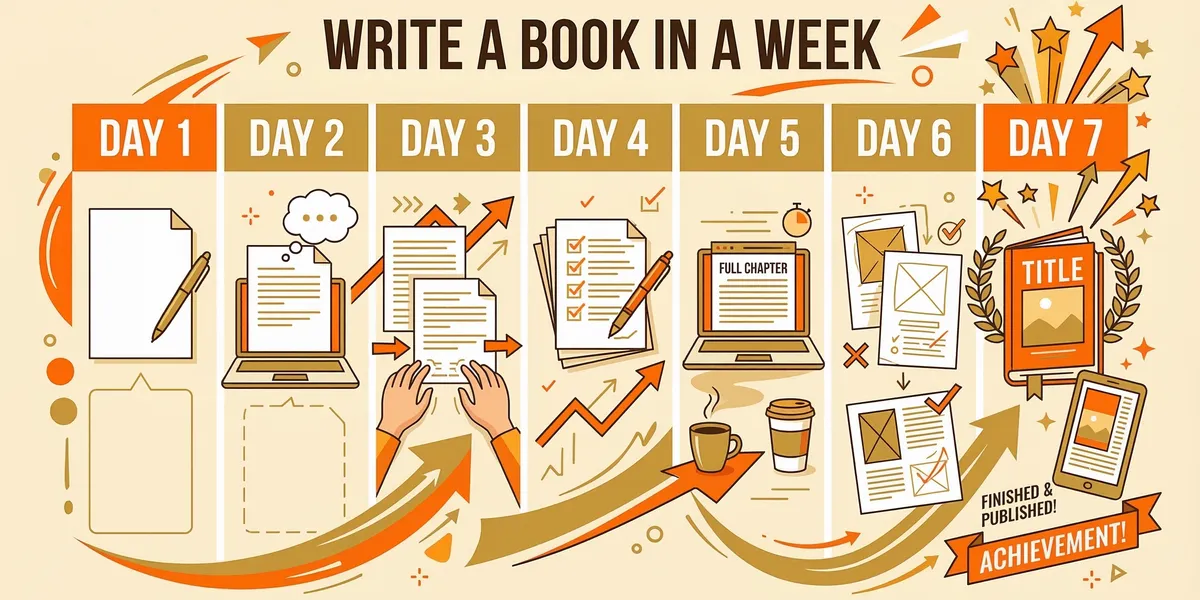
Yes, you can write a book in a week. Real authors have done it in three to seven days — and turned those books into clients, Amazon rankings, and five-figure launches. This guide shows you exactly how they did it, what tools they used, and gives you a day-by-day plan to do the same.
This is not a myth
Writing a book used to mean months of drafting, revising, and staring at a blinking cursor. That timeline still applies if you are hand-crafting a literary novel or researching a 400-page history of the Roman Empire.
But for nonfiction authority books, structured business guides, and genre fiction? The timeline has collapsed. AI writing tools have turned what used to take six months into a one-week project. Over 5,000 books have been created through Chapter alone, and many of those authors went from blank page to published in under seven days.
The key word is assisted. These are not randomly generated walls of text. They are real books written by real people who used AI to accelerate the parts that used to take the longest — generating first drafts, structuring chapters, and getting past the blank page.
The reality check
Before we get into the plan, let’s be honest about what “write a book in a week” actually means.
What works in a week:
- Nonfiction authority books (25,000-40,000 words)
- Business lead magnets (10,000-20,000 words)
- Structured genre fiction (romance, thriller, mystery)
- Self-help and how-to guides
What does not work in a week:
- Literary fiction that demands sentence-level craft
- Memoir requiring deep emotional excavation
- Research-heavy nonfiction needing months of sourcing
- Poetry collections
The authors who write books in a week are not cutting corners. They are choosing the right type of book for the timeline and using tools that handle the heavy lifting of first-draft generation. Then they spend their time where it matters most — editing, shaping, and making the book genuinely useful for readers.
Jim T. — from blank page to $13,200 client in 3 days
Jim T. is a business consultant based in Chicago. He had decades of expertise but no book to show for it. Using Chapter.pub, he went from zero to a finished book in three days.
The book was not the endgame. It was the door opener.
“A stranger read my book and reached out: ‘I need your help. What does it cost?’ I said $13,200. He started the same day.”
Three days of writing. One book. A $13,200 client who came to him — no pitching, no cold outreach, no convincing. The book did the selling.
This is what an authority book does. It positions you as the expert before a prospect ever gets on a call. Jim did not spend six months writing it. He spent three days, and the return was immediate.
Sarah M. — idea to Amazon #12 in 5 days
Sarah M. had a romance novel idea but no manuscript. Five days later, she had a published book ranking on Amazon.
“I went from idea to published book in 5 days. It hit #12 in Romance Contemporary!”
Number 12 in Romance Contemporary is not a vanity metric. That is a competitive category with thousands of titles. Sarah’s book did not get there by accident — she chose a proven genre, used AI to generate her draft quickly, then focused her editing time on voice, pacing, and the emotional beats that romance readers care about.
The speed did not hurt the quality. It freed her up to spend time on the parts that actually matter to readers instead of grinding through months of first-draft production.
The 7-day plan
Here is the exact day-by-day breakdown for writing and publishing a book in one week. This plan works for both nonfiction and structured fiction.
Day 1: Choose your topic, define your audience, and outline
Everything depends on this day. A clear topic and audience make the rest of the week flow. A vague idea makes every subsequent day harder.
For nonfiction: Pick a topic where you have genuine expertise or strong opinions. Define the specific reader — not “business owners” but “consultants who want to charge premium rates.” Write a 10-15 chapter outline where each chapter solves one problem.
For fiction: Choose your genre, write a one-paragraph premise, and outline your story arc. Know your protagonist, their goal, the main obstacle, and how the story ends. A chapter-by-chapter outline keeps you from getting stuck mid-week.
Day 2: Generate and write the first half
This is where AI tools change the game. Using Chapter.pub, you can generate a full manuscript draft from your outline. On Day 2, focus on the first half of your book.
If you are writing without AI assistance, aim for 5,000-8,000 words. Do not edit as you go. First drafts are supposed to be rough. Your job today is volume, not polish.
Day 3: Generate and write the second half
Same approach as Day 2, but for the back half of your book. By the end of today, you should have a complete first draft — beginning, middle, and end.
For nonfiction, make sure your final chapters deliver on the promise your introduction made. For fiction, confirm your story arc resolves and your ending feels earned.
Day 4: Read through, edit, and revise
Print it out or read it on a different device than the one you wrote on. Your brain catches different errors when the format changes.
Read the entire manuscript in one sitting if possible. Mark structural issues first — chapters that repeat each other, sections that drag, arguments that need stronger evidence, scenes that do not advance the plot. Do not fix typos yet. Structure first, sentences second.
Day 5: Final edit and format for publishing
Now fix the sentences. Tighten the prose, cut filler, fix grammar, and make sure each chapter opening hooks the reader forward. This is also the day to format your manuscript for publishing.
Amazon KDP accepts Word documents and EPUBs. Chapter.pub exports in publish-ready formats, which saves significant time on formatting headaches.
Day 6: Cover design and Amazon listing
Your cover sells the book before a single word gets read. For nonfiction, clean and professional wins — clear title, authoritative design, genre-appropriate colors. For fiction, study the top 20 covers in your genre and match the visual expectations readers have.
Set up your Amazon KDP account if you do not have one. Write your book description (this is sales copy, not a summary), choose your categories, and select seven keywords that match what readers search for.
Day 7: Publish
Upload your manuscript, preview it in Amazon’s viewer to catch any formatting issues, set your price, and hit publish. Amazon typically makes books available within 24-72 hours.
Congratulations — you are a published author. The entire process took seven days.
Tools that make it possible
Two tools handle 90% of what you need.
Our Pick — Chapter
AI book writing software that generates full manuscripts from your outline and expertise. Handles nonfiction authority books and fiction across genres. Over 2,147 authors and 5,000+ books created, with results featured in USA Today and the New York Times.
Best for: Writing the actual book — going from outline to complete manuscript in days instead of months Pricing: $97 one-time (nonfiction) — chapter.pub/software Why we built it: Most people who want to write a book never finish. Chapter removes the bottleneck of first-draft generation so you can focus on editing and publishing.
Amazon KDP handles the publishing side. It is free to use, gives you access to millions of readers, and pays 35-70% royalties depending on your pricing. Together, Chapter for writing and KDP for publishing cover the full pipeline from idea to bookstore.
What to write in a week
Not all books are equal candidates for a one-week timeline. Choose wisely.
| Good for a week | Why it works |
|---|---|
| Authority books | Structured around your existing expertise |
| Lead magnets | Shorter, focused on one topic |
| Niche nonfiction | Clear audience, clear problem, clear solution |
| Structured romance | Genre conventions provide built-in story structure |
| Business guides | Your knowledge already exists — just organize it |
| Not for a week | Why it doesn’t work |
|---|---|
| Literary fiction | Demands sentence-level craft that takes time |
| Memoir | Requires emotional processing, not just writing speed |
| Research-heavy nonfiction | Source-gathering alone takes weeks |
| Experimental fiction | No template to accelerate the process |
How long does it take to write a book in general? Anywhere from a week to several years, depending on the type of book and your approach. Choosing the right book for a one-week timeline is half the battle.
After the book — the real payoff
The book itself is often just the beginning. What happens after you publish is where the real value shows up.
Arek Z., an Amazon FBA coach based in Toronto, used his book as a lead magnet for his coaching business. The result: $60,000 in 48 hours from a launch built around the book.
Jim turned his into a $13,200 client. Sarah hit #12 on Amazon. Arek generated $60K in two days. Three different authors, three different strategies, one common thread — the book was the asset that made everything else work.
Here is what a published book unlocks:
- Client acquisition. A book positions you as the authority. Prospects come to you pre-sold, the way Jim’s client did.
- Lead generation. Offer your book as a free download in exchange for email addresses. Build an audience you own.
- Speaking opportunities. Event organizers book authors, not bloggers. A published book is your credential.
- Passive income. Amazon royalties add up, especially in niche categories where you can rank consistently.
- Course validation. Test your ideas as a book first. If people buy the book, they will buy the course.
The question is not whether you can write a book in a week. The question is what you will do with it once it exists.
Common mistakes to avoid
- Skipping the outline. The outline is day 1 for a reason. Without it, day 2 and 3 become a meandering mess.
- Editing while drafting. Separate creation from criticism. Draft first, edit later. Trying to do both at once is the fastest way to never finish.
- Choosing the wrong book type. A literary novel in a week will be bad. An authority book in a week can be excellent. Match the book to the timeline.
- Neglecting the cover. Readers judge books by covers. A cheap-looking cover kills sales regardless of how good the content is.
- Stopping at publish. Publishing is the starting line, not the finish. Have a plan for what the book does for you next.
FAQ
Can I really write a good book in just one week?
Yes, if you choose the right type of book. Nonfiction authority books and structured genre fiction work well in a one-week timeline, especially with AI-assisted drafting tools. Jim T. wrote his in three days and landed a $13,200 client from it. The quality was good enough to convince a stranger to hire him on the spot.
How many words can I write in a week?
With AI assistance from a tool like Chapter.pub, you can generate a 25,000-50,000 word manuscript in days 2-3, leaving the rest of the week for editing and publishing. Without AI, most writers produce 2,000-5,000 words per day, putting a full book in the 14,000-35,000 word range for a week.
Do I need to be an expert to write a nonfiction book?
You need genuine knowledge or experience in your topic. AI tools help you organize and articulate what you already know — they do not create expertise from nothing. If you can teach someone about your topic in a two-hour conversation, you have enough material for a book.
What does it cost to write and publish a book in a week?
Chapter.pub costs $97 one-time. Amazon KDP is free to publish on. A professional cover runs $50-500 depending on whether you use a template or custom design. Total realistic budget: $150-600.
Should I use AI to write my book?
AI-assisted writing is not the same as AI-generated writing. The best results come from authors who use AI to accelerate the draft, then apply their own expertise, voice, and editing judgment to shape the final product. Every author mentioned in this guide used AI tools and produced books that delivered real business results.