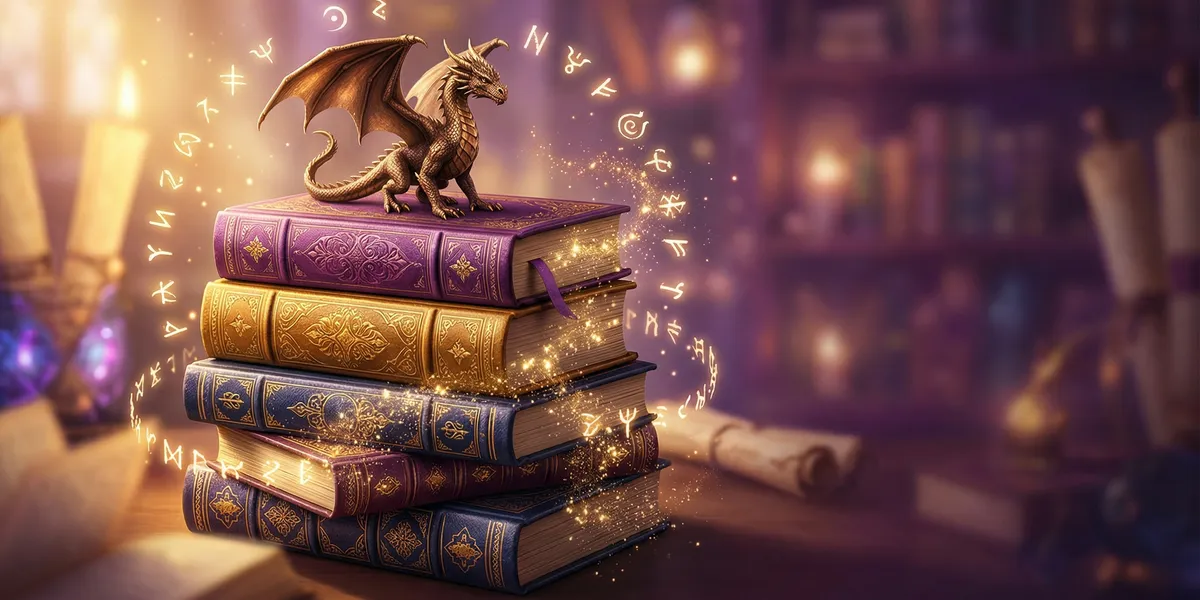
YA fantasy books remain the most popular category in young adult publishing, making up roughly 30% of all YA titles. Whether you are looking for your next read or researching the genre to write your own, this guide covers the best YA fantasy books across every major subgenre.
Below you will find 25 standout picks organized by category, plus guidance on what makes each subgenre work and how to start writing YA fantasy yourself.
Epic Fantasy
Epic fantasy delivers vast worlds, complex magic systems, and stakes that threaten entire civilizations. These books reward patient readers with layered plots and deep lore.
Throne of Glass by Sarah J. Maas follows Celaena Sardothien, an assassin forced to compete for her freedom in a deadly tournament. The series spans seven books and grows from a contained competition story into a continent-spanning war epic. Maas builds one of the most intricate magic systems in YA, and Celaena’s evolution from survivor to leader anchors every twist.
An Ember in the Ashes by Sabaa Tahir draws on ancient Rome and Middle Eastern folklore to create a brutal military empire where a scholar and a soldier find their fates intertwined. The dual-perspective structure keeps tension high, and Tahir does not shy away from real consequences for her characters.
Eragon by Christopher Paolini remains a gateway epic fantasy for younger readers. Written when Paolini was fifteen, the Inheritance Cycle follows a farm boy who discovers a dragon egg and gets pulled into a rebellion against a tyrant king. The worldbuilding is sprawling and the dragon-rider bond is genuinely compelling.
The Name of the Wind by Patrick Rothfuss sits at the boundary between YA and adult fantasy, but its coming-of-age structure and university setting make it a natural crossover. Kvothe’s narration of his own legend is clever, unreliable, and endlessly quotable.
Romantasy
Romantasy blends fantasy worldbuilding with a central love story. The subgenre surged in popularity through BookTok, and shows no signs of slowing down.
A Court of Thorns and Roses by Sarah J. Maas reimagines Beauty and the Beast with fae courts, political intrigue, and a protagonist who paints her way through trauma. The series matures significantly from book one, and the romance is woven tightly into the political stakes.
The Cruel Prince by Holly Black puts a mortal girl in a faerie court where she has no magic, no allies, and no reason to trust the prince who torments her. Black writes political maneuvering as well as anyone in the genre, and Jude Duarte is one of YA’s most compelling antiheroes.
Serpent & Dove by Shelby Mahurin pairs a witch in hiding with a witch hunter in a forced marriage. The premise sounds like a setup for a comedy, but Mahurin layers genuine danger underneath the banter. The French-inspired setting and church politics give the world texture beyond the romance.
These Hollow Vows by Ciara Smyth sends its protagonist into the fae realm to rescue her sister, where she gets caught between two princes with competing agendas. The betrayals land hard because Smyth earns them through careful character work.
Dystopian Fantasy
Dystopian YA fantasy puts young protagonists against oppressive systems. The best entries use their speculative settings to explore real questions about power, conformity, and resistance.
The Hunger Games by Suzanne Collins defined modern YA dystopia. Katniss Everdeen volunteers as tribute in a televised death match, and Collins uses the arena to dissect media manipulation, class warfare, and the cost of survival. The trilogy holds up on rereads because the political commentary sharpens with age.
Divergent by Veronica Roth splits its society into five factions based on personality traits, then follows Tris Prior as she discovers the system is built on a lie. The first book is a taut thriller, and the faction concept is one of the most memorable worldbuilding hooks in the genre.
Red Queen by Victoria Aveyard divides its world by blood color. Reds serve, Silvers rule with supernatural abilities, and Mare Barrow discovers she has powers that should be impossible. The political double-crosses escalate across the series, and Aveyard writes betrayal scenes that genuinely sting.
Legend by Marie Lu sets a military prodigy and the country’s most wanted criminal on a collision course in a futuristic Los Angeles. Lu’s tight, alternating chapters keep the pace relentless, and the romance develops organically from mutual respect rather than instant attraction.
Mythology and Folklore Retellings
These books pull from real-world myths and cultural traditions, reimagining them for contemporary YA audiences. The best retellings honor their source material while making it feel urgent and new.
Percy Jackson and the Olympians by Rick Riordan remains the gold standard. Percy discovers he is the son of Poseidon and gets thrown into a world where Greek myths are literally true. Riordan’s humor makes dense mythology accessible, and his representation of neurodivergent kids through demigod traits was ahead of its time.
Children of Blood and Bone by Tomi Adeyemi draws on West African Yoruba mythology to build Orisha, a kingdom where magic has been violently suppressed. Zelie’s quest to restore magic is personal, political, and deeply rooted in real cultural traditions. The action sequences are cinematic and the worldbuilding is rich.
Spin the Dawn by Elizabeth Lim reimagines Mulan through the lens of a tailor competing for the position of imperial tailor by sewing three magical gowns from the laughter of the sun, the tears of the moon, and the blood of stars. The craft-based magic system is original and the stakes are grounded in family loyalty.
The Star-Touched Queen by Roshani Chokshi weaves Hindu mythology into a story about a princess cursed with a horoscope that promises death and destruction. Chokshi’s prose is lush without becoming overwrought, and the mythological references reward readers who know the source material.
Dark and Gothic Fantasy
Dark YA fantasy leans into horror elements, morally gray characters, and settings that feel genuinely threatening. These books do not pull punches.
House of Salt and Sorrows by Erin A. Craig retells the Twelve Dancing Princesses as a gothic murder mystery set in a crumbling seaside estate. Sisters keep dying under mysterious circumstances, and the fairy tale framework makes every ballroom scene feel sinister. Craig controls atmosphere as well as any horror novelist.
Gideon the Ninth by Tamsyn Muir blends necromancy with a locked-room mystery and humor so sharp it cuts. Gideon Nav is a swordswoman forced to serve as cavalier to her childhood nemesis in a deadly trial among necromancers. The voice is unlike anything else in YA-adjacent fantasy.
Ninth House by Leigh Bardugo moves into dark academia territory, following Alex Stern as she monitors Yale’s secret societies and their very real magic. Bardugo trades the Grishaverse’s epic scope for close, gritty horror, and the result is her most unsettling work.
High Fantasy and Secondary Worlds
These books build entirely original worlds from scratch, creating their own histories, languages, and cosmologies.
Six of Crows by Leigh Bardugo assembles a crew of criminals for an impossible heist in a world inspired by Dutch mercantile culture. The ensemble cast is perfectly balanced, every character gets a complete arc, and the heist structure adds constant tension. This is widely considered Bardugo’s best work, and it holds up to that reputation.
Sabriel by Garth Nix sends its protagonist into a world where the boundary between life and death is a physical river that necromancers can walk. The Old Kingdom series has some of the most original magic in fantasy, using bells as tools of power, and Sabriel herself is competent from page one.
Graceling by Kristin Cashore features a heroine whose supernatural “Grace” is killing. Katsa has been weaponized by her uncle the king, and the story follows her reclaiming agency over her own abilities. Cashore writes fight scenes with precision and the central relationship develops through genuine partnership.
The Priory of the Orange Tree by Samantha Shannon delivers a standalone epic with dragon-riders, a secret sisterhood, and a world threatened by an ancient evil. At over 800 pages, it offers the scope of a full series in one volume, with diverse representation woven naturally into the worldbuilding.
New Releases Worth Reading
The YA fantasy landscape keeps evolving. Here are recent titles that earned their place on this list.
Greenteeth by Molly O’Neill has been called one of the biggest surprises in recent YA fantasy, combining folklore with a coming-of-age story that reminds readers why they fell in love with the genre.
The Floating World by Axie Oh brings a fresh perspective to YA fantasy with its imaginative premise and emotional depth, drawing on Korean-inspired worldbuilding.
How to Write Your Own YA Fantasy
Reading widely is the first step toward writing YA fantasy. If these books have sparked an idea, here is how to start developing it.
Build your world with rules. The best YA fantasy worlds have clear limitations on magic and power. Unlimited magic removes tension. Decide what your magic costs, who can access it, and what happens when it goes wrong. Our guide to worldbuilding tips covers this in detail.
Start with character, not lore. Readers connect with YA fantasy through the protagonist’s emotional journey. Your worldbuilding serves the character arc, not the other way around. Figure out what your character wants, what they fear, and what they are willing to sacrifice before you draw your map.
Use fantasy writing prompts to break through blocks. When you are stuck, a single premise can unlock an entire story. Prompts work best when they contain a built-in conflict and a world detail that implies history.
Write the first draft fast. YA fantasy readers expect momentum. If your draft bogs down in exposition, you are building the world for yourself instead of for the reader. Get the story moving, then add texture in revision.
Our Pick — Chapter
If you are ready to draft your YA fantasy novel, Chapter helps fiction writers move from idea to finished manuscript with AI-powered writing tools built specifically for book-length projects.
Best for: Writers who want to go from concept to complete YA fantasy draft without fighting their tools.
Why we built it: Writing a novel is hard enough without software getting in the way. Chapter keeps the focus on your story.
Common Mistakes to Avoid
- Overloading the first chapter with worldbuilding. Drop readers into action and reveal the world through the story. Info dumps in chapter one are the fastest way to lose a YA reader.
- Making the protagonist a passive observer. YA readers want characters who act, make mistakes, and drive the plot forward. A character who watches things happen to them is not a protagonist.
- Copying the magic system of books you love. Your favorite system already exists. Build something that serves your specific story instead.
- Ignoring the “young adult” part. YA protagonists are typically 14 to 18, and the emotional stakes should reflect that developmental stage. Adult concerns grafted onto a teenage character feel inauthentic.
- Neglecting the ending. YA fantasy series are notorious for weak conclusions. Plan your ending before you write your beginning.
FAQ
What age group are YA fantasy books for?
YA fantasy targets readers aged 12 to 18, though 55% of YA book buyers are actually adults. The protagonists are typically teenagers, and the themes center on identity, first experiences, and finding your place in the world.
What is the difference between YA fantasy and adult fantasy?
YA fantasy features teenage protagonists, faster pacing, and themes of self-discovery. Adult fantasy tends toward more complex political structures, slower burns, and protagonists dealing with established-life concerns. The line blurs frequently, especially with crossover titles like Six of Crows and The Name of the Wind.
What is romantasy?
Romantasy combines fantasy worldbuilding with a central romance plot. The term gained traction through BookTok and social media and describes books like A Court of Thorns and Roses where the love story is as important as the quest or conflict.
Where should I start if I have never read YA fantasy?
Start with Percy Jackson and the Olympians for accessible, humor-driven fantasy, The Hunger Games for fast-paced dystopia, or Six of Crows for a heist-driven ensemble story. All three are completed series, so you will not be left waiting for the next book.
Can I use AI to help write a YA fantasy novel?
Yes. AI writing tools like Chapter can help you develop outlines, draft scenes, and maintain consistency across a long manuscript. The key is using AI as a writing partner rather than a replacement for your creative voice. Our AI story generator guide covers how to use these tools effectively.