You can use AI to write your book ethically — but only if you understand where the lines are and how to stay on the right side of them.
In this guide, you’ll learn:
- The practical ethical framework that separates responsible AI use from risky shortcuts
- Exactly what to disclose, where, and how — across every major platform
- How copyright law applies to AI-assisted books in 2026
- Which AI writing practices are universally accepted and which will get you in trouble
Here’s everything you need to write with AI and sleep well at night.
What Does “Ethical AI Writing” Actually Mean?
Ethical AI writing means using artificial intelligence tools in your book-writing process while maintaining honesty about your methods, taking full responsibility for your content, and respecting the rights of other creators.
It does not mean avoiding AI entirely. And it does not mean anything goes as long as you publish.
The ethics of AI writing sit on a spectrum. On one end, you have universally accepted uses like grammar checking and research assistance. On the other, you have practices that most of the publishing world considers unethical — like submitting fully AI-generated manuscripts under your name without disclosure or revision.
Most authors fall somewhere in the middle, and that is exactly where the confusion lives.
The Authors Guild updated their AI best practices in May 2026 specifically because the question is no longer “should you use AI?” but “how should you use it responsibly?”
The Ethical AI Writing Framework: 4 Principles
You do not need to memorize every platform policy. You need a framework that works everywhere. These four principles cover it.
1. Transparency
Tell people you used AI. Not in a confessional, hand-wringing way — just honestly. If AI played a meaningful role in generating your content, disclose it.
Where transparency matters:
- Your book’s copyright page or author’s note — a brief statement about your process
- Publishing platform uploads — Amazon KDP, IngramSpark, and others now ask about AI use
- Query letters and publisher submissions — agents and editors want to know
- Marketing materials — if you reference your writing process
Transparency does not mean listing every prompt you typed. It means being honest about the nature of your work if someone asks.
2. Accountability
You are responsible for every word in your book, whether AI generated the first draft or not.
This means:
- Fact-checking everything. AI hallucinates. If your nonfiction book cites a study that doesn’t exist, that is your fault — not the AI’s.
- Reviewing for bias. AI models trained on internet data can reproduce stereotypes. Read critically.
- Ensuring originality. Run your manuscript through a plagiarism checker to catch any passages the AI may have lifted from training data.
The Committee on Publication Ethics (COPE) is clear: AI cannot be listed as an author because it cannot take responsibility. You can. That responsibility is non-negotiable.
3. Meaningful Human Contribution
Your book should reflect your ideas, expertise, and creative vision — not just your ability to write prompts.
The line between AI-assisted and AI-generated writing matters enormously here. AI-assisted means you are directing the creative process and substantially shaping the output. AI-generated means you hit “generate” and published whatever came out.
Ask yourself: if someone removed the AI from your process, would the core ideas still be yours? If yes, you are on solid ethical ground.
Our Pick — Chapter
Chapter was built around this principle. You bring the outline, the ideas, and the expertise — Chapter’s AI helps you draft and refine, but the creative direction stays with you through every step.
Best for: Authors who want AI assistance without losing creative ownership Pricing: $97 one-time (nonfiction) Why we built it: Because ethical AI writing starts with tools designed to keep the human author in charge.
4. Respect for Other Creators
The AI models you use were trained on other people’s writing. That raises legitimate ethical concerns — and acknowledging them matters.
What this looks like in practice:
- Don’t use AI to mimic a specific living author’s voice or style. Writing “in the style of [Author Name]” crosses ethical lines, even if the AI complies.
- Don’t use AI to generate content that competes directly with an identifiable source. If the AI is basically rewriting someone’s book, that is an ethical problem even if it passes a plagiarism check.
- Support fair compensation. The Alliance of Independent Authors argues that AI developers must provide transparency about training data and compensate creators whose work was used.
You can use AI tools while still caring about the ecosystem that makes writing possible.
What AI Writing Practices Are Ethical?
Not all AI use raises the same ethical concerns. Here is where the major organizations and publishers draw the lines.
Universally Accepted
These practices are considered ethical by virtually every publisher, platform, and industry group:
- Grammar and spelling tools — Grammarly, ProWritingAid, and built-in checkers
- Research assistance — using AI to find sources, summarize papers, explore topics
- Brainstorming and ideation — generating ideas, plot possibilities, character concepts
- Outlining — using AI to help structure your content
- Translation assistance — drafting translations for review by a human translator
Widely Accepted (With Disclosure)
These are standard practice for many authors but require transparency:
- AI-assisted first drafts — you provide detailed direction, AI helps draft the prose, you revise substantially
- AI developmental editing — using AI to identify structural issues in your manuscript
- AI-powered rewriting — feeding your own draft into AI for style improvements you then review
- Character and dialogue development — generating dialogue options you select from and refine
Ethically Questionable
These practices raise red flags and may violate platform terms:
- Publishing raw AI output — submitting AI-generated text without meaningful revision
- AI voice mimicry — prompting AI to write “like” a specific author
- Undisclosed AI authorship — presenting fully AI-generated content as entirely human-written
- Mass AI content farms — generating hundreds of low-quality books to flood a market
Clear Violations
These will get your book removed and potentially your account banned:
- Submitting AI-generated work under contract as if you wrote it yourself
- Using AI to plagiarize or paraphrase copyrighted works
- Misrepresenting AI work to agents or publishers who specifically prohibit it
How to Disclose AI Use in Your Book
Disclosure doesn’t need to be dramatic. A brief, honest statement is all most platforms and readers expect.
Where to Put Your Disclosure
In the book itself — Add a note on your copyright page or in your author’s note:
This book was written with the assistance of AI tools for drafting and research. All ideas, arguments, and conclusions are my own, and the final text was substantially revised and edited by the author.
On publishing platforms — Amazon KDP now includes AI content disclosure fields. Check the appropriate box and be specific.
In query letters — If you are submitting to traditional publishers, mention AI use briefly. Most publishers that accept AI-written books want to know the extent of AI involvement.
What to Say
Keep it simple. You don’t owe anyone your entire prompt history. A disclosure answers three questions:
- Did you use AI? Yes.
- How did you use it? For drafting, research, editing — be specific.
- What is yours? The ideas, structure, expertise, and final prose.
AI Writing Copyright in 2026
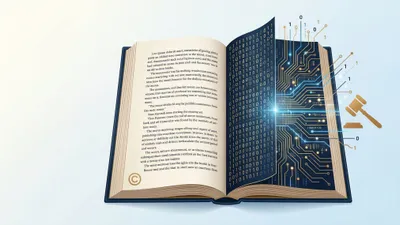
AI-generated content that lacks human authorship cannot be copyrighted under current U.S. law. But AI-assisted content — where a human author made substantial creative decisions — generally qualifies for protection.
The key legal distinction is between AI-generated and AI-assisted work. If you provided the creative direction, substantially edited the output, and made meaningful choices about what to keep and what to change, you likely have a valid copyright claim.
Here is how the spectrum works:
| Level of Human Involvement | Copyright Status | Example |
|---|---|---|
| No human involvement | Not copyrightable | Raw ChatGPT output published as-is |
| Minimal human involvement | Uncertain / risky | Light editing of AI-generated text |
| Substantial human involvement | Likely copyrightable | Human-directed outline, AI draft, heavy revision |
| AI as a tool only | Copyrightable | Grammar checking, research, brainstorming |
The U.S. Copyright Office has been issuing guidance on a case-by-case basis. The safest position: the more human creative input you add, the stronger your copyright claim.
For a deeper dive, see our full guide on whether it’s legal to use ChatGPT to write a book.
Platform Policies You Need to Know
Every major publishing platform has an AI content policy. Here are the ones that matter most for book authors.
Amazon KDP
Amazon requires you to disclose AI-generated content during the upload process. They distinguish between AI-assisted (human-directed) and AI-generated (primarily machine-created) content. Both are allowed, but disclosure is mandatory.
Violating Amazon’s disclosure policy can result in book removal, account warnings, or permanent bans. See our full breakdown of Amazon’s AI content policy.
IngramSpark
IngramSpark follows industry-standard guidelines. Disclose AI use and ensure your content meets their quality standards.
Traditional Publishers
Policies vary widely. Some publishers set a threshold — the University of Texas Press, for example, will not accept work that is more than 5% AI-generated by word count. Others evaluate on a case-by-case basis.
If you are pursuing traditional publishing, read submission guidelines carefully and disclose upfront. Hiding AI use and being discovered later will end that relationship.
Academic and Professional Publishing
Academic journals have the strictest policies. COPE requires full disclosure of AI tool use in methodology sections. Many journals prohibit AI-generated text entirely.
If you are writing in a professional or academic context, check your target publication’s specific policy before submitting.
How to Build an Ethical AI Writing Workflow
Here is a practical workflow that keeps you on the right side of every policy and principle.
Step 1: Start With Your Ideas
Before you open any AI tool, clarify what you want to say. Write your thesis, outline your chapters, identify your unique angle. The ideas must be yours.
Use our guide on AI book writing for beginners if you need help structuring this process.
Step 2: Use AI for Drafting, Not Thinking
Feed your outline and ideas into an AI tool and let it help you draft. But review every paragraph critically. Does it say what you mean? Is it accurate? Does it reflect your voice?
Tools like Chapter are designed for this exact workflow — you guide the AI with your outline and expertise, and it helps you produce a draft that you then refine into your own words.
Step 3: Revise Substantially
This is where ethics becomes practical. Read your AI-assisted draft and rewrite it until it sounds like you. Change the structure where it doesn’t flow. Add your own examples, stories, and insights. Remove anything that feels generic.
Learn techniques for how to humanize AI writing and maintain the human touch in AI writing that readers connect with.
Step 4: Fact-Check Everything
AI hallucinates confidently. Every statistic, citation, historical claim, and technical detail needs verification. Check our guide on AI hallucination in book writing for specific strategies.
Step 5: Disclose Honestly
Add your disclosure statement. Upload with the correct AI content flags. Move on without anxiety.
Common Mistakes Authors Make With AI Ethics
These are the ethical pitfalls that trip up well-intentioned authors:
- Assuming “everyone does it” excuses disclosure. Prevalence doesn’t eliminate the obligation to be transparent.
- Confusing efficiency with ethics. Writing faster with AI is fine. Skipping quality control because AI is “good enough” is not.
- Over-disclosing out of guilt. You don’t need to apologize for using AI or write a 500-word confession. A brief, factual disclosure is sufficient.
- Ignoring platform-specific rules. Each platform has different requirements. “I didn’t know” is not a defense.
- Using AI to avoid learning craft. AI can help you write better, but it is not a substitute for understanding story structure, character development, or your genre’s conventions.
Is AI Writing Ethical for Nonfiction vs. Fiction?
The ethical considerations shift depending on what you are writing.
Nonfiction
Nonfiction authors often have the strongest ethical case for AI use. You have real expertise. You have original ideas. You may just need help translating that knowledge into readable prose — which is exactly what ghostwriters have done for decades.
The ethical bar: your expertise and ideas are genuine, your facts are verified, and your readers know AI was involved. See our detailed take on whether it’s ethical to use AI for nonfiction.
Fiction
Fiction raises different questions. Readers buy novels for a specific author’s voice, imagination, and storytelling ability. Is AI writing cheating in fiction? Not necessarily — but the ethical expectation is higher.
If AI generates your plot, writes your dialogue, and creates your characters, what exactly is the human contribution? Fiction authors using AI ethically tend to use it for specific tasks — brainstorming plot possibilities, generating dialogue options, overcoming writer’s block — while maintaining control of the creative vision.
What the Authors Guild Says About AI Ethics
The Authors Guild’s updated best practices break AI use into risk categories rather than blanket prohibitions. Their position recognizes that different levels of AI involvement carry different ethical weight.
Their guiding principles:
- AI is a tool, not an author. The human writer bears full responsibility.
- Transparency is non-negotiable. Disclose AI use to publishers, platforms, and readers.
- Not all AI use is equal. Research and brainstorming carry less ethical risk than full manuscript generation.
- Protect the profession. Using AI responsibly means supporting fair compensation for creators whose work trains these models.
The Guild also warns about specific risks: AI-generated text can inadvertently reproduce copyrighted material, produce factual errors, and create legal liability for the author.
Will AI Ethics Standards Change?
Yes. They already are changing — and rapidly.
In 2024, most publishers had no AI policy at all. By 2026, every major platform and most traditional publishers have formal guidelines. The AI writing landscape continues to evolve alongside regulation.
What is likely to stay constant:
- Transparency requirements — these are only getting stricter
- Human accountability — no framework removes the author’s responsibility
- Platform-specific disclosure — expect more detailed requirements, not fewer
What may change:
- Copyright law — legislation is pending in multiple countries that could clarify AI content ownership
- Industry standards — as AI use becomes normalized, the line between “assisted” and “generated” may shift
- Reader expectations — audience comfort with AI-written content is growing but uneven
The safest strategy is to adopt higher ethical standards now. If the rules tighten, you are already compliant. If they loosen, you lose nothing by having been transparent.
FAQ
What is considered ethical AI writing?
Ethical AI writing is using artificial intelligence as a tool to assist your writing process while maintaining transparency, accountability, and meaningful human creative contribution. It means disclosing AI use, verifying all content for accuracy, and ensuring the final work reflects your ideas and expertise — not just AI output.
Do I have to disclose AI use in my book?
Yes, you should disclose AI use. Amazon KDP requires AI content disclosure during upload, and most traditional publishers expect transparency about your writing process. Include a brief statement on your copyright page or in your author’s note describing how AI was used and confirming the ideas are your own.
Can I copyright a book written with AI?
You can copyright AI-assisted books where you made substantial creative decisions — including directing the outline, providing expertise, and significantly revising the output. Fully AI-generated content with no meaningful human input is generally not copyrightable under current U.S. law.
Is using AI for writing the same as plagiarism?
Using AI for writing is not the same as plagiarism if you disclose your AI use and the content is original. However, AI can sometimes reproduce phrases from its training data. Run your manuscript through a plagiarism checker and revise any flagged passages to ensure originality.
What AI writing tools are most ethical to use?
The most ethical AI writing tools are those designed to keep the human author in control of the creative process. Tools like Chapter that follow an outline-first, human-directed workflow are inherently more ethical than tools that generate content from a single prompt with no author input.