You can use AI to build fictional characters that feel real — with layered backstories, genuine motivations, and voices that sound distinct on every page.
In this guide, you’ll find:
- 40+ copy-paste AI prompts organized by character development task
- Prompts for backstory, motivation, dialogue, arcs, flaws, and relationships
- A workshop method that uses AI as your character critique partner
- Tips for getting specific, useful output instead of generic descriptions
Here are the prompts, organized by what you need to build.
How AI Prompts for Character Development Actually Work
AI prompts for character development are specific instructions you give to an AI tool — like ChatGPT, Claude, or Chapter — to help you build fictional characters with depth, contradiction, and believability.
The key word is specific. A prompt like “create a character for my novel” gives you a flat, generic result. A prompt like “create a morally ambiguous female detective in 1940s Los Angeles who uses humor to deflect from a traumatic past” gives you something you can actually work with.
Good character development prompts target one element at a time: backstory, motivation, voice, flaws, relationships. You build a character in layers, not all at once.
Over 2,147 authors have used Chapter to write books with AI — and the ones who produce the most compelling fiction treat AI as a brainstorming partner, not a replacement for their creative instincts.
Backstory and Origin Prompts
Your character’s past shapes everything they do in the present. These prompts help you build backstories that create genuine motivation rather than decorative filler.
1. Core backstory generator
My character is a [age] [gender] [occupation] living in [setting]. Generate a detailed backstory that includes: a formative childhood experience, a relationship that shaped their worldview, a secret they keep from everyone, and the single event that made them who they are today.
2. Wound and scar prompt
What is the worst thing that ever happened to my character [name/description]? Describe the event in detail, then explain how it changed their behavior, what coping mechanisms they developed, and what triggers bring the memory flooding back.
3. Origin of a belief
My character believes [specific belief, e.g., “that vulnerability is weakness”]. Write the backstory scene — a specific moment in their past — that caused them to adopt this belief. Include sensory details and dialogue.
4. Family dynamics builder
Create a family profile for my character [name]. Include: parents’ occupations and personalities, sibling relationships and rivalries, the unspoken family rule everyone follows, and the family member my character is most like (and most afraid of becoming).
5. Memory inventory
List 10 specific memories my character [name/description] carries with them. Include: 3 happy memories, 3 painful ones, 2 embarrassing ones, 1 they’ve repressed, and 1 they’ve invented or distorted over time.
6. Before-the-story timeline
Create a timeline of the 10 most important events in my character’s life before the story begins. For each event, note: what happened, how old they were, who else was involved, and how it changed them. My character is [description].
Motivation and Goals Prompts
Character motivation is what separates a person on the page from a puppet on a string. These prompts dig into what your character wants — and the deeper need beneath the surface want.
7. Want vs. need separator
My character is a [description] who wants [external goal]. Identify the deeper emotional need driving this want. Then show how pursuing the external goal actually takes them further from what they truly need — until they’re forced to choose between the two.
8. Motivation stress test
My character wants [goal]. List 5 situations where this motivation would be tested. For each, describe what they’d do, what it would cost them, and the point at which they might abandon this goal entirely.
9. Competing desires
Give my character [name/description] three competing desires that can’t all be satisfied at the same time. Explain the tension between each pair and the specific scenario where they’d be forced to choose.
10. The lie they believe
My character’s fatal flaw is [flaw]. What lie do they tell themselves to justify it? Write their internal monologue — the story they repeat in their head about why this flaw is actually a strength.
11. Stakes escalator
My character wants [goal] in a [genre] story. Start with what they’d sacrifice to get it, then escalate five times. What’s the final, most extreme thing they’d give up — and would they actually do it?
Character Voice and Dialogue Prompts
No two people talk the same way. These prompts help you build a distinct voice for each character instead of every character sounding like the same AI output.
12. Speech pattern blueprint
Create a speech pattern profile for my character [description]. Include: average sentence length, vocabulary level, pet phrases they repeat, topics they avoid in conversation, how they sound when angry vs. nervous vs. lying, and a verbal tic that’s uniquely theirs.
13. Dialogue under pressure
Write 5 versions of my character [name/description] responding to this situation: [stressful scenario]. Show how their response changes based on who they’re talking to — a stranger, their boss, their best friend, their parent, and someone they’re attracted to.
14. Subtext exercise
Write a conversation between my character [name] and [other character] about [surface topic]. The real conversation underneath is about [subtext topic]. Neither character says what they actually mean. Include dialogue tags that reveal the tension.
15. Voice contrast test
I have two characters: [Character A description] and [Character B description]. Write the same scene twice — once from A’s perspective in their voice, once from B’s. The facts are identical. The telling should be completely different.
16. How they argue
My character [description] is in an argument about [topic] with [other character]. Write the argument showing my character’s specific arguing style. Do they get louder or quieter? Do they use logic or emotion? Do they fight to win, to be understood, or to hurt?
17. Internal monologue sample
Write a 200-word internal monologue for my character [description] as they [mundane activity, e.g., wait in a grocery store line]. Reveal their personality, anxieties, and worldview through how they think about ordinary things.
Character Flaw and Weakness Prompts
Perfect characters are forgettable. Character flaws make people real — and they drive plot by creating problems the character can’t solve without changing.
18. Flaw origin story
My character’s biggest flaw is [flaw]. Trace it back to a specific moment in their past. Show how this flaw was once a survival mechanism — something that protected them — and why it now sabotages them.
19. Flaw in action
Show 3 scenes where my character’s flaw ([specific flaw]) causes a specific, concrete problem in their life. One in their personal relationships, one in their work/quest, and one that’s purely internal — something only they know about.
20. Blind spot identifier
My character [description] thinks their biggest weakness is [what they think]. What is their ACTUAL biggest weakness — the one they can’t see? Write a scene where someone else notices it, but my character remains oblivious.
21. The flaw they love
Give my character a flaw they’re secretly proud of. Something they know is a problem but that they also see as part of their identity. Why are they reluctant to change it, even when it hurts them?
Character Arc Prompts
A character arc is the transformation your character undergoes from the first page to the last. These prompts help you plan that journey so the change feels earned, not sudden.
22. Arc architect
My character starts as [starting state] and needs to end as [ending state]. Design a 5-stage character arc: the trigger that starts the change, the first reluctant step, the false victory, the crisis that strips away the old self, and the final transformation.
23. Mirror scene writer
Write two versions of the same scene — one from the beginning of the story and one from near the end. In both, my character [description] faces [same challenge]. Show how their response has changed because of what they’ve experienced between the two moments.
24. Resistance to change
My character needs to learn [lesson/truth]. Write 3 scenes where they resist this lesson. Show the increasingly desperate ways they cling to their old way of being — and the mounting cost of refusing to change.
25. Negative arc designer
My character starts as [positive trait] but becomes [negative trait] by the end. Design this downward arc. What corrupts them? What moments could have saved them but didn’t? What’s the final scene that shows who they’ve become?
26. The moment of choice
My character [description] is at the climax of their arc. They must choose between [option A — tied to their old self] and [option B — tied to their growth]. Write the internal deliberation. Make both choices genuinely tempting.
Relationship and Dynamics Prompts
Characters don’t exist in isolation. Their relationships reveal who they are more than any backstory paragraph ever could.
27. Relationship map builder
My main character is [description]. Create 5 key relationships for them: a mentor, an antagonist, a love interest, a best friend, and someone who represents what they fear becoming. For each, define the dynamic, the source of tension, and what my character learns from them.
28. First meeting scene
My characters [Character A] and [Character B] meet for the first time in [setting]. Write the scene showing their immediate dynamic — who has power, who’s nervous, what assumptions each makes about the other, and the single detail each notices first.
29. Relationship under pressure
[Character A] and [Character B] have been [relationship type] for [time period]. Now [crisis] has happened. Write the conversation where their relationship is tested. Show what’s strong enough to survive and what cracks.
30. The thing they’d never say
What is the one thing [Character A] would never say to [Character B], even though it’s true? Why won’t they say it? Write the scene where they almost say it — and what they say instead.
31. Power shift
Design a relationship between two characters where the power dynamic shifts over the course of the story. Start with who has power and why, then map 3 turning points where the balance changes. End with the new equilibrium.
Physical Description and Presence Prompts
Description isn’t about catalog-listing eye color and hair. It’s about how a character occupies space — what you notice first and what that tells you about them.
32. First impression builder
My character [name] walks into a room. Describe them in 100 words — but don’t list physical features. Instead, describe the impression they create: how they move, what people notice first, the energy they bring, and the one detail that sticks in someone’s memory.
33. Description through another’s eyes
Describe my character [name/description] from the perspective of [another character who loves them / fears them / has just met them]. The same person should look completely different depending on who’s looking.
34. Body language vocabulary
Create a body language dictionary for my character [description]. How do they sit, stand, walk, and gesture when they’re comfortable? How does all of that change when they’re anxious, angry, lying, or attracted to someone?
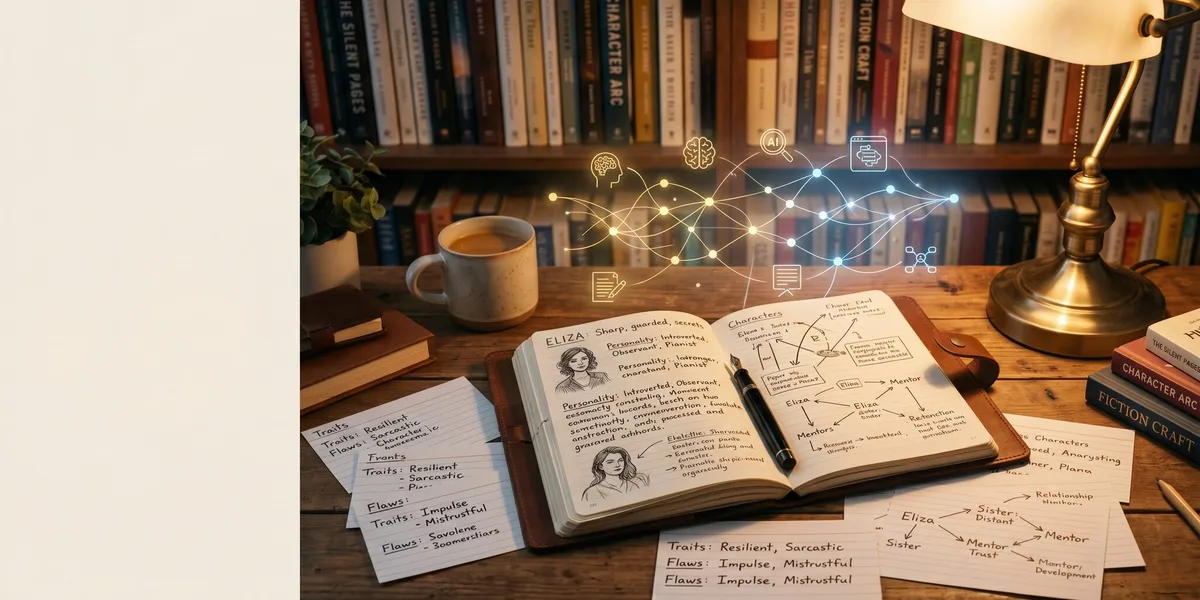
The AI Character Workshop Method
Most writers use AI to generate characters. The smarter approach is using AI to pressure-test characters you’ve already built. Here’s how to turn AI into your character critique partner.
This method treats AI like a writing group partner — someone who asks hard questions about your character until the weak spots surface.
35. The interview prompt
I’m going to describe a character I’ve created. After I do, interview me about them. Ask me 10 probing questions about things I might not have thought through — contradictions in their behavior, gaps in their backstory, motivations that don’t quite track. Push me to go deeper.
36. The reader reaction test
Here’s my character: [full character description]. As a critical reader, what would make you not believe this character? What feels underdeveloped, cliched, or convenient? Be specific and honest.
37. The contradiction finder
My character is [description with traits]. Find the contradictions in this character that I can lean into for depth. Which traits create natural internal conflict? Where does their backstory clash with their stated beliefs?
38. The “what would they do” test
Here’s my character: [description]. Put them in these 5 unrelated situations and tell me what they’d do. If the answers feel inconsistent or generic, tell me what’s missing from the characterization: [list 5 scenarios].
39. Comparison to known characters
My character is [description]. What published or filmed characters are they most similar to? What makes mine different? If the differences are superficial, suggest deeper ways to distinguish them.
40. The empathy check
Here’s my villain/antagonist: [description]. Can you find something genuinely sympathetic about them? If not, suggest changes to their backstory or motivation that would make a reader understand — not agree with, but understand — why they do what they do.
How to Get Better Results From Character Prompts
The prompts above work with any AI tool — ChatGPT, Claude, Chapter, Sudowrite — but your output quality depends on how you use them.
Be specific about genre and tone. A character in a literary novel needs different treatment than one in a space opera. Always include your genre and the tone you’re going for.
Feed the AI your existing work. Paste in scenes you’ve already written and ask the AI to analyze your character’s voice, identify inconsistencies, or suggest deeper layers based on what’s on the page.
Iterate, don’t accept. Your first AI output is a rough draft. Push back. Ask “make this more specific” or “this feels generic — give me something unexpected.” The best results come from the third or fourth attempt.
Use one prompt at a time. Don’t paste all 40 prompts at once. Work through them individually, building your character in layers. Each answer should inform the next prompt you choose.
Keep a character document. Paste the best AI outputs into a single character bible. Over time, you’ll have a reference that keeps your character consistent across a full novel.
Our Pick — Chapter
Chapter lets you develop characters inside the same tool where you write your book. Feed your character profiles directly into your writing sessions — so the AI already knows who your characters are when you start drafting scenes.
Best for: Fiction writers who want character development and book writing in one place Why we built it: Character consistency across a full-length novel is the hardest part of AI-assisted fiction — Chapter keeps your characters, outline, and draft connected.
Common Mistakes When Using AI for Character Development
Accepting the first output. AI defaults to archetypes. The detective with a dark past, the plucky underdog, the wise mentor. These are starting points, not finished characters. Always push for specificity.
Skipping the flaws. AI tends to create likeable characters unless you explicitly ask for flaws, contradictions, and ugly truths. Use the flaw prompts above — they’re where real characters live.
Describing instead of revealing. A list of traits isn’t a character. Ask for scenes, dialogue, and specific moments that show who the character is rather than telling you.
Using AI for every character. Your protagonist and key supporting cast need your creative instincts. Use AI for secondary characters, for pressure-testing your main characters, and for generating options — not for outsourcing your most important creative decisions.
Ignoring voice. Many writers use AI for backstory and motivation but forget to develop how the character talks. Use the dialogue prompts in this guide to give each character a distinct speaking style.
Can AI Really Help With Character Development?
AI can genuinely help with character development by generating options, finding blind spots, and pressure-testing characters you’ve already started building. It works best as a brainstorming partner that offers possibilities you wouldn’t have considered on your own.
What AI can’t do is make the creative decisions. It can generate 10 possible backstories for your character — but you have to feel which one resonates with your story. The prompts in this guide are designed to give you material to choose from, not finished characters to paste into your manuscript.
Authors who use AI tools like Chapter for character development report spending less time staring at blank pages and more time making creative choices. Over 5,000 books have been created on the platform — many starting with exactly this kind of character brainstorming.
What Is the Best AI Tool for Character Development?
The best AI tool for character development is one that remembers your character details across sessions and connects to your actual manuscript. General chatbots like ChatGPT work for individual prompts, but you lose context between conversations.
Chapter is purpose-built for book writing and keeps your character profiles, plot structure, and manuscript in one workspace. AI character generators are useful for quick profiles, while tools like Sudowrite focus more on prose generation than character building.
The right tool depends on where you are in the process. For initial brainstorming, any AI chatbot works. For developing characters across a full novel, you want a dedicated writing tool that maintains continuity.
FAQ
How do you write AI prompts for character development?
You write AI prompts for character development by targeting one character element at a time — backstory, motivation, voice, or flaws — rather than asking for a complete character at once. Include your character’s genre, setting, and existing traits in every prompt so the AI builds on what you’ve already created rather than starting from scratch.
Can ChatGPT create realistic characters?
ChatGPT can create realistic characters when you provide specific, layered prompts that go beyond surface-level descriptions. The key is iterating — pushing past the first generic output by asking follow-up questions about contradictions, flaws, and specific behaviors. Raw ChatGPT output tends toward archetypes, but guided prompting produces genuinely complex characters.
How many prompts do you need to develop a character?
You typically need 5-10 focused prompts to develop a well-rounded character for a novel. Start with backstory and motivation (2-3 prompts), then move to voice and dialogue (2-3 prompts), and finish with flaws and relationships (2-3 prompts). The workshop method adds another 2-3 prompts for pressure-testing the finished character.
What is the best AI for fiction writing?
The best AI for fiction writing depends on your needs. Chapter is built specifically for book-length fiction with character and plot continuity. ChatGPT and Claude are strong for individual brainstorming sessions. Sudowrite specializes in prose style. For character development specifically, any tool works if you use targeted prompts rather than open-ended requests.
Should you use AI for all your characters?
You should use AI selectively — focus your creative energy on protagonists and key characters while using AI to develop secondary characters, test existing characters for weaknesses, and generate options you hadn’t considered. The strongest fiction comes from combining your instincts with AI’s ability to rapidly generate alternatives and find character flaws you might have missed.