You do not need to write a new book every month to keep your newsletter interesting — you just need the right mix of content ideas that make subscribers glad they opened your email.
In this guide, you’ll learn:
- 30+ proven newsletter content ideas organized by category
- Which content types work best for fiction vs. nonfiction authors
- How to build a repeatable content calendar so you never stare at a blank email draft again
- The one mistake that causes more unsubscribes than anything else
Here is every newsletter idea you need, organized so you can start using them this week.
Why Your Newsletter Content Matters More Than Your List Size
Author newsletter content is the single biggest factor in whether subscribers stay or leave. Authors see average open rates of 43.14% — far above most industries — but they also have the highest unsubscribe rate at 0.21%. That gap tells you something important: readers sign up with high expectations, and they leave when the content disappoints.
The authors who keep subscribers engaged for years share one trait. They treat every email like a gift to the reader, not a sales pitch.
Your email list is the most valuable marketing asset you own. Social media algorithms decide who sees your posts. Every newsletter lands directly in your subscriber’s inbox. But only if the content earns the open.
Behind-the-Scenes Content Ideas
Readers subscribe to author newsletters because they want a relationship with the person who wrote the book. Behind-the-scenes content delivers exactly that.
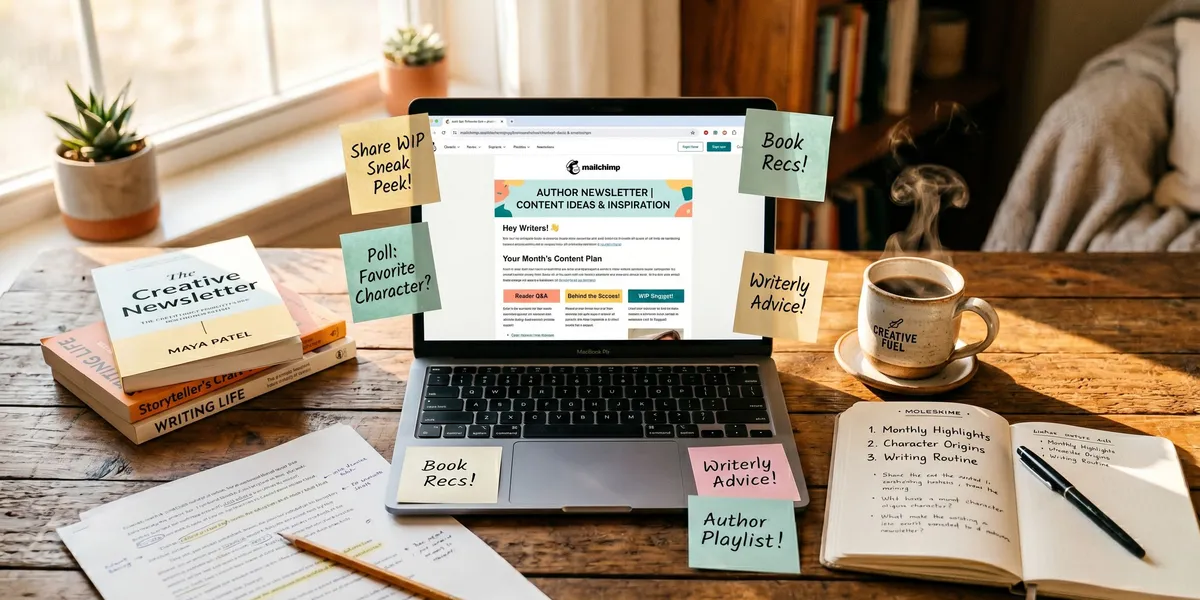
Your writing process. Share what your writing day actually looks like — the messy first drafts, the coffee-fueled revision sessions, the breakthroughs that happen at 2 a.m. Readers find this fascinating because most people never see how books get made.
Work-in-progress updates. Give subscribers a peek at your current project. Share your word count, a snippet of dialogue you’re proud of, or a problem you’re trying to solve in the plot. This builds anticipation for your next release while making readers feel like insiders.
Research adventures. If you visited a location for your novel, interviewed an expert for your nonfiction book, or fell down a Wikipedia rabbit hole at midnight — share it. Research stories are some of the most engaging newsletter content because they combine learning with entertainment.
Workspace photos. A quick photo of your desk, your writing setup, your overflowing bookshelf, or even your cat sitting on your keyboard. These personal touches make your newsletter feel like a letter from a friend.
Book and Reading Recommendation Ideas
Recommending other books is one of the highest-engagement newsletter strategies. It costs you nothing, and readers love discovering titles through someone whose taste they trust.
Monthly reading list. Share the 2-3 books you read last month with honest mini-reviews. Tell readers what you loved, what surprised you, and who the book is perfect for. This positions you as a well-read member of the literary community, not just someone promoting their own work.
Genre deep dives. Pick a subgenre, trope, or theme and recommend 5 books that do it brilliantly. If you write romance, you might do “5 enemies-to-lovers novels with genuinely clever banter.” If you write business nonfiction, try “3 books that changed how I think about productivity.”
Backlist spotlight. Highlight one of your own older titles that new subscribers might not know about. Share the story behind why you wrote it and what readers have said about it. This generates sales from books you have already published without feeling pushy.
What’s on your nightstand. A simple, recurring feature showing your current reads — even if you haven’t finished them yet. Readers enjoy seeing your in-progress reading stack.
Interactive and Community Content Ideas
Interactive content turns passive readers into active participants. These ideas build community around your newsletter and give you valuable insight into what your audience cares about.
Ask Me Anything (AMA). Invite subscribers to send questions, then answer the best ones in your next email. You can focus the AMA on your writing process, your books, your genre, or life as an author. This two-way conversation is what separates a newsletter from a blog post.
Polls and surveys. Ask readers to vote on something: your next book cover, a character name, which project you should write next, or a fun question related to your genre. Most email platforms now support embedded polls that make this easy.
Reader spotlight. Feature a subscriber who reached out with a great question, left a meaningful review, or has an interesting story connected to your books. This makes your community feel seen and encourages more engagement.
Book club discussion. Pick a book (yours or someone else’s) and host a discussion via email. Share discussion questions in one email, then compile the best reader responses in the next. This works especially well for nonfiction authors whose readers want to go deeper.
Exclusive Content That Rewards Subscribers
Exclusive content gives people a reason to stay subscribed. It answers the question every subscriber silently asks: “Why should I keep opening these emails?”
Bonus chapters or deleted scenes. Share a scene you cut from your book, an alternate ending you considered, or a character backstory that didn’t make the final draft. Fiction readers devour this content because it extends the experience of a book they loved.
Early access and sneak peeks. Let subscribers read the first chapter of your upcoming book before anyone else. This builds anticipation and makes subscribers feel like VIPs. It also pairs perfectly with a reader magnet strategy to grow your list.
Subscriber-only short stories. Write a short story set in your book’s world — a prequel, a side character’s perspective, or a holiday special. These don’t need to be long. Even 1,000 words feels generous and exclusive.
Free resources. For nonfiction authors, this could be a worksheet, template, checklist, or mini-guide related to your book’s topic. For fiction authors, consider character art, a playlist you wrote to, or a map of your story’s world. You can deliver these through services like BookFunnel for a polished experience.
Writing Tips and Craft Content Ideas
If your readers are fellow writers — or aspiring writers — sharing craft knowledge positions you as a generous expert and builds loyalty that translates into book sales.
Quick writing tips. Share one actionable writing tip per email. Keep it short, specific, and immediately usable. “How to write better dialogue tags” is more valuable than a vague essay about “finding your voice.”
Lessons from your own mistakes. Tell readers about a craft mistake you made and how you fixed it. This is vulnerable, relatable content that builds trust. It also performs well because readers appreciate honesty over perfection.
Book breakdowns. Analyze a scene from a published book (including your own) and explain what makes it work. Break down the pacing, the dialogue, the word choices. This is the kind of content that makes readers smarter — and they’ll remember you for it.
Publishing industry insights. Share what you’re learning about self-publishing, traditional publishing, marketing, or the business side of being an author. Readers who are also writers find this invaluable. Even fiction-only readers enjoy the peek behind the curtain.
Launch and Promotion Content Ideas
Your newsletter is your most powerful book launch tool. But promotion works best when it’s woven into a mix of valuable content — not blasted in every email.
Cover reveals. Share your new book cover with subscribers first, before you post it on social media. This exclusivity makes subscribers feel special, and cover reveals generate genuine excitement. Ask readers to share their reactions.
Pre-order announcements. When your book is available for pre-order, send a dedicated email explaining what the book is about, why you wrote it, and what early readers are saying. Include a direct link to pre-order. One email is enough — don’t send five.
Launch week updates. During launch week, send 2-3 emails: one announcing the book is live, one sharing early reviews or milestones, and one final reminder before any launch pricing ends. Your subscribers signed up to hear about your books — this is what they want.
Sale and deal alerts. When your book goes on sale, your newsletter audience should hear about it first. Keep the email short and direct: what’s on sale, the price, and a link. Pair this with your broader book promotion strategy for maximum reach.
Review requests. After launch, send a gentle email asking readers who’ve finished the book to leave an honest review on Amazon or Goodreads. Explain that reviews help other readers discover the book. Most readers want to help — they just need the reminder.
Personal and Lifestyle Content Ideas
Readers subscribe to you because they like you, not just your books. Personal content — in moderation — deepens that connection.
Life updates. Share what’s happening in your life beyond writing. A trip you took, a hobby you picked up, something funny your kid said. Keep it brief and genuine. This is a newsletter, not a diary — one or two personal touches per email is the sweet spot.
Lessons learned. Share a lesson from your life or career that connects to a theme in your writing. If you write about resilience in your novels, share a personal story about a setback you overcame. If you write business books, share a real business lesson from your week.
Seasonal and holiday content. Tie your newsletter to the calendar: reading recommendations for summer, a gratitude list in November, your writing goals for the new year. Seasonal content feels timely and gives you a natural content hook when you’re not sure what to write about.
How to Build a Newsletter Content Calendar
A content calendar eliminates the “what should I write?” paralysis that causes most authors to skip weeks (or months) between emails. Here’s a simple system.
Pick your frequency. Most authors send newsletters every 1-2 weeks. Weekly builds stronger habits, but biweekly is perfectly fine if it’s consistent. Whatever you choose, stick to it. Consistency matters more than frequency.
Use a rotation. Cycle through content categories so your newsletter stays varied:
- Week 1: Behind-the-scenes + personal touch
- Week 2: Book recommendation + writing tip
- Week 3: Interactive content (poll, AMA, or reader spotlight)
- Week 4: Exclusive content or promotion
Batch your content. Set aside one hour per month to outline your next 4 emails. You don’t need to write them — just decide the topic and main idea for each one. This is part of a solid book marketing plan and saves you hours of decision fatigue.
Keep a swipe file. When an idea hits you — a funny story, a writing insight, a book you loved — drop it into a notes app or document. When it’s time to write your newsletter, you’ll have a bank of ideas waiting.
Common Mistakes to Avoid
- Only emailing when you have something to sell. This trains subscribers to associate your name with “buy my book.” Mix in 3-4 value emails for every promotional one.
- Writing too long. Most successful author newsletters are 300-800 words. Respect your reader’s time. If you have more to say, link to a blog post or save it for next week.
- No personality. A newsletter that reads like a corporate press release will lose subscribers fast. Write like you’re emailing a friend who happens to love books.
- Inconsistent sending. Disappearing for months and then suddenly sending three emails in a week is a recipe for unsubscribes. Build a rhythm and protect it.
- Ignoring your analytics. Most email marketing platforms show you open rates and click rates per email. Pay attention. When a topic gets high engagement, do more of it. When something falls flat, try a different approach.
How Often Should You Send Your Author Newsletter?
You should send your author newsletter every 1-2 weeks for the best balance of engagement and sustainability. Weekly newsletters build stronger subscriber habits, but biweekly works well if you’re consistent. During a book launch, you can increase to 2-3 emails per week for a short period without annoying subscribers — they expect it.
The worst frequency is “whenever I remember.” Sporadic sending destroys open rates because subscribers forget who you are.
What Should Your First Newsletter to New Subscribers Say?
Your first newsletter to new subscribers should welcome them, deliver on whatever you promised (reader magnet, exclusive content, or updates), and set expectations for what’s coming. Tell them how often you’ll email, what kind of content you share, and give them one piece of immediate value — a book recommendation, a writing tip, or a link to your most popular blog post. A strong welcome email sets the tone for the entire relationship. This pairs with your reader magnet delivery for maximum impact.
Can You Use AI to Help Write Your Newsletter?
You can absolutely use AI to help draft, outline, and brainstorm your author newsletter — tools like Chapter help authors generate and refine written content efficiently. The key is using AI as a starting point, not a replacement for your voice. Draft with AI, then edit ruthlessly until every sentence sounds like you. Your subscribers signed up for your personality, so the final version must feel authentic. AI is best for beating blank-page paralysis, generating content ideas, and polishing rough drafts.
FAQ
What Are the Best Author Newsletter Content Ideas?
The best author newsletter content ideas are behind-the-scenes writing updates, book recommendations, exclusive bonus content, and interactive features like AMAs and polls. Mix personal stories with value-driven content. The key is variety — rotate between 4-5 content types so subscribers never know exactly what to expect, but always look forward to opening your email.
How Do I Keep My Author Newsletter Interesting?
To keep your author newsletter interesting, follow a content rotation that mixes value, personality, and promotion. Share writing process updates, recommend books you love, ask readers questions, and offer exclusive content like deleted scenes or early access. According to Writer’s Digest, the most engaging author newsletters feel like a conversation, not a broadcast. Keep emails under 800 words and write in your natural voice.
How Many Subscribers Do You Need to Make a Newsletter Worth It?
You need zero subscribers to start and as few as 100 engaged subscribers to see real results from an author newsletter. A small, engaged list outperforms a large, uninterested one. Authors with just a few hundred subscribers regularly launch books to strong first-week sales because those readers are genuine fans. Start building your list now — even before your first book launches.
Should Authors Use Substack, ConvertKit, or MailerLite?
Authors should choose their newsletter platform based on list size, features, and budget. MailerLite offers a generous free tier (up to 1,000 subscribers) with automation. ConvertKit (now Kit) is popular with authors for its tagging and sequence features. Substack works well if you want to publish publicly and potentially charge for subscriptions. All three integrate with BookFunnel for reader magnet delivery. Start free, then upgrade as your ebook marketing strategy grows.
What’s the Ideal Length for an Author Newsletter?
The ideal length for an author newsletter is 300-800 words for a standard edition. Shorter emails (under 500 words) tend to have higher click-through rates, while longer editions work when the content is genuinely compelling — like a personal essay or a detailed craft breakdown. 43% of readers decide whether to open based on the subject line alone, so invest as much thought in your subject line as your content.