You can create an author newsletter in a single afternoon — and it will become the most valuable marketing asset in your writing career.
In this guide, you’ll learn:
- How to choose the right newsletter platform for your genre and goals
- The reader magnet strategy that turns website visitors into subscribers
- What to actually send (so you never stare at a blank email draft again)
- How to grow your list from zero to your first 1,000 readers
Here’s exactly how to set up your author newsletter from scratch.
Why Every Author Needs a Newsletter
An author newsletter is a direct communication channel between you and your readers — no algorithm filtering your reach, no platform deciding who sees your updates. You own the list, and that ownership matters more than any social media following.
Here’s the reality: social media platforms change their algorithms constantly. A Facebook page that once reached 80% of followers now reaches around 5%. Instagram’s organic reach keeps declining. But your email list? That stays with you no matter what any tech company decides.
Email marketing still delivers the highest ROI of any digital channel — roughly $36 to $45 per dollar spent. For authors, that translates directly into book sales, launch-day momentum, and a sustainable career.
With over 2,147 authors building books on Chapter and launching them to eager audiences, the pattern is clear: the writers who build email lists before they publish consistently outsell those who don’t.
How to Choose Your Newsletter Platform
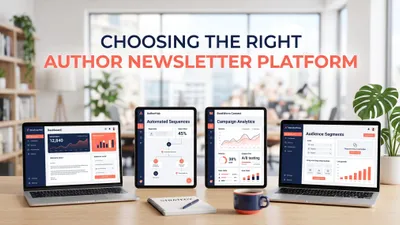
Your newsletter platform handles subscriber management, email design, and delivery. The right choice depends on your budget, technical comfort, and whether you want to monetize your newsletter directly.
Here’s how the most popular options compare:
| Platform | Free Tier | Best For | Key Strength |
|---|---|---|---|
| MailerLite | Up to 1,000 subscribers | Most authors | Automation + simplicity |
| ConvertKit (Kit) | Up to 10,000 subscribers | Full-time authors | Creator-focused tools |
| Substack | Unlimited | Writers who want built-in audience | Network discovery |
| Buttondown | Up to 100 subscribers | Minimalist writers | Clean, no-fuss setup |
| Mailchimp | Up to 500 subscribers | Authors with e-commerce | Integrations |
For most authors starting out, MailerLite or ConvertKit offers the best balance. Both have generous free tiers, automation workflows for welcome sequences, and landing page builders so you don’t need a separate website to start collecting emails.
If your goal is building a paid newsletter community (not just promoting books), Substack’s built-in network gives you discoverability that standalone platforms can’t match.
Check out our full author newsletter platforms comparison for a deeper breakdown of pricing, features, and which platform fits each type of author.
How to Set Up Your Newsletter Account
Once you’ve picked a platform, the setup takes about 30 minutes. Here’s what to do:
Step 1: Create your account. Sign up with a professional email address. If you have a custom domain (like yourname.com), use it — emails from branded domains have higher open rates than Gmail or Yahoo addresses.
Step 2: Set up your sender profile. Use your author name (or pen name) as the sender name. Your “from” address should look like [email protected] or [email protected].
Step 3: Design a simple template. Resist the urge to over-design. The best-performing author newsletters use a clean, text-focused layout with minimal images. A simple header with your name, body text, and a footer with unsubscribe and social links is all you need.
Step 4: Create your first sign-up form. Every platform provides embeddable forms and standalone landing pages. You’ll need at least one to start collecting subscribers.
Your author website is the natural home for your sign-up form — add it to your homepage, sidebar, and a dedicated newsletter page.
How to Create a Reader Magnet That Grows Your List
A reader magnet (also called a lead magnet) is a free piece of content you offer in exchange for an email address. It’s the single most effective way to grow your author newsletter.
Without a reader magnet, you’re asking strangers to hand over their email based on a vague promise of “updates.” With one, you’re offering something valuable right now.
Best Reader Magnets by Genre
For fiction authors:
- A free prequel novella or short story set in your series world
- The first 3 chapters of your latest book
- A bonus epilogue or alternate POV chapter
- A character art pack or story world map
For nonfiction authors:
- A checklist, worksheet, or template related to your book’s topic
- A condensed “quick-start” guide
- A resource list or toolkit
- An exclusive video training or mini-course
The key is matching your magnet to your ideal reader. Someone who downloads your fantasy prequel is exactly the person who’ll buy your fantasy series. That alignment is everything.
We have a complete walkthrough in our reader magnet creation guide — including delivery setup, landing page templates, and promotion strategies.
What to Send in Your Author Newsletter
This is where most authors get stuck. You signed up for a platform, created a form… and now what? The blank email draft is staring at you.
Here’s a simple content framework that works for both fiction and nonfiction authors.
The Welcome Email (Send Immediately)
Your welcome email is the most-opened email you’ll ever send — welcome emails average 60%+ open rates. Use it well:
- Deliver your reader magnet — include the download link prominently
- Introduce yourself in 2-3 sentences — your genre, what you write, why you write it
- Set expectations — tell them how often you’ll email and what you’ll share
- Ask a question — “What are you reading right now?” or “What drew you to [genre]?” This trains their inbox to expect replies from you (which helps deliverability)
Ongoing Newsletter Content Ideas
You don’t need to write a novel-length newsletter every time. Mix these content types on rotation:
- Behind-the-scenes writing updates — what you’re working on, word count milestones, cover reveals
- Book recommendations — share what you’re reading and why (readers love this)
- Exclusive content — deleted scenes, character backstories, bonus chapters
- Personal stories — a writing lesson you learned, a funny research rabbit hole, a publishing milestone
- Industry insights — publishing news, genre trends, market data relevant to your readers
- Direct asks — review requests, launch announcements, pre-order links (but not every email)
For a deeper dive into content planning, check out our author newsletter content ideas and author newsletter ideas posts.
How Often Should You Send Your Newsletter?
Start with twice a month. That’s 24 newsletters a year — frequent enough to stay top of mind, infrequent enough that you won’t burn out or annoy subscribers.
Once you’re comfortable, you can increase to weekly. But consistency matters more than frequency. A reliable twice-monthly newsletter outperforms a weekly one that shows up sporadically.
How to Write Newsletter Subject Lines That Get Opened
Your subject line determines whether your email gets opened or ignored. Average open rates for author newsletters hover around 40-43%, but strong subject lines can push that well above 50%.
Subject line formulas that work for authors:
| Formula | Example |
|---|---|
| Curiosity gap | ”The chapter I almost deleted” |
| Direct benefit | ”3 books that changed how I plot” |
| Personal story | ”I got rejected 47 times (here’s what happened next)“ |
| Exclusive offer | ”Cover reveal — you’re seeing this first” |
| Question | ”Would you read a book about [topic]?” |
What to avoid:
- ALL CAPS or excessive punctuation (triggers spam filters)
- Clickbait that doesn’t deliver (destroys trust fast)
- Generic subjects like “Newsletter #14” or “Monthly Update”
- Overly salesy language like “BUY NOW” or “LIMITED TIME”
Personalized subject lines can increase open rates by 20-26%, so use your subscriber’s first name when your platform supports it.
How to Grow Your Author Newsletter From Zero
Starting from zero subscribers feels daunting, but every successful author newsletter began the same way. Here’s a proven growth playbook.
Phase 1: Your First 100 Subscribers
Leverage your existing network. Email friends, family, writing group members, and social media followers. Tell them what your newsletter is about and what they’ll get. Don’t be shy — if you have a reader magnet, lead with that.
Add sign-up forms everywhere:
- Your author website homepage, about page, and sidebar
- The back matter of your books (print and ebook)
- Your social media bios (Instagram, Twitter/X, TikTok)
- Your email signature
Cross-promote with other authors. Find 3-5 authors in your genre and agree to mention each other’s newsletters. This is free, effective, and builds genuine community.
Phase 2: Growing to 500 Subscribers
Optimize your reader magnet. Test different offerings to see what converts best. A free first chapter might outperform a character art pack, or vice versa. Let the data guide you.
Use your content to drive sign-ups. If you post on social media, end posts with a soft CTA to your newsletter. Share snippets of newsletter-exclusive content to show what subscribers get.
Run a newsletter swap. Platforms like BookFunnel connect authors for cross-promotions where you feature each other’s reader magnets to your respective lists.
Phase 3: Scaling Past 1,000
Add a lead magnet to your book’s back matter. This is your highest-converting growth channel. Every reader who finishes your book and wants more will sign up. Include a dedicated page at the end of every book with a direct link to your sign-up landing page.
Create a welcome sequence. Instead of a single welcome email, build a 3-5 email automated sequence that delivers your reader magnet, introduces your backlist, and invites engagement. Most platforms let you set this up for free.
Guest on podcasts and blogs. Every guest appearance should include a mention of your free reader magnet and newsletter. This brings in subscribers who already trust you from hearing your voice.
Building your author platform and newsletter in parallel creates a compound effect — each channel feeds the other.
How to Use Your Newsletter to Launch Books
Your newsletter is your most powerful book launch tool. Authors with engaged email lists consistently see stronger first-week sales, more reviews, and better Amazon ranking momentum.
Here’s the launch newsletter framework:
6-8 weeks before launch: Tease the new book. Share the concept, behind-the-scenes moments, or an early excerpt. Build anticipation without asking for anything.
4 weeks before launch: Reveal the cover. Ask for pre-orders if available. This email typically gets the highest engagement of your entire launch sequence.
Launch week: Send 2-3 emails. Announce release day, share early reviews or reader reactions, and include direct purchase links. This is the one time being “salesy” is expected and welcome.
1-2 weeks after launch: Thank your readers. Share sales milestones, reader feedback, or a personal reflection. Ask for reviews from anyone who’s finished reading.
For the full email-by-email breakdown, see our book launch email sequence guide.
How to Segment Your Author Newsletter
Email segmentation means sending different content to different groups of subscribers based on their interests or behavior. It’s how you avoid the “one size fits none” problem.
Most author newsletter platforms let you segment by:
- Genre interest — if you write both romance and thriller, tag subscribers by what they signed up for
- Engagement level — separate active openers from dormant subscribers
- Reader magnet source — people who downloaded your fantasy prequel vs. your writing tips checklist want different content
- Purchase history — subscribers who’ve bought every book get different treatment than new sign-ups
Start simple. Even one segment (fiction readers vs. nonfiction readers) dramatically improves your open rates and reduces unsubscribes. Authors already face higher-than-average unsubscribe rates at 0.21%, so relevant content is your best retention tool.
Common Newsletter Mistakes Authors Make
Selling in every email. Your newsletter isn’t a sales channel — it’s a relationship channel. The 80/20 rule works well: 80% value and connection, 20% promotion and asks.
Inconsistent sending. Disappearing for three months then blasting five emails in a week is a guaranteed way to spike unsubscribes. Pick a schedule and stick to it.
Over-designing your emails. Fancy graphics and complex layouts often land in spam folders. Plain-text or simple HTML emails feel personal and deliver better.
Ignoring your welcome email. Your welcome email sets the tone for your entire subscriber relationship. A generic “Thanks for subscribing” wastes your highest-engagement touchpoint.
Not including a CTA. Every email should have one clear action — read a blog post, reply to a question, check out a book, save a date. Not a hard sell, just a next step.
How to Write a Newsletter When You Have Nothing to Say
Every author hits the “I have nothing to write about” wall. Here’s the fix: you don’t need news to send a newsletter.
Try the “3-1-1 framework” for any newsletter edition:
- 3 things: Three book recommendations, writing tips, or interesting links
- 1 personal update: A sentence or two about what you’re working on
- 1 question or CTA: Ask readers something or point them to one action
This framework takes 20 minutes to fill out and consistently performs well because it’s scannable, valuable, and personal.
You can also repurpose content you’ve already created. That social media post about your writing process? Newsletter content. That blog post about book marketing strategies? Summarize the key points with a link. That podcast interview you did? Share 3 takeaways.
How Much Does an Author Newsletter Cost?
Most authors can run a newsletter for free until they reach 500-1,000 subscribers. After that, paid plans start at $10-30/month depending on your platform and list size.
| List Size | MailerLite | ConvertKit | Mailchimp |
|---|---|---|---|
| 0-500 | Free | Free | Free |
| 500-1,000 | Free | Free | $13/mo |
| 1,000-2,500 | $10/mo | $25/mo | $27/mo |
| 2,500-5,000 | $15/mo | $25/mo | $50/mo |
| 5,000-10,000 | $30/mo | $41/mo | $75/mo |
The ROI math is straightforward: if your book earns $5 per sale and your newsletter converts even 2% of subscribers per launch, a 1,000-subscriber list generates $100 per book launch from email alone. Most authors report much higher conversion rates from engaged lists.
Your newsletter is also a powerful tool beyond book sales — it supports your broader author income streams including courses, speaking, coaching, and consulting.
Should You Start a Paid Newsletter?
Paid newsletters (through Substack or platform integrations) work best for authors who:
- Have an established audience (500+ engaged subscribers minimum)
- Offer ongoing educational or analytical content
- Write in niches where readers pay for expertise (business, investing, craft education)
- Can commit to a consistent premium content schedule
For most fiction authors and early-career nonfiction authors, keep your newsletter free. Focus on growing your list and building relationships first. You can always add a paid tier later once you’ve proven your content’s value.
How to Write Your Book With AI and Launch It to Your List
Once your newsletter is set up and growing, you need a book to launch to your audience. That’s where Chapter fits in.
Our Pick — Chapter
Chapter is an AI book writing platform that helps you draft, outline, and refine your manuscript. Over 2,147 authors have used it to create 5,000+ books — many launching directly to their email lists for strong first-week sales.
Best for: Authors who want to write their book faster without sacrificing quality Pricing: $97 one time, 2 books included (fiction or nonfiction), 30-day money-back guarantee Why we built it: Writing the book is step one — launching it to your newsletter subscribers is how you turn writing into a career.
One Chapter author generated $60K in 48 hours by using a book as a lead magnet and launching to an email list. That’s the power of combining great content with a direct reader connection.
The workflow is simple: write your book with Chapter, set up your newsletter, create a reader magnet from your content, and build an audience that’s ready to buy on launch day.
FAQ
How Many Subscribers Do You Need to Launch a Book?
You need at least 250 engaged subscribers to make a meaningful impact on your book launch. A list of 250 active readers who open your emails and care about your work outperforms a list of 5,000 disengaged subscribers. Focus on engagement quality over raw numbers — click-through rates and replies matter more than open rates.
What Is the Best Newsletter Platform for Authors?
The best newsletter platform for authors is MailerLite or ConvertKit for most writers. MailerLite offers the best free tier with automation, while ConvertKit excels for full-time creators who need advanced tagging and sequences. Substack is best if you want built-in audience discovery and plan to run a paid newsletter.
How Often Should an Author Send a Newsletter?
An author should send a newsletter at least twice per month to stay top of mind with readers. Consistency matters more than frequency — a reliable biweekly schedule outperforms sporadic weekly sends. During a book launch, increase to weekly or even twice-weekly emails for the launch window, then return to your normal cadence.
Can You Start an Author Newsletter With No Books Published?
Yes, you can start an author newsletter with no published books. Share your writing journey, offer early chapter previews, build anticipation for your upcoming release, and provide value through book recommendations or writing tips. Starting before publication means you’ll have an audience ready to buy on launch day instead of scrambling to find readers.
What Should Your First Newsletter Email Say?
Your first newsletter email should deliver your reader magnet, introduce yourself in 2-3 sentences, set expectations for email frequency and content, and ask your subscriber a question to encourage a reply. Welcome emails average over 60% open rates, making them your highest-engagement opportunity to build a lasting reader relationship.