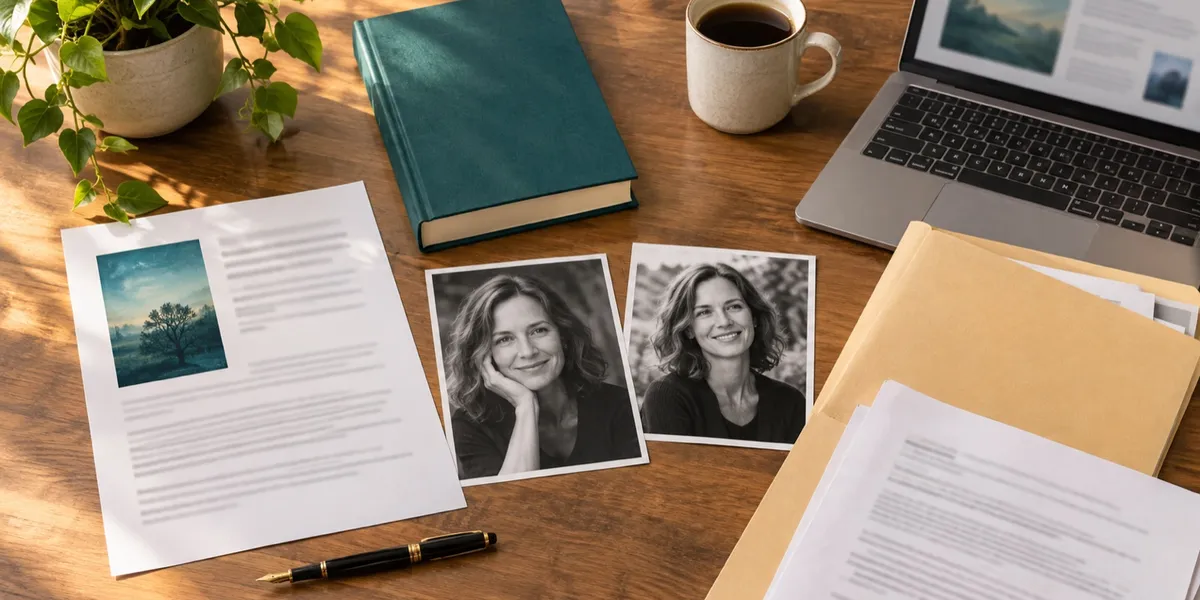
An author press kit is a ready-made package of your bio, headshots, book details, and contact information that lets a journalist, podcast host, or bookstore feature you without sending a single follow-up email. You can build a good one in an afternoon.
In this guide, you’ll get:
- The nine elements every author press kit needs, and which ones you can skip
- A copy-and-fill author press kit template
- Three sample kits for a novelist, a nonfiction expert, and a series author
- An honest take on when to build it yourself and when to pay for help
Start with what a press kit actually is, because the term gets used for three different things.
What Is an Author Press Kit?
Author press kit — A collection of ready-to-use materials (bio, photos, book facts, press release, interview questions, and contact details) that media and booksellers use to cover you and your book.
You’ll also see it called a media kit for authors or a book press kit. They mean the same thing. What changes is the packaging:
| Format | What it is | Best for |
|---|---|---|
| Press page | A page on your author website holding every element as plain text and downloads | Journalists who find you through search |
| One-page press kit (one-sheet) | A single designed PDF with your hook, cover, bio, headshot, and contact | Attaching to pitches and podcast applications |
| Sell sheet | A one-page book fact sheet with ISBN, price, formats, and distribution | Bookstores, libraries, and event buyers |
| Full kit folder | A shared folder or ZIP with every file at full resolution | Producers and editors who say yes |
Most authors need all four, and they all come from the same source material. If you want to see how the web version looks, study these author press page examples.
What Goes in an Author Press Kit?
A complete author press kit contains nine elements: a short and long author bio, high-resolution headshots, the book cover, a book fact sheet, a one-paragraph hook and description, a press release, sample interview questions, praise or press coverage, and your contact details. An excerpt is optional but useful.
Here’s the checklist, with who actually uses each piece:
| Element | Who uses it | Required? |
|---|---|---|
| Author bio (3 lengths) | Everyone | Yes |
| Headshots (hi-res and lo-res) | Print, web, event posters | Yes |
| Book cover image | Reviewers, bloggers, retailers | Yes |
| Book fact sheet | Bookstores, libraries | Yes |
| Hook and book description | Journalists, hosts | Yes |
| Press release | News outlets | At launch only |
| Interview questions or talking points | Podcast and radio hosts | Yes |
| Praise, reviews, coverage | Everyone deciding whether to book you | When you have it |
| Contact details | Everyone | Yes |
| Excerpt | Reviewers, book bloggers | Optional |
Author bio in three lengths
Write your bio in third person at three lengths: about 50 words, about 150 words, and about 300 words. A host introducing you reads the short one aloud. A magazine uses the medium one. A conference program might print the long one.
Lead with the credential that matters for this book, not your life story. Our guide to writing an author bio walks through the structure, and these author bio examples show it done well across genres.
Headshots
Include at least two headshots, one portrait and one landscape, in both high resolution (300 dpi for print) and a smaller web version. Name the files clearly, like jane-doe-headshot-portrait.jpg.
A cropped vacation photo signals you’re not ready for coverage. These author headshot tips cover lighting, backgrounds, and what to wear.
Book cover and fact sheet
Give the front cover as a high-resolution JPG and a web-size version. Then add the book’s facts: title, subtitle, genre, publication date, publisher or imprint, ISBNs per format, page count, price, and where to buy.
Get your ISBNs right before anything else. In the US, they come from Bowker’s MyIdentifiers, and each format (paperback, hardcover, ebook) needs its own.
Hook and book description
Write one sentence that tells a stranger why the book matters right now, then a 150-200 word description. The hook is what a journalist pastes into a story, so make it stand alone.
If your description still reads like a summary, rework it with this guide to writing a book description that sells.
Press release
A press release announces news: a launch, an award, an event. It’s the only time-sensitive part of the kit, so include one around launch and replace it when the news is old. Date it, including the year.
Press releases still matter. In Cision’s 2025 State of the Media survey of more than 3,000 journalists, 72% named press releases the most useful resource PR teams provide. Use this author press release template to draft yours.
Sample interview questions and talking points
Give hosts 8-10 questions they can ask you, each with a one-line note on where the answer goes. Most hosts won’t read your whole book before the interview, and this sheet is how you steer the conversation toward your best material.
Add 3-5 talking points tied to current events or seasons. “Why burnout spikes in January” gets you booked; “my book about burnout” doesn’t. Borrow from this author interview questions template.
Praise, reviews, and press coverage
List your strongest endorsements, review quotes, awards, and past media appearances. Lulu’s press kit guide tells you to promote your coverage boldly, because this is not the place for modesty.
No coverage yet? Use early reader reviews, a blurb from a peer author, or your professional credentials instead. Leave the section out rather than padding it.
Contact information
Put your name, a professional email, your website, and your agent or publicist’s details on every page of the kit. It sounds obvious, but a missing contact line is one of the most common press kit errors.
Author Press Kit Template (Copy and Fill In)
Use this author press kit template as your one-page kit. Copy it into a document, replace the brackets, and keep every section to the length shown.
[AUTHOR NAME] — PRESS KIT
[Book Title]: [Subtitle]
Contact: [email] | [phone, optional] | [website/press]
Representation: [agent or publicist name, email — or "Self-represented"]

THE HOOK (1 sentence)
[Why this book matters to a general audience right now.]

ABOUT THE BOOK (150-200 words)
[Problem or premise, what the reader gets, who it's for.]

BOOK DETAILS
Genre: [ ] | Pub date: [Month DD, YYYY] | Publisher/imprint: [ ]
Formats & ISBNs: Paperback [ ] | Hardcover [ ] | Ebook [ ]
Pages: [ ] | Price: [ ] | Available at: [retailers]

ABOUT THE AUTHOR (50 / 150 / 300 words — include all three)
[Short bio]

INTERVIEW TOPICS (3-5)
1. [Timely angle tied to news, a season or a trend]
2. [Counterintuitive claim from the book]
3. [Personal story behind the book]

SAMPLE QUESTIONS (8-10)
1. [Question]  — [one-line note on the answer]

PRAISE & COVERAGE
"[Quote]" — [Name, credential or outlet]
As featured in: [outlets, podcasts, events]

DOWNLOADS
Headshots (hi-res / web): [link]
Cover (hi-res / web): [link]
Excerpt (first chapter): [link]
Press release: [link]
Author Press Kit Examples: Three Ways to Package It
These three author press kit examples are illustrative builds, not real authors. They show how the same template bends to fit different books.
1. Debut novelist (romantic suspense). The hook leads with the premise and the comparable titles. Talking points lean on the setting and the research behind the crime. Praise comes from two peer authors and early reader reviews. The kit targets book bloggers, bookstagrammers, and local radio.
2. Nonfiction expert (a business book by a consultant). The hook is a claim about the reader’s problem, backed by one statistic from the book. The bio leads with client results and speaking credits. Interview topics map to three seasonal news hooks. This kit targets business podcasts and trade publications, and the podcast pitch links straight to it.
3. Series author (cozy mysteries, five books). The fact sheet becomes a series table with reading order, ISBNs, and the newest release on top. The press release covers only the new book. This kit targets libraries and bookstore event coordinators, so the sell sheet carries the most weight.
The pattern: the core files barely change, but the hook, the talking points, and the top of the page shift with your audience.
How to Build an Author Press Kit in 6 Steps
You can build an author press kit in six steps: gather assets, write the copy, design the one-sheet, publish the press page, package the downloads, and test every link. Plan on a few focused hours if your bio and photos already exist.
- Gather your assets. Collect your headshots, cover files, ISBNs, reviews, and any past coverage into one folder.
- Write the copy. Draft the three bios, the hook, the description, and the interview questions. Write the text once and reuse it everywhere.
- Design the one-sheet. Lay out the template above on one page in Canva, Google Docs, or Word. Keep the hook, cover, and headshot above the fold.
- Publish your press page. Add a page labeled “Press” or “Media” to your author website, with every element as plain text plus download links.
- Package the downloads. Put the full-resolution files in a ZIP or a view-only shared folder, with clearly named files.
- Test it. Open every link in a private browser window and on your phone. Then ask a friend to find your contact email in under ten seconds.
Should Your Press Kit Be a PDF, a Web Page, or a Folder?
Your press kit should be all three: a web page with copyable text, a one-page PDF for attachments, and a folder of full-resolution files. Each one solves a different problem, and the advice you’ll find online splits on this.
Sandra Beckwith of Build Book Buzz argues that PDF-only press materials are a blunder because journalists can’t easily copy and paste from them. Other guides, including Reedsy’s media kit template, recommend a downloadable PDF.
Both are right, for different moments. A reporter writing a story wants text they can lift from your press page. A podcast booker filling in an application wants one PDF to attach. A magazine art director wants the 300 dpi files. Build the text once, then publish it in all three places.
Should You Build It Yourself or Hire Someone?
Build it yourself if you have one book, decent photos, and a few spare hours. Hire help if your time is worth more than the fee, or if you want someone to also send the pitches that make the kit useful.
| Option | What you get | Honest trade-off |
|---|---|---|
| DIY with a template | Full control, near-zero cost | Your time, and design is on you |
| Freelance designer | A polished one-sheet and press page | You still write the copy and send the pitches |
| Book publicist | Kit plus outreach and relationships | The most expensive route; see what book publicists cost |
| Chapter Marketing AI | One-page press kit, author page, photos, and pitches | An annual plan, not a one-off kit purchase |
A press kit on its own gets nobody coverage. It works when someone uses it to pitch, which is why publicists and bundled services build the kit and the outreach together.
If that’s the gap you’re trying to fill, Chapter’s Marketing AI builds a one-page press kit, your author page, and pro photos, then writes and sends 100 pitches you approve. If all you need is the kit itself, the template above costs nothing.
Common Mistakes to Avoid
- No contact details on the kit. Put them on every page and file.
- Low-resolution or casual photos. Print outlets need 300 dpi files.
- An undated press release. Reporters need to know whether the news is current.
- One bio length. Hosts need a 50-word version they can read aloud.
- Burying the kit. Label the menu link “Press” or “Media,” not “Resources.”
- A stale kit. Update the praise, events, and press release with every new book.
When Should You Create Your Press Kit?
Create your press kit about four to six months before publication. Reedsy suggests starting around six months out and contacting journalists and bloggers three to four months before launch, because long-lead outlets plan issues months ahead.
Already published? Build it now. Podcasts and local media cover backlist books all the time when the angle is timely. Add the press kit step to your book launch checklist for the next one.
How Do You Send a Press Kit to the Media?
Don’t email the whole kit cold. Send a short, personal pitch with one angle that fits the outlet, then link to your press page or attach the one-page PDF. Save the full folder for people who say yes.
Relevance decides everything. In the same Cision survey, 86% of journalists said they immediately reject pitches that don’t fit their beat or audience. This guide to pitching your book to media covers the email itself, and getting your book into bookstores shows where the sell sheet earns its keep.
FAQ
What should an author press kit include?
An author press kit should include a short and long author bio, high-resolution headshots, the book cover, a book fact sheet with ISBNs and price, a one-line hook, a book description, sample interview questions, praise or coverage, and contact details. Add a press release around launch.
What is the difference between a press kit and a media kit for authors?
There is no real difference between a press kit and a media kit for authors. Both terms describe the same package of bio, photos, book details, and contact information. Some people use “press page” for the website version and “one-sheet” for the single-page PDF.
How long should an author press kit be?
An author press kit should be one page in its PDF form, with links to everything else. The full press page on your website can be longer, holding all three bio lengths, interview questions, and downloads. Journalists skim, so keep the one-sheet tight.
Do self-published authors need a press kit?
Yes, self-published authors need a press kit even more than traditionally published ones, because no publisher’s publicity team is speaking for them. A clear kit tells podcast hosts, bookstores, and reporters that you’re professional and easy to work with, which makes them more likely to book you.