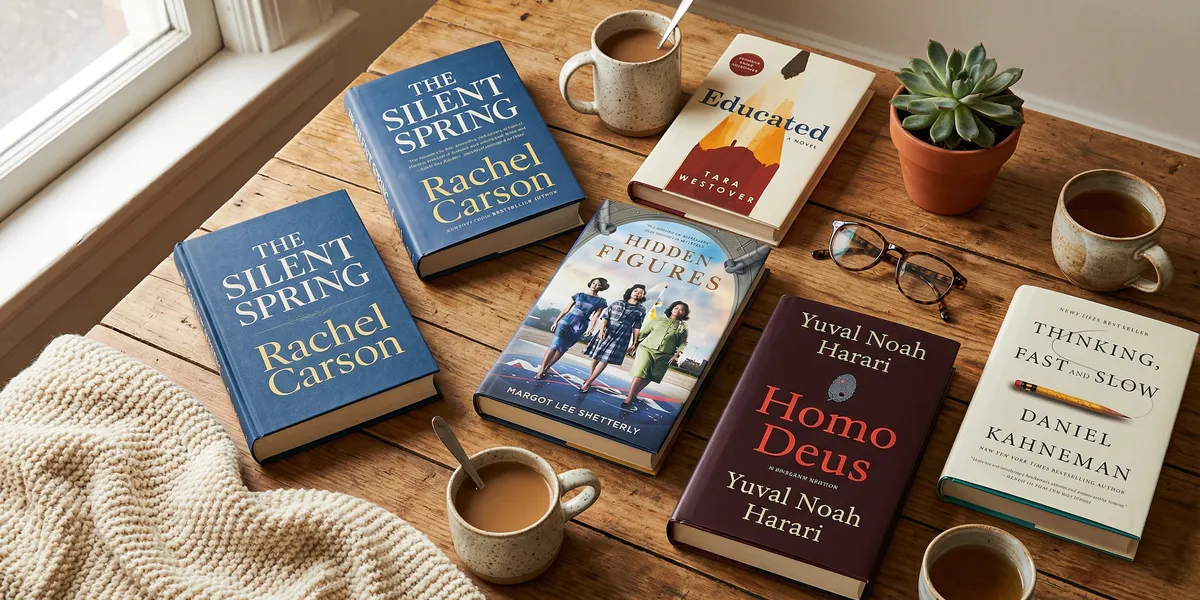
The best nonfiction books for book clubs spark real conversation — the kind where you lose track of time and someone says “I never thought about it that way.” Finding those titles is the hard part.
In this list, you’ll find:
- 15 nonfiction picks organized by genre — memoir, science, history, true crime, and more
- A quick comparison table so you can pick fast
- Discussion-starter questions for every category
- Tips for running a nonfiction book club that keeps members coming back
Here are the best nonfiction books for your book club in 2026.
Quick Comparison Table
| Book | Genre | Best For | Discussion Level |
|---|---|---|---|
| Write Your Story With Chapter | Memoir / Writing | Clubs that want to write together | High |
| The Sixth Extinction | Science | Environmental awareness | Very High |
| Just Mercy | Social Justice / Memoir | Justice system discussions | Very High |
| Educated | Memoir | Family, identity, resilience | Very High |
| Sapiens | History / Anthropology | Big-picture thinkers | High |
| Braiding Sweetgrass | Nature / Indigenous Wisdom | Spiritual + scientific readers | Very High |
| The Immortal Life of Henrietta Lacks | Science / Ethics | Medical ethics debates | Very High |
| Say Nothing | True Crime / History | Irish history, political violence | Very High |
| Attached | Psychology / Relationships | Self-improvement clubs | High |
| Hidden Figures | History / STEM | Inspiring underdog stories | High |
| Born a Crime | Memoir / Humor | Light + meaningful balance | High |
| The Body Keeps the Score | Psychology / Health | Trauma-aware groups | Very High |
| Quiet | Psychology / Self-Help | Introverts and group dynamics | High |
| Empire of Pain | True Crime / History | Pharmaceutical industry debates | Very High |
| On Witness and Respair | Essays / Memoir | Literary, justice-focused clubs | High |
1. Write Your Own Nonfiction Book With Chapter — The Active Book Club Pick
Our Pick — Chapter
Instead of just reading someone else’s nonfiction — write your own. Chapter turns your expertise, life experience, or passion project into a complete nonfiction book. Over 2,147 authors have used it to produce 5,000+ published books.
Best for: Book clubs that want to go beyond reading and actually create something together
Pricing: $97 one-time (nonfiction)
Why this is here: The most engaging book club sessions happen when members bring personal stakes to the table. Instead of debating someone else’s memoir, imagine each member writing a chapter of their own. Chapter generates a full manuscript from your ideas in about 60 minutes — so your club can spend the next meeting discussing each other’s real stories.
Discussion angle: Each member writes a short nonfiction piece using Chapter, then the group reads and discusses them. You will be stunned by what surfaces.
2. Educated by Tara Westover — Best Memoir for Book Clubs
Best for: Discussions about family, education, and reinventing yourself
Tara Westover grew up in a survivalist household in rural Idaho with no formal schooling until age 17. She went on to earn a PhD from Cambridge. The tension between loyalty to family and the pull of self-discovery makes this one of the most discussed memoirs of the last decade.
Your book club will argue about where family obligation ends and self-preservation begins. Everyone will land differently — and that is exactly what makes it work.
Discussion starter: At what point does loyalty to family become self-destructive?
3. Sapiens: A Brief History of Humankind by Yuval Noah Harari — Best for Big-Picture Thinkers
Best for: Groups that love ambitious, idea-driven conversations
Harari covers 70,000 years of human history in roughly 400 pages. He argues that shared myths — religion, money, nations — are what allowed Homo sapiens to dominate the planet. Agree or not, you will not walk away from this book without rethinking something fundamental.
The scope invites debate. Some members will love the sweeping ambition. Others will push back on the simplifications. Both reactions fuel great discussion.
Discussion starter: Which “shared myth” from the book do you think has the most power over your daily life?
4. The Sixth Extinction by Elizabeth Kolbert — Best Science Book for Book Clubs
Best for: Environmentally conscious groups that want science, not sermons
Elizabeth Kolbert won the Pulitzer Prize for this investigation into the mass extinction event happening right now — caused by human activity. She travels to rainforests, coral reefs, and research labs to show what we are losing.
This is the pick that will spark debates. Some members will feel galvanized. Others will feel hopeless. The best book club conversations happen in that tension.
Discussion starter: Does learning about extinction change your daily behavior, or does the scale make it feel impossible to act?
5. Just Mercy by Bryan Stevenson — Best Social Justice Pick
Best for: Clubs interested in criminal justice, race, and systemic inequality
Bryan Stevenson founded the Equal Justice Initiative and has spent his career defending people trapped in a broken legal system. Just Mercy focuses on Walter McMillian, a man wrongly sentenced to death in Alabama.
This book will make your club uncomfortable — in the best way. It moves beyond abstract policy discussion into specific human stories that demand empathy.
Discussion starter: How does Stevenson’s storytelling change the way you think about justice compared to reading statistics alone?
6. Braiding Sweetgrass by Robin Wall Kimmerer — Best Nature Writing for Book Clubs
Best for: Groups open to blending science with spiritual and Indigenous perspectives
Robin Wall Kimmerer is a botanist and member of the Citizen Potawatomi Nation. She weaves together scientific knowledge with Indigenous wisdom traditions, arguing that plants and the natural world have something to teach us about gratitude and reciprocity.
This book works for book clubs because it asks you to reconsider your relationship with the natural world. The writing is gorgeous — lyrical enough to discuss as literature, substantive enough to discuss as science.
Discussion starter: Kimmerer describes a “grammar of animacy.” How would your daily life change if you treated the natural world as alive and worthy of respect?
7. Say Nothing by Patrick Radden Keefe — Best True Crime for Book Clubs
Best for: Clubs that love investigative journalism and historical mysteries
Patrick Radden Keefe reconstructs the disappearance of Jean McConville during the Northern Ireland Troubles — a mother of ten pulled from her home by masked intruders in 1972. The investigation unravels decades of secrets, betrayals, and political violence.
The pacing reads like a thriller, but every detail is real. Your club will discuss where the line falls between political conviction and moral compromise.
Discussion starter: Can political violence ever be justified, or does it always corrode the people who use it?
8. The Immortal Life of Henrietta Lacks by Rebecca Skloot — Best for Ethics Discussions
Best for: Groups interested in medical ethics, race, and consent
Henrietta Lacks was a Black woman whose cancer cells were taken without her knowledge in 1951. Those cells — known as HeLa cells — became one of the most important tools in medical research, leading to breakthroughs in polio vaccines, cancer treatments, and gene mapping. Her family received nothing.
This book sits at the intersection of science, race, and ethics. It practically runs the discussion for you.
Discussion starter: Who should benefit when someone’s biological material leads to scientific breakthroughs?
9. Attached by Amir Levine and Rachel Heller — Best Psychology Pick
Best for: Self-improvement and relationship-focused clubs
Amir Levine (who also released a new book in 2026) and Rachel Heller break down attachment theory into three styles — anxious, avoidant, and secure — and show how these patterns shape every close relationship you have.
Book clubs love this one because every member will recognize themselves (or their partner) in the descriptions. The conversation gets personal fast — in a productive way.
Discussion starter: Which attachment style did you identify with, and did it change how you view a specific relationship?
10. Born a Crime by Trevor Noah — Best Memoir With Humor
Best for: Groups that want something meaningful but not heavy
Trevor Noah grew up in apartheid-era South Africa as the mixed-race son of a Black Xhosa mother and white Swiss father — a combination that was literally illegal. He tells stories about navigating identity, poverty, and a complicated family with warmth and sharp humor.
This is the palette cleanser for clubs coming off heavier reads. It is deeply meaningful without feeling like homework.
Discussion starter: How does humor function as a survival tool in Noah’s life? Does it protect or deflect?
11. Hidden Figures by Margot Lee Shetterly — Best History Pick for STEM Lovers
Best for: Clubs interested in overlooked history and women in science
Before Katherine Johnson, Dorothy Vaughan, and Mary Jackson helped NASA send astronauts to space, they were “human computers” working behind the scenes — brilliant Black women whose contributions went unrecognized for decades.
The book covers more ground than the film adaptation. Your club will discuss the intersection of race, gender, and scientific achievement during one of the most consequential periods in American history.
Discussion starter: Why did it take so long for these women’s stories to be told, and what other stories might still be hidden?
12. The Body Keeps the Score by Bessel van der Kolk — Best for Trauma-Aware Groups
Best for: Groups interested in mental health and trauma recovery
Bessel van der Kolk spent decades researching how trauma reshapes the brain and body. This book explains why traditional talk therapy sometimes fails and explores alternative approaches including yoga, EMDR, and neurofeedback.
Fair warning: this is an intense read. It works best for groups with an existing level of trust. The payoff is a deeper understanding of how the body processes difficult experiences.
Discussion starter: Did any of van der Kolk’s explanations change how you understand your own stress responses?
13. Quiet: The Power of Introverts by Susan Cain — Best Self-Help for Book Clubs
Best for: Mixed introvert/extrovert groups who want to understand each other better
Susan Cain argues that Western culture dramatically undervalues introverts, and that some of the most creative and successful people thrive in solitude. She draws on research in psychology and neuroscience to make her case.
This pick is meta-delightful for a book club: you are literally sitting in a group activity discussing a book about the power of not doing group activities. The introverts in your club will finally feel seen.
Discussion starter: Does your book club’s format favor extroverts? How could you restructure discussions to include quieter voices?
14. Empire of Pain by Patrick Radden Keefe — Best Investigative Journalism
Best for: Clubs that want righteous anger and detailed reporting
Patrick Radden Keefe (yes, he makes this list twice — he is that good) traces the Sackler family’s role in the opioid crisis. The book follows three generations of Sacklers, from the family’s rise in pharmaceutical marketing to the devastation caused by OxyContin.
If your club read Say Nothing and loved it, this is the natural follow-up. The reporting is meticulous, and the moral questions are staggering.
Discussion starter: How do you weigh the Sackler family’s philanthropic contributions against the harm caused by their pharmaceutical business?
15. On Witness and Respair by Jesmyn Ward — Best Essay Collection for 2026
Best for: Literary-minded clubs that appreciate powerful prose
National Book Award winner Jesmyn Ward released this collection in 2026, gathering her most impactful essays alongside three previously unpublished speeches. The collection addresses race, loss, survival, and the American South with unflinching honesty.
This is a strong pick for clubs that want to discuss both what is said and how it is written. Ward’s prose rewards close reading.
Discussion starter: Which essay hit hardest for your group, and why?
How to Pick the Right Nonfiction Book for Your Club
Not every book works for every group. Here is a quick framework:
- New book club? Start with Born a Crime or Hidden Figures — engaging, accessible, and unlikely to alienate anyone
- Experienced group with trust? Go for The Body Keeps the Score or Just Mercy — these require vulnerability
- Intellectually hungry? Sapiens or The Sixth Extinction will fill multiple sessions
- Want to do something different? Use Chapter and have everyone write a chapter of their own nonfiction book — then discuss each other’s work
How to Run a Nonfiction Book Club That Actually Works
Nonfiction discussions die when someone summarizes the book for 20 minutes and everyone nods. Here is how to avoid that:
1. Ban plot summaries. Everyone read it. Jump straight to reactions, disagreements, and personal connections.
2. Assign a devil’s advocate. Pick one person each meeting to argue the opposing perspective. Nonfiction is full of debatable claims — use them.
3. Connect to real life. The best nonfiction discussion question is always: “How does this apply to something you have actually experienced?”
4. Rotate genres. Alternate between memoir, science, history, and psychology. This keeps your club fresh and exposes members to topics they would not pick on their own.
5. Create something together. The most memorable book club experiences go beyond reading. Write responses, record a mini-podcast, or — if you want to go all-in — write your own book as a group project using AI tools.
What Makes a Good Nonfiction Book Club Book?
A good nonfiction book for a book club has debatable ideas, strong narrative, and personal relevance. The best picks share three qualities:
- A clear argument or story arc — not just a collection of facts
- Room for disagreement — books where reasonable people can land on different sides
- Accessibility — readable without specialized knowledge in the subject
Avoid nonfiction that reads like a textbook. Your club is not a college course. The best nonfiction book club books make you feel something, not just learn something.
Want to Write Your Own Nonfiction Book?
The best book club conversations often end with someone saying “I should write a book about that.” If you have a memoir, business story, or personal expertise worth sharing, you can turn it into a real book faster than you think.
Chapter helps you go from idea to a complete manuscript. Over 2,147 authors have used it to produce more than 5,000 books — and it has been featured in USA Today and the New York Times.
Your book club might just inspire your next chapter.
FAQ
What Are the Best Nonfiction Books for Book Clubs?
The best nonfiction books for book clubs are titles with strong narrative and debatable ideas — like Educated by Tara Westover, Sapiens by Yuval Noah Harari, Just Mercy by Bryan Stevenson, and Braiding Sweetgrass by Robin Wall Kimmerer. These books spark genuine discussion because reasonable people can disagree about the core themes.
How Do You Choose a Nonfiction Book for a Book Club?
You choose a nonfiction book for a book club by prioritizing narrative strength over topic. Look for books with a clear story arc, debatable arguments, and accessibility for non-experts. Alternate genres — memoir one month, science the next — to keep discussions fresh and expose members to new perspectives.
What Nonfiction Books Have the Best Discussion Questions?
Nonfiction books with the best discussion potential include The Immortal Life of Henrietta Lacks (medical ethics), The Sixth Extinction (environmental responsibility), and The Body Keeps the Score (trauma and mental health). These titles naturally generate questions about personal values, societal responsibility, and lived experience that go beyond surface-level summary.
How Often Should a Book Club Meet?
Most successful book clubs meet once per month. This gives members enough time to finish longer nonfiction titles (many run 300-400 pages) without losing momentum. Some clubs reading shorter books or essay collections meet every two weeks. The key is consistency — pick a schedule and protect it.
Can a Book Club Write a Book Together?
Yes — a book club can write a book together using AI writing tools like Chapter. Each member writes their own chapter on a shared theme, then the group discusses and refines the collection. It is one of the most engaging activities a nonfiction book club can do, and Chapter can generate a complete manuscript from your ideas in about 60 minutes.