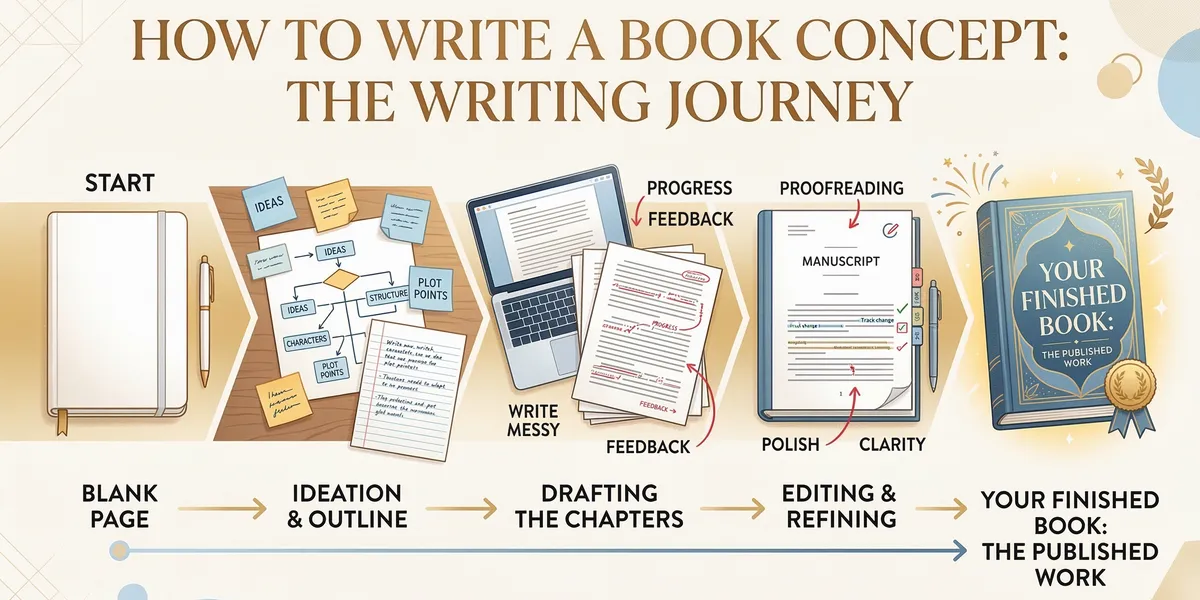
Most people who want to write a book never finish one. The difference between published authors and everyone else isn’t talent — it’s having a clear process and following it through to the end. More than 5,000 books have been created through Chapter alone, proving that the right system turns aspiring writers into published authors.
This guide breaks the entire book-writing process into ten manageable steps, from finding your idea to holding a finished copy. Whether you’re writing a novel, memoir, self-help book, or business guide, the fundamental path is the same.
What this guide covers
- Find your book idea
- Choose your genre and audience
- Create an outline
- Set a writing schedule
- Write the first draft
- Develop characters or organize expertise
- Revise and edit
- Get feedback
- Publish your book
- Tools and resources
- FAQ
1. Find your book idea
Every book starts with an idea, but not every idea makes a good book. The strongest book ideas live at the intersection of two things: something you care about deeply and something readers actually want to read.
Fiction vs. nonfiction
Fiction and nonfiction require different starting points. For fiction, you need a premise — a character with a problem in an interesting setting. For nonfiction, you need expertise or experience that solves a specific problem for a specific audience.
| Starting Point | Fiction | Nonfiction |
|---|---|---|
| Core question | ”What if…?" | "How do I…?” |
| Your advantage | Imagination and storytelling ability | Knowledge, experience, or research |
| Reader expectation | Entertainment, emotional connection | Practical value, transformation |
| Market test | Genre popularity, comparable titles | Search volume, audience pain points |
Test your idea before committing
Before spending months on a manuscript, validate your concept:
- Search Amazon. Are similar books selling? Competition is a good sign — it means readers pay money for this topic. No competition might mean no demand.
- Check online communities. Do people ask questions about your topic on Reddit, Quora, or Facebook groups? Those questions become chapters.
- Write a one-paragraph pitch. If you can’t explain what your book is about and who it’s for in one paragraph, the idea needs refinement.
- Tell three people. Gauge their reaction. Genuine curiosity (“When can I read it?”) beats polite encouragement (“That sounds nice”).
The goal isn’t to find a perfect idea. It’s to find a good idea you can commit to for the months ahead.
2. Choose your genre and audience
Knowing your genre and target reader shapes every decision from this point forward — word count, structure, tone, cover design, and marketing.
Define your genre
Genre isn’t just a marketing label. It’s a promise to the reader about what kind of experience they’ll get. A thriller promises tension and pacing. A memoir promises personal truth. A self-help book promises a solution.
Standard word count ranges vary by genre:
| Genre | Word Count Range | Notes |
|---|---|---|
| Literary fiction | 70,000–100,000 | Agents expect this range for debuts |
| Romance | 70,000–90,000 | Category romance can be shorter (50,000–70,000) |
| Mystery/Thriller | 70,000–90,000 | Fast pacing keeps word counts moderate |
| Fantasy/Sci-Fi | 90,000–120,000 | Worldbuilding allows higher counts |
| Memoir | 70,000–90,000 | Similar range to literary fiction |
| Self-Help | 40,000–60,000 | Readers want actionable, concise content |
| Business | 40,000–60,000 | Focused on practical takeaways |
| Children’s (middle grade) | 25,000–50,000 | Varies widely by age group |
| YA (young adult) | 55,000–80,000 | Pacing is key |
Browse the complete guide to book genres if you’re still deciding where your book fits.
Define your reader
Answer these four questions:
- Who is this person? Age, interests, reading habits, problems they face.
- Why will they pick up this book? Entertainment, education, inspiration, problem-solving.
- What do they already know? This determines your starting point and depth.
- Where do they find books? Amazon search, BookTok, blog reviews, word of mouth.
A nonfiction author writing a book about personal finance for twenty-somethings will make completely different choices than one writing about retirement planning for executives. Same broad topic, different audience, different book.
3. Create an outline
An outline is the architecture of your book. Writing without one is possible — some authors thrive on discovery — but most first-time writers who skip outlining either stall in the middle or produce a manuscript that needs heavy restructuring.
Fiction outlines
Fiction outlines focus on plot structure — the sequence of events that creates rising tension and satisfying resolution. A basic fiction outline includes:
- Opening hook. The scene or moment that pulls readers in. See our guide on how to start a story for detailed techniques.
- Inciting incident. The event that disrupts the protagonist’s normal life.
- Rising action. Escalating conflicts that build tension through the middle.
- Climax. The point of highest tension where the central conflict reaches its peak.
- Resolution. How the story settles after the climax.
You don’t need to plot every scene. Some writers outline chapter by chapter, others use a three-act structure with key turning points. The level of detail depends on what keeps you moving forward.
Nonfiction outlines
Nonfiction outlines are structural — think of them as building a curriculum. Each chapter should teach one main concept, solve one problem, or advance one argument.
A strong nonfiction outline answers: “If a reader follows these chapters in order, what will they know or be able to do by the end?”
Start with your chapter titles, add 3–5 bullet points under each for key topics, and arrange them in logical order. Our book outline guide walks through the full process with templates for both fiction and nonfiction.
How detailed should your outline be?
There’s no single right answer, but here’s a rule of thumb:
- Minimal outline (pantsers). Chapter-level notes with key scenes or topics. Works for experienced writers who know their genre well.
- Moderate outline (plantsers). Chapter summaries with major beats, character arcs, and key arguments. The sweet spot for most first-time authors.
- Detailed outline (plotters). Scene-by-scene breakdowns with dialogue notes, research references, and word count targets per section. Reduces writing time but takes longer upfront.
4. Set a writing schedule
Consistency beats intensity. Writing 500 words every day for five months produces a complete manuscript. Writing 5,000 words in a burst and then nothing for three weeks produces frustration.
Choose a realistic daily word count
According to a Reedsy survey, most authors take six months to a year to complete a book. Your timeline depends on how many words you commit to daily:
| Daily Words | Time to 75,000 Words | Pace |
|---|---|---|
| 200 | ~375 days (1 year) | Gentle — 15–20 minutes/day |
| 500 | ~150 days (5 months) | Moderate — 30–45 minutes/day |
| 750 | ~100 days (3.5 months) | Steady — 45–60 minutes/day |
| 1,000 | ~75 days (2.5 months) | Committed — 60–90 minutes/day |
| 2,000 | ~38 days (5.5 weeks) | Intensive — 2–3 hours/day |
For most first-time authors with day jobs, 500 words per day is sustainable and still produces a finished draft in about five months. That’s roughly 30–45 minutes of focused writing.
Build the habit
- Write at the same time every day. Morning before work, lunch break, after the kids go to bed — consistency matters more than the specific time.
- Protect your writing time. Treat it like a meeting you can’t cancel.
- Track your progress. A simple spreadsheet with dates and word counts creates accountability. Watching the numbers climb is motivating.
- Set a minimum, not a maximum. On bad days, write 200 words. On good days, write as many as flow. The minimum keeps you in the habit; removing the ceiling lets inspiration run.
What about writer’s block?
Writer’s block usually means one of three things: you don’t know what happens next (outline problem), you’re trying to write perfectly on the first pass (editing problem), or you’re burned out (rest problem). Match the fix to the cause. If you’re stuck on what to write next, return to your outline. If you’re agonizing over word choice, give yourself permission to write badly. If you’re exhausted, take a day off without guilt.
5. Write the first draft
The first draft is not supposed to be good. It’s supposed to exist. This is the single most important mindset shift for first-time authors.
The only rule: keep moving forward
Do not edit as you write. Do not go back and fix yesterday’s chapter. Do not rewrite your opening for the fourth time. Push forward until you reach the end.
Ernest Hemingway’s often-quoted advice applies here: “The first draft of anything is garbage.” He was right. Every published book you’ve ever admired was once a messy, unpolished first draft. The magic happens in revision — but you can’t revise a blank page.
Practical first-draft strategies
- Write out of order if needed. Stuck on chapter seven? Skip to chapter ten and write the scene you’re excited about. You can connect them later.
- Use placeholders. Don’t know a character’s last name yet? Write [LASTNAME] and keep going. Can’t find the right statistic? Write [STAT] and look it up later. Momentum matters more than completeness.
- Lower your standards deliberately. Tell yourself this draft is for your eyes only. Nobody will ever read it in this form. This removes the performance pressure that causes paralysis.
- End each session mid-sentence. It sounds counterintuitive, but stopping in the middle of a thought makes it easier to start again tomorrow. You already know what comes next.
How long should the first draft take?
Based on typical word count targets, here’s what to expect:
- Self-help or business book (50,000 words). At 500 words/day: about 3.5 months.
- Novel or memoir (80,000 words). At 500 words/day: about 5.5 months.
- Epic fantasy (110,000 words). At 500 words/day: about 7.5 months.
These timelines assume consistent daily writing. Life interrupts. Budget extra time for vacations, sick days, and the inevitable stretch where motivation dips. A realistic first-draft timeline adds 30–50% to the raw calculation.
6. Develop your characters (fiction) or organize your expertise (nonfiction)
This step happens partly during outlining, partly during drafting, and partly during revision. It gets its own section because character development and knowledge organization are where good books become great ones.
For fiction writers: build real characters
Flat characters sink otherwise strong stories. Readers connect with people, not plots. Your protagonist needs:
- A clear desire. What do they want more than anything?
- A deep flaw. What internal weakness or false belief holds them back?
- An arc. How does the story change them?
Supporting characters should each serve a purpose — challenging the protagonist, revealing backstory, adding conflict, or providing comic relief. If a character doesn’t move the story forward or deepen the reader’s understanding of someone who does, they might not need to be in the book.
Read our full guide on character development for techniques including character interviews, backstory development, and methods for writing believable dialogue.
For nonfiction writers: organize your expertise
Your book’s value comes from what you know that the reader doesn’t. The challenge is organizing that knowledge so a beginner can follow it and an intermediate reader still gains new insight.
Structure your expertise using the pyramid principle:
- Lead with the conclusion. Tell readers what they’ll learn or achieve in each chapter upfront.
- Support with evidence. Stories, data, case studies, frameworks.
- Make it actionable. End each chapter with specific steps or exercises.
Common nonfiction pitfalls:
- The knowledge curse. You forget what it’s like to not know this stuff. Have a beginner read early chapters and flag anything confusing.
- Too much theory, not enough practice. Readers bought a book to do something. Give them tools, templates, and step-by-step processes.
- No stories. Even technical nonfiction needs narrative. Case studies, personal anecdotes, and client examples make abstract concepts concrete.
7. Revise and edit
Revision is where your book transforms from a rough draft into something worth reading. Plan to go through multiple rounds — the exact number depends on how clean your first draft is and how high you set the bar.
Step 1: The big-picture revision
Put your manuscript away for at least two weeks after finishing the first draft. You need distance to see it clearly. When you return, read the entire thing without making changes. Take notes on:
- Structure. Does the book flow logically? Are there sections that drag or feel rushed?
- Consistency. Do characters stay in character? Does the argument build logically?
- Gaps. What’s missing? What questions would a reader have that you haven’t answered?
- Redundancy. What do you say twice (or three times) that only needs to be said once?
Fix these structural issues before touching sentence-level prose. Polishing paragraphs in a chapter you’ll later cut is wasted effort.
Step 2: Line editing
Once the structure is solid, go chapter by chapter and tighten the writing:
- Cut filler words. “Very,” “really,” “just,” “that” (when unnecessary), “in order to” (replace with “to”).
- Activate passive voice. “The ball was thrown by John” becomes “John threw the ball.”
- Vary sentence length. Short sentences create punch. Longer ones provide flow and detail. Mix them.
- Read aloud. Your ear catches awkwardness your eye misses. If you stumble reading a sentence aloud, rewrite it.
Step 3: Copyediting and proofreading
This is the detail pass — grammar, spelling, punctuation, consistency in formatting, fact-checking. Many authors hire a professional copyeditor for this stage. If budget is tight, at minimum:
- Use tools like Grammarly or ProWritingAid for a first pass.
- Print the manuscript and proof it on paper. You’ll catch errors on the printed page that you’ll miss on screen.
- Check proper nouns, dates, and any factual claims.
The editing hierarchy
| Round | Focus | Common Fixes |
|---|---|---|
| Developmental edit | Story/argument structure, pacing, character arcs | Rewriting chapters, reordering sections, cutting subplots |
| Line edit | Prose quality, voice, clarity | Sentence restructuring, word choice, tone consistency |
| Copyedit | Grammar, spelling, punctuation, consistency | Typos, comma usage, style guide compliance |
| Proofread | Final errors in formatted manuscript | Missed typos, formatting glitches, layout issues |
Most traditionally published books go through all four rounds with different editors at each stage. Self-published authors should invest in at least a copyedit — readers notice errors, and they affect reviews.
8. Get feedback
No author can objectively evaluate their own work. You need outside eyes, and the right kind of feedback at the right stage matters enormously.
Beta readers
Beta readers are people who read your finished or near-finished manuscript and give feedback from a reader’s perspective. They’re not editors — they’re your first real audience.
How to find beta readers:
- Writing communities. Critique Circle, r/BetaReaders on Reddit, and NaNoWriMo forums all facilitate beta reader exchanges.
- Your existing network. Friends and family can help, but choose ones who will be honest rather than just supportive.
- Genre-specific groups. Readers in your genre give the most relevant feedback. A romance reader knows pacing expectations that a literary fiction reader doesn’t.
What to ask beta readers:
Give them specific questions rather than “What did you think?” Try:
- Where did you stop reading or lose interest?
- Which character felt most real? Least real?
- Was anything confusing or unclear?
- Did the ending feel earned?
- For nonfiction: Was anything too basic or too advanced? What’s missing?
Writing groups and critique partners
Writing groups provide ongoing accountability and feedback. A good critique partner reads your chapters as you write them, catches problems early, and keeps you honest about quality.
Look for writing groups through local libraries, Meetup.com, or online communities on Discord and Facebook. The best groups have 4–8 members who write in compatible (not necessarily identical) genres and meet on a regular schedule.
When to hire a professional editor
If you plan to self-publish, a professional editor is not optional — it’s the difference between a book that earns reviews and one that earns complaints. If you’re pursuing traditional publishing, agents expect a polished manuscript, so professional editing gives you a competitive edge.
Budget ranges for professional editing:
| Service | Cost Range | When You Need It |
|---|---|---|
| Developmental edit | $0.03–$0.08/word | Major structural issues, first book |
| Line edit | $0.04–$0.10/word | Prose needs polish, voice inconsistencies |
| Copyedit | $0.02–$0.05/word | Grammar, spelling, consistency |
| Proofread | $0.01–$0.03/word | Final pass before publication |
For a 75,000-word book, expect to spend $1,500–$3,750 for a copyedit, or $2,250–$7,500 for a developmental edit. The Editorial Freelancers Association publishes current rate guidelines.
9. Publish your book
You have two main paths to publication: traditional publishing and self-publishing. Both are legitimate, and the right choice depends on your goals.
Traditional publishing
Traditional publishing means a publisher pays you (via an advance against royalties) and handles editing, design, printing, distribution, and some marketing. To get there, most authors need a literary agent who pitches their manuscript to editors at publishing houses.
The traditional path:
- Write a query letter and synopsis.
- Research agents who represent your genre (QueryTracker and Publishers Marketplace are essential tools).
- Submit queries (expect to send 50–100 before getting an offer of representation).
- Agent submits to editors at publishing houses.
- If a publisher offers, negotiate the contract.
- Publication happens 12–24 months after the deal.
Pros: No upfront cost, professional editing and design, bookstore distribution, industry validation.
Cons: Slow (2–4 years from finished manuscript to bookshelf), lower royalties (typically 10–15% for print, 25% for ebook), limited creative control, high rejection rates.
Self-publishing
Self-publishing means you control the entire process and keep a much higher share of revenue. The barrier to entry has never been lower, and the stigma has largely disappeared — some of the bestselling authors in the world are self-published.
The self-publishing path:
- Finalize your edited manuscript.
- Hire a cover designer (or use a design tool).
- Format for ebook and print.
- Choose your publishing platform(s).
- Upload, set your price, and publish.
- Market your book.
Pros: Full creative control, higher royalties (up to 70% on ebooks), faster time to market (weeks, not years), keep all rights.
Cons: All upfront costs fall on you (editing, cover, formatting), marketing is your responsibility, harder to get into physical bookstores without a distributor.
See our complete guide to the best self-publishing platforms for a detailed comparison of Amazon KDP, IngramSpark, Draft2Digital, and more.
Which path is right for you?
| Factor | Traditional | Self-Publishing |
|---|---|---|
| Time to publish | 2–4 years | 1–4 weeks |
| Upfront cost | $0 | $2,000–$5,000+ |
| Royalty rate | 10–25% | 35–70% |
| Creative control | Limited | Complete |
| Bookstore distribution | Strong | Limited (without Ingram) |
| Marketing support | Some (varies widely) | Entirely on you |
| Rights | Publisher holds rights | You keep all rights |
Many authors today use a hybrid approach — self-publishing some works while pursuing traditional deals for others. There’s no wrong answer as long as you’re clear on your priorities.
10. Tools and resources
The right tools won’t write your book for you, but they remove friction from the process. Here’s what’s worth your time at each stage.
Writing software
- Google Docs. Free, simple, and accessible from any device. Great for drafting, especially if you want easy collaboration with editors.
- Scrivener. The industry standard for long-form writing. Corkboard view, chapter organization, and research storage in one app. $49 one-time purchase.
- Ulysses. Clean, distraction-free writing for Mac and iPad. Popular with authors who want a minimal interface. Subscription-based.
Outlining and plotting
- Plottr. Visual timeline-based plotting for fiction writers. Helpful for tracking character arcs across chapters.
- Milanote. Visual brainstorming boards for both fiction and nonfiction planning.
- Simple index cards. Sometimes analog tools work best. Write one scene or chapter idea per card, spread them on a table, and rearrange.
AI writing tools
AI has become a legitimate part of the author’s toolkit. Tools like Chapter can generate complete book outlines, draft chapters from your direction, and accelerate the writing process from months to days. Over 2,147 authors have used Chapter to create more than 5,000 books.
AI works best when you bring the ideas and expertise and let the technology handle the heavy lifting of putting words on the page. If you’re interested in this approach, our guide on how to write a book with AI covers the full process.
Editing tools
- ProWritingAid. Comprehensive grammar and style checker with genre-specific analysis.
- Grammarly. Catches grammar errors and readability issues. Free tier handles basics.
- Hemingway Editor. Highlights complex sentences and passive voice. Useful for tightening prose.
Publishing and formatting
- Atticus. Format for ebook and print from a single file. Clean interface, one-time purchase.
- Vellum. The gold standard for ebook formatting on Mac. Beautiful output with minimal effort.
- Amazon KDP. Free publishing platform with access to the world’s largest book marketplace.
- Canva. Serviceable for basic book cover creation, though hiring a professional designer is strongly recommended for your primary cover.
FAQ
How long does it take to write a book?
Most authors take six months to a year to write a book, according to Reedsy’s author survey. The timeline depends on your genre, daily word count commitment, and how much revision your manuscript needs. A focused writer producing 500 words per day can complete an 80,000-word first draft in about five and a half months. Add two to three months for revision and editing, and you’re looking at eight to nine months from start to finished manuscript.
How many words should a book be?
Word count depends on genre and audience. Novels typically fall between 70,000 and 100,000 words, with fantasy and sci-fi running longer (90,000–120,000) and romance and mystery on the shorter end (70,000–90,000). Nonfiction books like self-help and business titles range from 40,000 to 60,000 words. Children’s books vary widely, from 500 words for picture books to 50,000 for middle grade novels.
Can I write a book with no experience?
Yes. Every published author was once a first-time writer. The skills you need — storytelling, clear communication, persistence — are all learnable. Read widely in your genre, study the craft through resources like books on writing (Stephen King’s On Writing and Anne Lamott’s Bird by Bird are two of the best), and commit to finishing your first draft. Your first book might not be your best, but the only way to get better is to write it.
Can I use AI to write my book?
AI writing tools are a legitimate option for authors at any level. Tools like Chapter help you generate outlines, draft chapters, and organize ideas faster than working from scratch. The key is using AI as a collaborator, not a replacement — you supply the ideas, expertise, and creative direction while the technology accelerates execution. Read our full guide on how to write a book with AI for the complete process.
Do I need an editor?
If you plan to publish — whether traditionally or self-published — professional editing significantly improves your book’s quality and reception. At minimum, invest in a copyedit to catch grammar, spelling, and consistency errors. For first-time authors, a developmental edit that addresses structure, pacing, and content gaps is worth the investment. Budget $1,500–$7,500 depending on the level of editing and your book’s word count.
How much does it cost to publish a book?
Traditional publishing costs you nothing upfront — the publisher covers all production costs and pays you an advance. Self-publishing costs range from $2,000 to $5,000 or more for professional editing, cover design, and formatting. You can reduce costs by doing some tasks yourself (formatting, basic proofreading) but cutting corners on cover design and copyediting usually hurts sales.
Should I self-publish or go traditional?
Self-publishing gives you speed, control, and higher royalties. Traditional publishing gives you bookstore distribution, an advance, and industry infrastructure. Choose self-publishing if you want to publish quickly, keep creative control, and are willing to handle marketing. Choose traditional if you want bookstore placement, don’t mind waiting two to four years, and want a publisher’s team behind you. Many successful authors do both, depending on the project.
How do I stay motivated to finish?
Set a daily writing minimum that’s small enough to be non-negotiable — even 200 words per day adds up to 73,000 words in a year. Track your word count, tell someone about your book (accountability helps), and remember that every published book was written one day at a time. When motivation dips, discipline carries you through. The authors who finish aren’t the most talented — they’re the most consistent.