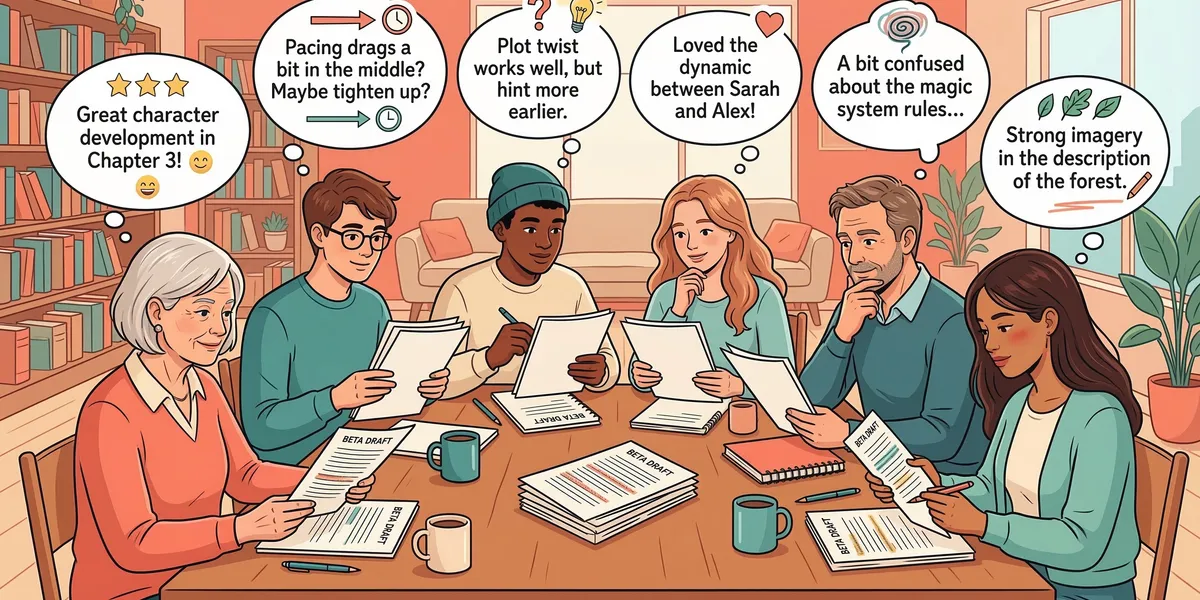
Beta readers are volunteer readers who read your manuscript before publication and give you honest feedback on story, characters, pacing, and readability. They are not editors. They are not your mom. They are the closest thing you get to a test audience before your book goes live.
Every traditionally published author uses them. Every serious self-published author should too. Here is how to find the right ones, ask the right questions, and turn their notes into a better book.
What Beta Readers Actually Do
A beta reader reads your manuscript and tells you what the experience was like. Did the opening hook them? Did the middle drag? Did the twist land? Did they care about the protagonist or want to skip her chapters?
Their job is to be a reader — nothing more, nothing less. They are not looking for typos or critiquing your prose style at the sentence level. They are telling you whether your book works as a reading experience. Where they got bored. Where they got confused. Where they cried, laughed, or threw the book across the room.
This feedback is irreplaceable. You cannot evaluate your own book as a reader because you already know what happens. You know the backstory you cut, the subplot you rewired, the ending you changed three times. A beta reader comes to it fresh. They only know what is on the page.
Beta Readers vs Editors
These two roles are fundamentally different, and you need both.
Beta readers give you the reader’s perspective. They tell you what they felt. “The middle section lost me.” “I didn’t buy the romance.” “The villain’s motivation made no sense.” They identify problems but rarely diagnose them.
Editors give you the professional craft perspective. A developmental editor can tell you why the middle section lost readers (the subplot stalls the main plot arc) and how to fix it (cut chapters 12-14 and weave the subplot details into the main thread). They diagnose and prescribe.
| Beta Readers | Editors | |
|---|---|---|
| Perspective | Reader experience | Professional craft |
| Feedback type | ”This didn’t work for me" | "Here’s why it doesn’t work and how to fix it” |
| Cost | Free (usually) | $500-$5,000+ |
| Expertise | Avid readers | Trained professionals |
| Best for | Identifying problems | Solving problems |
Skipping beta readers and going straight to an editor is like skipping user testing and going straight to a code review. The code might be clean, but does the product actually work for the people using it?
When to Use Beta Readers
Timing matters. Send your manuscript to beta readers at the wrong stage and you waste their time and yours.
After your own revisions, before professional editing. That is the sweet spot.
Here is the sequence that works:
- Write the first draft. Do not show this to anyone. It is a mess and you know it.
- Revise it yourself. Fix the structural problems you already see. Tighten the prose. Cut what needs cutting. Do at least one full revision pass, ideally two.
- Send to beta readers. The manuscript should be the best version you can make it on your own.
- Revise based on beta feedback. Look for patterns (more on that below) and address the real issues.
- Send to a professional editor. Now an editor can focus on craft refinement rather than problems your beta readers already flagged.
If you send your unrevised first draft to beta readers, two things happen. First, they spend all their energy on surface-level problems you would have caught yourself. Second, they burn out on your book and will not want to read the revised version. You get one shot with each beta reader. Make it count.
How to Find Beta Readers
This is where most writers get stuck. You need people who read your genre, will be honest, and will actually finish the book. Here is where to find them.
Online Writing Communities
Reddit’s r/BetaReaders is the single best free resource. The subreddit exists specifically for this purpose. You post your genre, word count, and a brief pitch, and interested readers respond. The community is active and the expectations are clear.
Critique Circle is a structured online workshop where you earn credits by critiquing others’ work, then spend those credits to get your own work reviewed. The feedback tends to be more detailed than casual beta reads because the community attracts serious writers.
Goodreads groups dedicated to beta reading exist for most major genres. Search for “[your genre] beta readers” and you will find them. The quality varies, but the genre-specific targeting is valuable.
Writing Groups
Local writing groups — whether through libraries, bookstores, or meetups — are a reliable source. You already know these people, you have read their work, and there is a built-in reciprocity. You beta read for them, they beta read for you.
Online writing groups on Discord and Facebook serve the same function for writers who prefer digital connections. Look for groups specific to your genre rather than general writing groups.
Writing Conferences and Workshops
If you attend writing conferences, you meet other writers at your stage. Exchange manuscripts. Some of the best beta reading relationships start with a conversation at a craft session or hotel bar.
Social Media Writing Communities
Writing Twitter (or whatever it is called this week), writing Instagram, and writing TikTok all have active communities. Post that you are looking for beta readers in your genre, and you will get responses. Vet them carefully — social media attracts both dedicated readers and people who will say yes and never follow through.
Friends Who Are Avid Readers (Not Family)
Friends who read voraciously in your genre can be excellent beta readers. The key word is avid. Your friend who reads two books a year is not the person for this job.
Do not use family. Your mother will tell you it is wonderful. Your spouse will either lie or start a fight. Family members cannot separate their relationship with you from their reaction to the book. The feedback is useless either way.
What to Ask Beta Readers
Handing someone your manuscript and saying “tell me what you think” is a mistake. You will get vague responses like “I liked it” or “it was good.” That helps no one.
Give your beta readers specific questions. Write them down. Send them as a feedback form alongside the manuscript.
General Questions That Work
- Where did you stop reading and have to make yourself pick it back up?
- Which character felt most real to you? Which felt least real?
- Was there anything that confused you?
- Did the ending feel earned?
- What do you think the book is about, thematically?
Targeted Questions for Specific Concerns
If you already suspect certain areas are weak, ask directly:
- “Did the pacing feel slow in chapters 8-12?” (You already suspect the middle drags.)
- “Did you buy the romance between Sarah and Marcus?” (You are not sure the chemistry works.)
- “Was the twist in chapter 20 surprising, or did you see it coming?” (You are worried it is too telegraphed.)
Questions to Skip
Do not ask “did you like it?” That is a social question, not a craft question. People will say yes to be polite. Ask what they experienced, not whether they approved.
A simple feedback form with 8-10 specific questions gets you vastly better data than an open-ended request. It also makes the beta reader’s job easier — they know exactly what you need from them.
How Many Beta Readers You Need
Three to seven. That is the range that works.
Fewer than three and you cannot spot patterns. One reader’s complaint might be a personal preference. But if three out of five readers say the middle dragged, the middle drags.
More than seven and the feedback becomes overwhelming. You will get contradictory notes, niche opinions, and so much data that you cannot see the signal through the noise. You will spend more time managing feedback than using it.
Five is the sweet spot for most books. It is enough to identify real patterns and few enough to process without losing your mind.
If you write in a niche genre — hard science fiction, historical romance set in Regency England, literary fiction — try to find beta readers who already read that genre. A romance reader beta reading your military thriller will give you feedback filtered through the wrong expectations.
How to Handle Beta Feedback
You have your feedback. Five readers, five sets of notes. Now what?
Look for Patterns
This is the most important rule. If one reader says the ending felt rushed, that might be their preference. If four readers say the ending felt rushed, the ending is rushed. Fix it.
Go through all the feedback and mark every point that comes up more than once. Those are your priorities. A problem that multiple readers independently identify is almost certainly a real problem.
Ignore One-Off Preferences
One reader wants more description. Another wants less. One thinks the love interest should be introduced earlier. Another thinks he shows up at exactly the right time.
Single-reader feedback that contradicts other readers is usually personal preference. Note it and move on. You cannot write a book that satisfies every individual taste, and trying will make the book worse, not better.
Do Not Argue
When a beta reader tells you something did not work, the correct response is “thank you.” Not “but you missed the point” or “if you read more carefully, you would have seen that I set it up in chapter three.”
If they missed the setup in chapter three, your setup did not work. That is the feedback. The reader is never wrong about their experience — they are only wrong about their suggested fix, which is why you ask about experiences, not solutions.
Thank Them
Beta reading is unpaid labor. Someone spent hours — possibly days — reading your manuscript and writing thoughtful notes. Thank them sincerely. Acknowledge specific feedback that was helpful. And when the book comes out, put their name in the acknowledgments.
Writers who treat beta readers well get beta readers who come back for the next book.
Common Mistakes
Sending too early. Your first draft is not ready for beta eyes. Revise it yourself first. At least once, preferably twice. Beta readers should see the best version you can produce alone.
Choosing only friends. Friends want to support you. That is admirable and useless. You need at least some beta readers who have no personal loyalty to you and will tell you the truth without worrying about your feelings.
Not asking specific questions. “Tell me what you think” gets you “I liked it!” Give them a feedback form with targeted questions. You will get targeted answers.
Trying to please every reader. If you rewrite to satisfy every note from every reader, you will gut the book. Use the pattern rule — fix what multiple readers flag, ignore the rest.
Skipping betas because you have an editor. Editors are not readers. They are professionals evaluating craft. Beta readers tell you whether the book works as an experience. You need both perspectives, and beta feedback should come first.
FAQ
Do beta readers get paid?
Usually no. Beta reading is typically a volunteer arrangement between writers and readers. Some beta readers do charge a small fee ($50-$150), and paid betas tend to be more reliable about finishing and providing detailed feedback. But the majority of beta reading happens through free reciprocal arrangements in writing communities.
How long should I give beta readers to finish?
Two to four weeks is standard for a full-length novel. Set a clear deadline upfront. Some readers will not finish — that is normal. If more than half your betas fail to complete the manuscript, the book may have a problem that is causing them to put it down, and that itself is valuable feedback.
Can I use beta readers for nonfiction?
Absolutely. Nonfiction beta readers are testing whether your argument is clear, your structure makes sense, and your advice is actionable. They are especially valuable for how-to books and memoirs, where reader engagement matters as much as accuracy.
Should beta readers sign an NDA?
For most unpublished manuscripts, an NDA is unnecessary and can scare off potential readers. If you are working with a high-profile project or writing about sensitive material, a simple one-page agreement is reasonable. But for the vast majority of writers, trust and reputation within writing communities provide sufficient protection.
What is the difference between a beta reader and a critique partner?
A critique partner is a fellow writer who reads your work with a craft lens — they give feedback on technique, structure, and prose quality, often chapter by chapter. A beta reader is a general reader who reads the whole manuscript and reports on their experience. Critique partners tend to be ongoing relationships. Beta readers are typically project-specific. Both are valuable at different stages of character development and novel writing.