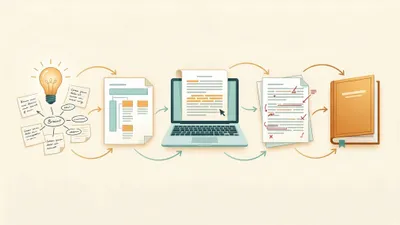
You write a novel by starting with a strong premise, building characters readers care about, choosing a structure that fits your story, and then writing a complete first draft before you revise. The process takes most writers three to twelve months, depending on genre and pace — and every published novel you have ever read started as a rough, imperfect first attempt.
This guide walks through the entire novel-writing process in ten steps, from the initial spark of an idea to deciding what happens after you type “The End.” Whether this is your first novel or your fifth, the fundamentals are the same.
What this guide covers
- Start with a premise
- Develop your characters first
- Choose your structure
- Build your world
- Write a scene-by-scene outline
- Set your word count target
- Write the first draft
- Revision strategy
- Getting feedback
- What comes next
- FAQ
1. Start with a premise
Every novel begins with a “what if” question. Not a theme, not a character sketch, not a vague feeling — a specific question that creates tension and demands a story to answer it.
The best premises combine a compelling situation with built-in conflict:
- “What if a boy discovered he was a famous wizard — and the dark lord who killed his parents was coming back?” (Harry Potter)
- “What if society forced children to fight to the death on live television?” (The Hunger Games)
- “What if a woman woke up every morning with no memory of the day before, and her husband might be lying about their past?” (Before I Go to Sleep)
- “What if an aging fisherman went 84 days without catching a fish, then hooked the biggest marlin anyone had ever seen?” (The Old Man and the Sea)
Notice the pattern. Each premise contains a character, a situation, and a source of conflict. “What if there was a magical school” is a setting, not a premise. “What if an orphan discovered he was famous in a world he never knew existed” is a premise — it immediately raises questions the reader wants answered.
How to find your premise
If you are staring at a blank page without a premise, try these approaches:
- Flip an assumption. Take something everyone accepts as true and reverse it. What if aging worked backward? What if animals could testify in court?
- Combine two unrelated ideas. A heist story set in a monastery. A love story during a zombie apocalypse. Unexpected combinations create fresh premises.
- Start with a character in trouble. Think about a person in the worst possible situation for someone like them. A pacifist drafted into war. A germaphobe stranded in the wilderness.
- Mine your own obsessions. What topics make you lose track of time? What injustice makes you angry? What question keeps you up at night? Your novel will take months — you need a premise that holds your attention.
Write your premise in one sentence. If it takes a paragraph to explain, it is not focused enough yet. Refine it until you can say, “My novel is about [character] who must [goal] despite [obstacle].”
For more techniques on finding the right opening moment, see our guide on how to start a story.
2. Develop your characters first
Plot is what happens. Character is why anyone cares. The most intricate plot in the world falls flat if readers do not connect with the people living through it.
Build your protagonist
Your protagonist needs two things: a conscious want and an unconscious need. The want drives the external plot. The need drives the character arc.
Example: In The Hunger Games, Katniss wants to survive the Games and protect her sister. She needs to learn that she cannot carry every burden alone and that allowing others to help her is not weakness.
Ask these questions about your protagonist:
- What do they want more than anything? This becomes the story goal.
- What are they afraid of? This creates internal conflict.
- What flaw holds them back? This gives them room to grow.
- What would they never do? This is what the story will eventually force them to do.
Build your antagonist
The antagonist is not simply “the bad guy.” The best antagonists believe they are the hero of their own story. Their goals directly oppose the protagonist’s goals, and their logic — from their perspective — makes perfect sense.
A compelling antagonist should be capable enough to genuinely threaten the protagonist. If your hero can easily win, there is no tension. The antagonist should challenge the protagonist’s worldview, not just their safety.
Supporting cast
Every supporting character should serve at least one of these functions: reveal something about the protagonist, create conflict, provide essential skills or information, or represent the theme. If a character does none of these, cut them.
Dive deeper into building a memorable cast in our character development guide.
3. Choose your structure
Structure is the skeleton of your novel — the framework that holds everything together. You do not need to choose one rigid system, but understanding the options helps you build a story that keeps readers turning pages.
Three approaches to structuring
Plotters plan everything before writing. They create detailed outlines, know every major scene, and write with a roadmap. This approach reduces dead ends and makes drafting faster but can feel rigid.
Pantsers (writing “by the seat of your pants”) discover the story as they write. They start with a character or situation and follow the thread. This approach captures spontaneity but often requires heavier revision.
Plantsers blend both. They outline key turning points but leave room for discovery between them. Most professional novelists land somewhere in this middle ground.
None of these approaches is superior. The right one is whichever gets you to a finished manuscript.
Structural frameworks
Several proven frameworks can guide your story’s shape:
Three-Act Structure — The most intuitive framework. Act One (roughly 25% of the novel) introduces the character and world, then disrupts them with an inciting incident. Act Two (roughly 50%) escalates conflict through rising stakes and a midpoint shift. Act Three (roughly 25%) delivers the climax and resolution.
The Hero’s Journey — Joseph Campbell’s mythic structure traces a protagonist from their ordinary world through a series of trials, a transformation, and a return. Works especially well for fantasy, sci-fi, and adventure novels.
Save the Cat! Beat Sheet — Blake Snyder’s framework breaks a story into fifteen specific “beats,” from the opening image to the finale. Originally designed for screenwriting, it translates well to novel plotting and gives you concrete milestones to hit.
Seven-Point Story Structure — Hook, Plot Turn 1, Pinch Point 1, Midpoint, Pinch Point 2, Plot Turn 2, Resolution. A streamlined framework that focuses on escalation.
Explore these structures in detail in our plot structure guide, and see how story arcs create satisfying emotional trajectories.
4. Build your world
Worldbuilding is not just for fantasy and science fiction. Every novel has a world — the physical, social, cultural, and emotional environment your characters inhabit. A legal thriller set in Manhattan needs worldbuilding as much as an epic fantasy.
Setting as character
The best settings feel alive. They influence the plot, constrain the characters, and create atmosphere. Think about:
- Physical environment. Geography, weather, architecture. A story set in a cramped apartment in a rainy city feels fundamentally different from one set on a sprawling ranch in summer.
- Rules and systems. Every world operates on rules, whether they are magical laws, social hierarchies, or economic realities. Define the rules, then let your characters push against them.
- Atmosphere. What does the world feel like? The oppressive surveillance of Orwell’s 1984 creates constant tension. The whimsical danger of Hogwarts creates wonder and stakes simultaneously.
- Time period. Historical settings require research; futuristic settings require consistency. Even contemporary settings need attention to how time shapes daily life.
The iceberg rule
Build ten times more world than you show on the page. Knowing the history of your fictional city, the economic system of your fantasy kingdom, or the daily routine of your protagonist’s neighborhood gives your writing authority — even if 90% of that knowledge never makes it into the novel directly.
Example: Tolkien created entire languages, histories, and genealogies for Middle-earth. Most of it never appeared in The Lord of the Rings, but its presence underneath the surface gave the world a depth readers could feel.
Genre-specific worldbuilding
| Genre | Key Worldbuilding Focus |
|---|---|
| Fantasy | Magic systems, political structures, races/cultures, geography |
| Sci-fi | Technology rules, societal impact, space/time mechanics |
| Historical | Period accuracy, social norms, material culture, language |
| Contemporary | Subcultures, economic class, geography, institutional dynamics |
| Thriller | Power structures, surveillance, technology, jurisdictions |
| Romance | Social circles, workplace dynamics, community, barriers to love |
5. Write a scene-by-scene outline
Some writers need a detailed scene-by-scene outline. Others need a loose list of major turning points. Both approaches produce finished novels — the question is which one keeps you moving forward.
The detailed outline approach
A scene-by-scene outline typically includes:
- Scene goal. What must this scene accomplish for the plot?
- POV character. Whose perspective drives the scene?
- Conflict. What tension or obstacle appears?
- Outcome. How does the scene end — and what question does it raise for the next scene?
A 75,000-word novel typically has 50 to 80 scenes. Outlining each one takes time upfront but dramatically speeds drafting. You never sit down wondering “what happens next” — you already know.
The loose outline approach
If detailed outlines kill your creative energy, try a milestone outline instead. Identify five to ten key moments:
- Opening scene / hook
- Inciting incident
- First major plot turn
- Midpoint reversal
- Dark moment / all is lost
- Climax
- Resolution
Write toward each milestone, discovering the connecting scenes as you go. This approach gives you direction without rigid constraints.
Our book outline guide provides templates and examples for both detailed and loose approaches.
6. Set your word count target
Novel length varies by genre, and hitting the expected range matters — especially if you plan to pursue traditional publishing. Agents and editors have expectations, and significantly over- or under-shooting them raises red flags.
Novel lengths by genre
| Genre | Word Count Range | Notes |
|---|---|---|
| Literary fiction | 70,000–100,000 | Debut novels should lean toward 80,000–90,000 |
| Romance | 50,000–80,000 | Category romance can run shorter (50,000–60,000) |
| Fantasy | 80,000–120,000 | Epic fantasy can go higher, but debut novels over 120K are a tough sell |
| Thriller / Suspense | 70,000–90,000 | Tight pacing keeps word counts moderate |
| Mystery | 70,000–90,000 | Cozy mysteries trend shorter (60,000–75,000) |
| Science fiction | 80,000–110,000 | Worldbuilding justifies higher counts |
| YA (young adult) | 50,000–80,000 | Upper YA can push toward 90,000 for fantasy |
| Horror | 70,000–90,000 | Shorter can work if tension is relentless |
Calculate your timeline
Once you know your target, set a daily word count goal and calculate how long the first draft will take:
- 500 words/day = 80,000-word draft in about 5 months
- 1,000 words/day = 80,000-word draft in about 2.5 months
- 2,000 words/day = 80,000-word draft in about 6 weeks
Choose a pace you can maintain for months, not a sprint you will abandon after two weeks. Consistency matters far more than speed.
If you want to accelerate your drafting process, AI writing tools like Chapter’s fiction software can help you maintain momentum — generating scene drafts, working through dialogue, and pushing past blocks while you stay in creative control. Over 5,000 books have been created through the platform, and it is built specifically for fiction writers who want a collaborator, not a replacement.
7. Write the first draft
This is where most aspiring novelists stop being aspiring and start being actual novelists. The first draft is the hardest step — not because writing is hard (though it can be) but because finishing is hard.
The messy middle
Almost every novelist hits a wall somewhere between 20,000 and 50,000 words. The excitement of the beginning has faded, the ending feels impossibly far away, and every sentence feels wrong. This is normal. It has a name: the messy middle.
Strategies for pushing through:
- Skip ahead. Write a scene you are excited about, then come back and fill in the gap later.
- Lower your standards. Your first draft is not supposed to be good. It is supposed to exist. Write the worst version of the scene and move on.
- Revisit your premise. Reread your “what if” question. Does it still excite you? If not, you might need a stronger premise — which is better to discover at 30,000 words than at 80,000.
- Talk to your characters. Write a journal entry from your protagonist’s perspective. What are they feeling? What do they want right now? Sometimes the character knows what should happen next, even when you do not.
Daily writing practices
- Write at the same time every day. Building a routine removes the decision of “when” and lets you focus on the work.
- Set a timer, not just a word count. Some days the words flow; other days you grind. Either way, spending an hour in the chair is progress.
- Do not edit yesterday’s work. If you must reread, give yourself five minutes, then push forward. Editing mid-draft is the single most common reason novels do not get finished.
- End each session mid-scene. Hemingway’s trick — stop writing when you know what happens next. It makes starting the next session dramatically easier.
Writing through doubt
Every novelist — including the bestselling ones — has moments of thinking “this is terrible and no one will want to read it.” That thought is not a signal to stop. It is a signal that you are doing the hard creative work that matters.
The only failed novel is the one you stop writing. A finished rough draft can be revised into something excellent. An abandoned manuscript cannot.
8. Revision strategy
Revision is where a rough draft becomes a real novel. The key is working from big picture to small detail — fixing the foundation before you polish the trim.
Round one: structural revision
Read your entire draft without editing. Take notes on:
- Plot holes. Does the sequence of events make logical sense? Are there scenes that contradict each other?
- Character arcs. Does every major character change from beginning to end? Are those changes earned through the events of the story?
- Pacing. Where did you get bored reading your own work? Those are the sections readers will skip — cut them, compress them, or add conflict.
- Stakes. Do the stakes escalate throughout? Is there enough at risk to keep readers invested?
This round often involves cutting entire scenes, adding new chapters, rearranging the timeline, and rewriting significant sections. It is the most labor-intensive revision pass, and it is the most important one.
Round two: scene-level revision
Once the structure holds, work through each scene individually:
- Does each scene have a clear goal and conflict? Scenes without tension are scenes readers skim.
- Does each scene end with a shift? Something should change — a new piece of information, a decision, a reversal. If a scene ends in the same emotional or informational place it started, it is not pulling its weight.
- Are transitions smooth? Can the reader follow the movement between scenes, locations, and time periods?
Round three: line-level editing
Now you polish the prose:
- Dialogue. Does each character sound distinct? Read dialogue aloud — if every character sounds the same, rewrite with their individual speech patterns in mind.
- Description. Is it specific and sensory, or generic? “The room was nice” tells the reader nothing. “The room smelled like old carpet and lemon cleaner, and the light through the blinds striped everything in gold” creates an experience.
- Word choice. Cut adverbs where a stronger verb works. Remove filler words (just, really, very, quite). Tighten every sentence.
- Opening and closing paragraphs. The first paragraph of your novel and the last paragraph of every chapter matter most. Give them extra attention.
9. Getting feedback
You cannot objectively evaluate your own novel. You are too close to it. Outside readers catch problems you are blind to — confusing plot points that make sense to you because you know the backstory, characters who feel vivid in your head but flat on the page, pacing issues you cannot see because you already know what happens next.
Beta readers
Beta readers are volunteer readers who read your manuscript and provide feedback. The best beta readers are:
- In your target audience. A romance reader for your romance novel. A thriller fan for your thriller.
- Honest. You need people who will tell you the truth, not people who will tell you it is wonderful to avoid hurting your feelings.
- Specific. “I liked it” is not helpful. “I lost interest in chapter twelve because the subplot with the neighbor felt disconnected from the main plot” is useful.
Find beta readers through writing groups, online communities (r/BetaReaders, Goodreads groups), or local writing workshops.
Critique partners
A critique partner is another writer who exchanges manuscripts with you. You read and critique each other’s work. This relationship is more intensive than beta reading — critique partners typically provide detailed, craft-focused feedback on structure, character, prose, and technique.
What to do with feedback
Not every piece of feedback deserves action. Use the “two out of three” rule: if two or more readers flag the same issue, it is almost certainly a real problem. If only one reader mentions something, consider whether it aligns with your vision before changing anything.
Listen for patterns, not prescriptions. Readers are excellent at identifying when something does not work. They are less reliable at prescribing the fix. Your job is to hear the problem, then find your own solution.
10. What comes next
You have a revised, polished, beta-read manuscript. Now you choose your path to publication.
Traditional publishing
The traditional route goes: query letter to literary agent, agent submits to publishers, publisher offers a deal. This path gives you professional editing, cover design, distribution, and the prestige of a publishing house — but it is slow (often 1-2 years from signed deal to bookshelf) and highly competitive.
To query agents, you need a polished query letter (one page), a synopsis (1-3 pages), and a complete, revised manuscript. Research agents who represent your genre, personalize each query, and prepare for rejection — even successful authors typically receive dozens of rejections before landing representation.
Self-publishing
Self-publishing gives you full creative control, higher royalty percentages (up to 70% on Amazon KDP), and speed — you can go from finished manuscript to published book in weeks. The tradeoff is that you handle everything: editing, cover design, formatting, marketing, and distribution.
Explore the best platforms, royalty structures, and strategies in our guide to the best self-publishing platforms.
Hybrid publishing
Some authors combine both approaches — traditionally publishing some works and self-publishing others. Others start by self-publishing to build an audience, then leverage those sales numbers to attract a traditional deal.
There is no single right answer. The right path depends on your goals, timeline, and how much control you want over the process.
For a broader view of the entire book-writing journey including nonfiction, see our complete guide on how to write a book.
FAQ
How long does it take to write a novel?
Most first-time novelists take six months to a year to complete a draft, then another two to six months revising. The total timeline from first word to polished manuscript is typically nine to eighteen months. Some writers finish faster (especially with consistent daily habits or AI writing tools), while others take several years. The variable that matters most is consistent daily writing — 500 words a day produces a complete draft in five months.
How many words should a novel be?
A standard novel falls between 70,000 and 100,000 words. Genre expectations vary: literary fiction and thrillers tend toward 70,000-90,000, while fantasy and sci-fi can run 80,000-120,000. YA novels typically range from 50,000 to 80,000 words. For debut novelists pursuing traditional publishing, staying within your genre’s expected range gives you the best chance with agents.
Do I need to outline my novel before writing?
No. Some successful novelists are dedicated “pantsers” who discover the story as they write. Others are strict plotters who outline every scene. Most fall somewhere in between. If you are a first-time novelist, a moderate outline — major turning points and character arcs mapped, with room for discovery in between — reduces the risk of getting stuck in the middle or producing a draft that needs complete restructuring.
Can I write a novel with AI?
Yes. AI writing tools can help with brainstorming premises, developing characters, drafting scenes, working through blocks, and revising prose. The key is using AI as a collaborator rather than a replacement — you provide the creative vision, emotional truth, and storytelling instincts, while AI helps with the execution. Tools like Chapter are built specifically for this collaborative approach to fiction writing.
What is the hardest part of writing a novel?
For most writers, it is finishing the first draft — specifically, pushing through the “messy middle” between roughly 25% and 75% of the manuscript. The beginning is exciting and the ending is motivating, but the middle requires discipline. The second hardest part is revision, because it demands you cut scenes you love and rewrite sections you thought were finished. Both challenges are normal and surmountable with the right process.