Arek Z., an Amazon FBA coach in Toronto, used a single book as a lead magnet and generated $60,000 in revenue in 48 hours. Not from book sales. From clients who read the book and hired him.
“$60,000 in 48 hours from one lead magnet — and that was a book,” Arek said. “The fact that it was so hands-off… absolutely epic.” He went on to clear $100K in revenue in Q1 alone, all traceable back to one short book.
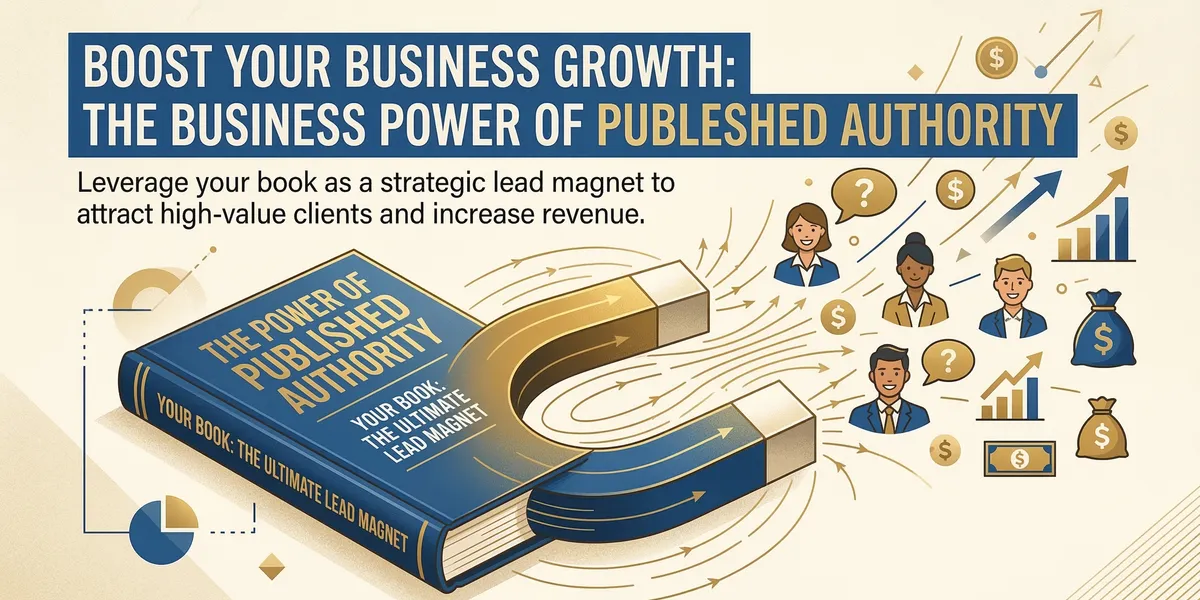
This guide breaks down exactly how a book as a lead magnet works, why it outperforms every other lead magnet format, and how to create yours in days instead of months.
What this guide covers
- What is a book lead magnet
- Why books beat PDFs and checklists
- The book-to-client pipeline
- How to write your lead magnet book
- Getting your book done fast
- Distribution strategy
- Beyond clients: unexpected doors a book opens
- The ROI math
What is a book lead magnet
A book lead magnet is a short, focused book — typically 80 to 150 pages — that you give away for free, sell at a low price, or use as a bonus to attract your ideal clients. Unlike a typical lead magnet (a PDF checklist, a webinar recording, a free email course), a book positions you as a published authority in your field.
The goal is not royalties. The goal is clients.
You write a book that solves one specific problem your ideal customer has. They read it, recognize your expertise, and reach out to hire you for the bigger problem only you can solve. The book does the selling so you don’t have to.
Here is what separates a lead magnet book from a traditional book:
| Traditional Book | Lead Magnet Book | |
|---|---|---|
| Length | 200-400 pages | 80-150 pages |
| Goal | Royalties & prestige | Client acquisition |
| Price | $15-$30 | Free to $4.99 |
| Depth | Comprehensive coverage | Solves one core problem |
| Call to action | ”Buy my next book" | "Here’s how to work with me” |
| Timeline | 6-18 months | Days to weeks |
The key insight: a lead magnet book gives away enough value to prove your expertise, while naturally creating demand for your paid services.
Why books beat PDFs and checklists as lead magnets
Every coach, consultant, and service provider has a PDF lead magnet. That is exactly the problem. When everyone offers a “free guide” or a “5-step checklist,” none of them stand out. A book does.
Perceived value is incomparable
A PDF has a perceived value of zero. People download it, glance at it, and forget it exists. A book — even a short one — has a perceived value of $15 to $25 in the reader’s mind. People keep books. They put them on shelves. They tell friends about them. Nobody tells their friends about your free checklist.
The “published author” effect
The moment you publish a book, you join a different category in your prospect’s mind. You are no longer just another coach or consultant. You are the person who literally wrote the book on the subject. This is the foundation of building an authority book that positions you as the go-to expert.
That shift in perception is worth more than any ad campaign. It changes the power dynamic in every sales conversation. Instead of convincing prospects to hire you, they come to you pre-sold.
Amazon presence builds passive credibility
When your book is published on Amazon, anyone who Googles your name finds it. That instant credibility check closes deals before you ever get on a call. Prospects who find your book independently come in warmer than any referral.
Longer shelf life
A PDF gets buried in a downloads folder. An email sequence gets archived. A book sits on someone’s desk, nightstand, or Kindle library for months or years. Every time they see the spine, they think of you.
The book-to-client pipeline
Here is how the book-to-client pipeline works in practice:
Book → Reader → “This person is an expert” → Inquiry → Client
It sounds simple because it is. But the results are staggering when you see it work.
Jim T., a business consultant in Chicago, experienced this firsthand. He wrote a book about his area of expertise and put it out into the world. Then the calls started coming.
“A stranger read my book and reached out: ‘I need your help. What does it cost?’” Jim said. “I said $13,200. He started the same day.”
No sales funnel. No follow-up sequence. No discovery call where Jim had to justify his price. The book did all of that work in advance. By the time the prospect picked up the phone, the only question was how much — not whether Jim was qualified.
This is what a book does that no other marketing asset can: it gives prospects enough time with your thinking to build genuine trust. A 100-page book takes two to four hours to read. That is two to four hours where your ideal client is absorbing your expertise, your frameworks, and your perspective. By the last page, they already feel like they know you.
Why the pipeline converts so well
- Self-qualification. Only people genuinely interested in your topic read an entire book. Everyone else drops off early. The people who reach out are already qualified.
- Price anchoring. Your book demonstrates the depth of your knowledge. When you name a premium price, it feels justified — they’ve seen the proof.
- Trust building at scale. You cannot have a two-hour conversation with every prospect. But you can put a book in their hands that does the same job.
- Objection handling. A well-structured lead magnet book addresses common doubts and objections naturally, through stories, case studies, and frameworks.
How to write your lead magnet book
Writing a lead magnet book is different from writing a comprehensive reference book. You are not trying to cover everything. You are trying to solve one problem well enough that readers think, “If the free book is this good, imagine what working with them directly is like.”
Step 1: Choose the right topic
Your topic should sit at the intersection of three things:
- Your ideal client’s biggest pain point. What keeps them up at night? What problem would they pay thousands to solve?
- Your proven expertise. What have you helped clients achieve, repeatedly? What results can you point to?
- A natural bridge to your services. The book should solve a problem that creates awareness of a bigger problem — one you solve through your paid offering.
For example, if you are a business coach who helps companies scale to seven figures, your book might cover the five mistakes that keep businesses stuck below $500K. Readers identify their mistakes, realize they need help fixing them, and reach out to you.
Step 2: Structure around the reader’s problem
A lead magnet book is not an autobiography. Structure it around the reader’s journey:
- Open with the problem. Make readers feel understood.
- Explain why the problem exists. Give context and credibility.
- Present your framework. This is your unique method or approach.
- Show proof it works. Case studies, results, testimonials.
- Close with the next step. A clear call to action for readers who want more help.
Keep chapters short — 1,500 to 2,500 words each. Eight to twelve chapters is the sweet spot for a 100-page lead magnet book.
Step 3: Include a clear call to action
This is where most authors fail. They write a great book and forget to tell the reader what to do next. Your book needs a call to action — not pushy, but clear.
Options that work:
- A dedicated final chapter titled “What to do next” or “Working together”
- A link to a free consultation or strategy call
- An invitation to a private community or resource hub
- A QR code to a landing page with your services
The call to action should feel like a natural extension of the book’s value, not an interruption.
Getting your book done fast
The biggest objection to using a book as a lead magnet is time. Writing a book takes months, right?
Not anymore.
Both Arek and Jim created their books using Chapter, an AI book writing platform that helps authors go from idea to finished manuscript in days instead of months. Over 2,147 authors have used Chapter to create more than 5,000 books — and the platform has been featured in USA Today and the New York Times.
Here is what the process looks like:
- Define your topic and audience — one session, about 30 minutes
- Generate your outline — Chapter’s AI structures your book around your expertise
- Write and refine — work through each chapter with AI assistance, adding your voice, stories, and frameworks
- Edit and polish — clean up the manuscript for publication
- Export and publish — your book is ready for Amazon KDP, your website, or both
The entire process can happen in a weekend. Compare that to the traditional route: six months to a year of writing, $5,000 to $25,000 for a ghostwriter, plus editing and formatting costs.
When the barrier to creating a book drops from months and thousands of dollars to days and $97, there is no reason not to have one. Writing a book has never been more accessible.
Distribution strategy: getting your book in front of ideal clients
A lead magnet book only works if people read it. Here are the distribution channels that drive the most client acquisition.
Amazon KDP
Publishing on Amazon does two things: it makes your book discoverable to people searching for your topic, and it gives you the credibility of being “an Amazon-published author.” Even if you give the book away elsewhere, having it on Amazon matters. Follow a solid guide to self-publishing your book to get the listing right.
Price it between $0.99 and $4.99 on Kindle. The goal is not revenue — it is reach and credibility.
Your website opt-in
Offer the book as a free download on your website in exchange for an email address. This builds your email list with highly qualified leads. A landing page with the book cover, a one-paragraph description, and an email form is all you need.
Events and speaking engagements
Hand out physical copies at conferences, networking events, and client meetings. A book is the most powerful business card you can carry. Nobody throws away a book.
Sales funnels
Add the book to your existing sales funnel:
- Top of funnel: free book download captures leads
- Middle of funnel: email sequence follows up with additional value
- Bottom of funnel: invitation to a consultation or strategy call
Social media and content marketing
Share excerpts, key insights, and chapter summaries on LinkedIn, Instagram, and your blog. Every piece of content links back to the book. The book links back to your services.
Partnerships and affiliates
Give copies to complementary service providers, podcast hosts, and industry contacts. When they recommend your book, they are effectively recommending you.
Beyond clients: unexpected doors a book opens
A book as a lead magnet does more than attract clients. It opens doors you never expected.
Kerri-Anne K., a CEO in Australia, experienced this in a way she never anticipated. After completing her book using Chapter, she shared the news publicly.
“A lady reached out and offered me a speaking engagement in Vegas — in front of 20,000 people,” Kerri-Anne said. “Just from saying my book was done.”
One book. One announcement. A speaking gig in front of 20,000 people.
This is not an isolated story. Published authors regularly report:
- Speaking invitations. Event organizers prefer speakers who have written books — it validates their expertise and gives attendees a takeaway.
- Media features. Journalists and podcast hosts look for credible sources. A published book makes you one.
- Partnership opportunities. Other businesses want to align with published authorities. Your book becomes the proof point.
- Premium pricing power. Published authors command higher fees for consulting, coaching, and services. The book justifies the premium.
The book itself might generate modest direct revenue. The opportunities it creates are worth orders of magnitude more.
The ROI math: why this is the cheapest marketing investment you’ll make
Let’s put real numbers to this.
The cost side
| Expense | Traditional Route | Using Chapter |
|---|---|---|
| Writing/ghostwriting | $5,000-$25,000 | $97 (Chapter subscription) |
| Your time | 6-12 months | A few days |
| Editing | $1,000-$3,000 | Built into the process |
| Cover design | $500-$1,500 | Free tools available |
| Formatting | $200-$500 | Export-ready from Chapter |
| Total | $6,700-$30,000 | Under $200 |
The return side
Look at the real results from the case studies in this guide:
- Arek Z.: $60,000 in 48 hours. $100K in Q1. From one book.
- Jim T.: $13,200 from a single client who found his book. No sales conversation needed.
- Kerri-Anne K.: A speaking engagement in front of 20,000 people. Priceless for brand building.
Even if your results are a fraction of these, the math is overwhelming. One client worth $5,000 from a book that cost you $97 and a weekend of your time is a 5,000% return on investment.
Compare that to other marketing channels:
| Channel | Cost per Lead | Typical Close Rate | Cost per Client |
|---|---|---|---|
| Google Ads | $50-$200 | 2-5% | $1,000-$10,000 |
| Facebook Ads | $20-$100 | 1-3% | $700-$10,000 |
| Cold outreach | $10-$50 (tools + time) | 1-2% | $500-$5,000 |
| Lead magnet book | $1-$5 (printing/delivery) | 10-30% | $10-$50 |
Books convert at dramatically higher rates because readers are pre-sold by the time they finish. You are not cold-pitching a stranger. You are answering a call from someone who already trusts your expertise.
Your next step
You have seen the math. You have seen the case studies. You know that a short, focused book can attract clients, command premium prices, and open doors you never imagined.
The only question is how quickly you want to start.
Chapter makes it possible to go from idea to finished lead magnet book in days. Over 5,000 books have been created on the platform — by coaches, consultants, CEOs, and service providers who understood that a book is the most powerful marketing asset you can own.
Your future clients are looking for an expert. Give them a book that proves you are one.