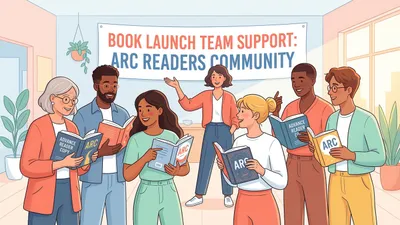
A book launch team checklist is a dated task list that tells you exactly what to do, and when, from the day you start recruiting readers to the week after your book goes live. Run it properly and you can walk into launch day with 30 or more reviews already queued up.
In this guide, you will get:
- The full 90-day checklist, broken into five phases with deadlines attached
- The math that tells you how many team members you actually need for your review goal
- A role matrix so nobody on your team wonders what they are supposed to do
- Copy-and-paste message templates for recruiting, onboarding, and launch-day nudges
Here is the checklist, phase by phase.
What Is a Book Launch Team Checklist?
Book launch team checklist — a phased task list that coordinates the recruiting, onboarding, and activation of the volunteer readers who review and promote your book during release week.
It differs from a general book launch checklist in one important way. A launch checklist covers everything you do. A launch team checklist covers everything your people do, and everything you must do to make their part easy.
That distinction matters because launch teams fail on logistics, not enthusiasm. Readers say yes, then never get a file, or get a file they cannot open, or get no reminder on the day it counts.
If you have not built a team yet, start with our guide on how to build a book launch team, then come back here for the execution plan.
How Many People Do You Need on Your Launch Team?
You need roughly three to four committed team members for every review you want on launch day. A well-run team converts about 25 to 35 percent of members into an actual posted review, so a 30-review goal means recruiting 90 to 120 people.
That ratio surprises most first-time authors, so here is the arithmetic written out.
Team size = (review goal ÷ 0.30) × 1.15
The 1.15 accounts for attrition. Between the day someone signs up and the day your book releases, roughly 15 percent of your list goes quiet — new job, new baby, forgotten inbox.
| Review goal | Members to recruit | Realistic reviews by day 7 |
|---|---|---|
| 10 | 38 | 10 to 13 |
| 25 | 96 | 24 to 33 |
| 50 | 192 | 48 to 67 |
| 100 | 383 | 96 to 134 |
Do not inflate the numbers by adding people who have never heard of you. A 40-person team of genuine readers outperforms a 300-person team scraped from Facebook groups, because Amazon weights reviews by account history and purchase behavior.
Phase 1 — Days 90 to 61 Before Launch (Foundation)
In the 90 to 61 day window, your only job is infrastructure. You are building the containers your team will pour into later, and none of it is public yet.
Checklist:
- Set your review goal and back into a team size using the formula above
- Lock your release date — see our breakdown of the best days to launch a book before you commit
- Finish the manuscript through the copyedit stage (an ARC with typos costs you goodwill)
- Finalize the cover, because your team will share it constantly
- Choose a distribution method for the ARC file (BookFunnel, StoryOrigin, or a plain emailed EPUB)
- Create a dedicated launch team email list or tag, separate from your main newsletter
- Draft the team welcome page that explains what you are asking for
- Write the five-email onboarding sequence you will send once people join
- Build a simple tracking sheet with columns for name, email, ARC sent, review posted, platform
That last item does more work than anything else on the list. A single spreadsheet is the difference between “I think about 20 people reviewed” and knowing exactly who to thank and who to nudge.
For file delivery specifically, compare BookFunnel for authors against the alternatives before you pay for a year.
Phase 2 — Days 60 to 31 Before Launch (Recruiting)
Recruiting opens 60 days out and closes 30 days out. A shorter window creates urgency. An open-ended invitation creates procrastination.
Checklist:
- Announce the launch team to your newsletter list first — warm readers convert 5 to 10 times better than cold ones
- Post the invitation to your social channels three times, not once
- Direct-message 20 to 30 individual readers who have engaged with your work before
- Ask three author friends in your genre to share the invitation
- Invite past street team members from previous books
- Screen every application for a real reading history, not just a pulse
- Add a role question to the signup form so members self-select reviewer, amplifier, or connector
- Send the welcome email within 24 hours of each signup
- Set the expectation in writing — one honest review, posted during launch week
- Close recruiting on day 31 and announce the cutoff
Here is the recruiting message that works. Keep it short and be specific about the ask.
I am putting together a small launch team for [BOOK TITLE], out [DATE]. Team members get the book free about four weeks early, a peek at the cover process, and my personal thanks in the acknowledgements. In exchange I ask for one honest review posted during launch week. If that sounds good, reply with the word IN and I will send details.
Notice what is missing. No begging, no guilt, no promise of five-star reviews. Asking for an honest review is both an Amazon policy requirement and the reason people trust the reviews they read.
Phase 3 — Days 30 to 8 Before Launch (Distribution and Warm-Up)
This is the window where launches are actually won or lost. Your team has the book, and your job shifts from recruiting to keeping momentum alive without becoming annoying.
Checklist:
- Send ARCs to the full team on day 30 — that is the minimum for a full-length book
- Confirm delivery and troubleshoot download problems within 48 hours
- Send the reading-progress check-in on day 21
- Share a behind-the-scenes update on day 18 (deleted scene, research photo, cover process)
- Deliver the promo kit on day 14 — cover images, three graphics, five suggested captions, buy links
- Post the preorder link and ask the team to grab it on day 12
- Send the “how to post an Amazon review” walkthrough on day 10
- Ask for early Goodreads reviews on day 9 (Goodreads allows reviews before release, Amazon does not)
- Send launch-day instructions on day 8 with the exact date and links
The 30-day ARC window is not arbitrary. Publishing consultants and review-outreach teams generally treat four to six weeks as the working minimum, and Reedsy and other launch guides converge on the same range. Send earlier for a 120,000-word epic fantasy. Send at 30 days for anything under 90,000 words.
Timing your emails around this window is easier with a prewritten book launch email sequence rather than writing each one under pressure.
The Promo Kit — What to Actually Include
Your team wants to help and has no idea what to post. Remove the guesswork completely.
- The cover in three sizes — square, vertical, and story format
- Three ready-made graphics with a quote from the book
- Five suggested captions your team can copy or personalize
- Your universal buy link and your Goodreads link
- Two hashtags, not fifteen
- One sentence describing the book that a stranger would understand
Every item you leave out is an item that does not get posted.
Phase 4 — Launch Week (Days 7 to 0)
Launch week is coordination, not creation. Everything should already be written. You are now a conductor.
Checklist:
- Day 7 — send the countdown email with the exact launch date and time
- Day 3 — send the reminder with the review link pre-built
- Day 1 — send the “tomorrow” email at the time your list opens email most
- Launch day, morning — send the go-live email with live buy links
- Launch day — post your own announcement before asking anyone else to
- Launch day — thank every reviewer publicly by first name as reviews appear
- Day 1 after launch — share a screenshot of early reviews to create social proof
- Day 3 — send a gentle nudge to anyone who has not posted yet
- Day 5 — send the second and final nudge, then stop asking
- Day 7 — mark the tracking sheet and calculate your actual conversion rate
Two nudges is the limit. A third turns a volunteer into someone who unsubscribes.
Concentrating reviews into a tight window matters because Amazon’s sales rank updates hourly and its recommendation systems respond to velocity, not totals. Thirty reviews across launch week does more than thirty reviews spread over three months. If you are new to the mechanics, read how to get book reviews on Amazon.
Phase 5 — Days 1 to 30 After Launch (Retention)
Most authors stop here. That is why most authors rebuild their team from scratch every single book.
Checklist:
- Send a genuine thank-you email to the entire team within 48 hours
- Share the results — units sold, reviews posted, rank hit — so the team feels ownership
- Deliver whatever you promised (acknowledgements credit, bonus content, giveaway entry)
- Personally thank the top 10 most active members
- Ask the team what was confusing or annoying, and write the answers down
- Invite everyone to stay on for the next book
- Move active members into a permanent ARC team list
- Archive the tracking sheet with your conversion rate noted for next time
- Update your Amazon Author Central profile with the new release
A team that gets thanked properly comes back at roughly double the rate of one that goes silent after launch day.
Who Does What — The Launch Team Role Matrix
Not everyone on your team should do the same thing. Assigning roles raises participation because a specific ask is easier to say yes to than a general one.
| Role | Team size | Primary task | Time asked |
|---|---|---|---|
| Reviewers | 70% of team | Read the ARC, post one honest review in launch week | 5 to 8 hours |
| Amplifiers | 20% of team | Share the promo kit on their platforms 3 times | 15 minutes |
| Connectors | 5% of team | Introduce you to podcasts, newsletters, bookclubs | 30 minutes |
| Core crew | 3 to 5 people | Answer team questions, post first, keep energy up | 2 hours |
Let people self-select their role in the signup form. Someone with 40,000 TikTok followers and no time to read is worth more as an amplifier than as a reluctant reviewer.
Common Mistakes to Avoid
- Recruiting too late. A team assembled two weeks out has no time to read. Close recruiting at day 31.
- Sending the ARC without instructions. People need to be told which platform, which week, and how long the review should be.
- Asking for five stars. It violates Amazon’s review policy and it reads as desperate. Ask for honesty.
- Going silent between the ARC send and launch day. Three weeks of no contact means half your team forgets.
- No tracking sheet. Without one you cannot nudge selectively, thank accurately, or improve next time.
- Treating the team as a mailing list. Reply to individuals. Use names. It is the whole reason this works.
Negative reviews from a launch team will happen. Do not remove people over it, and read how to handle negative book reviews before you reply to anything.
How Long Does It Take to Run a Launch Team?
Running a launch team takes about 12 to 18 hours of total work spread across 90 days, with roughly half of that concentrated in the recruiting phase and launch week. Most tasks are 10 to 20 minutes. The heaviest single item is assembling the promo kit, which takes two to three hours once.
That estimate assumes you write your emails in advance. Writing them live, during launch week, is what makes authors describe launches as exhausting.
What Should You Include in the Launch Team Welcome Email?
Your launch team welcome email should confirm the person is in, state the one thing you are asking for, give the ARC delivery date, and set the launch date. Keep it under 200 words. Repeat the ask in bold so it survives a skim, and end with a single reply-friendly question to start a conversation.
Anything more than that gets skimmed and forgotten. Save the details for the emails that follow.
Can You Run a Launch Team Without an Email List?
You can run a launch team without an email list by recruiting through direct messages, existing reader communities, and author cross-promotion, but conversion will be lower. Social followers convert to reviews at roughly a third of the rate email subscribers do, because inboxes get checked and feeds get scrolled past.
If you are starting from zero, build the list alongside the book. A simple reader magnet attached to your next release gives you a warm list for the one after that.
Where Chapter Fits Into a Launch
Our Pick — Chapter
Chapter is AI book writing software for nonfiction authors. It takes you from an idea to a structured, finished manuscript, which is the part of the launch timeline that usually slips and drags every other deadline with it.
Best for: nonfiction authors who need a finished manuscript far enough ahead of launch to actually run a team Pricing: $97 one time, 2 books included (fiction or nonfiction), 30-day money-back guarantee Why we built it: 2,147+ authors have written books with Chapter and 5,000+ books have been created on the platform, and the single most common launch failure we see is a manuscript that is not ready 30 days out.
That last point is the honest connection to this checklist. Chapter does not manage your launch team, send your ARCs, or track your reviews. It solves the upstream problem — having a finished, copyedit-ready draft on day 90 instead of scrambling on day 20 and cutting your ARC window in half.
Chapter has been featured in USA Today and the New York Times, and authors using it have reported results including $13,200 from a single book and $60,000 in 48 hours.
FAQ
How many people should be on a book launch team?
A book launch team should have three to four members for every review you want, since 25 to 35 percent of members typically post. For 25 launch-week reviews, recruit around 96 people. Smaller, genuinely engaged teams outperform large lists of strangers on review conversion and account quality.
When should you send ARCs to your launch team?
Send ARCs 30 days before launch for books under 90,000 words, and 45 days for longer works. That gives readers time to finish, draft a review, and post during launch week. Sending later compresses reading time and cuts your review conversion rate sharply.
Can launch team members post reviews before the book is released?
Launch team members can post reviews on Goodreads before release, but Amazon does not accept customer reviews until the book is live. Ask your team for Goodreads reviews in the week before launch, then redirect them to Amazon on launch day for maximum velocity.
Do you have to pay a book launch team?
You do not pay a book launch team, and paying for reviews violates Amazon’s policies. Team members receive a free advance copy, early access, and acknowledgements credit. Paid or incentivized reviews risk review removal and account suspension, which costs far more than it gains.
What is the difference between a launch team and an ARC team?
A launch team promotes your book across social media, newsletters, and word of mouth during release week. An ARC team is a subset focused specifically on reading advance copies and posting reviews. Most authors run both from one list, with roles assigned at signup.
How do you get launch team members to actually post reviews?
You get launch team members to post reviews by sending the direct review link, giving an exact deadline, providing a walkthrough of the posting process, and sending two reminders during launch week. Clear instructions raise posting rates more than any incentive does.
Next Steps
Pick your release date, run the team-size math, and open the tracking sheet today. Everything else on this checklist hangs off those three decisions.
From there, pair this with a book launch plan template and a launch timeline so your team calendar and your marketing calendar line up instead of competing.
Sources: BookBub Partners · Reedsy · Amazon Community Guidelines · Goodreads Author Program · Alliance of Independent Authors