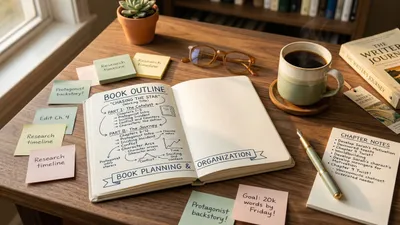
You can outline your entire book today using a free template — no software purchase, no email signup wall, no “freemium” bait-and-switch. Below you’ll find five copy-and-paste book outline templates that cover fiction, nonfiction, memoir, self-help, and children’s books.
In this guide, you’ll learn:
- Five free book outline templates you can copy right now (one per genre)
- How to customize each template for your specific project
- Which outlining method matches your writing style
- Where to go when you outgrow a static template
Pick the one that matches what you’re writing, paste it into your document, and start filling in the blanks.
What Is a Book Outline Template?
A book outline template is a pre-built structural framework that maps your book’s chapters, scenes, or sections before you write a single page. Instead of staring at a blank document, you start with a skeleton — headings, placeholders, and structural beats — and fill in the details that make it yours.
Think of it like architectural blueprints. You don’t design the foundation layout from scratch every time you build a house. You start with a proven structure and customize it for your lot, your budget, and your taste.
Authors who outline before drafting finish their manuscripts faster and spend less time on structural rewrites. A template takes this further by eliminating the “what should an outline even look like?” problem entirely.
The five templates below follow structures that thousands of published authors have used. Each one is free, requires no account, and works in any writing tool — Google Docs, Word, Scrivener, or a plain notebook.
Free Fiction Book Outline Template (Three Act Structure)
This fiction book outline template uses the three-act structure — the most widely used plotting framework in English-language fiction. It divides your story into setup (25%), confrontation (50%), and resolution (25%).
Copy the template below and fill in each section:
Act 1 — Setup (First 25% of Your Book)
Opening Hook
- What scene or image grabs the reader immediately?
- Your opening hook: _______________
Protagonist Introduction
- Who is your main character? What is their ordinary world?
- What do they want (external goal)? _______________
- What do they need (internal need they don’t recognize yet)? _______________
Inciting Incident (around 10-12% mark)
- What event disrupts the protagonist’s ordinary world?
- The inciting incident: _______________
First Plot Point / Door of No Return (around 25% mark)
- What forces the protagonist to commit to the journey?
- The turning point: _______________
Act 2 — Confrontation (Middle 50%)
Rising Action & Obstacles
- List 3-5 escalating obstacles your protagonist faces:
-
Midpoint Shift (around 50% mark)
- What revelation or event changes everything?
- How does the protagonist’s approach shift?
- The midpoint: _______________
Subplot Threads
- B-story (romance, friendship, mentor): _______________
- C-story (if applicable): _______________
All Is Lost Moment (around 75% mark)
- What is the protagonist’s lowest point?
- The crisis: _______________
Act 3 — Resolution (Final 25%)
Climax
- How does the protagonist face the central conflict head-on?
- The climax scene: _______________
Resolution
- How are loose threads tied up?
- How has the protagonist changed internally?
- The new normal: _______________
Final Image
- What closing scene mirrors or contrasts the opening?
- Your final image: _______________
This template works for literary fiction, thrillers, romance, sci-fi, and fantasy. If you’re writing genre fiction that needs more specific beat sheets, check our novel outline template guide, which includes genre-specific variations.
Free Nonfiction Book Outline Template
Nonfiction outlines follow a different logic than fiction — you’re organizing ideas, not plot points. This template uses a problem-solution framework that works for how-to books, business books, and prescriptive nonfiction.
Front Matter
Book Title (working): _______________ Subtitle: _______________ Target Reader: Who is this book for? _______________ Core Promise: What will the reader be able to do after reading this? _______________ One-Sentence Summary: _______________
Introduction
- What problem does your reader face? _______________
- Why should they trust you to solve it? (Your credentials or experience) _______________
- What will this book cover? (Preview of chapters) _______________
- What will they walk away with? _______________
Part 1: Foundation (Chapters 1-3)
Chapter 1: [The Problem]
- Key point 1: _______________
- Key point 2: _______________
- Key point 3: _______________
- Story or example: _______________
- Chapter takeaway: _______________
Chapter 2: [Why It Matters]
- Key point 1: _______________
- Key point 2: _______________
- Key point 3: _______________
- Data or research: _______________
- Chapter takeaway: _______________
Chapter 3: [The Mindset Shift]
- Key point 1: _______________
- Key point 2: _______________
- Key point 3: _______________
- Case study: _______________
- Chapter takeaway: _______________
Part 2: The Method (Chapters 4-8)
Chapter 4-8: [One Chapter Per Step in Your Process]
- Step description: _______________
- Why this step matters: _______________
- How to do it (instructions): _______________
- Common mistake to avoid: _______________
- Real example: _______________
- Chapter takeaway: _______________
Part 3: Advanced Application (Chapters 9-10)
Chapter 9: [Putting It All Together]
- How the steps connect: _______________
- Complete case study: _______________
Chapter 10: [What to Do Next]
- Action plan: _______________
- Resources: _______________
Conclusion
- Recap of the core message: _______________
- Final encouragement: _______________
- Call to action: _______________
This framework works for most prescriptive nonfiction. If you’re writing a nonfiction book outline for a narrative nonfiction or essay collection, you’ll want to adapt the structure to be more chronological or thematic.
Free Memoir Outline Template
Memoir outlines blend fiction techniques (scenes, arcs, tension) with nonfiction structure (real events, themes, reflection). This template focuses on the emotional arc — the through-line that turns a collection of memories into a story.
Pre-Outline Work
Central Theme: What is this memoir really about? (Not “my life” — the specific lens) _______________ Time Span: What period of your life does this cover? _______________ Emotional Arc: Where does the narrator start emotionally, and where do they end? _______________ Target Reader: Who will relate to this story? _______________
The Opening
Opening Scene
- A vivid, specific moment that drops the reader into the world
- Scene setting: _______________
- Why this moment matters to the larger story: _______________
The Setup (First 20%)
Chapter 1-3: Establish the “Before”
- Your ordinary world before the catalyst: _______________
- Key relationships: _______________
- What you believed to be true: _______________
- Tension simmering under the surface: _______________
The Catalyst
The Event That Changed Everything
- What happened? _______________
- How did it disrupt your world? _______________
- Scene (not summary): _______________
The Journey (Middle 60%)
Chapter 4-5: Initial Response
- How you first reacted: _______________
- Key scene: _______________
Chapter 6-7: Deepening Complications
- What made it harder than expected: _______________
- Key scene: _______________
Chapter 8-9: The Turning Point
- The moment of clarity, confrontation, or breakdown: _______________
- Key scene: _______________
The Resolution (Final 20%)
Chapter 10-11: Integration
- How you came through the other side: _______________
- What you learned (show, don’t tell): _______________
Final Chapter: The New Normal
- Where you are now: _______________
- How you’re different: _______________
- Closing scene that echoes or contrasts the opening: _______________
Reflection Layer
For each chapter, note:
- Then: What you thought/felt in the moment
- Now: What you understand in retrospect
- Universal: Why this matters to the reader, not just to you
If you want to go deeper on memoir structure, our guide on how to write a memoir covers narrative techniques specific to personal storytelling.
Free Self-Help Book Outline Template
Self-help books succeed or fail based on one thing: does the reader actually change their behavior? This template is built around a transformation arc — taking your reader from their current state to a desired state through concrete, actionable steps.
Front Matter
Book Title (working): _______________ The Transformation: From _______________ (current pain) to _______________ (desired outcome) Target Reader: _______________ Your Credibility: Why should they listen to you? _______________ One-Line Promise: “By the end of this book, you will _______________.”
Introduction: The Promise
- Paint the “after” picture: What life looks like when this problem is solved
- Acknowledge the reader’s current frustration
- Explain why other solutions have failed them
- Preview your unique method
- Your story: How you discovered this approach
Part 1: The Problem (Chapters 1-3)
Chapter 1: Name the Pain
- The specific problem your reader faces: _______________
- How it shows up in daily life: _______________
- The hidden cost of leaving it unsolved: _______________
Chapter 2: Why It’s Not Your Fault
- Common myths or bad advice: _______________
- Systemic or psychological reasons this problem persists: _______________
- Permission to stop blaming yourself: _______________
Chapter 3: The Core Insight
- Your counterintuitive or proprietary framework: _______________
- Why this approach works differently: _______________
- Proof it works (your results, client results, research): _______________
Part 2: The Method (Chapters 4-9)
Each Chapter = One Step:
- Step name: _______________
- Why this step matters: _______________
- How to do it (specific instructions): _______________
- Exercise or worksheet: _______________
- Common pitfall: _______________
- Success story: _______________
Part 3: Making It Stick (Chapters 10-11)
Chapter 10: Troubleshooting
- “What if it doesn’t work?” scenarios: _______________
- How to adapt the method: _______________
Chapter 11: Your 30-Day Action Plan
- Week-by-week implementation: _______________
- Accountability strategies: _______________
Conclusion: The Invitation
- Revisit the “before and after” from the introduction
- Final encouragement
- Next steps and resources
This structure maps closely to the frameworks used by bestselling self-help authors. If you need help generating chapter content from your outline, AI book writing tools can turn each chapter skeleton into a full draft in hours.
Free Children’s Book Outline Template
Children’s book outlines are shorter but structurally tight. Every word matters when you only have 500-1,000 of them. This template works for picture books (ages 4-8) and early chapter books (ages 6-9).
Picture Book Template (32 Pages)
Concept
- Title (working): _______________
- Age range: _______________
- Theme or lesson: _______________
- One-sentence summary: _______________
Characters
- Main character: _______________
- Main character’s want: _______________
- Supporting character(s): _______________
Page-by-Page Spread Plan
| Pages | What Happens | Illustration Notes |
|---|---|---|
| 1-2 | Introduce character and world | _______________ |
| 3-4 | Character wants something | _______________ |
| 5-6 | First attempt (fails) | _______________ |
| 7-8 | Second attempt (fails differently) | _______________ |
| 9-10 | Third attempt or new approach | _______________ |
| 11-12 | Climax — biggest challenge | _______________ |
| 13-14 | Resolution | _______________ |
| 15-16 | New normal / ending image | _______________ |
Note: Most picture books use a pattern of three attempts (the “rule of three”) before the resolution. Each attempt should escalate the stakes or humor.
Early Chapter Book Template (6-10 Chapters)
Chapter 1: Hook + introduce character + establish the problem Chapter 2: Character’s first attempt to solve it Chapter 3: Complication — things get harder Chapter 4: New ally or discovery Chapter 5: Setback — the plan falls apart Chapter 6: Climax — character faces the biggest challenge Chapter 7: Resolution + what the character learned Chapter 8 (optional): Epilogue or setup for book 2
For more on structuring stories for young readers, see our guide on how to write a children’s book.
How to Customize Any Book Outline Template
A template is a starting point, not a cage. Here’s how to adapt these frameworks to your specific project.
Add or remove chapters. The nonfiction template shows 10-11 chapters, but your book might need 7 or 15. Adjust based on how many key points you need to make. A focused 7-chapter book often outperforms a padded 15-chapter one.
Change the internal structure. If your fiction doesn’t fit the three-act structure, try the story arc template or the Save the Cat beat sheet. The goal is a structure that maps your story naturally, not one that forces your story into an unnatural shape.
Blend templates. Writing a self-help book with memoir elements? Use the self-help skeleton for the overall structure and the memoir template for personal story chapters. Many successful books mix frameworks.
Start rough, refine later. Your first pass through any template should be fast — just fill in the blanks with whatever comes to mind. Spend 30 minutes getting messy ideas into the structure. Then come back and refine.
The Derek Murphy 24-chapter outline method, available as a free PDF from Creative Indie, offers another approach: map your story to 24 specific plot beats, each aligned to reader expectations. It’s particularly useful if you want more granularity than the three-act structure provides.
Best Free Tools for Building Your Book Outline
You don’t need expensive software to outline a book. Here are the best free options.
Our Pick — Chapter
Chapter uses AI to generate a custom book outline from your topic, genre, and target audience. Instead of filling in a static template, you describe your book and Chapter builds a tailored chapter-by-chapter outline in minutes — then helps you write each chapter from it.
Best for: Authors who want an AI-generated outline customized to their specific book Pricing: $97 one time, 2 books included (fiction or nonfiction), 30-day money-back guarantee Why we built it: Static templates give you structure, but they can’t adapt to your specific topic. Over 2,147 authors have used Chapter to outline and write 5,000+ books.
Google Docs — Free, accessible anywhere, and easy to share with editors or writing partners. Paste any template above directly into a new doc.
Notion — Offers built-in writing templates with database features. Good for authors who want to track characters, scenes, and research alongside their outline.
Scrivener — Not free ($49), but the gold standard for long-form writing. Its corkboard and binder features make rearranging outline sections easy. See our Scrivener review for a full breakdown.
Microsoft Word — If you already have it, Word handles outlines perfectly well. Use the heading styles (Heading 1, Heading 2, Heading 3) to create a collapsible, navigable outline. Our free book template for Word guide covers the setup.
Which Outline Template Should You Use?
Not sure which template fits your project? Use this quick-reference table:
| If You’re Writing… | Use This Template | Why |
|---|---|---|
| A novel (any genre) | Fiction / Three Act Structure | Universal story framework that adapts to any genre |
| A how-to or business book | Nonfiction / Problem-Solution | Reader-centered structure built around transformation |
| A personal story | Memoir | Emotional arc focus with scene-driven structure |
| A self-improvement book | Self-Help / Transformation | Built around behavior change and actionable steps |
| A picture book or chapter book | Children’s Book | Age-appropriate pacing with the rule-of-three structure |
If your book crosses categories — say, a business book with memoir elements — start with the primary category template and borrow sections from the secondary one. Most bestsellers blend structures rather than following a single framework rigidly.
For more book planning templates covering premise worksheets, character profiles, and timeline planners, check our complete template library.
Common Mistakes When Using Book Outline Templates
Even with a template, authors stumble on a few predictable problems.
-
Over-outlining. You spend six months perfecting the outline and never start writing. Set a time limit — two hours for a first pass — and start drafting even if the outline feels incomplete. The outline will improve as you write.
-
Treating the outline as sacred. Your outline is a guide, not a contract. If you discover a better direction while writing, follow it. The best books surprise even their authors.
-
Skipping the “why” for each chapter. Fill in what happens, but also note why this chapter matters. If you can’t articulate why a chapter earns its place, cut it.
-
Ignoring your reader’s journey. Every chapter should move the reader forward — emotionally (fiction and memoir) or intellectually (nonfiction). If a chapter doesn’t advance the reader’s experience, it’s filler.
-
Using the wrong template for your book. A novel squeezed into a nonfiction framework will feel mechanical. A memoir forced into the three-act structure will feel artificial. Match the template to how your content naturally flows, then adjust from there.
Can You Outline a Book With AI?
You can, and an increasing number of authors do. A 2024 BookBub survey found that 45% of authors now use AI tools in their writing process, with outlining being one of the most common applications.
AI book outline tools work differently than static templates. Instead of giving you a blank framework to fill in, you describe your book idea — the topic, genre, audience, and goals — and the AI generates a custom outline based on successful structures in your category.
The advantage is personalization. A static template for “nonfiction” treats every nonfiction book the same, whether it’s a parenting guide or a business strategy book. AI tools like Chapter generate outlines tailored to your specific topic and audience, with chapter titles, section summaries, and content suggestions baked in.
The limitation is that AI-generated outlines still need your judgment. The AI doesn’t know your unique perspective, your proprietary frameworks, or the stories only you can tell. Use AI outlines as an advanced starting point, then reshape them with your expertise.
If you want to explore this approach, our complete guide on how to write a book outline with AI walks through the process step by step.
How Long Should a Book Outline Be?
A book outline should be long enough to guide your writing and short enough to finish in one sitting. For most authors, that means 2-5 pages.
Here’s what works for each format:
- Fiction (50,000-90,000 words): 3-5 pages covering major plot points, character arcs, and chapter summaries. One paragraph per chapter is enough.
- Nonfiction (30,000-60,000 words): 2-4 pages listing chapters, key points per chapter, and supporting examples. Bullet points work better than prose.
- Memoir (60,000-80,000 words): 3-5 pages mapping key scenes, the emotional arc, and reflection points. Include specific memories you plan to expand into full scenes.
- Children’s book (500-10,000 words): 1 page for picture books. 2-3 pages for chapter books.
The test isn’t length — it’s usefulness. If you can sit down to write chapter 7 and your outline tells you exactly what that chapter needs to accomplish, it’s doing its job. If you still feel lost, add more detail to that section.
Do You Really Need a Book Outline?
Not every author outlines. Writers like Stephen King famously write without one, discovering the story as they draft. But most debut authors benefit enormously from at least a rough outline.
Here’s the honest trade-off:
Outlining works best when you:
- Want to minimize structural rewrites
- Are writing nonfiction with a logical argument
- Have a deadline
- Struggle with the “messy middle” of long projects
- Want to write faster once you start drafting
Skipping the outline works when you:
- Write best through discovery
- Are writing literary fiction where voice drives structure
- Have experience finishing long projects without one
- Are comfortable throwing away sections that don’t work
If you’ve never finished a book before, start with an outline. You can always deviate from it. But starting with a map makes the journey significantly less likely to end in an abandoned manuscript.
For a deep dive on how to outline a book — including seven different methods beyond templates — see our comprehensive outlining guide.
FAQ
What Is the Best Free Book Outline Template?
The best free book outline template depends on what you’re writing. For fiction, the three-act structure template is the most versatile — it works across every genre from romance to thriller. For nonfiction, the problem-solution template organizes your ideas around your reader’s transformation. Both are available above with no signup required.
How Do You Create a Book Outline for Free?
You create a book outline for free by copying a template into Google Docs, Word, or Notion and filling in the blanks for your project. Start with your book’s premise, identify your major sections or plot points, then expand each section with key details. The five free templates in this guide give you a ready-made starting point for fiction, nonfiction, memoir, self-help, and children’s books.
What Is the Difference Between a Book Outline and a Book Template?
A book outline is a structural plan that maps your content — chapters, plot points, arguments, or scenes. A book template is a formatted document with preset styles, margins, and layouts for the finished manuscript. You use an outline during the planning stage and a template during the formatting stage. For free formatting templates, see our complete template library.
Can AI Write a Book Outline for Me?
Yes, AI tools can generate a custom book outline based on your topic, genre, and audience. Tools like Chapter create tailored outlines with chapter titles, section summaries, and content suggestions — going beyond static templates. Over 2,147 authors have used Chapter to plan and write more than 5,000 books. The AI handles the structure; you bring the expertise and voice.
How Many Chapters Should a Book Outline Have?
Most book outlines contain 10-15 chapters for nonfiction and 20-30 chapters for fiction, but there’s no fixed rule. A focused self-help book might need 8 chapters. An epic fantasy might need 40. The right number depends on your content, not a formula. Each chapter should earn its place by advancing the reader’s journey — either intellectually (nonfiction) or emotionally (fiction).