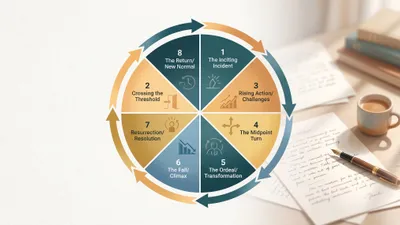
The Save the Cat story structure is a 15-beat framework that maps every major turning point your story needs, from opening image to final image. Blake Snyder created it for screenwriters. Jessica Brody adapted it for novelists. It works for both.
In this guide, you’ll learn:
- What the Save the Cat structure is and why it works
- How the 15 beats fit into the three-act structure
- How to apply each beat to your novel, step by step
- Real examples from published fiction
Here’s everything you need to start using it.
What Is the Save the Cat Story Structure?
The Save the Cat story structure is a plotting framework built on 15 story beats organized across three acts. Each beat has a specific purpose and a target position in your manuscript, expressed as a percentage of total word count.
Blake Snyder introduced the method in Save the Cat! The Last Book on Screenwriting You’ll Ever Need (2005). He analyzed dozens of successful films and identified the structural patterns they shared. The result was a beat sheet that tells you exactly what should happen and when.
Jessica Brody later brought the framework to novelists with Save the Cat! Writes a Novel (2018). She proved the same beats work for books, not just screenplays.
The name comes from a storytelling principle: early in your story, have your protagonist do something likable — like saving a cat — so readers root for them before things get hard.
Why writers use it
Save the Cat is the most prescriptive popular story framework. That’s its superpower and its controversy.
Unlike the hero’s journey, which describes broad mythological stages, or the three-act structure, which gives you a skeleton without specifics, Save the Cat tells you exactly what should happen at the 10% mark, the 20% mark, the 50% mark, and beyond.
For writers who struggle with pacing, sagging middles, or knowing what comes next, that precision eliminates guesswork.
How the 15 Beats Map to Three Acts
The Save the Cat story structure divides your book into three acts with specific beat targets. Here’s the complete framework at a glance.
| Beat | Name | Position | Act |
|---|---|---|---|
| 1 | Opening Image | 0-1% | Act 1 |
| 2 | Theme Stated | 5% | Act 1 |
| 3 | Set-Up | 1-10% | Act 1 |
| 4 | Catalyst | 10% | Act 1 |
| 5 | Debate | 10-20% | Act 1 |
| 6 | Break Into Two | 20% | Act 2A |
| 7 | B Story | 22% | Act 2A |
| 8 | Fun and Games | 20-50% | Act 2A |
| 9 | Midpoint | 50% | Act 2A |
| 10 | Bad Guys Close In | 50-75% | Act 2B |
| 11 | All Is Lost | 75% | Act 2B |
| 12 | Dark Night of the Soul | 75-80% | Act 2B |
| 13 | Break Into Three | 80% | Act 3 |
| 14 | Finale | 80-99% | Act 3 |
| 15 | Final Image | 99-100% | Act 3 |
For a detailed breakdown of each individual beat with examples and page targets, see our complete Save the Cat beat sheet guide.
Act 1: The Setup (Beats 1-5, Pages 0-20%)
Act 1 introduces your protagonist, establishes their flawed world, and delivers the event that launches the story.
Opening Image and Theme Stated
Your Opening Image is the “before” photo. Show your protagonist’s world as it exists before the story changes everything. Within the first 5%, someone — usually not the protagonist — states the story’s thematic question.
You’re establishing two things simultaneously: what the world looks like now and what your character needs to learn.
The Set-Up
The first 10% of your book does the heavy lifting. Introduce your main characters. Show what’s missing in the protagonist’s life. Establish the relationships, flaws, and desires that will drive the story.
A common mistake is rushing the Set-Up. You need readers to care about your character before you disrupt their world. That’s the whole point of “saving the cat” — give your protagonist a likable moment early so readers invest emotionally.
Catalyst and Debate
The Catalyst hits at the 10% mark. This is your inciting incident — the event that knocks the protagonist’s world off balance.
Then comes the Debate (10-20%). Your protagonist reacts, resists, questions, or prepares. This is the “should I go?” phase. It builds tension before the story shifts into a new world.
Act 2A: The Fun and Games (Beats 6-9, Pages 20-50%)
This is where your story delivers on the promise of its premise.
Break Into Two and B Story
At the 20% mark, your protagonist makes a choice and enters a new world — physically, emotionally, or both. This is the Break Into Two. There’s no going back.
The B Story introduces a secondary relationship (often a love interest or mentor) that carries the thematic argument. While the A Story drives plot, the B Story drives character development.
Fun and Games
The Fun and Games section (20-50%) is the reason readers picked up your book. If your novel is a heist, this is where the heist unfolds. If it’s a romance, this is where the couple falls for each other.
This beat is often called the “promise of the premise.” It’s the heart of your story and the section most readers remember.
The Midpoint
At exactly 50%, something shifts. The Midpoint is either a “false victory” (things seem great but won’t last) or a “false defeat” (things seem terrible but it’s not the real low point yet). The stakes rise. The clock starts ticking.
The Midpoint transforms your protagonist from reactive to proactive. Before the Midpoint, things happen to them. After it, they start making things happen.
Act 2B: The Descent (Beats 10-12, Pages 50-80%)
The second half of Act 2 tears everything apart.
Bad Guys Close In
From 50-75%, internal doubts and external enemies intensify. Your antagonist gains ground. Allies betray or abandon the protagonist. The team fractures.
“Bad guys” doesn’t have to mean literal villains. In a literary novel, the “bad guys” might be self-doubt, addiction, or a crumbling marriage. Whatever force opposes your protagonist, it’s winning now.
All Is Lost and Dark Night of the Soul
At 75%, the All Is Lost beat delivers the protagonist’s lowest point. Snyder calls for a “whiff of death” — someone dies, a relationship ends, or something symbolically dies.
The Dark Night of the Soul (75-80%) is the emotional aftermath. Your protagonist sits in their loss. They process, grieve, or stare into the void. This is the moment before transformation.
This is where many novels go wrong. Writers rush past the low point because it’s uncomfortable to write. Don’t. Your readers need to feel the depth of the loss before the resolution means anything.
Act 3: The Resolution (Beats 13-15, Pages 80-100%)
Everything comes together.
Break Into Three
At 80%, the protagonist discovers the solution — often through a combination of the A Story lesson and the B Story theme. They know what they have to do.
This realization should feel earned. The protagonist connects what they learned from the B Story relationship with what they need to do in the A Story conflict.
The Finale
The Finale (80-99%) is not a single scene. Snyder breaks it into a five-point structure:
- Gathering the team — the protagonist assembles allies and resources
- Executing the plan — the initial attempt to resolve the conflict
- The high tower surprise — an unexpected complication
- Dig deep down — the protagonist must use their inner transformation to overcome the surprise
- Execution of the new plan — victory through change
This five-point Finale is one of the most valuable parts of Save the Cat. Many writers know how their story ends but struggle to fill the final 20% with momentum. These five steps give you a blueprint.
Final Image
Your Final Image mirrors your Opening Image — but changed. It’s the “after” photo that shows how far your protagonist has traveled.
If your Opening Image showed a lonely woman eating dinner alone, your Final Image might show her hosting a dinner party. The visual bookend proves transformation happened.
How to Apply Save the Cat to Your Novel (Step by Step)
Here’s the practical workflow for using Save the Cat story structure in your own book.
Step 1: Know your word count target
Save the Cat percentages need a baseline. If you’re writing an 80,000-word novel, 1% is 800 words. A 60,000-word novel puts 1% at 600 words.
| Novel Length | 10% (Catalyst) | 20% (Break Into 2) | 50% (Midpoint) | 75% (All Is Lost) |
|---|---|---|---|---|
| 60,000 words | 6,000 | 12,000 | 30,000 | 45,000 |
| 80,000 words | 8,000 | 16,000 | 40,000 | 60,000 |
| 100,000 words | 10,000 | 20,000 | 50,000 | 75,000 |
Step 2: Identify your four tent-pole beats
Before filling in all 15 beats, nail these four first:
- Catalyst (10%) — What launches your story?
- Midpoint (50%) — What raises the stakes?
- All Is Lost (75%) — What’s the lowest point?
- Break Into Three (80%) — What triggers the solution?
These four beats are the structural backbone. Everything else connects between them.
Step 3: Fill in the remaining beats
Work outward from your tent-pole beats. What needs to happen in the Set-Up for the Catalyst to land? What does Fun and Games look like given your Midpoint? What leads to All Is Lost during Bad Guys Close In?
If you’re outlining a novel for the first time, this is where an AI writing tool like Chapter can accelerate the process. Feed it your genre, premise, and tent-pole beats, and it generates a full beat sheet outline you can refine.
Step 4: Write your beat sheet
List all 15 beats with 1-3 sentences each. This becomes your roadmap. You’re not writing the novel yet — you’re charting the course.
A complete beat sheet fits on a single page. If it doesn’t, you’re overcomplicating it.
Step 5: Expand beats into scenes
Each beat contains one or more scenes. The Set-Up might have five scenes. Fun and Games might have ten. Map your beats to scenes, and you have a complete novel outline.
Save the Cat vs Other Story Structures
How does Save the Cat compare to other popular frameworks? Here’s a quick comparison.
| Framework | Beats/Stages | Prescriptiveness | Best For |
|---|---|---|---|
| Save the Cat | 15 beats | Very specific timing | Writers who want precise structure |
| Three-Act Structure | 3 acts | Flexible | Writers who want a loose skeleton |
| Hero’s Journey | 12 stages | Moderate | Fantasy, adventure, mythic stories |
| Plot Structure (Freytag) | 5 parts | Moderate | Literary fiction, shorter works |
| Romance Beat Sheet | 8 beats | Genre-specific | Romance novelists |
Save the Cat works for any genre. It’s not inherently better or worse than these alternatives — it’s more specific. If you want to know exactly what should happen at the 22% mark of your novel, no other framework tells you.
If you’re deciding between approaches, our guide to story structure covers all major frameworks in depth.
Common Mistakes When Using Save the Cat
Treating beats as rigid rules
The percentages are targets, not handcuffs. If your Catalyst hits at 12% instead of 10%, your novel isn’t broken. The beats describe proportions, not exact page counts.
Skipping the Debate
Writers often rush from Catalyst to Break Into Two. The Debate section builds anticipation and lets readers process the Catalyst alongside the protagonist. Cutting it makes the story feel rushed.
Making the Midpoint a scene, not a shift
The Midpoint isn’t just a plot event. It’s a fundamental shift in how your protagonist engages with the story. If nothing changes in their approach or awareness, the Midpoint isn’t doing its job.
Neglecting the B Story
The B Story carries your theme. If you treat it as filler or a subplot to check off, your Finale won’t resonate. The B Story insight is what unlocks the Break Into Three.
Writing a flat Dark Night of the Soul
Don’t rush past the emotional low point. Your readers need to feel the protagonist sitting in genuine despair before the resolution carries weight.
Can You Use Save the Cat for Nonfiction?
Yes, but with adaptation. Nonfiction memoirs map naturally to the 15 beats because they follow a protagonist (you) through transformation. Business books and how-to guides don’t use Save the Cat directly, but the underlying principle — promise, complicate, deliver — still applies.
For memoir writers, Save the Cat provides a useful lens for deciding which life events to include and where to place them for maximum emotional impact.
Does Save the Cat Work for Pantsers?
You might think Save the Cat is only for plotters. It’s actually useful for pantsers too — just in a different way.
Instead of outlining all 15 beats before writing, pantsers can use Save the Cat as a diagnostic tool. Write your first draft freely, then overlay the beat sheet to find structural problems. Is your Catalyst too late? Is there no real Midpoint? Does the Finale lack a five-point structure?
This “retrofit” approach gives pantsers structural awareness without constraining their creative process.
How Long Does It Take to Outline With Save the Cat?
Outlining with Save the Cat typically takes 2-5 hours for writers who already know their premise and main characters. The process is faster than it looks because the framework tells you exactly what to figure out at each step.
If you use an AI tool like Chapter to generate a starting beat sheet, you can cut that to under an hour. You’ll still need to refine and personalize the output, but the heavy lifting of structural math and beat placement is handled for you.
Is Save the Cat the Best Story Structure?
Save the Cat is the best story structure for writers who want specific guidance on pacing and plot timing. It’s not the only valid framework, and it’s not ideal for every project.
Choose Save the Cat when:
- You struggle with pacing or sagging middles
- You want a concrete roadmap before drafting
- You’re writing genre fiction with clear protagonist arcs
- You need help structuring the second half of your novel
Choose a different framework when:
- You’re writing experimental or nonlinear fiction
- You prefer discovering the story as you write (though you can retrofit later)
- Your story doesn’t follow a single protagonist’s transformation
The framework is a tool, not a cage. Use the parts that serve your story. Ignore the parts that don’t.
FAQ
What is the Save the Cat story structure?
The Save the Cat story structure is a 15-beat plotting framework created by screenwriter Blake Snyder and adapted for novelists by Jessica Brody. It maps every major turning point across three acts, with specific percentage targets for when each beat should occur in your manuscript.
How many beats are in Save the Cat?
Save the Cat contains 15 beats divided across three acts. Act 1 has 5 beats (Opening Image through Debate), Act 2 has 7 beats (Break Into Two through Dark Night of the Soul), and Act 3 has 3 beats (Break Into Three, Finale, and Final Image).
What is the difference between Save the Cat and the three-act structure?
The Save the Cat structure is a more detailed version of the three-act structure. While three-act structure divides your story into setup, confrontation, and resolution, Save the Cat breaks those three acts into 15 specific beats with target page percentages — giving you a far more prescriptive roadmap.
Can you use Save the Cat for novels?
Yes. Jessica Brody adapted Save the Cat for novelists in Save the Cat! Writes a Novel (2018). The 15 beats work for any genre of fiction, from romance to thriller to literary. The percentage targets translate directly to word count targets based on your novel’s total length.
What is the “Save the Cat” moment?
The “Save the Cat” moment is a scene early in your story where the protagonist does something likable or heroic — like literally saving a cat — to make readers root for them. It appears in the Set-Up beat (first 10%) and ensures your audience cares about the protagonist before the story puts them through conflict.