The right book tracking app turns your scattered reading life into something you can actually see — shelves organized, stats tracked, and reading goals you stick with instead of abandon by February.
In this guide, you’ll learn:
- Which book tracking apps are worth your time (and which are overhyped)
- How each app handles stats, social features, and reading goals
- The best option for your specific reading style — whether you’re a casual reader, data nerd, or aspiring author
Here’s every major option, tested and compared.
What Is a Book Tracking App?
A book tracking app is software that helps you log the books you’ve read, track your reading progress, and organize your personal library. Most apps also offer reading goals, statistics, and social features like reviews and recommendations. The best book tracking apps go beyond simple logging to help you read more consistently and discover your next great book.
Book tracking apps range from massive social platforms like Goodreads (150+ million users) to focused, privacy-first tools like Bookmory. The market has exploded in recent years, with the broader book reading app space projected to hit $2.56 billion by 2032.
The question isn’t whether you should use one. It’s which one fits how you actually read.
The 10 Best Book Tracking Apps in 2026
Here’s every app worth considering, ranked by overall value for readers in 2026.
1. Goodreads — The Giant Everyone Knows
Best for: Social discovery and the largest book database on the internet
Goodreads is still the default book tracking app for most readers, and for good reason. With over 150 million registered users, it has the largest community, the most reviews, and the deepest book database you’ll find anywhere.
You can create virtual shelves (read, currently-reading, want-to-read), set annual reading goals, join groups, and browse recommendations. The Kindle integration syncs your highlights and reading progress automatically if you’re in Amazon’s ecosystem.
The downsides are well-documented. The interface hasn’t meaningfully changed since Amazon acquired it in 2013. The recommendation algorithm feels opaque. And the social feed can be noisy.
Pricing: Free Rating system: Whole stars only (1-5) Platforms: iOS, Android, Web
2. The StoryGraph — Best for Reading Statistics
Best for: Data-driven readers who want detailed mood, pace, and genre analytics
The StoryGraph is what happens when a reader builds the app Goodreads should have become. Founded by Nadia Odunayo in 2019, it now has around 4 million users and growing fast.
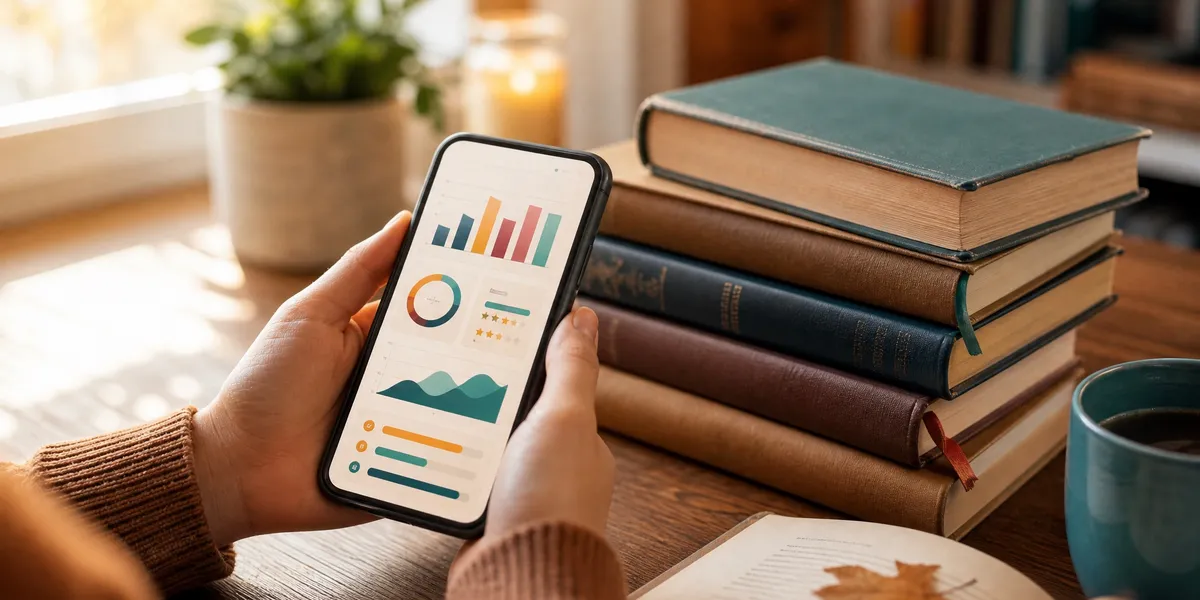
The stats page is the standout feature. You get breakdowns of mood (dark, hopeful, funny), pace (slow, medium, fast), fiction vs. nonfiction ratios, genre distribution, and year-end summaries that put every other app to shame. The quarter-star rating system lets you distinguish between a 3-star and a 3.75-star book.
The social features are more limited than Goodreads, and the book database is smaller. But for readers who want to understand their reading patterns, nothing else comes close.
Pricing: Free (Plus plan at $4.99/month for extra stats) Rating system: Quarter-star increments Platforms: iOS, Android, Web
3. Bookly — Best for Building Reading Habits
Best for: Readers who want to read more consistently using timers, streaks, and daily goals
Bookly treats reading like a fitness habit. You start a reading session, the timer tracks your time, and the app calculates your reading speed, pages per minute, and estimated time to finish your current book.
Daily reading goals, streaks, badges, and weekly reports keep you motivated. The annual reading challenge feature lets you set page counts or book counts as your target.
If your main problem isn’t finding books but actually sitting down to read them, Bookly solves that.
Pricing: Free (Premium at $4.99/month) Rating system: Star ratings Platforms: iOS, Android
4. Hardcover — Best Goodreads Alternative for Book Discovery
Best for: Readers who want a modern social platform without Amazon’s data ecosystem
Hardcover launched in 2021 as an Amazon-free alternative to Goodreads. It blends social discovery with detailed tracking — you can follow other readers, browse curated lists, and track your reading progress with a clean, modern interface.
The community is smaller but more engaged. The design feels contemporary instead of stuck in 2013. And it remains ad-free.
Pricing: Free Rating system: Half-star increments Platforms: Web (mobile apps in development)
5. Fable — Best for Book Clubs
Best for: Social readers who want to discuss books chapter by chapter with friends
Fable, now owned by Scribd, focuses on the social side of reading. Over one million users and 100,000+ book clubs make it the strongest option for group reading. You can discuss books chapter by chapter, join celebrity book clubs, and read ebooks directly within the app.
The tracking features are secondary to the social experience. If you want deep stats or a private reading log, look elsewhere. If you want to read with people, Fable is built for that.
Pricing: Free (premium features via Scribd subscription) Platforms: iOS, Android, Web
6. Bookmory — Best for Private, Minimalist Tracking
Best for: Readers who want a calm reading journal without social noise
Bookmory strips away the social feed and gives you a clean, private reading journal. You log books, track pages and time, save quotes, and write personal notes. The calendar view shows your reading streaks visually.
No followers. No public reviews. No algorithm pushing recommendations. Just your books and your thoughts about them.
Pricing: Free (Premium for advanced stats) Rating system: Star ratings Platforms: iOS, Android
7. Basmo — Best for Reading Sessions and Quotes
Best for: Readers who want to capture quotes and notes during reading sessions
Basmo combines a reading timer with a built-in note-taking system. You can scan pages to capture quotes, organize notes by book, and track your reading streaks and statistics.
The quote-scanning feature is genuinely useful if you’re the type of reader who underlines passages and then forgets where they were. It uses OCR to pull text from photos of book pages.
Pricing: Free (Premium at $4.99/month) Platforms: iOS, Android
8. Literal — Best for Curated Recommendations
Best for: Readers who want human-curated book recommendations from taste-matched readers
Literal focuses on quality over quantity in its social features. The recommendation engine connects you with readers who share your taste, and the feed surfaces thoughtful reviews rather than star-rating spam.
The book club feature and private notes system are solid. The user base is smaller, which means fewer reviews but generally higher-quality ones.
Pricing: Free Platforms: iOS, Android, Web
9. Bookshelf — Best for Quick Barcode Scanning
Best for: Readers who want to catalog their physical library fast
Bookshelf makes the initial setup painless. Point your phone at a barcode, and the book is in your library. Set a reading goal, track your progress, and you’re done. No social features, no complex stats — just your books on a digital shelf.
If you own hundreds of physical books and want to digitize your collection fast, start here.
Pricing: Free (Pro features available) Platforms: iOS, Android
10. Libby — Best for Library Readers
Best for: Readers who borrow ebooks and audiobooks from their local library
Libby isn’t a traditional book tracker, but if you’re a library reader, it deserves a spot on this list. It connects to your library card, lets you borrow ebooks and audiobooks, and automatically syncs your reading progress.
The timeline feature tracks everything you’ve borrowed, creating a reading history without manual logging. If your reading habit runs on library books, Libby handles both borrowing and tracking in one place.
Pricing: Free (requires library card) Platforms: iOS, Android
Quick Comparison Table
| App | Best For | Stats Depth | Social Features | Price | Rating |
|---|---|---|---|---|---|
| Goodreads | Social discovery | Basic | Extensive | Free | ⭐⭐⭐⭐ |
| StoryGraph | Detailed analytics | Excellent | Moderate | Free/$4.99/mo | ⭐⭐⭐⭐⭐ |
| Bookly | Reading habits | Good | None | Free/$4.99/mo | ⭐⭐⭐⭐ |
| Hardcover | Modern social | Good | Strong | Free | ⭐⭐⭐⭐ |
| Fable | Book clubs | Basic | Excellent | Free | ⭐⭐⭐⭐ |
| Bookmory | Private journal | Moderate | None | Free | ⭐⭐⭐⭐ |
| Basmo | Quotes & notes | Good | Minimal | Free/$4.99/mo | ⭐⭐⭐⭐ |
| Literal | Curated recs | Moderate | Moderate | Free | ⭐⭐⭐ |
| Bookshelf | Quick cataloging | Basic | None | Free | ⭐⭐⭐ |
| Libby | Library borrowing | Basic | None | Free | ⭐⭐⭐⭐ |
How to Choose the Right Book Tracking App
Choosing a book tracking app comes down to three questions about how you actually read. Answer these, and the right app becomes obvious.
What’s your main goal?
Track what you read (simple logging) → Goodreads or Bookshelf Understand your reading patterns (stats and analytics) → StoryGraph Read more consistently (habits and streaks) → Bookly Find your next book (discovery and social) → Hardcover or Fable Keep a private reading journal → Bookmory or Basmo
How social do you want it?
If you want a thriving community with millions of reviews, Goodreads is still the only option with that scale. If you want book club features, Fable is purpose-built. If you want zero social pressure, Bookmory and Bookly keep it private.
Do you read physical books, ebooks, or both?
Library readers should check Libby first. Kindle users get automatic syncing with Goodreads. Physical book readers benefit from Bookshelf’s barcode scanner. StoryGraph and Hardcover handle all formats well.
How to Track Your Reading Progress Effectively
Picking an app is step one. Actually using it consistently is where most readers fail. Here’s how to make tracking stick.
Log books immediately. The moment you finish a book — or even start one — add it. Waiting until “later” means you forget. Most apps have widgets or quick-add features that take under 10 seconds.
Set realistic goals. A reading goal of 100 books per year sounds impressive, but if you read 12 last year, it’s a setup for failure. Start with one book per month and adjust upward. StoryGraph and Bookly both let you modify goals mid-year without shame.
Use the timer (if available). Bookly and Basmo both have reading session timers. Tracking your actual reading time reveals patterns — maybe you read faster in the morning, or you consistently lose focus after 45 minutes. That data helps you build a better reading habit.
Don’t track everything. Some readers feel pressure to rate and review every book. You don’t have to. Logging the title and date is enough to build a useful reading history. Detailed reviews are optional.
If you’re also working on writing your own book, tracking what you read in your genre is essential research. Tools like Chapter can help you turn that reading research into a finished manuscript, especially when you’re studying craft patterns across dozens of books in your genre.
Book Tracking Apps for Authors and Writers
If you’re not just a reader but also a writer, your book tracking needs are different. You’re reading strategically — studying genre conventions, analyzing pacing, and cataloging craft techniques.
Here’s what to look for in a book tracker when you’re also writing:
Note-taking depth matters. You need more than a star rating. You need to capture observations about structure, character arcs, and prose style. Basmo’s quote-scanning feature and Bookmory’s note system handle this well.
Genre and mood tagging helps. StoryGraph’s mood and pace tags let you analyze the books in your genre systematically. If you’re writing a dark, slow-burn thriller, you can filter your reading history to find comps with similar profiles.
Reading speed data informs pacing. Bookly tracks your reading speed per book. If your thriller readers expect a pace of 1.5 minutes per page, you want your draft to match that tempo. Reading speed data gives you a benchmark.
A writing tool completes the loop. Tracking your reading is research. Writing your book is the actual work. Many authors pair a reading tracker with a book writing app to keep both activities organized. If you’re using AI to accelerate your drafting, an AI writing tool can turn your genre research into a first draft faster than you’d expect.
For a complete workflow from idea to publication, check out our guide on how to write a book.
Goodreads Alternatives Worth Trying
Goodreads still dominates by sheer user numbers, but it’s not the only option — and for many readers, it’s not the best one anymore.
Why readers are switching:
- The interface hasn’t been updated meaningfully since 2013
- All reading data feeds Amazon’s recommendation engine
- The recommendation algorithm feels generic
- Limited rating options (whole stars only vs. StoryGraph’s quarter-stars)
- No mood, pace, or format tracking
The strongest alternatives by use case:
- Best overall replacement: StoryGraph (closest to feature parity plus better stats)
- Best for social without Amazon: Hardcover
- Best for book clubs: Fable
- Best for private tracking: Bookmory
You don’t have to choose just one. Many readers run Goodreads alongside StoryGraph or Hardcover — using Goodreads for its database and community, and a second app for the features Goodreads lacks.
If you’re looking for reading recommendations specifically for book clubs, check out our list of best nonfiction book club books.
Best Free Book Tracking Apps
Every app on this list has a free tier, but some free versions are more generous than others.
Completely free (no premium tier):
- Goodreads
- Hardcover
- Literal
- Libby (requires library card)
Free with optional premium:
- StoryGraph (free covers most features; Plus adds advanced stats)
- Bookly (free for basic tracking; premium for advanced reports)
- Basmo (free for session tracking; premium for unlimited scans)
- Bookmory (free with essential features)
The honest take: You can track your reading effectively without paying a cent. Goodreads and StoryGraph’s free tiers cover 90% of what most readers need. Premium tiers add nice-to-have analytics but aren’t essential.
How to Set Up Your Book Tracking System
Getting started with any book tracking app takes about 10 minutes if you follow this process:
- Pick one app from this list based on your priorities (stats, social, privacy, or simplicity)
- Import your existing reading history. Goodreads lets you export your data as a CSV file, and most other apps can import it. If you’re starting fresh, just begin logging from today.
- Create your shelves. At minimum, set up “read,” “currently reading,” and “want to read.” Add custom shelves for genre research or specific projects if you’re a writer.
- Set a reading goal. Start modest — even one book per month is 12 books per year, which puts you ahead of the average American reader.
- Add the widget to your phone’s home screen. Visibility drives habit formation. If the app is always one tap away, you’re more likely to log consistently.
For a more analog approach, some readers pair a digital tracker with a reading journal template to capture deeper reflections on each book.
Managing Your TBR (To-Be-Read) List
Every book tracker has a “want to read” shelf, but managing it is an art form. Here’s what works:
Cap your TBR at a realistic number. An infinite want-to-read list creates decision paralysis. Some readers cap theirs at 20-30 books and only add a new one when they remove one. The TBR list system helps you stay focused instead of overwhelmed.
Organize by priority, not just title. Most apps let you sort or tag your TBR. Group books by urgency: “reading next,” “this quarter,” and “someday.” This turns a wall of titles into an actionable queue.
Use it for genre research. If you’re an author studying your market, your TBR list doubles as a research queue. Track which competitor titles you need to analyze before writing your next book. That research pays off when you understand what readers in your genre expect — especially if you’re planning to self-publish.
Common Mistakes to Avoid
- Tracking too much detail. Rating, reviewing, and noting every book leads to burnout. Start simple and add complexity only if it serves you.
- Ignoring the social features entirely. Even if you prefer private tracking, following a few readers with similar taste surfaces great recommendations you wouldn’t find alone.
- Chasing the “best” app forever. Pick one, use it for a month, and evaluate. App-hopping wastes more time than any single app’s limitations.
- Setting unrealistic reading goals. A goal you abandon by March does more harm than no goal at all. Track your natural pace first, then stretch it by 20%.
- Forgetting to back up your data. If you’ve logged hundreds of books, export your data periodically. Most apps offer CSV export. Don’t let years of reading history live only in one app’s database.
Is There an App to Track Books You’ve Read?
Yes — every app on this list tracks books you’ve read. Goodreads is the most popular option with over 150 million users, while StoryGraph offers the most detailed reading analytics. For a simple, private log, Bookmory lets you track finished books, reading time, and personal notes without any social features. Most readers start with Goodreads and then explore alternatives based on what features they value most.
Can You Use Book Tracking Apps for Audiobooks?
You can track audiobooks in most book tracking apps. StoryGraph tracks audiobook listening time separately from page reading. Bookly lets you log audiobook sessions with its timer. Libby automatically tracks audiobooks borrowed from your library. Goodreads supports audiobook logging but doesn’t distinguish between reading formats in its stats. If audiobooks are your primary format, StoryGraph gives you the most detailed listening analytics.
FAQ
What is the best book tracking app?
The best book tracking app depends on your priorities. StoryGraph is the best overall for readers who want detailed reading statistics, mood tracking, and genre analytics. Goodreads has the largest community for social discovery. Bookly is best for building consistent reading habits through timers and streaks. For private tracking without social features, Bookmory keeps it simple and distraction-free.
Is StoryGraph better than Goodreads?
StoryGraph is better than Goodreads for reading analytics, mood tracking, and rating precision (quarter-star vs. whole-star ratings). Goodreads is better for social features, community size, and book database depth. Many readers use both — Goodreads for its massive community and StoryGraph for its superior stats. If you only want one app and value data over social, StoryGraph wins.
Are book tracking apps free?
Most book tracking apps are free to use for core features including book logging, shelves, reading goals, and basic statistics. Goodreads, Hardcover, Literal, and Libby are completely free. StoryGraph, Bookly, Basmo, and Bookmory offer free tiers with optional premium upgrades (typically $4.99/month) for advanced analytics, unlimited features, or ad removal. You can track your reading effectively without paying anything.
How do I track my reading progress?
Track your reading progress by choosing a book tracking app, logging each book as you start it, and updating your page count or percentage regularly. Apps like Bookly and Basmo include built-in reading timers that track sessions automatically. Set a reading goal (start with one book per month), add the app widget to your phone’s home screen, and log immediately after each reading session. Consistency matters more than detail.
What is the best alternative to Goodreads?
The best Goodreads alternative is StoryGraph for most readers, offering superior reading statistics, mood and pace tracking, and quarter-star ratings that Goodreads lacks. For a modern social experience without Amazon, try Hardcover. For book clubs, Fable is purpose-built. For private tracking, Bookmory removes the social layer entirely. The right alternative depends on what you wish Goodreads did better.