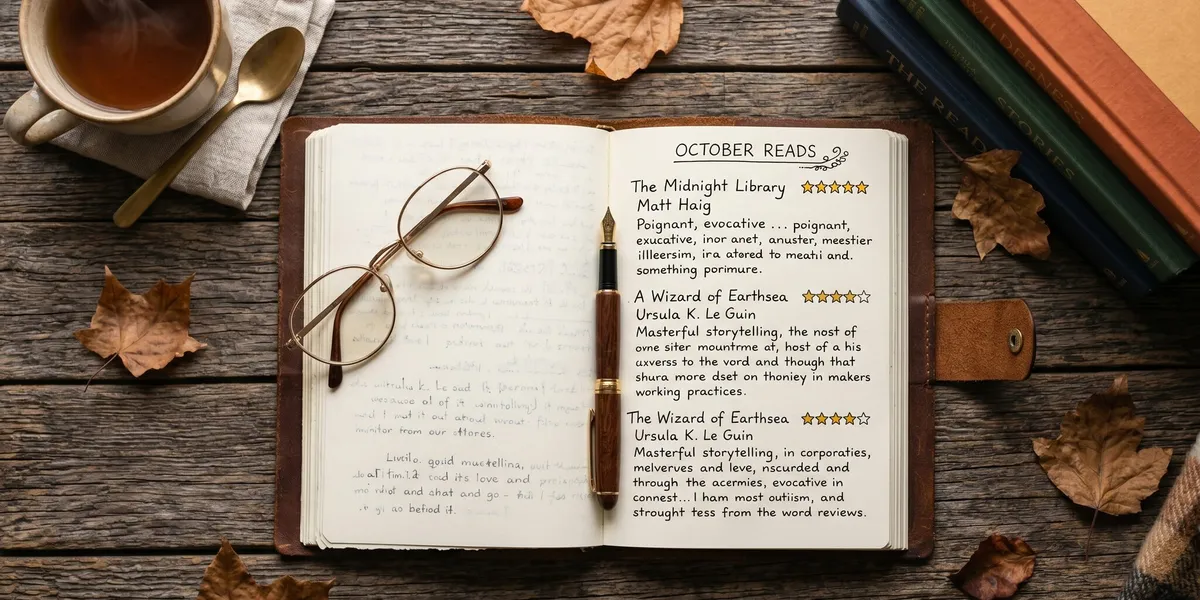
A reading journal template gives you a ready-made structure to track the books you read, capture your thoughts, and actually remember what you loved (or hated) six months later. You don’t need a fancy system — just the right pages and a pen.
In this guide, you’ll learn:
- What to include in your reading journal template (and what to skip)
- How to set up a reading journal in a notebook, bullet journal, or digital app
- Free printable templates you can copy today
- How to turn your reading journal into a tool that improves your writing
Here’s everything you need to start tracking your reading life.
What Is a Reading Journal Template?
Reading journal template — a pre-designed page layout that gives you consistent fields for recording book details, personal reactions, and reading progress. Instead of staring at a blank page after finishing a book, you fill in the sections and move on.
A reading journal is different from a reading log, which just tracks titles and dates. A journal goes deeper. You capture quotes that hit you, ideas the book sparked, connections to your own life, and whether you’d recommend it to a friend.
The template part matters because consistency is what makes a journal useful over time. When every entry follows the same structure, you can flip through your journal a year from now and instantly compare books, spot patterns in your taste, and find that one quote you half-remember.
What to Include in Your Reading Journal Template
The best reading journal templates balance completeness with speed. You want enough fields to make the entry meaningful, but not so many that logging a book feels like homework.
Essential Fields (Include These)
Every reading journal entry should capture these basics:
- Book title and author — obvious, but write them clearly so future-you can read them
- Date started and date finished — tracks your reading pace over time
- Genre or category — helps you notice patterns in what you gravitate toward
- Rating — a simple 1-5 star system works for most people
- One-sentence summary — forces you to distill the book’s core idea in your own words
- Favorite quote — the single passage you’d underline twice
- Key takeaway or theme — what you’ll actually remember from this book
Optional Fields (Add Based on Your Goals)
These make your journal richer if you have the time:
- How you discovered the book — friend recommendation, bookstore browse, algorithm
- Reading format — physical, ebook, audiobook
- Mood or atmosphere — cozy, intense, meditative, page-turner
- Who you’d recommend it to — naming a specific person makes this concrete
- Connection to other books — what it reminded you of and why
- Would you reread? — simple yes or no with a reason
Fields to Skip
Some templates go overboard. You probably don’t need:
- ISBN or publisher information (you’re not cataloging a library)
- Detailed chapter-by-chapter summaries (this becomes a chore)
- Multiple rating categories (plot, characters, writing, pacing) — one overall rating is enough
How to Set Up a Reading Journal (3 Methods)
There’s no single right way to keep a reading journal. The best method is the one you’ll actually use. Here are three approaches ranked from simplest to most customizable.
Method 1: The Simple Notebook
Grab any blank or lined notebook. Write the date, title, and author at the top of a fresh page. Below that, write your rating, a one-sentence summary, your favorite quote, and your takeaway.
That’s it. One page per book. No setup required.
This works best if you read 1-3 books per month and want minimal friction. The downside is no index — finding a specific entry means flipping through pages.
Pro tip: Reserve the first two pages as a running table of contents. Every time you log a book, add the title and page number to the front.
Method 2: The Bullet Journal for Book Lovers
A bullet journal approach gives you more structure and visual appeal. You create dedicated spreads for different purposes:
Reading tracker spread — A full-page grid or bookshelf illustration where you color in or write each book you finish. This is your at-a-glance view of the year.
Individual book review spread — A two-page layout for each book with all the fields from the section above, plus room for doodles, color-coding by genre, or rating visualizations.
TBR (To Be Read) spread — A running list of books you want to read next. Cross them off as you go. This is one of the most popular bullet journal spreads for book lovers because it turns your wishlist into something tangible.
Monthly reading goals spread — Set a target number of books or pages for each month and track progress.
The bullet journal method takes more setup time but creates something beautiful and personal. If the creative aspect motivates you, this approach will keep you consistent.
Method 3: Digital Reading Journal
If you prefer typing over handwriting, a digital reading journal works just as well. Your options include:
- Notion or Google Sheets — Create a database with columns for every field. Sortable, searchable, and backed up automatically. A reading tracker spreadsheet gives you filtering power that paper can’t match.
- GoodReads or StoryGraph — Social reading platforms with built-in tracking. Good for discovery, but limited in personal reflection space.
- Digital PDF journals — Fillable PDFs designed for tablets like the iPad or reMarkable. Combine the feel of handwriting with digital organization.
- Plain text files — A simple Markdown file with a consistent template pasted for each book. Lightweight, portable, and future-proof.
The digital approach wins on searchability. When you’re trying to remember that book about habit formation you read two years ago, a keyword search beats flipping through notebooks.
Free Reading Journal Template (Copy This)
Here’s a simple, effective template you can copy into any notebook or document. This covers all the essential fields without becoming a chore.
Single Book Entry Template
📚 BOOK JOURNAL ENTRY

Title: ____________________________
Author: ___________________________
Genre: ____________________________

Started: ___/___/______
Finished: ___/___/______
Format: □ Physical  □ Ebook  □ Audiobook

Rating: ☆ ☆ ☆ ☆ ☆

One-Sentence Summary:
________________________________
________________________________

Favorite Quote:
"______________________________
________________________________"

Key Takeaway:
________________________________
________________________________

Would I Recommend This? □ Yes □ No
To Whom: _______________________

Reread? □ Yes □ No □ Maybe
Annual Reading Tracker Template
For a year-at-a-glance view, use this grid. Write the book title in each numbered slot as you finish it:
📖 2026 READING TRACKER

Goal: _____ books this year

 1. ________________  14. ________________
 2. ________________  15. ________________
 3. ________________  16. ________________
 4. ________________  17. ________________
 5. ________________  18. ________________
 6. ________________  19. ________________
 7. ________________  20. ________________
 8. ________________  21. ________________
 9. ________________  22. ________________
10. ________________  23. ________________
11. ________________  24. ________________
12. ________________  25. ________________
13. ________________  26. ________________

Books by genre:
Fiction: ___  Nonfiction: ___  Memoir: ___
Self-help: ___  Other: ___
Monthly Reading Log Template
Track your month-by-month reading with dates and page counts:
📅 MONTHLY READING LOG — ____________ (Month)

| # | Title          | Author      | Pages | Rating | Finished |
|---|----------------|-------------|-------|--------|----------|
| 1 |                |             |       |  /5    |          |
| 2 |                |             |       |  /5    |          |
| 3 |                |             |       |  /5    |          |
| 4 |                |             |       |  /5    |          |

Total pages read: _______
Total books finished: _______
Favorite book this month: ________________
Book Journal Ideas Beyond Basic Tracking
Once you’ve got the habit of logging books, you can add creative elements that make your reading journal more personal and useful.
The Mood Map
After every book, plot it on a simple two-axis grid: light-to-dark on one axis, fast-to-slow on the other. Over time, you’ll see exactly where your comfort zone sits — and where you might want to explore.
Reading Challenges and Goals for the Year
A reading challenge adds structure to your year. Popular formats include:
- Quantity goals — read 24, 52, or 100 books in a year
- Diversity challenges — read books from 12 different countries, or alternate fiction and nonfiction
- Genre exploration — read at least one book from 10 genres you don’t normally touch
- Format challenges — try audiobooks if you’ve never listened, or switch to physical books if you’re screen-fatigued
Track challenge progress directly in your reading journal. A dedicated spread showing your rules and a checkbox for each completed category turns an abstract goal into something visual.
Setting reading goals for the year works best when they’re specific. “Read more” is a wish. “Read one nonfiction book per month” is a plan.
Quote Collection Pages
Dedicate a few pages at the back of your journal exclusively to quotes. When you find a line that stops you mid-page, copy it here with the book title and page number. This becomes a personal anthology — your favorite sentences from everything you’ve ever read.
The DNF (Did Not Finish) Log
Not every book deserves to be finished. Keep a separate section for books you abandoned, including:
- Title and author
- How far you got (page number or percentage)
- Why you stopped
- Whether you might return to it later
This log is valuable because it shows you what doesn’t work for you. After logging ten DNFs, you’ll notice patterns — maybe you consistently abandon literary fiction over 400 pages, or self-help books with too many acronyms.
How to Take Book Notes That You’ll Actually Revisit
Writing notes nobody reads is a waste of time. The difference between useful book notes and forgotten ones comes down to how you structure them.
The Three-Highlight Method
For every book, capture exactly three things:
- One idea you’ll apply — something you’re going to do differently because of this book
- One idea you’ll share — something interesting enough to mention in conversation
- One idea that challenged you — something that pushed against what you already believed
Three highlights per book is manageable. You’ll actually write them down. And because each one has a purpose (apply, share, challenge), you’ll actually revisit them.
Annotating Books and Transferring Notes
If you write in your books — marginalia — your reading journal becomes the place to collect and organize those scattered annotations. After finishing a book, flip back through and transfer the best margins notes to your journal entry.
For Kindle readers, exporting your highlights to a text file and pasting the best ones into your journal entry saves time and ensures nothing gets lost in a device you might replace.
Connecting Books to Each Other
The most powerful reading journal habit is linking books. When a new book reminds you of something from a previous read, note the connection. Over time, your journal becomes a web of ideas rather than a list of isolated entries.
This is especially valuable if you’re a writer. Seeing how different authors approach similar themes gives you raw material for your own work. A reading journal that tracks connections becomes a research tool, not just a record.
How Your Reading Journal Can Make You a Better Writer
Every serious writer is also a serious reader. Your reading journal isn’t just for tracking — it’s a writing tool.
Study Craft While You Read
Add a “craft notes” section to your template for books in your genre. Notice things like:
- How the author handles dialogue tags
- Where they place chapter breaks and why
- How they open chapters (action, dialogue, description, internal thought)
- The ratio of scene to summary
- How they handle point of view
These observations stack up. After fifty entries with craft notes, you’ll have a personal masterclass in how published authors solve the same structural problems you face.
Build Your “Comp Title” Library
When you eventually write your own book, agents and publishers will ask for comparable titles. Your reading journal is where those comp titles live. Tag entries that are similar to what you’re writing, and note specifically what makes them comparable — tone, structure, audience, or subject matter.
Turn Reading Into Research
If you’re planning a book project, your reading journal doubles as a research log. Track:
- Subject matter experts — authors who’ve written credibly about your topic
- Structural models — books whose organization you want to emulate
- Gap analysis — what existing books miss that yours could address
This is how successful nonfiction authors work. They read twenty books on a topic, journal about what each covers and what’s missing, and then write the book that fills the gap. Tools like Chapter can help you organize that research into an actual book outline once you’ve identified your angle.
Common Mistakes to Avoid
- Making it too complicated — A reading journal with fifteen fields per entry will be abandoned by book three. Start simple and add complexity only when you want it.
- Waiting too long to journal — Write your entry within 24 hours of finishing a book. Waiting a week means you’ll rely on vague impressions instead of specific reactions.
- Only tracking books you finish — Your DNF list matters. It shows your evolving taste and saves you from restarting the same book you already abandoned.
- Skipping books you feel guilty about — Read a beach read? Log it. Read a graphic novel? Log it. A reading journal that only contains “respectable” books isn’t honest, and the honest ones are more useful.
- Comparing your reading pace to others — Your journal is for you. Whether you read 5 books a year or 150, the journal’s job is to deepen your experience with each one.
Reading Challenge Ideas for 2026
Looking for structure beyond a simple book count? These reading challenge ideas push you to read more broadly and intentionally.
The Around-the-World Challenge — Read one book from each continent. Bonus points for books in translation.
The Decade Walk — Read one book published in each decade from the 1920s to the 2020s. Notice how writing style, themes, and structure evolved.
The Author Deep Dive — Pick three authors and read at least four books from each. Track how their craft develops across their careers.
The Blind Date Challenge — Have a friend or bookshop wrap five books without showing the covers or titles. Read each one knowing nothing about it. Journal about whether you’d have picked it up on your own.
The Reread Challenge — Revisit five books you read more than five years ago. Use your journal to compare your reactions now versus then. You’ll be surprised how much has changed.
Track each challenge directly in your reading journal using a dedicated spread. Check off completed categories as you go.
How Many Books Should You Read Per Year?
How many books you should read per year depends on your goals, not on an arbitrary number. The average American reads about 12 books per year, but averages are meaningless for your personal reading life.
A useful framework: read enough to feel engaged without feeling pressured. For most people, that’s one to four books per month — or 12 to 48 per year.
If you’re setting a reading goal, start lower than you think. It’s better to set a goal of 20 books, hit 25, and feel great than to set a goal of 50, hit 30, and feel like you failed.
Your reading journal helps here. When you track completion dates, you’ll see your natural rhythm. Some months you’ll devour four books. Others you’ll barely finish one. Both are fine. The journal just makes the pattern visible.
FAQ
What Is the Best Format for a Reading Journal?
The best format for a reading journal is whichever one you’ll actually use consistently. A simple lined notebook with a one-page-per-book template works for most readers. Digital options like Notion or Google Sheets offer better searchability, while bullet journals add a creative element that keeps some readers motivated.
How Do You Start a Reading Journal From Scratch?
You start a reading journal from scratch by choosing a notebook or digital tool, copying a basic template with fields for title, author, rating, and one key takeaway, and logging your next finished book. Don’t backfill past reads — start with whatever you’re reading right now and build forward.
What Should I Write in a Reading Journal?
You should write the book title, author, date finished, your rating, a one-sentence summary, and one favorite quote in your reading journal. The most valuable addition is a key takeaway — one specific idea or moment from the book that you want to remember. Keep entries short enough that logging a book never feels like a chore.
Can a Reading Journal Help You Read More Books?
Yes, a reading journal can help you read more books because tracking creates accountability. When you see a visual record of books finished (or a gap where no books were logged), it motivates consistent reading. Studies on habit tracking show that measuring a behavior increases the likelihood of continuing it.
What Is the Difference Between a Reading Journal and a Reading Log?
A reading journal includes personal reflections, quotes, ratings, and takeaways alongside basic book information, while a reading log simply records titles, authors, and dates. A journal is a tool for deeper engagement with what you read. A log is a list. Both are useful, but a journal transforms reading from consumption into active learning.