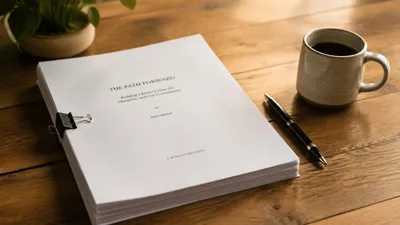
A business book proposal to a publisher is a 20-to-50-page business case that proves your book will sell before a single chapter exists. It is not a summary of your idea. It is a sales document that convinces an agent or acquisitions editor to invest money in you.
Here is what you’ll learn in this guide:
- The 7 sections every business book proposal must contain
- How publishers actually evaluate your platform and decide on an advance
- The mistakes that get proposals rejected in the first 60 seconds
- Whether you need a literary agent before you submit
The good news: unlike fiction, you can sell a business book on a proposal alone. Get the document right and a publisher pays you to finish writing it.
What Is a Business Book Proposal?
A business book proposal — a structured sales document that argues why your business book is marketable, who will buy it, and why you are the right author to write it. Most run 20 to 50 pages and combine market analysis, author platform, comparable titles, a chapter outline, and 1-2 polished sample chapters.
Think of it as a back-cover blurb fused with a business plan. The proposal does double duty: it pitches the concept and it forecasts sales.
As literary agents repeatedly stress, a proposal is read by a publisher’s sales and marketing teams, not just an editor. Those teams want evidence that real people will pay for this book. According to Jane Friedman’s foundational guide on book proposals, the document argues why your idea is “salable and marketable in today’s market.”
For nonfiction, this matters more than the writing itself. You don’t finish the book first. You sell the proposal, sign a contract, collect an advance, and then write. That’s the opposite of fiction, where you query a finished manuscript.
If you want the broader path, our guide on how to get a book deal walks through the full submission journey from idea to contract.
What Are the 7 Sections of a Business Book Proposal?
A business book proposal to a publisher follows a standard structure: overview, target audience, comparable titles, author platform, marketing plan, chapter outline, and sample chapters. Almost every proposal that sells contains these seven sections, in roughly this order.
Skip one and an agent assumes you don’t understand the business of publishing. Here’s what each section does and how to make it land.
1. The Overview (Your Hook)
The overview is the most important page in the document. It answers, in compelling prose, what the book is, why it matters now, and why it will sell. Open with a hook, not a definition.
Lead with the central argument of your book and a single statistic or story that makes the reader lean in. Keep it to 1-3 pages. If the overview is flat, editors stop reading before they reach your platform.
State the working title, the approximate word count (most business books run 50,000-70,000 words), and the timeline to delivery. Make the promise of the book unmistakable.
2. Target Audience and Market Analysis
Publishers need proof that a motivated, buying audience already exists. Vague targeting kills proposals. “Marketing professionals” is too broad. “CMOs at mid-sized SaaS firms struggling with AI adoption” tells a publisher exactly who reaches for their wallet.
Quantify the market. How many people hold this job title? How many attend the relevant conferences? How big is the relevant subreddit, LinkedIn group, or trade association?
You are the expert on this niche, so use that authority. Show secondary audiences too: corporate training departments, MBA programs, and bulk-buyers all expand the sales case.
Tie the audience to timing. Publishers buy books that ride a wave, so name the trend your reader is reacting to right now, whether that’s AI adoption, hybrid work, or a shift in regulation. A timely “why now” turns a solid audience into an urgent one.
3. Comparable Titles (Comps)
List 4-6 comparable books your reader would already own. For each comp, give the author, title, publisher, publication date, page count, and a 2-3 sentence note on how your book is similar but different.
Choose comps that are recent (within 3-5 years) and traditionally published. A mix of bestsellers and solid mid-list titles signals you understand the real market, not just the fantasy of becoming the next Atomic Habits.
Literary agent Jeff Shreve advises authors to describe other books’ shortcomings respectfully, since “you’ll be submitting your proposal to the publishers of many of these competitive titles.” Be honest about gaps your book fills without trashing the competition.
The comps section is really an evidence section. Strong-selling comps prove the category has buyers, and your point of difference proves there’s still room on the shelf. Avoid comparing yourself only to mega-bestsellers, which makes the claim feel inflated, and avoid comps that are too obscure to signal a market at all.
4. Author Platform (The Section That Decides Your Advance)
Your platform is the first thing an agent checks. Author platform — your existing, measurable ability to reach buyers: email subscribers, social following, podcast downloads, speaking engagements, media features, and professional reach.
Lead with hard numbers. “12,000 newsletter subscribers, 38% open rate, 25 keynote talks in 2025, monthly column in Inc.” beats any adjective. The bigger and more engaged your platform, the larger the advance publishers will offer.
A real 2026 example: an author with 50,000 email subscribers, regular speaking gigs, and a successful course landed a $200,000 advance for a business book, despite having written no prior books. Platform overcame the lack of writing credentials.
If your platform is thin, you can still win. A PhD researcher with only 2,000 subscribers secured a $75,000 advance by leading with credentials and a fresh, timely angle. Exceptional expertise can offset a small audience, but you must position it deliberately. To build that audience first, see our guide to LinkedIn for nonfiction authors.
Frame your platform as access, not vanity. If you don’t have huge follower counts, show direct lines to your buyers: a 30,000-member professional association where you speak annually, a corporate client base of 200 companies, or a podcast where your ideal reader already listens. Publishers care about reach to the right people, not raw numbers alone. Include testimonials, media logos, and metrics that a marketing team can verify in seconds.
5. Marketing Plan
Publishers expect authors to be the primary marketing engine. Mid-list business books rarely get a big publisher push, so your plan needs to be specific, dated, and realistic.
Replace “I’ll do publicity” with “I’ll appear on 20 podcasts in the launch quarter, run a 6-week email sequence to my list, and present at 4 industry conferences.” Include any special features that move copies: a foreword from a recognized name, a planned bulk buy-back, or a hired publicist.
Bulk sales are the quiet engine of business books. A single corporate order of 500-5,000 copies can dwarf a year of retail royalties, and nonfiction authors often earn 40-70% of their income from bulk and special sales. Flag any corporate or association relationships that could trigger these orders. A structured book marketing plan shows publishers you’ve thought past launch day.
6. Chapter Outline (Annotated Table of Contents)
The chapter outline proves your idea is fully formed, not just inspired. List every chapter title with a paragraph describing its content. Most business books run 10-15 chapters.
This section shows the book has enough substance to fill its pages and reveals your voice and structure. For business and self-help, agents weigh this heavily because the architecture is the value.
Build it from a solid skeleton first. Our business book outline template and broader nonfiction book structure guide help you map chapters before you write the proposal.
7. Sample Chapters
Include the introduction plus 1-2 sample chapters, usually 25-50 pages. These must be polished, not drafts. Many editors skim the overview and jump straight to your writing.
Double-space them, use 12-point font, add page numbers, and save as PDF. If your prose isn’t ready, hire a copy editor before submitting. First impressions on the page are final.
Pick your strongest material, not necessarily chapter one. Editors want to see your best thinking and your clearest writing, so lead with the chapter that proves you can deliver both. The introduction should hook hard; the sample chapter should demonstrate that you can sustain that energy across a full book.
Our Pick — Chapter
Drafting a sharp introduction and sample chapters is where most proposals stall. Chapter is an AI book-writing platform built for nonfiction authors who need to turn an outline into clean, on-brand prose fast. It’s helped 2,147+ authors create over 5,000 books, and it’s been featured in USA Today and the New York Times. One author earned $13,200 from a single book; another generated $60K in 48 hours. At $97 one-time for the nonfiction tool, it’s a practical way to produce the polished sample chapters a proposal demands.
Common Mistakes to Avoid
Most proposals are rejected for predictable, avoidable reasons. Watch for these before you submit.
- Submitting rough sample chapters. Typos and weak writing end the read instantly. Polish or pay an editor.
- Overhyping. “This is the next Good to Great” hurts you when the comps and platform don’t support it. Be confident, not inflated.
- Vague targeting. “Anyone in business” tells a publisher you haven’t done the work. Name the exact buyer.
- A thin marketing plan. “I’ll use social media” is not a plan. Dates, numbers, and channels are.
- Ignoring submission guidelines. Every agent and publisher lists requirements. Follow them exactly or get auto-rejected.
- Forgetting the platform numbers. Adjectives don’t sell; metrics do. Lead every platform claim with a figure.
A common cause of weak proposals is treating the document as a description instead of a sales pitch. Reframe every section around one question: why will this book make the publisher money?
How Should You Format and Submit a Business Book Proposal?
Format your business book proposal cleanly and professionally: a title page, a table of contents, then each section in order, with a running header carrying your name and contact details on every page. Submit as a single PDF unless the agent’s guidelines say otherwise.
Use generous margins, a readable serif font, and consistent headings. Publishers read dozens of proposals a week, so anything that slows the eye works against you. Clean design signals a professional who will be easy to work with.
Tailor every submission. Read the agent’s or publisher’s guidelines line by line and match them exactly, including word counts, attachment formats, and what to paste into the email body. A proposal that ignores stated rules rarely reaches a full read.
Personalize the query that carries the proposal. Reference a specific book that agent represented or a comp from their list. Generic mass-blasts are obvious and easy to reject, while a targeted pitch shows you’ve done the homework an author who can market a book would do.
Do You Need a Literary Agent Before You Submit?
In most cases, yes. The Big Five publishers rarely accept unagented submissions, so a literary agent is your gateway to a major business book deal. The agent knows which editors want what, negotiates your contract, and takes roughly 15% of your earnings.
You typically query an agent with a short pitch first, then send the full proposal once they’re interested. A query letter — a one-page pitch designed to hook an agent’s attention — is the door; the proposal is the room behind it.
Our guides on how to find a literary agent and how to write a query letter cover the front half of this process. Some independent and university presses accept direct submissions, so check the Big Five publishers’ submission guidelines and any smaller imprints on your comp list.
How Much Will a Publisher Pay for a Business Book?
Debut business book advances in 2026 typically range from $5,000 to $15,000, with strong platforms or auction interest pushing well beyond that. Six-figure advances exist but are rare, usually under 3% of debuts, and almost always tied to a large existing audience.
Advances are paid in installments, commonly one-third on signing, one-third on delivery of the manuscript, and one-third on publication. Many books never earn out, meaning the advance becomes the author’s entire lifetime payment on the contract.
Traditional royalties run roughly 8-15% of sales, versus 60-70% for self-publishing. If your platform is strong and your goal is income rather than prestige, weigh the tradeoffs in our self-publishing vs traditional comparison before committing to the proposal route.
How Long Does a Business Book Proposal Take to Write?
A strong proposal usually takes 4-12 weeks of focused work, with the sample chapters and platform-building consuming most of that time. The overview and comps move fast; researching the market and polishing 30 pages of prose does not.
Treat the timeline as part of your pitch. Publishers want authors who can deliver a finished manuscript 9-12 months after signing, so demonstrate that pace in how cleanly your proposal is executed. If you’re still shaping the underlying book, start with our guide on how to write a business book before building the proposal around it.
Frequently Asked Questions
How long should a business book proposal be?
A business book proposal to a publisher typically runs 20 to 50 pages, including 25-50 pages of sample material. The non-sample sections (overview, audience, comps, platform, marketing, outline) usually total 10-20 pages. Length varies by publisher guidelines, so always check before submitting.
Do I need to finish the book before submitting a proposal?
No. For nonfiction and business books, you sell the proposal first, not a finished manuscript. You only need the introduction and 1-2 polished sample chapters. If a publisher accepts, you sign a contract and write the rest, usually within 9-12 months of signing.
What is the most important section of a business book proposal?
The overview and the author platform matter most. The overview hooks the editor in the first page, while the platform section, read by sales and marketing teams, often decides the size of your advance. Strong, measurable platform metrics can outweigh limited writing credentials.
Can I submit a business book proposal without a literary agent?
Sometimes. The Big Five publishers rarely accept unagented submissions, but many independent presses, university presses, and hybrid publishers do. For a major business book deal, securing a literary agent first remains the most reliable path to a strong advance and contract.
How many comparable titles should I include?
Include 4-6 comparable titles published within the last 3-5 years by traditional publishers. For each, list the author, title, publisher, date, page count, and a short note on how your book is similar yet distinct. A realistic mix of bestsellers and mid-list books signals real market understanding.