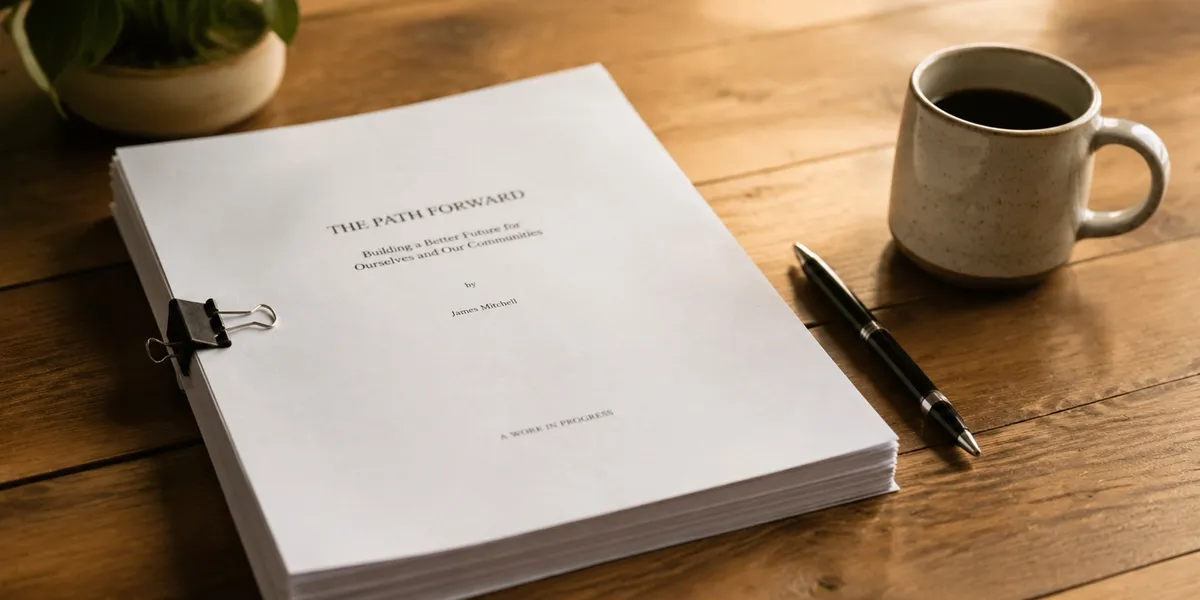
You can write a professional book proposal using a free template — and a strong proposal is the single document that decides whether your nonfiction book gets a publishing deal.
In this guide, you’ll learn:
- Every section your book proposal needs (with a fill-in-the-blank template)
- How to write each section so agents and publishers actually read it
- The formatting and length guidelines that match industry standards
- Common proposal mistakes that trigger instant rejections
Here’s your complete, free book proposal template — section by section.
What Is a Book Proposal (And Why Do You Need a Template)?
A book proposal is a 15-to-50-page document that sells your nonfiction book idea to literary agents and publishers before you write the full manuscript. It works like a business plan — you pitch the concept, prove you can deliver, and show the book will sell.
Unlike fiction writing, where you finish the manuscript first, nonfiction publishing works in reverse. Publishers buy the idea based on your proposal, then you write the book after signing the deal.
A template gives you the exact structure publishers expect. You fill in the blanks instead of guessing what goes where. The result is a polished, professionally formatted proposal that looks like you’ve done this before — even if it’s your first time.
The 7 Sections Every Book Proposal Template Needs
Every successful book proposal follows the same core structure. Here are the seven sections your free template should include — and what goes inside each one.
1. Title Page
Your title page is simple. Include:
- Working title and subtitle
- Your name (and pen name, if applicable)
- Contact information (email, phone, website)
- Word count estimate for the finished book
- Agent or editor name (customize for each submission)
Keep the title page to one page. No graphics, no fancy fonts. Clean and professional wins.
2. Overview (1-2 Pages)
The overview is the most important section of your proposal. It’s the first thing agents read, and most make their decision here.
Your overview should answer five questions in roughly 500 words:
- What is this book about? (The core concept in 2-3 sentences)
- Why does this book need to exist now? (Timeliness and market gap)
- Who will buy it? (Your target reader, briefly)
- What makes you the right author? (Your authority, in one sentence)
- What’s the hook? (The angle that makes this book different from existing titles)
Template for your overview:
[Working Title] is a [word count]-word [category/genre] book that [one-sentence description of what the book does for the reader]. While books like [Comp Title 1] and [Comp Title 2] cover [related territory], [Working Title] is the first to [your unique angle].
[Target reader] faces [specific problem]. This book provides [specific solution] through [your approach — stories, research, framework, etc.].
[Your name] is [one sentence of authority — credentials, experience, platform]. [One sentence connecting your background to why you can write this book].
Write the overview last, even though it appears first. You’ll have a clearer sense of your pitch after drafting the other sections.
3. Target Audience
This section proves your book has buyers. Publishers think in terms of market size, not vague demographics.
Be specific. Don’t write “anyone interested in productivity.” Write “the 4.2 million Americans who purchased a productivity book on Amazon in 2025, plus the 2.3 million subscribers to productivity-focused newsletters like James Clear’s 3-2-1 Thursday.”
Your target audience section should include:
- Primary audience (your core buyer — one specific group)
- Secondary audiences (2-3 additional groups who would also buy)
- Market size evidence (numbers from industry reports, social media followings, conference attendance, newsletter subscriber counts)
- How to reach them (your existing platform, their gathering places)
Template:
Primary audience: [Specific group] — approximately [number] people who [behavior that proves they buy books like this].
Secondary audiences:
- [Group 2]: [Size] people who [reason they’d buy]
- [Group 3]: [Size] people who [reason they’d buy]
Market evidence: [Data point 1]. [Data point 2]. [Data point 3].
4. Competitive Title Analysis
Publishers call this section “comp titles” or “competitive analysis.” You’re not listing every book ever written on your topic — you’re showing you understand the market and explaining where your book fits.
Pick 5-7 books published within the last 3-5 years. For each one:
- Title, author, publisher, year, format, page count
- One sentence on what the book covers
- One sentence on how your book differs (not “mine is better” — explain the gap your book fills)
Template for each comp title:
[Title] by [Author] ([Publisher], [Year], [pages] pages). This [bestselling/popular/award-winning] book covers [brief description]. While [Title] focuses on [its angle], [Your Title] addresses [the gap] by [your approach].
Avoid these comp title mistakes:
- Picking books that are too old (pre-2021 signals you haven’t done recent research)
- Picking massive bestsellers as your only comps (“This is the next Atomic Habits” makes you look naive)
- Trashing competitors (agents want to see market awareness, not ego)
5. Author Bio and Platform
This section answers: “Why should you write this book?” Publishers want two things — credentials and reach.
Credentials prove you know the subject. These include degrees, professional experience, published articles, speaking engagements, awards, and relevant life experience.
Platform proves you can sell the book. This means:
- Email list size
- Social media following (with engagement rates, not just follower counts)
- Website traffic
- Podcast downloads
- Speaking calendar
- Media appearances
- Professional network
Template:
[Your name] is a [credential — title, degree, experience] who has [relevant accomplishment]. [He/She/They] has been featured in [media outlets] and [speaks/teaches/consults] on [topic] at [venues/organizations].
Platform:
- Email newsletter: [number] subscribers ([frequency])
- Website: [monthly visitors]
- Speaking: [number] events per year at [types of venues]
- Media: Featured in [outlets]
If your platform is small, lean into your credentials and explain your growth plan. A compelling expertise angle can outweigh a modest following — especially for specialized nonfiction.
6. Chapter Outline
The chapter outline shows publishers exactly what they’re buying. For each chapter, write a 100-200 word summary that covers:
- Chapter title
- The main point or argument
- Key stories, examples, or data you’ll include
- What the reader gains from this chapter
Template for each chapter:
Chapter [Number]: [Title]
[One-sentence summary of the chapter’s thesis]. This chapter explores [main topic] through [approach — personal stories, case studies, research, exercises].
Key content includes [specific example 1], [specific example 2], and [specific framework or takeaway]. By the end of this chapter, the reader will [specific outcome or understanding].
For a typical nonfiction book, plan 10-15 chapters. Keep each summary tight. The outline section usually runs 3-8 pages total.
7. Sample Chapters
Include 1-2 complete sample chapters. These are fully written, polished chapters — not drafts. They prove you can deliver on the promise of your proposal.
Which chapters to include:
- Always include Chapter 1. Agents want to see how you open the book.
- Include one middle chapter that showcases your strongest writing, most compelling story, or most original research.
- Skip the introduction as a sample chapter — it’s too similar to the overview.
Each sample chapter should be roughly 3,000-5,000 words. Combined with the rest of your proposal, the full package will land between 25-50 pages.
Pro tip: If you’re using AI tools to help draft your proposal, start with the sample chapters. They’ll sharpen your voice and clarify your argument before you write the marketing-focused sections.
Free Book Proposal Template: Copy-and-Fill Format
Here’s the complete template you can copy and adapt. Each section includes the exact fields publishers expect.
[TITLE PAGE]
| Field | Your Entry |
|---|---|
| Working Title | |
| Subtitle | |
| Author Name | |
| Phone | |
| Website | |
| Estimated Word Count | |
| Category |
[OVERVIEW] — 500 words max
[TARGET AUDIENCE] — Primary + 2-3 secondary audiences with market data
[COMPETITIVE TITLES] — 5-7 books with publisher, year, and differentiation
[AUTHOR BIO & PLATFORM] — Credentials + reach metrics
[CHAPTER OUTLINE] — 100-200 words per chapter, 10-15 chapters
[SAMPLE CHAPTERS] — Chapter 1 + one additional chapter, fully polished
Book Proposal Formatting Guidelines
Formatting matters. Agents reject sloppy proposals before reading the content. Follow these industry-standard rules:
| Element | Standard |
|---|---|
| Font | Times New Roman or Georgia, 12pt |
| Spacing | Double-spaced body text |
| Margins | 1 inch on all sides |
| Header | Your last name / title / page number |
| File format | .doc or .docx (not PDF, unless requested) |
| Length | 15-50 pages (excluding sample chapters) |
One formatting detail most templates miss: publisher-specific requirements vary. Springer’s proposal form asks for a detailed table of contents and timeline upfront. Routledge’s form requires a “significance of the work” section. Always check the specific agent or publisher’s submission guidelines before sending.
How to Use AI to Speed Up Your Book Proposal
Writing a book proposal from scratch takes most authors 2-6 weeks. AI writing tools can cut that to a few days while producing stronger output.
Here’s how to use AI for each proposal section:
- Overview: Feed the AI your book concept and ask it to generate three different angles. Pick the strongest one and refine it in your voice.
- Target audience: Ask AI to research market size data for your niche. It can pull demographic data and industry statistics faster than manual research.
- Comp titles: Use AI to find recently published books in your category and generate comparison summaries.
- Chapter outline: Describe your book’s structure and have AI expand each chapter into a 150-word summary.
Our Pick — Chapter
Chapter helps nonfiction authors go from concept to complete book — and the same AI-powered workflow works for drafting proposal sections. You can outline your entire book, generate chapter summaries, and polish your writing, all in one tool.
Best for: Nonfiction authors who want to draft both their proposal and their book in the same workspace Pricing: $97 one-time Why we built it: Over 10,000 authors have used Chapter to write books. The same structured workflow that helps you write a nonfiction book also produces proposal-ready outlines and sample chapters.
Important: AI is a drafting tool, not a replacement for your voice. Every section should sound like you — agents can spot generic AI output. Use AI for structure and speed, then rewrite for authenticity.
Common Book Proposal Mistakes to Avoid
These five mistakes get proposals rejected before the second page:
- Writing an overview that reads like a book report. Your overview is a sales pitch, not a summary. Lead with the market opportunity, not a description of chapter contents.
- Skipping the platform section. Even if your platform is small, omitting it signals you don’t understand how publishing works. Be honest and show your growth plan.
- Choosing outdated comp titles. Books from 2015 tell publishers you haven’t researched the current market. Stick to titles published within the last 3-5 years.
- Submitting unpolished sample chapters. Sample chapters are your audition. Typos, weak openings, or meandering prose will kill an otherwise strong proposal.
- Sending the same proposal to every agent. Customize your overview and the “why this agent” paragraph for each submission. Batch querying with a generic template gets generic rejections.
How Long Should a Book Proposal Be?
A book proposal should be 15-50 pages (double-spaced) excluding sample chapters. With sample chapters included, the full package typically runs 25-75 pages.
Here’s how that breaks down by section:
| Section | Typical Length |
|---|---|
| Title page | 1 page |
| Overview | 1-2 pages |
| Target audience | 1-2 pages |
| Comp titles | 2-3 pages |
| Author bio & platform | 1-2 pages |
| Chapter outline | 3-8 pages |
| Sample chapters | 10-25 pages |
Shorter is usually better. A tight 20-page proposal that makes a clear case beats a bloated 50-page proposal that buries the point. According to Jane Friedman, the quality of your proposal often matters more than the quality of your sample chapters.
Do You Need a Book Proposal for Self-Publishing?
You don’t need a traditional book proposal if you’re self-publishing. But writing one anyway is one of the smartest things you can do.
A proposal forces you to answer the hard questions before you invest months writing:
- Who specifically will buy this book? (Not “everyone” — a real audience)
- What makes your book different from the 20 others on this topic?
- Can you actually fill 200+ pages with original, valuable content?
Think of a self-publishing proposal as a strategic planning document. You skip the agent-focused sections (platform, comp titles for publishers) and focus on the reader-facing ones: overview, audience, and chapter outline.
If you discover your concept doesn’t hold up during the proposal process, that’s a win — you saved yourself months of writing a book that wouldn’t sell.
What Comes After the Proposal?
Once your proposal is done, the next step is finding a literary agent who represents your genre. Here’s the sequence:
- Research agents who have sold similar books recently
- Write a query letter — your one-page pitch that accompanies the proposal
- Submit according to each agent’s specific guidelines (some want the full proposal upfront; others want a query first)
- Wait — response times range from a few weeks to several months
- Revise based on agent feedback, or pivot to new agents
If the traditional route feels slow, many authors publish their book on Amazon while simultaneously querying agents — hedging both paths.
FAQ
What should a book proposal include?
A book proposal should include seven core sections: a title page, overview, target audience analysis, competitive title analysis, author bio and platform, a detailed chapter outline, and 1-2 polished sample chapters. The proposal typically runs 15-50 pages (excluding sample chapters) and serves as a business plan that convinces publishers your nonfiction book will sell.
Can I use a free book proposal template?
Yes, you can use a free book proposal template to structure your proposal correctly. A good template ensures you include every section publishers and literary agents expect. The key is customizing the template with your unique content — agents spot generic, fill-in-the-blank proposals instantly. Use the template for structure, then make every word your own.
How long does it take to write a book proposal?
Writing a book proposal typically takes 2-6 weeks for most first-time authors. The sample chapters require the most time, followed by the competitive analysis and overview. Using AI writing tools can reduce that timeline to 3-5 days by helping you draft each section faster — though you still need time for research and revision.
Do fiction writers need a book proposal?
Fiction writers typically do not need a book proposal. In fiction publishing, agents and publishers want to see a completed manuscript, not a proposal. The exception is established fiction authors with a track record — they can sometimes sell a novel based on a proposal and sample chapters. First-time novelists should focus on finishing their manuscript and writing a strong query letter instead.
What’s the difference between a book proposal and a query letter?
A book proposal is a 15-50-page document that covers your book’s concept, market, your credentials, chapter outline, and sample chapters. A query letter is a one-page pitch letter you send to agents before they request the full proposal. Think of the query as the door-opener and the proposal as the full presentation. You need both for traditional nonfiction publishing.