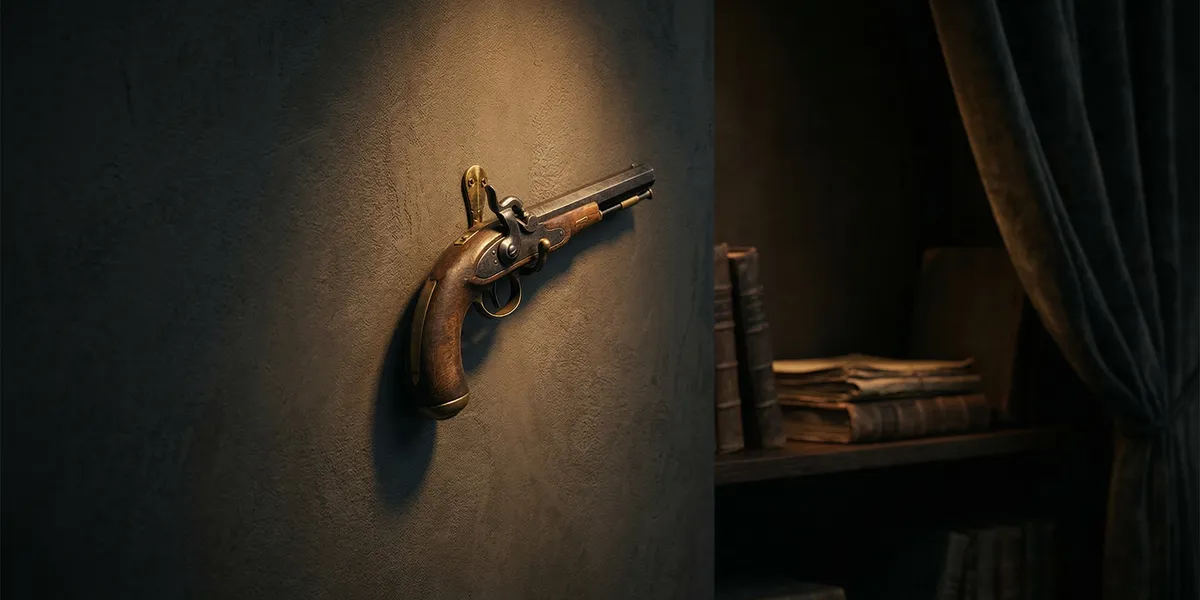
“If in the first act you have hung a pistol on the wall, then in the following one it should be fired. Otherwise don’t put it there.” — Anton Chekhov
This is not a rule about guns. It is a rule about promises.
What Chekhov’s Gun Really Means
Every detail you include in a story creates an expectation. When you describe a locked safe in the office, the reader expects to learn what is inside. When you mention a character’s ability to pick locks, the reader expects that skill to matter. When you spend a paragraph on a crumbling bridge, the reader expects someone to cross it.
Chekhov’s Gun is the principle that every meaningful element in a story must serve a purpose. If it does not contribute to the narrative — if it does not pay off — it should be removed.
The principle works in both directions. If you introduce a detail, pay it off. If you need something in the climax, introduce it earlier. The first direction is about efficiency. The second is about credibility.
How to Use Chekhov’s Gun
If You Introduce It, Pay It Off
A detail that is introduced and never used creates narrative debt. The reader remembers it. They are waiting for it to matter. When it never does, they feel a specific kind of dissatisfaction — the sense that the author lost track of their own story, or worse, that the detail was there to pad the word count.
This does not mean every sentence must be a loaded gun. Atmospheric details, setting descriptions, and character quirks create texture and do not all require explicit payoffs. But significant details — objects that receive focused attention, skills that are specifically mentioned, relationships that are established with emphasis — these create expectations that must be fulfilled.
The test: if you removed the detail, would the story lose something? If yes, it belongs. If no, it is either doing invisible atmospheric work (fine) or it is clutter (cut it).
If You Need It Later, Plant It Now
The reverse application of Chekhov’s Gun is arguably more useful for working writers. You are in the climax. Your protagonist needs a weapon, a skill, a piece of knowledge, or an ally to survive. If that element appears for the first time in the moment it is needed, it feels like a coincidence — or worse, a deus ex machina.
The solution is to go backward. Write the climax. Identify what the protagonist needs. Then return to earlier chapters and plant the seed. The gun on the wall in act one makes the gun in the protagonist’s hand in act three feel earned rather than convenient.
This is why revision is essential. First drafts often contain moments where the solution appears from nowhere. The revision pass is where you trace each solution backward and lay the groundwork.
Readers Remember What You Show Them
Chekhov’s Gun works because of how human attention operates. When a narrative pauses to describe something — when the prose lingers on an object, a detail, a piece of information — the reader’s brain flags it as important. This is an automatic process. The reader may not consciously think “that will matter later,” but their subconscious is filing it away.
This means you have to be deliberate about what you show. Every time the narrative camera focuses on something, you are telling the reader: this matters. If it does not matter, you are training the reader to ignore your signals. After enough false alarms, the reader stops trusting the narrative — and when the real gun fires, they are not paying attention.
Chekhov’s Gun and Foreshadowing
Chekhov’s Gun is a specific form of foreshadowing. Both involve planting information early that becomes significant later. The difference is in scope and intent.
Foreshadowing is broad. It includes mood, imagery, symbolism, prophecy, and structural echoes. A storm gathering before a betrayal is foreshadowing. A character’s dream that mirrors a future event is foreshadowing.
Chekhov’s Gun is narrow and concrete. It is a specific object, skill, character, or piece of information that is introduced and then used. The pistol on the wall. The locked box. The character who mentions they once worked as a nurse — and then, in the third act, performs emergency surgery.
Every Chekhov’s Gun is foreshadowing, but not every piece of foreshadowing is a Chekhov’s Gun. Foreshadowing creates atmosphere and anticipation. Chekhov’s Gun creates setup and payoff.
When to “Break” the Rule
Red Herrings
A red herring is a deliberate violation of Chekhov’s Gun. You introduce a detail that seems significant, the reader expects it to pay off in a specific way, and then it turns out to mean something different — or nothing at all. Mystery writers depend on this technique. The suspicious character, the misleading clue, the object that seemed like a weapon but was innocent: these are guns on the wall that deliberately do not fire.
The difference between a red herring and a broken promise is intent. A red herring is designed to mislead — the author knows it will not pay off in the expected way, and the misdirection serves the story. A broken promise is an accident — the author forgot about the detail or did not realize they had created an expectation.
Red herrings work best when they are eventually explained. The gun did not fire, but the reader learns why it was on the wall. The suspicious character was innocent of the murder, but guilty of something else. The misleading clue was real — it just pointed somewhere the reader was not looking.
Literary Fiction and Meaningless Detail
Some literary fiction intentionally includes details that serve no narrative purpose because life includes details that serve no purpose. A character notices a crack in the ceiling. It never matters. The crack is just a crack. This is realism pushing back against the artificiality of perfectly constructed narratives.
This technique works when it is a deliberate aesthetic choice and the reader understands the genre’s conventions. In a thriller, an unresolved detail is a flaw. In literary fiction, it can be a feature — a reminder that not everything in life carries meaning, and that the compulsion to make everything significant is itself a kind of fiction.
The risk: if you lean on this too often, the reader stops engaging. Why pay attention to details if they might not matter? Chekhov’s Gun earns its status as a principle because it aligns with how readers naturally interact with stories. Breaking it requires confidence and control.
Famous Examples
The Mockingjay Pin in The Hunger Games. Introduced in the first book as a token from District 12, the pin becomes the symbol of the entire rebellion across the trilogy. Suzanne Collins plants the object as a small personal detail and lets it grow into the most recognizable image in the series. By the time it represents a revolution, the seed was planted hundreds of pages earlier.
The Lightsaber in Star Wars. Obi-Wan gives Luke his father’s lightsaber early in A New Hope. It seems like a keepsake. By the film’s climax, it is the weapon Luke uses to destroy the Death Star (guided by the Force, another element introduced earlier). The lightsaber and the Force are both Chekhov’s Guns — planted in the first act, fired in the third.
The Diary in Harry Potter and the Chamber of Secrets. Riddle’s diary appears as a mysterious found object. It is used and destroyed within the same book. But four books later, in Half-Blood Prince, the diary is revealed to have been a Horcrux — one of seven objects containing pieces of Voldemort’s soul. Rowling planted a Chekhov’s Gun that took six years to fully fire.
Rosebud in Citizen Kane. Kane’s dying word — “Rosebud” — is the first detail the audience encounters. The entire film is an investigation into what it means. The reveal (the childhood sled, burning in a furnace) pays off the first scene of the movie. Rosebud is the gun on the wall in the opening frame and the gun that fires in the closing one.
Common Mistakes
Planting guns that never fire. You describe a character’s archery skills in chapter three. Archery never comes up again. The reader remembers. They were waiting for the bow. You owe them the arrow.
Firing guns that were never planted. The protagonist needs to escape a locked room. Conveniently, she happens to know how to pick locks — a skill never mentioned before this exact moment. The reader’s trust drops. This is the opposite of Chekhov’s Gun: it is narrative convenience disguised as competence.
Over-planting. Every other paragraph introduces a new significant detail. The protagonist checks a knife, examines a map, notices a loose brick, studies a painting, and tests a floorboard — all in one chapter. The reader has no idea which details matter because everything is presented with equal weight. Chekhov’s Gun requires restraint. The fewer guns on the wall, the more powerful each one becomes.
Paying off too quickly. A character mentions she is afraid of water on page 10. On page 12, she falls in a lake. The setup needs room to breathe. Distance between the plant and the payoff is what makes the payoff feel earned. A gun introduced and fired in the same scene is not a Chekhov’s Gun — it is just a plot point.
The Principle Behind the Principle
Chekhov’s Gun is ultimately about trust between author and reader. When you include a detail, you are making a promise: this matters. When you pay it off, you are keeping that promise. When every promise in a story is kept, the reader develops a deep trust in the narrative — the feeling that the story knows where it is going, that every piece is part of a coherent structure, that the author is in control.
That trust is what allows readers to surrender to a story. They stop questioning and start believing. They lean into plot twists because they trust the author has earned them. They accept surprises because they trust the groundwork was laid.
Chekhov put a pistol on the wall and demanded it be fired. The demand was not about pistols. It was about the contract between a storyteller and an audience. Include what matters. Pay off what you include. Earn every detail. That contract, kept faithfully, is what transforms a collection of scenes into a story.