Conflict is not an element of fiction. It is the element. Without conflict, there is no story — only a sequence of events. A character wants something, something stands in the way, and the struggle between desire and obstacle generates everything a reader cares about: tension, suspense, growth, meaning.
Why Conflict Is Essential
A story without conflict is a report. Someone wakes up, goes to work, comes home, goes to sleep. Nothing is at stake. Nothing is resisted. Nothing changes. The reader has no reason to turn the page because nothing on the next page can matter.
Conflict creates stakes. It forces characters to make decisions under pressure, and those decisions reveal who they are. A person’s character is not visible in comfort — it is visible in crisis. What do they do when the thing they want most requires them to sacrifice the thing they value most? That question is the engine of every memorable story ever told.
Conflict also creates structure. The rising action of a narrative is conflict escalating. The climax is conflict reaching its peak. The resolution is conflict finding its answer. Remove the conflict and the architecture of the story collapses.
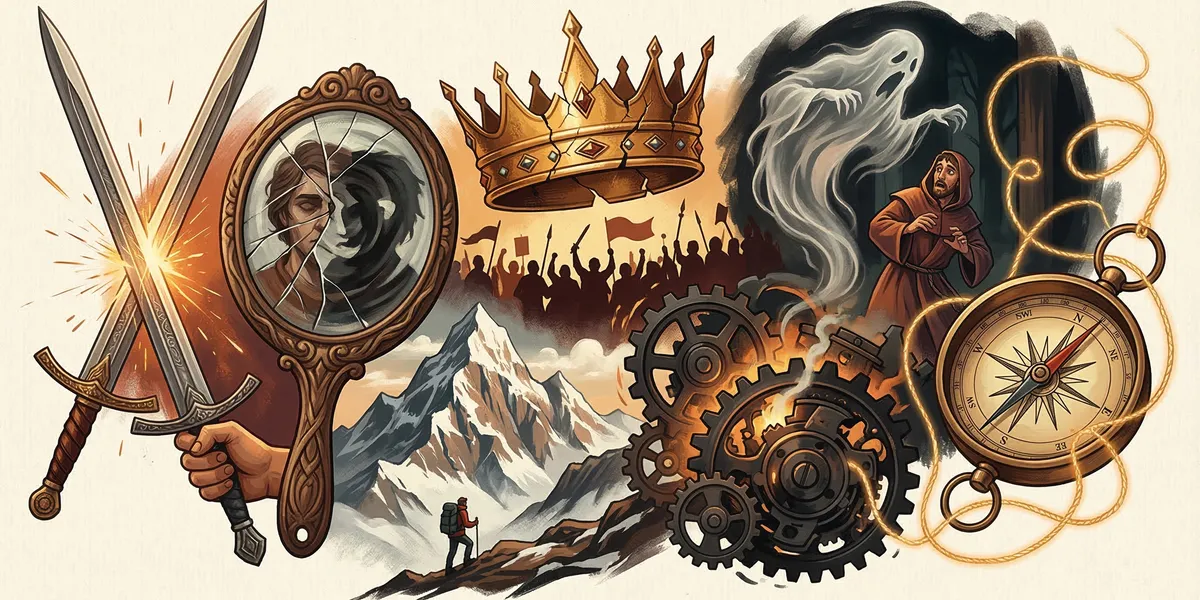
The 7 Types of Conflict
1. Person vs Person
The most straightforward form of conflict: one character against another. Hero against villain. Protagonist against antagonist. Two people who want incompatible things, and the story is the collision.
The Count of Monte Cristo by Alexandre Dumas is person vs person distilled to its essence. Edmond Dantes is betrayed by people he trusted, imprisoned for years, and then pursues an elaborate revenge against each of them. The conflict is personal, specific, and driven by clear motivation on both sides.
Person vs person conflict works best when both sides have understandable motivations. A villain who is evil for no reason creates flat conflict. A villain who believes they are right — who wants something the reader can almost sympathize with — creates tension that resonates. The best person vs person conflicts make the reader uncertain, at least briefly, about who should win.
2. Person vs Self
Internal conflict. A character at war with their own desires, fears, beliefs, or identity. This is often the most emotionally complex form of conflict because the enemy cannot be defeated, outwitted, or escaped. The enemy is inside.
Hamlet is the defining example. The prince of Denmark knows his uncle killed his father. He has the means and the motive for revenge. But he cannot act. His internal conflict — between duty and doubt, action and contemplation, rage and morality — paralyzes him for the entire play. The external plot is simple. The internal conflict is the tragedy.
Person vs self conflict drives character arcs. A character who overcomes their internal obstacle — their fear, their addiction, their self-deception — completes a transformation that gives the story meaning beyond plot. The external conflict may resolve with a battle or a revelation. The internal conflict resolves with change.
3. Person vs Society
A character against the rules, norms, expectations, or power structures of the world they live in. The conflict is not with a single antagonist but with a system — and the system is bigger than any individual.
1984 by George Orwell is person vs society at its bleakest. Winston Smith resists the totalitarian state of Oceania, but the state is omnipresent and omniscient. His rebellion is internal and small, and the society crushes it completely. The conflict’s power comes from the imbalance — one person against an entire system designed to eliminate individual thought.
The Hunger Games inverts the dynamic. Katniss Everdeen begins as a reluctant participant in a society’s brutal ritual and becomes, against her will, a symbol of rebellion. The conflict escalates from survival to revolution. Person vs society works because it raises the stakes beyond the individual — it is not just the character’s fate at risk but the fate of everyone trapped in the same system.
4. Person vs Nature
Survival. A character against the indifferent forces of the natural world — weather, wilderness, disease, animals, the fundamental hostility of an environment that does not care whether they live or die.
Hatchet by Gary Paulsen places a thirteen-year-old boy alone in the Canadian wilderness with nothing but a hatchet. Every chapter is a new confrontation with nature — hunger, cold, animals, injury. Nature does not hate Brian. Nature does not know Brian exists. That indifference is what makes the conflict terrifying.
Person vs nature works because it strips away social complexity and reduces conflict to its most primal form: survive or die. The character cannot negotiate with a blizzard. They cannot persuade a bear. They can only act, adapt, and endure. This purity of conflict is why survival stories remain compelling across cultures and centuries.
5. Person vs Technology
A character against the machines, systems, or inventions that humans created but can no longer control. This conflict examines the consequences of innovation and the boundary between creator and creation.
Frankenstein by Mary Shelley is the origin of this conflict type in modern fiction. Victor Frankenstein creates a living being and then recoils from it. The creature, abandoned by its creator, becomes dangerous — not because it is inherently evil but because it was made and then rejected. The conflict is not simply “human fights monster.” It is “creator is destroyed by the consequences of creation.”
In contemporary fiction, person vs technology encompasses artificial intelligence, surveillance, social media, genetic engineering, and any system where human tools develop agency or consequences beyond their intended purpose. The conflict is always, at its root, about control — the illusion that we control what we build, and the revelation that we do not.
6. Person vs Supernatural
A character against forces that exist outside the natural world — ghosts, demons, gods, curses, magic, or any power that operates beyond human understanding and cannot be confronted with ordinary means.
The Shining by Stephen King places Jack Torrance inside the Overlook Hotel, where supernatural forces amplify his worst impulses until he becomes a threat to his own family. The supernatural conflict works because it mirrors the internal one: the hotel does not create Jack’s violence. It feeds what was already there. The ghost story is also a story about alcoholism, isolation, and the failure of a man to protect the people who depend on him.
Person vs supernatural conflict is most effective when the supernatural force reflects or amplifies a human truth. Ghosts that are simply scary are less compelling than ghosts that represent something — guilt, grief, the past’s refusal to stay buried. The best supernatural conflict is always also person vs self.
7. Person vs Fate
A character against destiny, prophecy, or the predetermined order of the universe. The conflict is not with an opponent but with the structure of existence itself — the idea that the outcome is already decided and the character’s struggle against it is either heroic or futile.
Oedipus Rex is the foundational example. The oracle prophesies that Oedipus will kill his father and marry his mother. Every action Oedipus takes to avoid this fate drives him closer to it. His struggle against destiny is the tragedy — not because he fails, but because his failure was built into the universe before he was born.
Person vs fate raises the deepest thematic questions fiction can ask: Do we have free will? Can we change our nature? Is the fight meaningful even when the outcome is fixed? These questions give person vs fate conflict a philosophical weight that other conflict types do not inherently carry.
Layering Conflicts
The best stories do not rely on a single type of conflict. They layer multiple types so that the narrative operates on several levels simultaneously.
In The Hunger Games, Katniss faces person vs person (other tributes), person vs society (the Capitol), person vs nature (the arena’s hazards), and person vs self (her guilt, her growing awareness that she is being used). Each layer reinforces the others. The external battles mirror the internal ones. The society’s cruelty is reflected in the arena’s design. The personal conflicts between tributes illuminate the larger political conflict.
When you plan your story, identify the primary conflict — the one that drives the main plot — and then ask what secondary conflicts can deepen it. A person vs person thriller gains emotional depth when the protagonist also faces person vs self. A person vs nature survival story becomes more than a physical ordeal when the character is also running from something internal.
Internal and External Conflict Working Together
The most resonant stories connect the outer battle to the inner one. The external conflict — the visible struggle, the plot — mirrors or tests the internal conflict — the character’s psychological, moral, or emotional struggle.
In The Lord of the Rings, the external conflict is the quest to destroy the One Ring. The internal conflict is the Ring’s corruption of its bearers — the temptation of power, the erosion of will. Frodo’s external journey (carry the Ring to Mount Doom) is also his internal journey (resist the Ring’s influence on his soul). The two conflicts are inseparable, and each makes the other more meaningful.
When the outer and inner conflicts align, the story’s climax resolves both simultaneously. The character defeats the external enemy by overcoming the internal obstacle. The victory is not just physical but psychological. The reader feels it on both levels.
Escalation
Conflict must escalate. If the obstacles remain at the same intensity throughout the story, the narrative flatlines. The reader needs to feel that things are getting harder, that the stakes are rising, that the character is being pushed closer to a breaking point they may not survive.
Escalation does not mean every chapter must contain an explosion. It means the difficulty, the consequences, and the personal cost of the conflict must increase as the story progresses. A mystery that starts with a missing object and escalates to a missing person and then to a threat against the detective’s own family — that is escalation. Each stage raises the stakes.
The simplest rule: each plot structure turning point should make the character’s situation worse before it gets better. Take away their resources. Remove their allies. Force them to confront the thing they most want to avoid. Escalation is the craft of making victory feel earned by making defeat feel inevitable.
Common Mistakes
- Conflict that resolves too easily — If the problem is solved without significant effort, sacrifice, or cost, the reader feels cheated. Conflict without difficulty is not conflict. It is a formality.
- No internal conflict — A character who faces only external obstacles is a character the reader watches but does not inhabit. Internal conflict is what creates emotional investment. Without it, the story is spectacle.
- Conflict that does not connect to theme — Random obstacles are not the same as meaningful conflict. Every conflict in the story should illuminate what the story is about. If the theme is the cost of ambition, the conflicts should test the character’s ambition and force them to pay for it.
- Static conflict — The same obstacle repeated at the same intensity across multiple chapters. Conflict must evolve, escalate, and transform. If the character faces the same problem in chapter twelve that they faced in chapter three, the story has stalled.
- Unmotivated antagonism — An antagonist who opposes the protagonist for no discernible reason creates conflict that feels manufactured. Give every opposing force a reason — even the impersonal ones. Nature is indifferent, not malicious. Society has its own logic. Even fate, in the best stories, has a terrible consistency.
Conflict is not something that happens to characters. It is something that reveals them. Every obstacle strips away another layer of pretense and forces the character to show who they are when comfort and safety are gone. That revelation — raw, honest, sometimes ugly — is why readers read fiction. Not to watch people succeed, but to watch people struggle and discover, in the struggle, what they are made of.