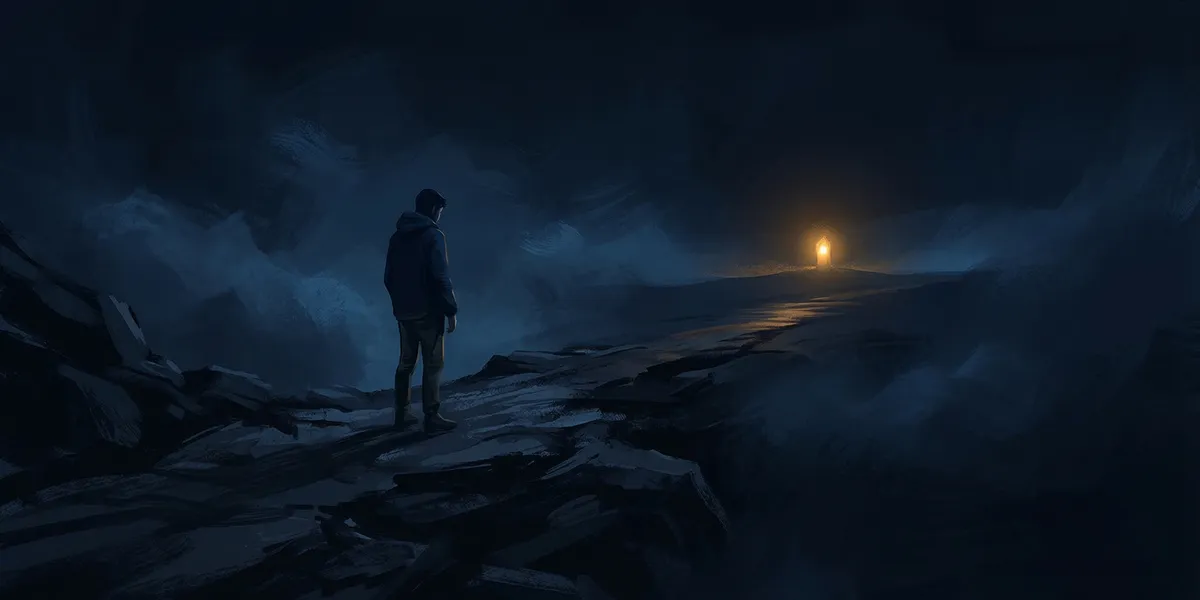
The dark night of the soul is the moment in a story where the protagonist hits absolute rock bottom. Every advantage is gone. Every ally has failed, left, or died. The path forward seems impossible. This is the all-is-lost point, and it typically falls at roughly 75% of the narrative, just before the final act begins.
It is the lowest point that makes the highest point meaningful.
What is the dark night of the soul?
The dark night of the soul is an emotional and narrative beat where the protagonist faces their deepest despair. It is not merely a setback. It is the moment where the protagonist’s entire approach to the story’s problem has failed and they must confront an internal truth before they can move forward.
The term originates from a 16th-century poem by Saint John of the Cross, describing a spiritual crisis that precedes enlightenment. In fiction, it serves the same structural purpose: the destruction of the old self that makes the transformed self possible.
Three things define this beat:
- External loss. Something tangible is taken away: an ally, a weapon, a plan, safety.
- Internal crisis. The protagonist confronts their deepest fear, flaw, or false belief.
- A choice. After sitting in the darkness, the protagonist decides to fight one last time, but differently than before.
Why it is essential
The dark night of the soul serves the story in ways that no other beat can.
It earns the climax. A climax where the hero triumphs is satisfying only if the reader believed they might not. The dark night creates genuine doubt. If the hero never seems in danger of losing, the victory feels hollow.
It completes the character arc. The dark night forces the protagonist to shed their false belief, the lie they have been telling themselves throughout the story. In the wreckage of the all-is-lost moment, they find the truth they need for the final act.
It creates emotional contrast. Storytelling runs on contrast. Joy is more vivid after sorrow. Victory resonates after defeat. The dark night provides the shadow that makes the climax shine.
It connects to the theme. The dark night of the soul is often where the story’s theme crystallizes. The protagonist’s lowest point is the moment they, and the reader, understand what the story was really about.
Examples from famous fiction
Harry Potter and the Deathly Hallows — Harry walks into the forest
Harry learns he is the final Horcrux. To destroy Voldemort, he must die. He walks into the Forbidden Forest knowing he will not come back. His parents, Sirius, and Lupin walk beside him as ghostly companions. He drops the Resurrection Stone and faces Voldemort unarmed.
This is a dark night so complete that the protagonist actually dies. The “resurrection” that follows is literal. Harry’s sacrifice, his willingness to die for others, is both the thematic culmination and the mechanism of Voldemort’s defeat.
The Hunger Games — The rule change is revoked
After fighting alongside Peeta to survive, Katniss hears the announcement: the rule allowing two victors from the same district is reversed. Only one can win. Everything she fought for, protecting Peeta, believing they could both survive, is destroyed.
Katniss must choose between killing someone she cares about and dying herself. Her dark night is not physical danger (she has faced that for the entire Games) but emotional impossibility.
Rocky — The night before the fight
Rocky Balboa cannot sleep. He walks to the empty arena, looks at the ring, and tells Adrian: “It don’t matter if I lose. All I wanna do is go the distance.” He strips away the external goal (winning) and confronts the internal truth (he needs to prove he is not “just another bum from the neighborhood”).
This is a quieter dark night, but no less powerful. Rocky does not lose everything. He simply faces the reality that he probably will, and decides the fight matters anyway.
Pride and Prejudice — Elizabeth reads Darcy’s letter
After her furious rejection of Darcy’s first proposal, Elizabeth reads his letter explaining Wickham’s true character and his reasons for separating Bingley and Jane. The letter is a mirror that reflects her own prejudice back at her.
Elizabeth’s dark night is internal. She has not lost an ally or a battle. She has lost her certainty. “Till this moment I never knew myself,” she admits. The old Elizabeth, defined by her snap judgments, must die so the real Elizabeth can emerge.
The Lord of the Rings — Frodo at Mount Doom
Frodo reaches the Crack of Doom and cannot throw the Ring in. After walking across Middle-earth, enduring starvation, betrayal, and the Ring’s constant corruption, he fails at the final moment. The Ring wins.
The dark night here is a failure of will at the worst possible time. The resolution (Gollum’s accidental destruction of the Ring) works because Tolkien earned it through hundreds of pages of Frodo’s deterioration. The dark night is not a single scene but a gradual collapse.
How to write your dark night of the soul
Strip away external support
Remove whatever the protagonist has been relying on. Their mentor, their weapon, their plan, their team. The dark night works when the protagonist is alone with their flaw.
If your protagonist has a wise mentor who always has the answer, the mentor should be gone by this point (dead, captured, estranged, or simply wrong). If they have a powerful weapon, it should be broken or useless. If they have allies, those allies should be scattered or lost.
Force an internal reckoning
The external loss should mirror an internal failure. The protagonist’s flaw, the thing they have been avoiding or denying throughout the story, must become impossible to avoid.
Ask: What lie has my protagonist been telling themselves? What is the truth they have been refusing to see? The dark night forces them to see it.
Let the protagonist sit in it
Do not rush through the despair. The dark night needs space. The reader should feel the weight of the loss. A single paragraph of “she felt terrible” is not a dark night. A scene where the protagonist grieves, reflects, and confronts what they have lost, that is.
This does not mean the scene should be long. It means the emotional content should be genuine.
End with a choice, not a rescue
The dark night ends when the protagonist decides to act again, not when someone saves them. If a mentor arrives with a new plan, that is a rescue, not a transformation. The power of the dark night is that the protagonist finds a new way forward from within themselves.
That choice should reflect growth. They do not return to the same approach that failed. They approach the final act with something new, usually the truth they discovered in their lowest moment.
Where the dark night fits in story structure
| Framework | Term | Placement |
|---|---|---|
| Three Act Structure | Second turning point | ~75%, end of Act 2 |
| Save the Cat | All Is Lost + Dark Night (Beats 11-12) | 75-80% |
| Hero’s Journey | Road Back / Resurrection threshold | Stages 10-11 |
The dark night of the soul is the bridge between Act 2 and Act 3. It is both an ending (the death of the protagonist’s old approach) and a beginning (the birth of their final, true self). Every story needs this moment. The depth of the darkness determines the height of the climax that follows.