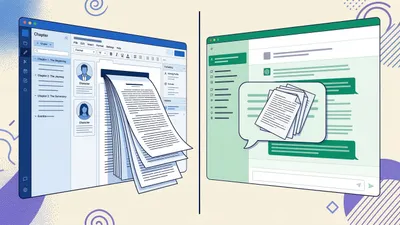
DeepSeek vs ChatGPT for writing comes down to this: ChatGPT writes more polished fiction prose and offers better project tools, while DeepSeek is cheaper, holds far more text at once, and is stronger at plot logic. Neither one keeps a whole book consistent for you.
In this comparison, you’ll learn:
- Which tool writes better fiction and better nonfiction
- How much of your manuscript each one can actually hold
- What each costs as of November 2026, and the privacy trade-off
- When a dedicated book tool beats both, and when it does not
Here is the side-by-side first.
DeepSeek vs ChatGPT at a Glance
DeepSeek wins on price, context size and openness. ChatGPT wins on prose polish, memory and ecosystem. This table covers the differences that matter when you are writing a book, as of November 2026.
| Feature | DeepSeek | ChatGPT |
|---|---|---|
| Chat app price | Free (no paid chat plan listed) | Free, Go, Plus $20/mo, Pro from $100/mo |
| Current models | V4.1 Flash, V4 Pro | GPT-6 family (more models on paid plans) |
| Largest context | 1M tokens (API) | 400K reasoning tokens (Pro) |
| Free-tier context | Not published | 27K tokens (about 12 pages) |
| Fiction prose polish | Competent, tidy | Stronger, more varied |
| Plot logic and structure | Strong | Strong |
| Remembers your project | No | Partly, via memory and Projects |
| Open weights | Yes | No |
| Where your data is stored | China (official app) | US-based provider |
For deeper single-tool reviews, see DeepSeek for writing a book and ChatGPT for writing a book.
Is DeepSeek Better Than ChatGPT for Creative Writing?
Is DeepSeek better than ChatGPT for creative writing? For most fiction, no. ChatGPT’s prose is usually more vivid, with more varied rhythm and stronger dialogue. DeepSeek is better at the logic underneath a story: clue placement, timelines and whether a plot twist is actually earned.
Published comparisons and writers’ reports mostly agree: DeepSeek’s scenes read clean but safe. Sentences land at similar lengths, emotions get named rather than shown, and endings tie up neatly. That is fine for a first draft you plan to rewrite.
ChatGPT takes more risks with voice. It handles banter, period dialect and genre tone (cozy, noir, romantic tension) with less prompting. It also has its own tics, such as tidy moral summaries and overused imagery, so you still edit hard.
Independent evidence is thin. Benchmarks like EQ-Bench’s creative writing leaderboard score both families, but rankings shift with every model update. Run your own test: give both tools the same 300-word sample of your prose and the same scene brief, then compare.
If you write genre fiction with ChatGPT, our ChatGPT prompts for fiction writers cut the generic tone noticeably.
Which Is Better for Nonfiction and Plotting?
Which is better for nonfiction and plotting? DeepSeek has a slight edge on structure and reasoning; ChatGPT has the edge on research tools. For a business or self-help book, both turn a good outline into clear, organized sections.
DeepSeek’s thinking mode is very good at stress-testing an argument. Ask it whether chapter six actually follows from chapter five, and it works through the logic rather than agreeing with you. The same skill helps novelists check a mystery’s fairness or a thriller’s timeline.
ChatGPT pulls ahead when your book needs current facts. Its web browsing and deep research tools are more mature, and paid plans get more research runs. DeepSeek offers a search toggle, but it is simpler.
Both tools invent statistics and sources when they cannot find one. Verify every number before it goes in your book, whichever tool wrote it. A solid book outline up front reduces how much either one improvises.
Which Handles a Full Manuscript Better?
Which handles a full manuscript better? DeepSeek, through its API. Both DeepSeek API models accept 1 million tokens of context, roughly 750,000 words. That fits several complete novels, so you can paste your whole draft and ask for a continuity check in one pass.
ChatGPT’s limits depend on your plan. As of November 2026, OpenAI’s pricing page lists a 27K-token context on the free plan, about 12 pages of input. Plus raises the reasoning context to 256K tokens, and Pro reaches 400K.
That makes free ChatGPT a poor fit for whole-book work. It loses track of anything older than the last few chapters you pasted. Plus can hold a full novel in reasoning mode, but long inputs eat into your usage limits.
DeepSeek does not publish its free chat app’s limits. For a long manuscript, the API or a tool built on it is the dependable route.
One caveat applies to both: long-context models miss details buried in the middle of huge inputs. Run a continuity pass twice, with chapters in a different order, and you will catch more errors.
Memory, Projects and Workflow
ChatGPT is the better workspace; DeepSeek is the better engine. ChatGPT’s memory and Projects features let you keep your character sheets, style notes and chapter files in one place, so you re-paste less. DeepSeek starts every conversation blank.
With DeepSeek, you keep a master context document (premise, characters, voice sample, chapter list) and paste it into every session. It works, but it is manual. Skip it once and chapter twelve will contradict chapter three.
ChatGPT’s memory helps, but it is not a story bible. It remembers preferences and some facts, not every plot decision across 80,000 words. Our ChatGPT vs Claude for writing books comparison shows the same gap in Claude.
DeepSeek vs ChatGPT Pricing for Writers
DeepSeek is far cheaper. Its chat app is free, and its API costs a few dollars at most for a full novel. ChatGPT Plus costs $20 a month, which is the plan most serious writers end up on. These prices are as of November 2026.
DeepSeek API (pricing page), per 1 million tokens at peak rates:
| Model | Input (cache miss) | Output | Context |
|---|---|---|---|
| deepseek-flash (V4.1 Flash) | $0.30 | $1.20 | 1M |
| deepseek-v4-pro (V4 Pro) | $1.32 | $3.96 | 1M |
Off-peak rates are half of those. Drafting a 70,000-word novel in sections, with context re-sent each time, costs under $1 on Flash and about $3 on V4 Pro by our estimate.
ChatGPT plans: Free; Go at $8 a month in the US, which may include ads; Plus at $20 a month; and Pro from $100 a month across three usage tiers. A year of Plus is $240. See our full ChatGPT pricing breakdown for plan limits.
Is DeepSeek Safe for Your Manuscript?
Is DeepSeek safe for your manuscript? For most fiction, it is a reasonable risk. For confidential material, use another option. DeepSeek’s privacy policy, last updated February 10, 2026, says it stores personal data in the People’s Republic of China and uses it to train its models.
You can opt out of training, but only by emailing DeepSeek’s privacy address. ChatGPT offers an in-app setting under Data Controls that stops your chats from training OpenAI’s models.
DeepSeek also avoids topics that are sensitive in China. In 2025, researchers found the app declined about 85% of such prompts. A thriller set in Beijing or a memoir about Hong Kong may hit walls.
The workaround is DeepSeek’s open weights. The models are published on Hugging Face, so non-China hosts run them under their own privacy terms, and you can run smaller builds on your own hardware.
Where DeepSeek and ChatGPT Beat Chapter
DeepSeek and ChatGPT beat Chapter on price, flexibility and range, and you should know that before you pay for anything. If one of these describes you, a general chatbot may be the better choice.
- You have no budget. DeepSeek’s app is free, and so is ChatGPT’s free plan. Chapter is $97 one time. Chapter has no free tier.
- You want an endless sandbox. Fifty premises, ten alternate endings, a dozen openings: chatbots let you experiment without limit. Chapter is built to produce a book.
- You need help beyond the book. Both tools draft launch emails, research your market and answer questions about your website. Chapter does one job.
- You already have a draft. If your manuscript is finished and you want it critiqued, DeepSeek’s 1M-token context or ChatGPT Plus is the right tool for that pass.
- You want total data control. You can run DeepSeek’s open weights on your own machine. No hosted service, Chapter included, offers that.
Where Chapter Beats Both: The Tool We Built
Chapter beats both on the job neither chatbot was designed for: producing a complete, consistent book without you managing dozens of sessions. If you want a finished manuscript rather than a writing partner, that is the whole decision.
Our Product — Chapter
Chapter is a dedicated AI book writing platform. You describe your topic or story, your reader and your style, and it builds a structured, complete manuscript, holding characters, facts and voice consistent across every chapter. You get book files, not a chat transcript.
Best for: authors who want the book finished, not another chat window to manage Pricing: $97 one time, 2 books included (fiction or nonfiction), no subscription, 30-day money-back guarantee Why we built it: 10,000+ authors have used Chapter because chatbots leave the hardest part to you: keeping 80,000 words consistent
Compare the cost honestly. A year of ChatGPT Plus is $240, and you still do the project management yourself. Chapter’s one-time price covers two complete books.
For a direct matchup, read Chapter vs ChatGPT or our ranking of the best AI for writing a book.
The Verdict: Which Should You Choose?
Pick DeepSeek if your budget is zero, you plot logic-heavy fiction or argument-driven nonfiction, or you need to feed a whole manuscript in at once. Pick ChatGPT if prose quality, dialogue and research matter most, and $20 a month is fine.
Many writers use both: DeepSeek for cheap brainstorming and continuity checks, ChatGPT for drafting scenes. That works, but it doubles the copy-and-paste.
Pick Chapter if your goal is a finished, consistent book rather than a better chatbot. For the full process with any tool, see how to write a book with AI.
DeepSeek and ChatGPT help you write a book one prompt at a time; if you want the complete manuscript, Chapter for nonfiction and Chapter for fiction write it for $97 one time, with 2 books included and a 30-day money-back guarantee.
FAQ
Is DeepSeek better than ChatGPT for writing?
Is DeepSeek better than ChatGPT for writing? Not for polished prose. ChatGPT usually writes more vivid fiction and dialogue. DeepSeek is better for plot logic, argument structure and whole-manuscript review, and it costs far less. Many authors use DeepSeek for planning and checking, and ChatGPT for drafting.
Is DeepSeek free for writers?
Is DeepSeek free for writers? Yes, the DeepSeek chat app is free to use with an account, and no paid chat subscription is listed as of November 2026. The API is pay-per-token, and drafting a full novel through it typically costs a few dollars at most.
Can ChatGPT or DeepSeek write a whole book?
Can ChatGPT or DeepSeek write a whole book? Both can draft one section by section, but neither keeps a full book consistent on its own. You manage the outline, characters and continuity across sessions. See our guide to whether ChatGPT can write a novel for the full picture.
Is it safe to put my novel into DeepSeek?
Is it safe to put my novel into DeepSeek? For most fiction, it is a reasonable risk if you opt out of training. DeepSeek stores data in China under its privacy policy. For confidential or sensitive manuscripts, use a non-China host running DeepSeek’s open weights, or a different tool.