Deus ex machina is a sudden, unearned resolution that drops into the story like a gift from nowhere — solving the plot’s central problem without setup, struggle, or cost. The term is Latin for “god from the machine,” and it is one of the fastest ways to lose a reader’s trust.
What Is Deus Ex Machina
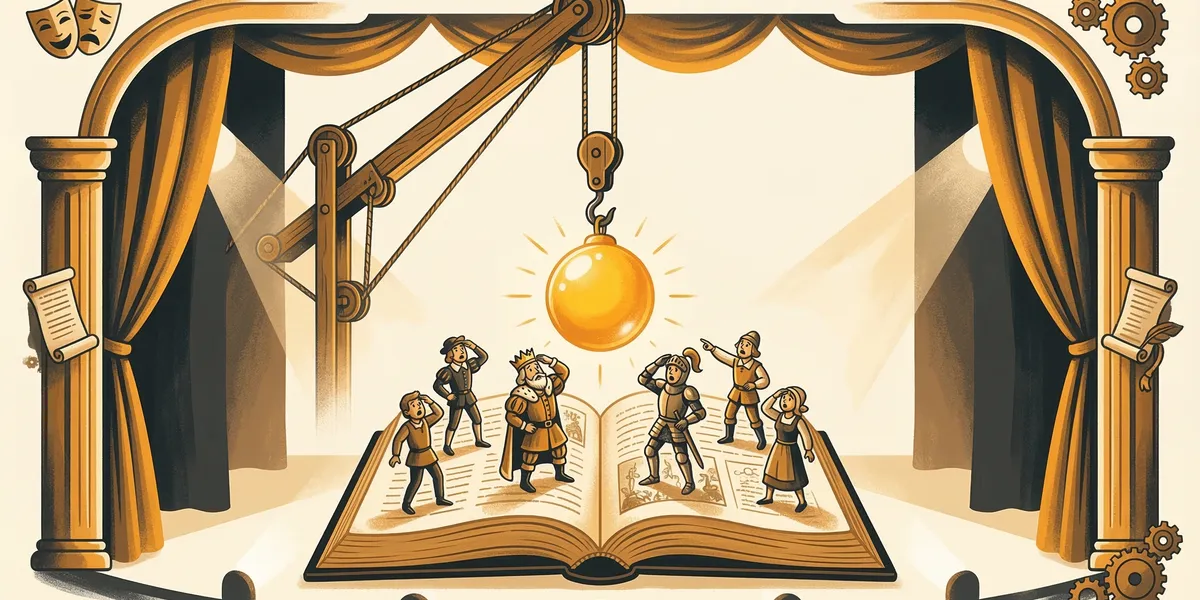
In ancient Greek theater, actors playing gods were literally lowered onto the stage by a crane (the mechane) to resolve plots that had tangled beyond human solution. The god descended, declared an outcome, and the play ended. Audiences tolerated it because divine intervention was part of the cosmology. Modern readers are less forgiving.
A deus ex machina occurs when the resolution to a story’s conflict arrives from outside the logic the story has established. It is not set up. It is not foreshadowed. It does not emerge from the characters’ choices or the world’s rules. It simply appears — and it works, which is the problem. The plot resolves, but the resolution feels hollow.
The reason it fails is psychological. Readers invest in a story because they believe the outcome depends on what the characters do. When the solution comes from somewhere the characters (and the reader) had no access to, that investment is betrayed. The story was not a puzzle to be solved. It was a waiting game for a rescue that was always going to arrive.
Famous Examples
War of the Worlds (H.G. Wells) — The Martian invasion is unstoppable. Humanity’s weapons fail. Cities fall. Then, without warning, the Martians die from common bacteria. The resolution has nothing to do with human action, ingenuity, or sacrifice. Wells was making a point about hubris and biological reality, but the ending remains one of the most cited examples of deus ex machina in literary history.
The Eagles in The Lord of the Rings — This one is debated. The Great Eagles arrive at the last moment to rescue characters from Mount Doom, from the Black Gate, from Isengard. Tolkien defenders argue the Eagles are established within Middle-earth’s mythology and that their intervention has limits. Critics argue that if the Eagles can fly to Mordor at the end, the entire quest was unnecessary. The debate itself illustrates why borderline deus ex machina is dangerous — even when defensible, it plants doubt.
Jurassic Park (film) — The velociraptors have the heroes cornered. Escape is impossible. Then the Tyrannosaurus Rex crashes through the wall and attacks the raptors, allowing the humans to flee. The T-Rex had no narrative reason to appear at that moment. It is a spectacle rescue, thrilling in the theater and hollow on reflection.
Countless romance and thriller endings — The sudden inheritance that solves the financial crisis. The estranged friend who appears with exactly the right skill. The villain who trips at the critical moment. These are all variations of the same structural failure: a solution the author invented because they wrote themselves into a corner.
Why Readers Never Forgive It
Deus ex machina does not just disappoint — it retroactively damages everything that came before it. If the solution was always going to fall from the sky, then every obstacle the character faced was meaningless. Every sacrifice was theater. The tension was a lie.
Readers describe the feeling as being cheated, and the word is precise. A story is an implicit contract between writer and reader: the setup promises a payoff that is earned. Deus ex machina breaks that contract. The author could not solve their own plot, so they reached outside the story and grabbed an answer.
This is why readers remember bad endings more vividly than good ones. A single deus ex machina can define an otherwise excellent book in the reader’s memory.
How to Avoid It
Set Up Your Solutions Early
The antidote to deus ex machina is foreshadowing. If a solution will arrive in the final act, the pieces must be visible in the first and second acts. The reader does not need to predict the ending — they need to look back afterward and see that every element of the resolution was already in the story.
This is the principle behind Chekhov’s Gun: if you show a loaded rifle on the wall in Act One, it must fire by Act Three. The reverse is equally true. If a rifle fires in Act Three, it must have been visible on the wall in Act One.
The best plot resolutions feel both surprising and inevitable. Surprising because the reader did not see how the pieces would fit together. Inevitable because, looking back, every piece was there.
Let Characters Solve Their Own Problems
The most satisfying resolutions come from character agency. The protagonist makes a choice, takes an action, or uses a skill that was established earlier in the story. The resolution flows from who they are and what they have learned.
If your hero needs to pick a lock in the climax, establish earlier that they know how to pick locks — or better, show them failing at it, so the final success carries the weight of growth. If your detective solves the case through a sudden flash of insight, make sure the clue was available to both the detective and the reader.
Characters who solve their own problems are characters readers respect. Characters who are rescued by coincidence are characters readers forget.
If the Solution Is External, Foreshadow It
Sometimes the resolution does need to come from outside the protagonist. An ally intervenes. A natural event shifts the landscape. A piece of technology activates. These are not automatically deus ex machina — they become deus ex machina only when they appear without setup.
If an ally will save the hero, establish that ally’s existence, their motivation to help, and their capability to arrive. If a storm will destroy the enemy fleet, seed the weather earlier in the narrative. The external solution should feel like a payoff, not a surprise.
Make the Solution Cost Something
Even a well-foreshadowed resolution can feel hollow if it comes without sacrifice. Readers need to see that the victory was not free. The character lost something to gain something. The solution worked, but it left a mark.
The eagles can rescue Frodo from Mount Doom because Frodo already destroyed the Ring — at the cost of his finger, his innocence, and ultimately his ability to live peacefully in the Shire. The rescue is a mercy, not a cheat, because the sacrifice already happened.
Cost is what separates a resolution from a bailout.
The Earned Miracle
There is a version of late intervention that works brilliantly: the earned miracle. This is a moment where rescue arrives at the last possible second, and the audience accepts it because the story laid the groundwork.
In The Return of the King, Gandalf arrives at Helm’s Deep at dawn with the Rohirrim — exactly as he said he would. The rescue is dramatic, last-minute, and deeply satisfying because Gandalf made a promise and kept it. The audience was told it would happen. The tension came from wondering whether it would happen in time.
An earned miracle has three elements: the possibility is established early, the outcome remains uncertain until the last moment, and the resolution costs something even though help arrives.
When Deus Ex Machina Is Intentional
In comedy and satire, deus ex machina can be used deliberately for effect. Monty Python and the Holy Grail ends with the police literally arresting the characters and stopping the film — a deus ex machina so absurd that it becomes the joke. The audience laughs because the convention is being mocked, not employed.
Douglas Adams used absurd coincidence as a structural device throughout The Hitchhiker’s Guide to the Galaxy. The Infinite Improbability Drive exists specifically to justify impossible rescues. It is deus ex machina as worldbuilding — a universe where unlikely things happen because the universe itself is ridiculous.
These uses work because the audience is in on the joke. The contract between writer and reader is different in comedy. Surprise and absurdity are the point, not violations of it.
Common Deus Ex Machina Patterns to Watch For
- The sudden inheritance — A character’s financial problem is solved by money they did not know about from a relative they never mentioned.
- The convenient stranger — Someone with exactly the right skill appears at exactly the right moment with no prior connection to the story.
- The hidden power — The hero discovers an ability they never knew they had, precisely when they need it, with no prior hints.
- The villain’s mistake — The antagonist, previously shown as competent and dangerous, suddenly makes an inexplicable error that hands the protagonist victory.
- The weather — A natural event (storm, earthquake, flood) resolves the conflict with no narrative setup.
Each of these has a version that works — if it is foreshadowed, if it costs something, and if it connects to the logic of the story. The difference between a cheat and a twist is always preparation.
How to Fix a Deus Ex Machina in Your Draft
If you have already written a deus ex machina into your manuscript, the fix is almost always in revision, not in the ending itself. Go backward. Find the moment where the resolution appears and ask: what would the reader need to have seen earlier for this to feel earned?
Then plant those seeds. Add the foreshadowing. Establish the ally. Show the weapon. Create the promise that the ending will fulfill.
The ending you wrote may be exactly right. It may just need roots.
Writing yourself into a corner is not a failure — it is a normal part of drafting. The failure is leaving the corner’s solution unexplained. Plot structure gives your story a skeleton. Foreshadowing gives the ending its bones. And letting your characters earn their own resolution is what makes readers trust you enough to pick up your next book.