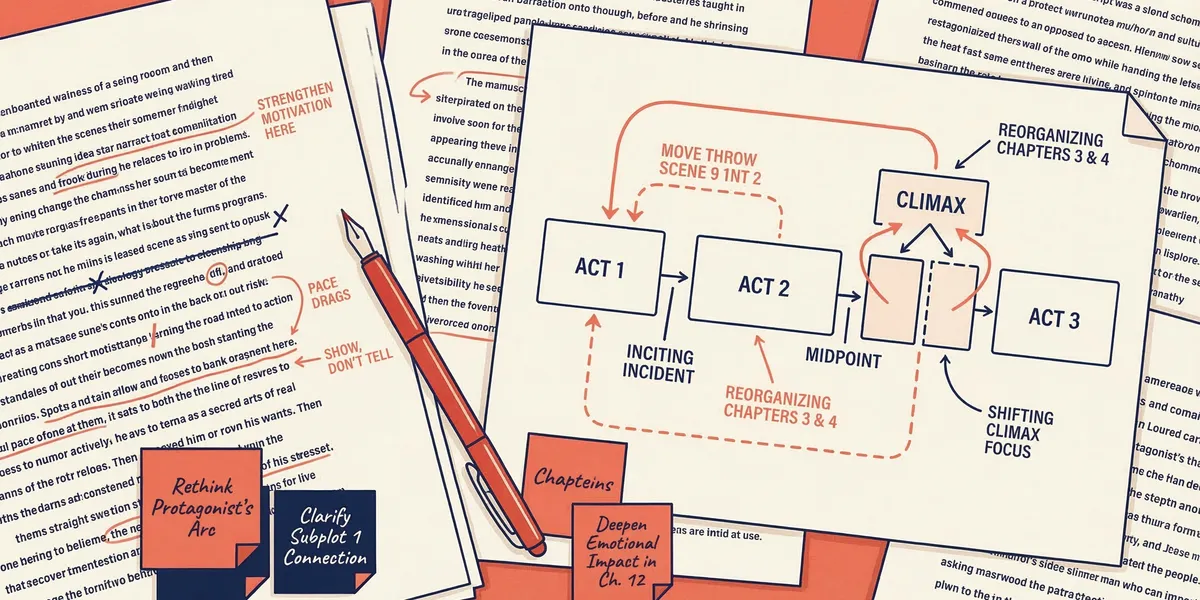
Developmental editing examines the big-picture elements of your manuscript — plot structure, character arcs, pacing, theme, point of view, and overall narrative coherence. It’s the most substantive type of editing you can get, and for most first-time authors, it’s the single investment that makes the biggest difference between a manuscript that works and one that doesn’t.
This guide covers what a developmental editor actually looks at, how it differs from other editing types, what it costs, and how to find the right editor for your book.
What a developmental editor looks at
A developmental editor reads your entire manuscript and evaluates it as a whole. They’re not fixing commas or polishing sentences. They’re asking whether your book works at a structural level.
Here’s what falls under a developmental editor’s scope:
- Plot holes and logic gaps. Events that contradict each other, timelines that don’t track, or cause-and-effect chains that break down.
- Character motivation. Characters who act in ways that don’t match their established personality, goals, or the situation they’re in.
- Pacing problems. Sections that drag, action sequences that resolve too quickly, or a middle that sags under its own weight.
- Structural issues. Chapters that belong somewhere else, subplots that lead nowhere, or a story arc that peaks too early.
- Theme consistency. Whether the book’s underlying ideas hold together or contradict themselves.
- Opening and ending strength. A first chapter that doesn’t hook, or a final chapter that doesn’t land.
- Point of view consistency. Head-hopping, POV breaks, or a narrative voice that shifts without purpose.
- Dialogue authenticity. Conversations that sound like exposition dumps rather than real people talking.
A good developmental editor sees the forest when you’ve been staring at individual trees for months. They identify what isn’t working and — just as importantly — explain why it isn’t working, so you can fix it yourself.
Developmental editing vs other types of editing
Most authors confuse the different editing stages, which leads to hiring the wrong editor at the wrong time. Each type targets a different layer of the manuscript.
| Type | Focus | What it fixes | When to use |
|---|---|---|---|
| Developmental editing | Big picture | Story structure, characters, plot, pacing, theme | After your first or second draft |
| Line editing | Sentence-level craft | Prose style, voice, rhythm, word choice | After structural issues are resolved |
| Copy editing | Correctness | Grammar, spelling, punctuation, consistency, fact-checking | After the manuscript is structurally and stylistically final |
| Proofreading | Surface errors | Typos, formatting issues, minor oversights | Final pass before publication |
The order matters. There’s no point paying a copy editor to perfect the grammar in chapter twelve if a developmental editor later tells you chapter twelve needs to be cut entirely. Always work from the outside in: structure first, then sentences, then correctness, then final polish.
Think of it like building a house. Developmental editing is the architecture. Line editing is the interior design. Copy editing is the inspection. Proofreading is the final walkthrough before you hand over the keys.
When you need developmental editing
Not every manuscript needs a developmental edit, but certain situations make it almost essential.
You’re writing your first novel. First-time novelists consistently underestimate how difficult story structure is. A developmental editor catches problems you don’t have the experience to see yet. According to the Editorial Freelancers Association, developmental editing is the most commonly requested service for debut authors.
You’re doing a major revision. If you’ve rewritten significant portions of your book, a developmental editor ensures the new material integrates with the old. Patchwork revisions often create continuity problems that are invisible to the author.
You’re switching genres. Writing your first thriller after publishing three literary novels? The structural expectations are different. A developmental editor who knows the target genre can flag where your instincts from the old genre are leading you astray.
Beta reader feedback is contradictory. One beta reader says the pacing is too slow. Another says it’s too fast. A third loves the subplot you were thinking of cutting. When feedback conflicts, a professional developmental editor can diagnose the actual underlying problem that’s generating all that contradictory noise.
You know something is off but can’t identify what. This is the most common reason authors seek developmental editing. The book doesn’t feel right, but after living inside it for months, you’ve lost the perspective to diagnose why. A fresh, trained set of eyes solves that.
When you might not need developmental editing
Developmental editing isn’t always the right call. Save the money if any of these apply.
You’re an experienced author with a strong revision process. If you’ve published multiple books and have beta readers or critique partners who give you reliable structural feedback, you may not need to pay for what your network already provides.
You’re writing short works. A 5,000-word short story or a 15,000-word novella rarely justifies a full developmental edit. The investment doesn’t scale down well. A detailed critique from a writing group or a freelance editorial letter is usually sufficient.
Your budget is tight and you need to prioritize. If you can only afford one type of editing, copy editing gives you the most visible quality improvement per dollar. A structurally imperfect but cleanly edited book reads better than a well-structured book riddled with errors. That said, consider these alternatives for structural feedback:
- Critique partners. Other writers who read your manuscript and provide feedback. Free, but quality varies.
- Editorial assessments. A shorter, cheaper version of developmental editing. The editor reads your manuscript and writes a 5-10 page letter about what’s working and what isn’t, without line-by-line margin notes. Typically costs 30-50% less than a full developmental edit.
- Writing workshops. Programs like Gotham Writers or community workshops where you get structured peer feedback on portions of your manuscript.
How much does developmental editing cost
Developmental editing is the most expensive type of editing because it requires the most time and expertise. Here are current market rates.
| Manuscript length | Cost range | Per-word rate |
|---|---|---|
| 40,000 words (short novel/novella) | $1,200 - $4,000 | $0.03 - $0.10 |
| 60,000 words (standard novel) | $1,800 - $6,000 | $0.03 - $0.10 |
| 80,000 words (full-length novel) | $2,400 - $8,000 | $0.03 - $0.10 |
| 100,000 words (epic/saga) | $3,000 - $10,000 | $0.03 - $0.10 |
The Editorial Freelancers Association rate chart lists developmental editing at $56-$70 per hour, with most editors processing 1-5 manuscript pages per hour. Rates vary based on the editor’s experience, your genre, and how much work the manuscript needs.
Is it worth it? For your first book, almost certainly yes. A developmental editor doesn’t just improve one manuscript — they teach you to see structural problems in every manuscript you write afterward. The investment pays forward across your entire writing career.
If you’re working on a nonfiction book and want structural help before you draft, Chapter helps authors organize ideas into a coherent book outline and chapter structure before writing begins. Over 2,147 authors have used it to structure and draft more than 5,000 books. It won’t replace a human developmental editor’s nuanced feedback on a finished manuscript, but it can prevent many structural problems from forming in the first place.
How to find a developmental editor
Finding the right editor matters more than finding the cheapest one. A developmental editor who doesn’t understand your genre will give you advice that works against the book you’re trying to write.
Where to look:
- Reedsy. Marketplace with vetted editors. You can filter by genre, see reviews, and request quotes from multiple editors.
- Editorial Freelancers Association. Professional directory with searchable member listings. Members adhere to the organization’s standards of practice.
- Writing conferences. Events like Writer’s Digest Annual Conference often feature editor pitch sessions. Meeting an editor in person gives you a feel for whether you’d work well together.
- Referrals from other authors. The most reliable method. If a writer whose work you admire recommends their editor, that’s a strong signal.
- Literary agency recommendations. Some agents refer authors to developmental editors before signing them. These recommendations tend to be high quality.
Red flags to avoid:
- No sample edit offered. Reputable editors will edit 5-10 pages of your manuscript for free or a small fee so you can assess their style. If an editor refuses, move on.
- Guarantees of publication. No editor can guarantee your book will get published or sell well. Anyone who promises this is selling something other than editing.
- No genre experience. Ask what they’ve edited recently. A developmental editor who primarily works on literary fiction may not understand the structural expectations of a commercial thriller.
- Unusually low rates. If someone charges $500 to developmentally edit an 80,000-word novel, the math doesn’t work. That’s roughly 60 cents per hour. Either they’re not reading the whole manuscript or they’re not doing developmental editing.
- No contract. Professional editors provide a written agreement covering scope, timeline, payment terms, and revision expectations.
What to expect from the developmental editing process
Knowing the process reduces anxiety and helps you get more from the investment.
Step 1: The editor reads your full manuscript. This typically takes 1-2 weeks. They’re reading holistically, taking notes on structure, characters, pacing, and narrative coherence.
Step 2: You receive an editorial letter. This is a detailed document — usually 8-20 pages — covering the editor’s assessment of your manuscript’s strengths and weaknesses. It addresses big-picture issues: what’s working, what isn’t, and specific suggestions for revision.
Step 3: You receive margin notes. Alongside the editorial letter, most developmental editors annotate your manuscript directly. These notes flag specific passages where problems occur — “this character’s motivation contradicts chapter four,” “this scene slows the pacing,” “consider restructuring this sequence.”
The typical timeline: Expect 4-8 weeks from submission to receiving feedback. Complex manuscripts or busy editors may take longer. Ask about turnaround time before committing.
How to handle tough feedback:
The first read of a developmental edit stings for almost every author. That’s normal. Your manuscript is a piece of you, and someone just spent twenty pages explaining what’s wrong with it.
Here’s how experienced authors handle it:
- Read the editorial letter once, then walk away for 48 hours. Your emotional reaction to the first read is unreliable. Distance gives perspective.
- Read it again with a highlighter. Mark the points where the editor identified something you already suspected. Those are your highest-priority fixes.
- Separate “I disagree” from “I don’t want to hear this.” The editor might be wrong about some things. But if you find yourself resisting every suggestion, the problem is probably not the editor.
- Ask questions. Good editors welcome follow-up conversations. If a note is unclear or you want to discuss alternatives, ask.
- Make a revision plan before you start rewriting. Map out which changes you’ll make, which you won’t, and in what order. Then revise systematically rather than attacking the manuscript at random.
Common mistakes when hiring a developmental editor
- Sending a first draft. Clean up obvious issues before sending your manuscript. Fix the typos, remove the notes-to-self, and make sure the draft is as good as you can make it on your own. Your editor’s time is expensive — don’t waste it on problems you could have caught yourself.
- Hiring too late in the process. If you’ve already copy edited and proofread, a developmental edit that recommends structural changes means you’ll need to redo those later stages. Get developmental feedback early.
- Expecting the editor to rewrite your book. A developmental editor diagnoses problems and suggests solutions. The rewriting is your job. If you want someone to rewrite, you need a ghostwriter or co-author.
- Ignoring feedback you paid for. You hired an expert. If you’re going to dismiss most of their suggestions, you’ve wasted your money. Listen first, then decide what to implement.
- Not establishing clear expectations upfront. Discuss the scope of the edit, the timeline, and the number of follow-up questions included before work begins. Surprises about cost or deliverables damage the working relationship.
FAQ
How long does developmental editing take?
Most developmental editors need 4-8 weeks to read and annotate a full manuscript. Rush services exist but cost 50-100% more. After receiving feedback, plan for 2-6 months of revision work depending on the scope of changes needed.
Can I get developmental editing for nonfiction?
Yes. Nonfiction developmental editing focuses on argument structure, logical flow, audience targeting, chapter organization, and whether the book delivers on its core promise. The principles are the same — it’s big-picture editing — but the specific criteria differ from fiction.
Should I use beta readers before or after a developmental edit?
Before. Beta readers give you free, reader-level feedback that can reveal obvious problems worth fixing before you pay an editor. Send your revised post-beta draft to the developmental editor so they can focus on the deeper issues your betas couldn’t articulate.
What’s the difference between a developmental edit and a manuscript assessment?
A manuscript assessment (also called an editorial assessment) provides a high-level editorial letter without margin notes. It’s faster and cheaper — typically 30-50% less — but less detailed. Choose an assessment if your budget is limited or if you mainly need confirmation that your structure works. Choose a full developmental edit if you need specific, passage-level guidance on what to fix.
Do I need developmental editing if I used a book outline?
A solid book outline reduces structural problems significantly, but execution introduces its own issues. Character development that looked good in outline form might fall flat on the page. Pacing problems emerge during drafting that no outline can predict. An outline is prevention; developmental editing is diagnosis.