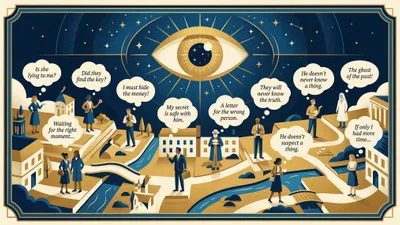
The difference between narrator and author is simple: the author is the real person who wrote the book, and the narrator is the voice that tells the story inside it. They are never the same entity — not even in a first-person memoir.
In this guide, you’ll learn:
- A one-sentence rule that settles narrator vs. author every time
- Why the narrator and author stay separate even when they seem identical
- The “implied author” — the hidden third layer most explanations skip
- Real examples from famous novels, and why the distinction changes how you write
Here’s the clearest way to tell them apart.
What Is the Difference Between the Narrator and the Author?
The difference between a narrator and an author is that the author is the flesh-and-blood person who wrote the text, while the narrator is the fictional voice within the text that delivers the story. The author creates the narrator. The narrator only exists on the page — the author exists in the real world.
| Author | Narrator | |
|---|---|---|
| Exists | In the real world | Inside the story |
| Role | Writes and constructs the book | Tells the story to the reader |
| Number | Always one real person (or co-authors) | Can be one, several, or shifting |
| Reliability | Not part of the question | Can be reliable or unreliable |
| Example | F. Scott Fitzgerald | Nick Carraway |
Think of it this way: the author builds the stage and hires the storyteller. The narrator is that storyteller — a role the author invents, even when the role is loosely based on the author’s own life.
What Is an Author?
Author — the real, historical person who conceives, writes, and is legally credited with creating a text.
The author is a human being with a name on the cover, a publishing contract, and a life outside the book. F. Scott Fitzgerald was an author. Toni Morrison was an author. You become an author the moment you write and take responsibility for a work.
The author makes every decision in the book — plot, characters, word choice, and crucially, who tells the story. But the author never speaks to the reader directly through the prose. Every word on the page is filtered through a narrator the author has chosen.
This holds true across every form of writing. In nonfiction, self-help, and how-to books, the author still constructs a narrating voice — often a version of themselves, polished and shaped for the page.
What Is a Narrator?
Narrator — the voice or persona within a text that recounts the events of the story to the reader.
The narrator lives inside the book. Sometimes the narrator is a character who participates in the plot, like Nick Carraway in The Great Gatsby. Sometimes the narrator is a disembodied, all-knowing presence, like the omniscient narrator in a Tolkien novel who sees every character’s thoughts.
A narrator has a personality, a level of knowledge, and a relationship to the events. Those traits are chosen by the author to serve the story. The narrator can lie, misunderstand, hold biases, or hide information — all deliberate choices the author makes to shape the reader’s experience.
The narrator is tied closely to point of view. A first-person narrator says “I.” A third-person limited narrator follows one character closely. The narrator is who tells the story; point of view is the angle from which they tell it.
Narrator vs. Author: 4 Key Differences
Here are the four distinctions that separate a narrator from an author:
-
Reality vs. fiction. The author is a real person. The narrator is a construct that exists only within the text.
-
One vs. many. A book has one author (or a fixed set of co-authors), but it can have multiple narrators who alternate chapters or perspectives.
-
Trust. You can question a narrator’s honesty — an unreliable narrator may deceive you on purpose. You don’t question whether the author “really” exists.
-
Voice vs. hand. The narrator speaks; the author writes. Everything the narrator says was constructed by the author, but the author’s own opinions may differ sharply from the narrator’s.
Why the Narrator Is Never the Author (Even in First Person)
The narrator is never the author because the “I” on the page is a version selected, edited, and framed for the story — not the living person typing the words. Even in memoir, the narrating self is a curated persona, not the full human being.
This trips up a lot of new writers. When you write “I walked into the room,” the “I” is a narrator you’ve built, even if that narrator shares your name and your memories. You choose what that voice reveals, what it emphasizes, and what it leaves out.
Consider a memoir. The author sitting at a desk in 2026 is not identical to the “I” recalling their childhood on the page. The narrating “I” knows only what the author chooses to give it, and speaks in a voice the author has shaped for effect. The gap may be small, but it is always there.
This is why literary critics insist on keeping the two apart. Attributing a narrator’s beliefs directly to the author is a classic reading mistake — the intentional fallacy, a concept from literary theory warning against confusing the text’s voice with the writer’s real intentions.
The Implied Author: The Missing Third Layer
Most explanations stop at “author” and “narrator.” But literary theory adds a crucial third layer: the implied author.
Implied author — the version of the writer that a reader constructs from the text itself: the values, sensibility, and worldview the book seems to endorse, distinct from both the real author and the narrator.
The critic Wayne C. Booth introduced this idea in The Rhetoric of Fiction (1961) to explain a gap readers sense but can’t quite name. Even when a narrator is unreliable or repellent, we detect a guiding intelligence behind the whole book — the implied author — steering us toward a judgment the narrator never states.
So there are really three layers:
- The real author — the historical person (Vladimir Nabokov).
- The implied author — the moral and artistic sensibility the book projects.
- The narrator — the voice telling the story (Humbert Humbert in Lolita).
In Lolita, Nabokov (real author) creates a charming, monstrous narrator whose self-justifications the implied author clearly wants us to reject. Understanding this three-layer structure is what separates a surface reading from a sophisticated one — and it’s a framework most narrator-vs-author explainers skip entirely.
Narrator vs. Author vs. Point of View vs. Narrative Voice
These four terms get tangled constantly. Here’s how they relate:
| Term | What It Means |
|---|---|
| Author | The real person who wrote the book |
| Narrator | The in-story voice that tells the events |
| Point of view | The position the narrator tells from (first, second, third person) |
| Narrative voice | The narrator’s personality, tone, and style |
The author chooses a narrator. The narrator has a point of view and a narrative voice. All three of the story-side terms are tools the author uses. For a deeper look at how these interact, see our guide to narrative techniques.
Examples of Narrator vs. Author
Real books make the distinction obvious:
The Great Gatsby. The author is F. Scott Fitzgerald. The narrator is Nick Carraway, a Midwestern bond salesman who watches Gatsby’s tragedy unfold. Nick’s judgments are not Fitzgerald’s; Nick is a character with his own blind spots.
A Christmas Carol. The author is Charles Dickens. The narrator is an unnamed, warm, slightly gossipy omniscient voice who addresses the reader directly (“Marley was dead, to begin with”). That voice is a performance Dickens crafted, not Dickens himself.
Gone Girl. The author is Gillian Flynn. Two narrators — Nick and Amy — alternate, and both mislead you. Flynn is honest with her reader; her narrators are not. The gap between author and narrator is the entire engine of the book.
A memoir like Educated. The author is Tara Westover. The narrating “I” is a shaped, reflective version of her younger self, selecting and ordering memories for meaning. Even here, author and narrator are not identical.
Why This Distinction Matters for Your Writing
Understanding the narrator-author split is one of the most practical skills in fiction, because it frees you to write voices that aren’t your own. Once you see the narrator as a construct, you can build one whose knowledge, biases, and blind spots serve the story.
It also protects you as a writer. A racist narrator does not make you racist. A cruel narrator does not make you cruel. Readers who understand the distinction won’t confuse your characters’ views with your own — and you can write braver, more honest fiction because of it.
When you’re drafting, decide deliberately: Who is telling this story? How much do they know? Can the reader trust them? Tools like Chapter help you outline and draft with a consistent narrating voice from the first page — useful whether you’re writing a novel or a nonfiction book where your author-persona needs to stay steady across chapters.
Common Mistakes to Avoid
- Assuming the narrator speaks for the author. A narrator’s opinions are the character’s, not necessarily the writer’s.
- Confusing first person with autobiography. An “I” narrator is a construct, even when the story feels personal.
- Forgetting the narrator can be wrong. Narrators misremember, lie, and misjudge — that’s a feature, not a bug.
- Treating “author” and “narrator” as interchangeable in analysis. In an essay or book report, using them loosely signals a shallow reading.
- Ignoring the implied author. The sensibility behind the whole book is often where the real meaning lives.
FAQ
Is the narrator the same as the author?
No, the narrator is not the same as the author. The author is the real person who wrote the book, while the narrator is the fictional voice that tells the story inside it. Even in a first-person memoir, the narrating “I” is a crafted persona, not the living writer.
Can the author and narrator be the same person?
The author and narrator can share a name and history — as in memoir or autofiction — but they are never fully the same. The narrator is a shaped, selective version of the self that the author constructs for the page, with limited knowledge the author deliberately controls.
What is the difference between a narrator and a protagonist?
The difference between a narrator and a protagonist is that the narrator tells the story while the protagonist is the main character the story is about. Sometimes they are the same person (Nick is a narrator but not the protagonist in Gatsby), and sometimes they are different characters entirely.
Why do teachers say not to confuse the author and narrator?
Teachers warn against confusing the author and narrator because attributing a narrator’s views to the writer is a reading error. A narrator can be biased, unreliable, or immoral by design. Separating the two lets you analyze how the author uses that voice to create meaning.
What is an unreliable narrator?
An unreliable narrator is a narrator whose account cannot be fully trusted — because they lie, misunderstand, or hold strong biases. The author creates unreliability on purpose, giving readers clues that the narrator’s version of events differs from what really happened. Learn more in our guide to the unreliable narrator.