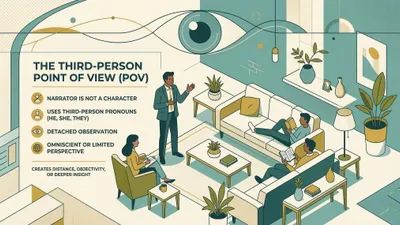
Point of view is the narrative perspective through which a story is told. It determines who is speaking, what they can know, and how much distance exists between the reader and the events on the page.
Every story has a point of view. Choosing one is not optional — it is the first structural decision a writer makes, and it shapes everything that follows. Merriam-Webster classifies it by the pronouns used: I (first person), you (second person), or he/she/they (third person).
The Four Main Points of View
| POV Type | Pronoun | What the Narrator Knows | Common In |
|---|---|---|---|
| First person | I / we | Only their own thoughts and observations | Memoir, YA, literary fiction |
| Second person | You | Varies — often limited | Experimental fiction, choose-your-own-adventure |
| Third person limited | He / she / they | One character’s thoughts per scene or chapter | Most contemporary fiction |
| Third person omniscient | He / she / they | Everything — all characters’ thoughts, past, and future | Epic fantasy, classic literature |
First Person Point of View
First person uses “I” (or, rarely, “we”) to tell the story from inside a character’s head. The reader sees only what the narrator sees, knows only what the narrator knows.
Example: “I watched him cross the room, and something about the way he avoided my eyes told me he already knew.”
First person excels at voice-driven fiction. When a narrator’s personality is as compelling as the plot itself, this POV makes the two inseparable. It dominates memoir, confessional fiction, and coming-of-age stories where intimacy is the point, as MasterClass notes in their guide to first-person narration.
The limitation is real: the narrator cannot describe events they did not witness or read minds they do not inhabit. This constraint is also its greatest tool. The gap between what the narrator believes and what actually happened is where some of the best fiction operates.
Famous examples: The Catcher in the Rye (J.D. Salinger), The Great Gatsby (F. Scott Fitzgerald), The Hunger Games (Suzanne Collins)
For a deeper look, see the full guide to first person point of view.
Second Person Point of View
Second person addresses the reader directly as “you,” placing them inside the story as a participant rather than an observer.
Example: “You walk into the bar and scan the room. The woman in the corner booth is already watching you.”
This is the rarest POV in published fiction. It creates an unusual effect — part immersion, part disorientation — that works well in short doses but is difficult to sustain across a full novel. As LitCharts explains, writers who use it well tend to be making a deliberate stylistic choice rather than reaching for the default.
Famous examples: Bright Lights, Big City (Jay McInerney), If on a winter’s night a traveler (Italo Calvino)
Read more in the full guide to second person point of view.
Third Person Limited
Third person limited uses “he,” “she,” or “they” while restricting access to one character’s inner world at a time. The narrator stays close to a single character per scene or chapter, reporting their thoughts and perceptions but not anyone else’s.
Example: “She turned the letter over in her hands, certain it was bad news. Across the table, Marcus smiled — but she couldn’t know why.”
This is the most common POV in contemporary fiction, according to The Write Practice. It offers the intimacy of first person without the pronoun constraints, and it allows authors to shift between characters at chapter or scene breaks. Most thriller, romance, and literary fiction published today uses third person limited.
A closely related technique is deep POV, which strips away almost all narrative distance, plunging the reader so far into a character’s consciousness that it reads almost like first person.
Famous examples: Harry Potter series (J.K. Rowling), Pride and Prejudice (Jane Austen), A Game of Thrones (George R.R. Martin)
The full guide to third person point of view covers this in detail.
Third Person Omniscient
Third person omniscient uses the same pronouns as third person limited, but the narrator has unrestricted access to every character’s thoughts, feelings, and knowledge. The narrator can move freely between minds, zoom out to describe events no character witnesses, and even comment on the action directly.
Example: “She believed he was lying. He believed he was telling the truth. Neither of them realized they were both wrong.”
Omniscient narration was the dominant mode in 19th-century fiction and remains common in epic fantasy, historical sagas, and literary fiction with large casts, as Reedsy details in their comprehensive POV guide. It gives the writer maximum flexibility but demands careful management — jumping between characters’ heads too quickly creates confusion rather than depth.
An omniscient narrator can also be a distinct character in its own right, with opinions, humor, and a voice that exists apart from any character in the story.
Famous examples: War and Peace (Leo Tolstoy), Middlemarch (George Eliot), The Lord of the Rings (J.R.R. Tolkien)
See the full breakdown in the guide to third person omniscient.
Less Common Variations
Beyond the four main types, a few specialized approaches are worth knowing:
Multiple first person — Two or more characters narrate in alternating first person chapters. Each “I” is a different person. Gone Girl (Gillian Flynn) and The Poisonwood Bible (Barbara Kingsolver) use this structure. Kindlepreneur covers this approach in their POV breakdown. For practical advice, see how to write multiple POV.
Unreliable narrator — Any POV can be unreliable, but first person makes it easiest. The narrator’s version of events is deliberately skewed, incomplete, or false. The reader must read between the lines. See the full guide to the unreliable narrator.
Third person objective — The narrator reports only external actions and dialogue. No thoughts, no feelings, no interiority. Ernest Hemingway’s “Hills Like White Elephants” is the textbook example. This style forces the reader to interpret meaning from behavior alone.
Quick-Reference Comparison
| Question | First Person | Second Person | Third Limited | Third Omniscient |
|---|---|---|---|---|
| Can enter multiple minds? | No | No | One at a time | Yes, any character |
| Narrator is a character? | Yes | Sometimes | No | No (usually) |
| Reader identification | Very high | Variable | High | Moderate |
| Flexibility for subplots | Low | Low | Medium | High |
| Difficulty level | Medium | High | Medium | High |
How to Choose a Point of View
The decision comes down to what the story needs, not personal preference.
Choose first person when voice is the engine of the story, when the narrator’s personality is as interesting as the plot, or when limited awareness creates tension.
Choose second person only with a specific artistic reason. It is not a safe default.
Choose third person limited when you want intimacy plus the ability to shift between characters. This is the most versatile option for most fiction.
Choose third person omniscient when the story’s scope is bigger than any single character — when the reader needs to see the full board, not just one player’s perspective.
There is no universally correct answer. The right POV is the one that makes the story work. When in doubt, write the opening scene in two different points of view and see which one pulls you forward.
Point of View vs. Perspective
These terms are related but not identical.
Point of view is a technical choice — first person, third person limited, and so on. It defines the grammatical and structural rules the narration follows.
Perspective is broader. It refers to a character’s worldview, biases, values, and way of interpreting events. Two characters can both narrate in first person and have radically different perspectives. Grammarly offers a useful breakdown of this distinction.
A story’s POV determines who is telling it. The narrator’s perspective determines how they see the world they are describing. Both matter, but they operate on different levels.
Related Concepts
- Narrative structure — how a story’s events are organized
- Character development — how characters change over the course of a story
- Show, don’t tell — a technique that works differently in each POV
- Plot structure — the framework of rising action, climax, and resolution
Point of view is not a cosmetic choice. It is structural. It determines what information the reader receives, how close they feel to the characters, and what kind of tension is possible. Understanding the options — and choosing deliberately — is one of the most consequential decisions a writer makes.