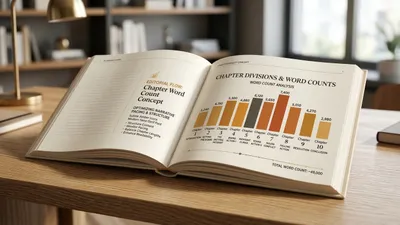
The difference between a scene and a chapter is the difference between story and packaging. A scene is a unit of story action — continuous time, continuous place, something changes. A chapter is a unit of presentation — a labelled block of pages you use to control how the reader experiences those scenes.
In this guide, you will learn:
- The one-sentence test that tells you whether you have written a scene or just a passage
- How many scenes belong in a chapter, and why the answer depends on your genre
- Where to break a scene versus where to break a chapter
- How to format a scene break inside a chapter without confusing anyone
Start with the two definitions, because almost every structural mistake traces back to blurring them.
What Is a Scene?
Scene — a continuous unit of story action in which something changes, taking place in one location over one unbroken stretch of time.
The word carries its theatrical inheritance. In drama, a scene is a division of an act marked by a change of setting or cast, and Merriam-Webster still leads with that staged sense. Prose fiction borrowed the concept wholesale.
A scene has three non-negotiables:
- Unity of time. No jumps. If you skip three hours, you have ended the scene.
- Unity of place. One location, or one continuous movement through space.
- A value shift. Something is different at the end than it was at the start.
That third item is the one writers skip. A conversation where nobody wins, loses, decides, or realises anything is not a scene. It is a passage of dialogue with scenery attached.
The one-sentence scene test
Finish this sentence about your draft: “At the start of this scene, X was ___; by the end, X was ___.”
If both blanks hold the same word, you do not have a scene yet. Safe becomes threatened. Certain becomes doubtful. Allies become rivals. The charge has to flip, even slightly.
This is the diagnostic that separates working scenes from filler, and it applies whether you are writing a fight scene, an emotional confrontation, or a quiet negotiation over tea.
What Is a Chapter?
Chapter — a numbered or titled division of a book, used to group content, mark a pause, and manage the reader experience.
Notice what is absent from that definition. No requirement about time. No requirement about place. No requirement that anything change. A chapter is a container, and containers do not care what you put in them.
Chapters exist for the reader, not the story. They are the reason a book has natural stopping points, the reason a table of contents is navigable, and the reason your reader tells themselves one more chapter at midnight. Publishing conventions around them are handled as formatting matters in style references like The Chicago Manual of Style rather than as craft rules.
Chapters also carry practical weight your scenes never do. They set audiobook track boundaries, ebook navigation points, and print page budgets. If you want the numbers side of this, see our breakdown of how long a chapter should be and how many chapters belong in a book.
Difference Between Scene and Chapter, Side by Side
| Scene | Chapter | |
|---|---|---|
| What it is | Unit of story action | Unit of presentation |
| Defined by | Time, place, change | Author choice and page count |
| Serves | The story | The reader |
| Must contain change? | Yes | No |
| Has a number or title? | No | Usually |
| Typical length | 500 to 2,500 words | 1,500 to 5,000 words |
| Decided during | Drafting | Drafting and revision |
| Reader notices it | Unconsciously | Consciously |
The most useful line in that table is the second-to-last one. Scenes are written. Chapters are edited. You discover your scenes as you draft because they are dictated by what happens. You decide your chapters, and you are free to redecide them in revision without touching a word of prose.
How Many Scenes Should Be in a Chapter?
A chapter usually contains one to four scenes, with two being the most common in commercial fiction. There is no rule, only a pacing consequence, and that consequence is predictable enough to use deliberately.
- One scene per chapter reads fast and clean. Thrillers and middle grade live here. Each chapter is a single continuous experience, so momentum never breaks.
- Two to three scenes per chapter reads as substantial and layered. Literary fiction, epic fantasy, and most historical novels sit in this range.
- Four or more scenes per chapter starts to feel like a section rather than a chapter. It works in multi-POV sagas where a chapter covers a week across three storylines.
The genre correlation is not arbitrary. Fewer scenes per chapter means more chapter breaks per hundred pages, which means more places the reader gets a small hit of completion. That is why airport thrillers feel propulsive at the same word count as a slower literary novel.
When Should a Scene and a Chapter Be the Same Thing?
Make one scene equal one chapter when your priority is pace and clarity. This one-to-one mapping is the simplest structure available, and it is the right default for a first novel.
You want the overlap when:
- You are writing in a fast genre — thriller, action, romance with short beats
- You are writing for younger readers, where chapter books rely on short self-contained units
- You are alternating point-of-view characters and want each chapter to belong to exactly one head
- You are new to structure and want the safest option
You want to break the overlap when a single scene runs so long it becomes a slog, or when two short scenes are so tightly linked that separating them into chapters would feel like a stutter.
How Do You Tell Where a Scene Ends?
A scene ends the moment one of its three unities breaks. Watch for the three exits:
- Time jumps. “Two hours later” ends the scene, no matter how smoothly you wrote the transition.
- Place changes. Characters leaving the room ends the scene, unless you follow them continuously.
- The value settles. Once the change has landed and been registered, the scene has done its job. Every sentence after that is drag.
The third exit is where most drafts bleed. Writers keep going past the turn — characters process, tidy up, say goodbye. Cut back to the moment the change lands, and let the next scene start late.
How Do You Tell Where a Chapter Should Break?
Break a chapter where the reader will want to keep going but could stop. That tension is the entire craft of chapter breaks, and it is a revision decision more than a drafting one.
Strong chapter-break positions:
- Immediately after a value shift, before the consequences are shown
- On a question, so the unanswered one pulls the reader forward
- At a genuine time or place gap in the story, where the pause feels earned
- At a POV handoff in multi-viewpoint books
Weak chapter-break positions:
- Mid-scene, with no tension at the cut, purely to hit a word count
- After the consequences have already been resolved, which gives the reader permission to put the book down
- At arbitrary intervals imposed by an outline rather than by the story
If you are planning breaks before drafting, a chapter outline template helps you map scenes to chapters before you commit prose to either.
Our Pick — Chapter
Mapping scenes to chapters is exactly the work writers stall on, because it needs a whole-book view you cannot hold in your head at 40,000 words. Chapter builds your outline as a scene-and-chapter hierarchy, so you can see which chapters are carrying three scenes and which are carrying none before you draft into them.
Best for: writers who can write a scene but lose the shape of the book Pricing: $97 one-time (nonfiction) | see fiction software for novels Why we built it: 2,147+ authors have used Chapter to write books, and structure — not sentences — is where most of them were stuck.
Scene, Chapter, Beat, and Sequel — the Full Hierarchy
Scene and chapter are two rungs on a ladder. Knowing the rungs above and below stops you from misdiagnosing a structural problem.
| Level | Unit | Size |
|---|---|---|
| Largest | Act | 25 to 50 percent of the book |
| Part or section | Several chapters | |
| Chapter | 1 to 4 scenes | |
| Scene | 500 to 2,500 words | |
| Sequel | A few paragraphs to a page | |
| Smallest | Beat | A single exchange or gesture |
Beat — the smallest unit of change, usually a single action and reaction within a scene.
Sequel — the short reactive passage after a scene, where a character absorbs what happened and decides what to do next.
The scene-and-sequel pairing comes from Dwight Swain and remains one of the most quietly useful patterns in fiction. A scene is proactive — a character wants something and is opposed. A sequel is reactive — the character feels, thinks, and chooses. Sequels are why a run of pure scenes can feel exhausting rather than exciting.
Above the chapter, acts do the load-bearing. If your chapter breaks feel arbitrary, the problem is often one level up, in the three-act structure or your broader story structure. Fix the act shape and chapter breaks often place themselves.
Do Nonfiction Books Have Scenes?
Nonfiction books have chapters always and scenes sometimes. In memoir and narrative nonfiction, scenes work exactly as they do in fiction — continuous time, continuous place, a change. In prescriptive nonfiction, chapters contain arguments and examples rather than scenes.
The distinction matters when you are structuring a nonfiction manuscript. A how-to chapter is organised by idea, not by action, so the unit inside it is the section, not the scene. See how to structure a nonfiction book for that logic, and how to structure a memoir when your chapters do carry real scenes.
Memoirists get the hardest version of this problem. Your life happened in scenes but your book needs chapters, and the two rarely align on their own.
How Do You Format a Scene Break Inside a Chapter?
Format a scene break inside a chapter with a centred blank-line marker — traditionally three asterisks or a single hash, or in typeset books simply extra vertical white space. The convention exists because the reader needs to know a jump happened without being told.
In your manuscript, use a centred # or * * * on its own line. Publishers replace it with their house style at typesetting. Never signal a scene break with only a blank line, because blank lines vanish in reflowed ebooks and page breaks.
Practical rules:
- Do not number scenes. Numbering is a chapter privilege.
- Do not give scenes titles. If a scene needs a title, it probably needs to be a chapter — see how to write chapter titles.
- Keep the marker consistent throughout the whole manuscript.
Common Mistakes to Avoid
- Writing chapters instead of scenes. If you draft toward a page count rather than toward a change, you get chapters full of activity and empty of story.
- Refusing to split a scene across chapters. Sometimes the sharpest break in the book is mid-scene, right as a door opens. Allowed, and effective.
- Locking chapter breaks during drafting. Chapters are the cheapest thing in your manuscript to change. Treat them as provisional until revision.
- Ending scenes late. Cut on the turn, not after the tidy-up.
- Forcing every chapter to the same length. Uniform chapters flatten pace. A two-page chapter after four long ones lands like a slap, which is fast pacing done on purpose.
- Confusing a POV switch with a scene break. A new viewpoint usually deserves a chapter, not an asterisk.
Do Scenes and Chapters Change Your Pacing?
Scenes and chapters both control pacing, but through different levers. Scene length controls how fast the story moves. Chapter length controls how fast the reading feels.
A long scene can be fast if the value shifts keep landing. A short chapter feels fast almost regardless of content, because the reader crosses a finish line. That is why two books at identical word counts can read at wildly different speeds — one has 20 chapters, the other has 60.
Practical consequence: if beta readers say your book drags, check chapter count before you cut prose. Sometimes the fix is more breaks, not fewer words. Editors and industry writers at outlets like Jane Friedman and Writer’s Digest return to this point often, because it is the cheapest pacing fix available.
How Do You Study Scenes and Chapters in Published Books?
Read the table of contents, then count. Pick three novels in your genre from Project Gutenberg or your own shelf and record, for each of the first five chapters, how many scene breaks it contains and how many words it runs.
You will have a genre benchmark in under an hour, and it will be more accurate than any general rule — including the ones in this article. Craft resources like Reedsy and writing guides at Purdue OWL are useful, but your own count of books in your subgenre beats both.
Do the same exercise on your own draft. Most writers are surprised by the variance they find.
FAQ
Is a scene the same as a chapter?
A scene is not the same as a chapter. A scene is a unit of story action defined by continuous time, place, and a change. A chapter is a unit of presentation you choose for the reader. One chapter can hold several scenes, and one scene can be split across chapters.
How many scenes should a chapter have?
A chapter should have one to four scenes, with two being most common. Fewer scenes per chapter creates faster pacing because the reader hits more chapter breaks. Thrillers often use one scene per chapter; literary and epic fantasy often use two or three.
Can a chapter have only one scene?
A chapter can absolutely have only one scene, and this one-to-one structure is the cleanest option available. It keeps each chapter continuous in time and place, which reads fast and reduces confusion. It is the standard approach in thrillers, romance, and chapter books.
Can one scene span two chapters?
One scene can span two chapters when you break at a moment of high tension. The scene continues in unbroken story time across the chapter boundary, which creates a strong cliffhanger. Use it sparingly — every chapter of a book cannot end mid-scene without the trick wearing thin.
What is the difference between a scene and a beat?
The difference between a scene and a beat is scale. A beat is the smallest unit of change — one action and its reaction. A scene is built from many beats and ends with a larger value shift. Beats are sentences to paragraphs; scenes are hundreds to thousands of words.
Should I plan scenes or chapters first?
Plan scenes first, chapters second. Scenes are dictated by your story, so they come from the plot. Chapters are a reader-experience decision you make once you know what the scenes are. Working the other way around produces chapters that hit a word count but carry no change.