You can create a professional fantasy map for your novel — even if you can’t draw a straight line.
In this guide, you’ll learn:
- How to design realistic geography that makes your world feel lived-in
- The step-by-step process for building a fantasy map from scratch
- Which free and paid map-making tools actually work for authors
- How to get your map publication-ready for print and ebook formats
Here’s everything you need to know about fantasy map making for writers.
What Is Fantasy Map Making for Writers?
Fantasy map making for writers is the process of creating a visual representation of your fictional world to guide your storytelling and immerse your readers. Unlike decorative art maps, a writer’s map serves as a narrative tool — it keeps your plot geographically consistent, helps you track character journeys, and reveals story opportunities you might otherwise miss.
Think about the maps in The Lord of the Rings, A Game of Thrones, or The Way of Kings. Those maps don’t just look cool. They ground the reader in the world and make sprawling plots easier to follow.
You don’t need to be an artist to make one. Modern tools handle the visual heavy lifting. Your job is the part you’re already good at — building the world.
Why Your Fantasy Novel Needs a Map
A fantasy map isn’t just a nice bonus for readers. It’s a writing tool that solves real problems during the drafting process.
Geographic consistency. When your characters travel from the capital to the coast, a map tells you exactly how long that journey takes. No more accidentally teleporting characters across a continent in a single chapter.
Plot discovery. Placing a mountain range between two kingdoms instantly suggests conflict. A river running through a city creates rich and poor districts. Geography generates story.
Reader immersion. According to a 2023 survey by Reedsy, fantasy maps are among the most requested features from readers of the genre. Readers flip back to the map constantly — it’s part of the reading experience.
Worldbuilding depth. Once you place your terrain, the rest of your worldbuilding follows logically. Climate, trade routes, cultural boundaries, and political borders all emerge from geography.
How to Write a Fantasy Map: 7-Step Process
Writers often ask how to write a fantasy map rather than how to draw one — and that’s the right instinct. A map for a novel is written before it’s drawn: you’re making decisions about terrain, climate, and civilization, and the artwork is just the last step. This process works whether you’re sketching on paper or using digital tools. Start rough and refine as you go.
Step 1: Define the Scope of Your Map
Before you draw anything, decide what your map needs to show. Not every fantasy novel needs a full world map.
- World map — Multiple continents, oceans, and global features (best for epic fantasy spanning many regions)
- Continental map — A single landmass with countries, mountain ranges, and major rivers (most common for fantasy novels)
- Regional map — A specific area like a kingdom, province, or valley (good for stories set in a single location)
- City map — Streets, districts, and landmarks (useful for urban fantasy or heist stories)
Match your map’s scope to your story’s scope. If your characters never leave a single kingdom, a world map is unnecessary — and a detailed regional map will serve you better.
Step 2: Build Your Landmasses
Start with the shapes of your continents and major land features. Here’s a trick professional cartographers use: toss a handful of rice or dried beans onto a blank page. The clusters suggest natural-looking coastlines and island chains.
Draw rough outlines around the clusters. Vary your coastlines — some jagged and fjord-like, others smooth and beachy. Real coastlines are never perfectly smooth, and neither should yours be.
Key principle: Landmasses don’t exist in isolation. Think about your world’s tectonic plates. Where plates collide, you get mountain ranges and volcanic islands. Where they pull apart, you get rift valleys and inland seas.
Step 3: Place Mountains and Terrain
Mountains are the backbone of your map’s geography. Everything else — rivers, forests, deserts, settlements — flows from where you place them.
How mountains actually form:
- Mountain ranges run in chains, not as isolated peaks. Think of the Rockies, the Himalayas, or the Andes — they stretch for thousands of miles.
- Place ranges along the edges of your tectonic plates or where continents collide.
- Volcanic mountains can appear in chains (like island arcs) or as isolated peaks near plate boundaries.
After mountains, add hills, plateaus, and valleys. These transitional terrains connect your dramatic peaks to your flatlands and make the geography feel natural.
Step 4: Add Rivers, Lakes, and Water Features
Rivers are where most fantasy writers make mistakes. Follow these rules to keep your map geologically plausible.
The golden rules of fantasy rivers:
- Rivers flow downhill — from mountains to oceans. Always.
- Rivers merge as they flow downstream. Two small streams join to form a bigger river. They almost never split (except in deltas near the coast).
- Rivers don’t flow coast to coast. A river starting near one ocean won’t cross a continent to reach another.
- Every river ends somewhere — an ocean, a large lake, or an inland sea.
Place your major rivers originating in mountain ranges and flowing toward your coastlines. Add lakes where natural basins would collect water — in valleys between mountain ranges or in low-lying plains.
Step 5: Create Biomes and Climate Zones
This is where your map goes from “shapes on a page” to a living, breathing world. Your terrain placement determines your climate — and your climate determines everything from what people eat to how they fight wars.
Rain shadow effect — This is the single most important geographic concept for fantasy writers. When moist air from the ocean hits a mountain range, it rises, cools, and dumps rain on the ocean-facing side. The other side gets almost nothing. That’s why you’ll often see lush forests on one side of mountains and deserts on the other.
Climate zones to consider:
| Biome | Where It Goes | Story Potential |
|---|---|---|
| Dense forest | Moderate rainfall, temperate zones | Hidden kingdoms, ancient ruins, elven territory |
| Desert | Rain shadow side of mountains, inland areas | Nomadic cultures, buried cities, harsh survival |
| Tundra | Far north/south, high elevation | Isolated communities, frozen threats, rare resources |
| Grassland | Flat terrain with moderate rainfall | Horse cultures, farming communities, open warfare |
| Swamp/wetland | Low-lying areas near rivers or coasts | Mysterious creatures, hard-to-reach hideouts |
| Tropical jungle | Near the equator with high rainfall | Ancient civilizations, dangerous wildlife |
Use these biomes to create natural borders between cultures. A mountain range makes a better kingdom boundary than an arbitrary line on a map — and it gives you built-in conflict when someone tries to cross it.
Step 6: Place Settlements and Civilization
Now that your physical world exists, populate it. Settlements don’t appear randomly — they form where geography makes life possible.
Where cities grow:
- River crossings — Where a bridge or ford allows trade to flow (London, Paris, and Cairo all started this way)
- Natural harbors — Protected bays with deep water for ships
- Resource sites — Near mines, fertile farmland, or forests
- Defensive positions — Hilltops, islands, river bends, or narrow passes
- Trade route intersections — Where two or more paths naturally converge
Where cities don’t grow:
- In the middle of deserts (without an oasis)
- On exposed mountainsides (unless deliberately isolated)
- Far from any water source
After placing your major cities, add roads connecting them. Roads follow the path of least resistance — along river valleys, through mountain passes, and across flat terrain. They avoid swamps, dense forests, and steep climbs when possible.
Step 7: Add Labels and Final Details
Your map needs names. This is where your fantasy name generator skills come in handy.
Naming conventions that feel authentic:
- Use consistent phonetic patterns within each culture. If your northern people use harsh consonants (Kragmor, Theldrak), keep that pattern for all their settlements.
- Name geographic features descriptively — “Blackwater River,” “The Teeth” (for jagged mountains), “Widow’s Bay”
- Mix languages if your world has multiple cultures. The same river might have different names on each side of a border.
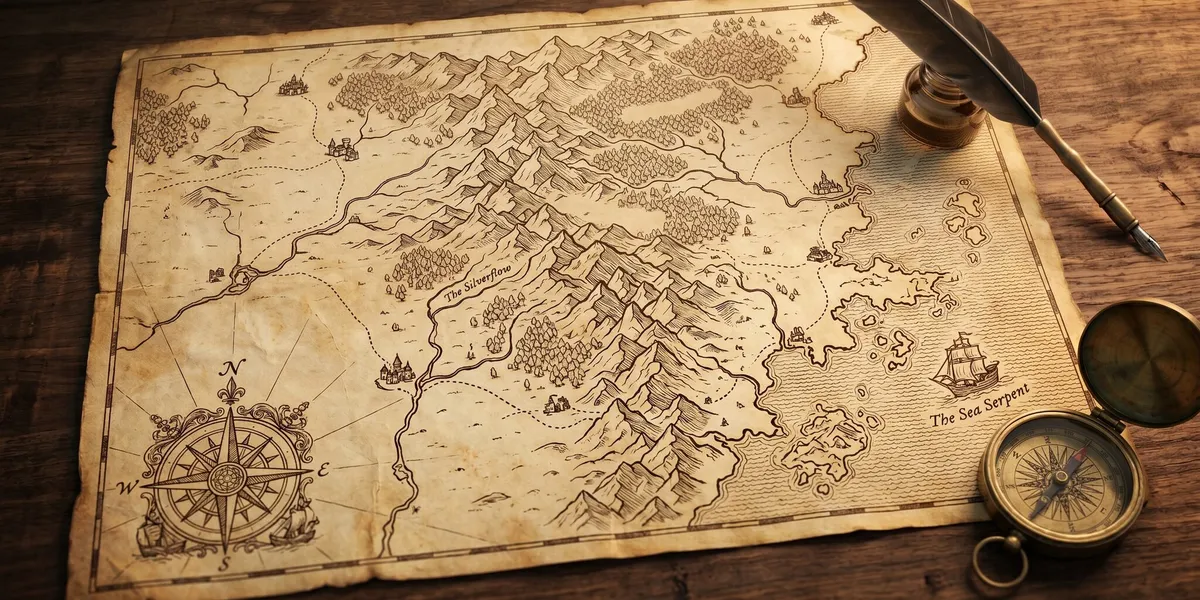
Add a compass rose, a scale bar, and any legend symbols you need. These small details signal “this is a real place” to your reader’s brain.
Best Fantasy Map Making Tools for Writers
You have three approaches: draw by hand, use digital map-making software, or hire a professional cartographer. Here’s what works best for each situation.
Our Pick — Chapter
Chapter helps you build your entire fantasy world before you ever touch a map tool. Use Chapter’s AI worldbuilding features to develop your geography, cultures, and history — then export that framework to guide your map creation. When your world is internally consistent, your map practically draws itself.
Best for: Writers who want to develop deep, consistent worldbuilding alongside their manuscript Why we built it: Fantasy writers kept telling us their maps contradicted their prose. Building the world and the story together solves that.
Free Tools
Azgaar’s Fantasy Map Generator — The most powerful free option. Generates complete world maps with countries, cities, religions, rivers, and terrain. You can customize everything after generation. Best for writers who want a starting point to refine.
Donjon World Generator — Quick and simple. Set your parameters (land ratio, city count, style) and get an instant map. Less customizable than Azgaar, but perfect for rough drafts.
Roll for Fantasy Map Creator — A grid-based generator with symmetry tools. Good for creating balanced, aesthetically pleasing continent shapes.
Paid Tools
Inkarnate — Free basic tier, $27.53/year for full features. Browser-based with an intuitive drag-and-drop interface. Importantly, the paid Studio tier includes commercial licensing — meaning you can legally include Inkarnate maps in your published book.
Wonderdraft — $29.99 one-time purchase. A desktop application with a Tolkien-esque aesthetic. More customizable than Inkarnate, with a huge community creating free asset packs. Includes commercial licensing.
Campaign Cartographer 3 — $22.45. The professional standard for tabletop RPG maps. Steep learning curve but unmatched detail and flexibility. Best for writers who also run tabletop games.
Quick Comparison
| Tool | Price | Commercial License | Best For |
|---|---|---|---|
| Azgaar’s | Free | Check terms | Quick world generation |
| Inkarnate | Free / $27.53/yr | Paid tier only | Beautiful maps, easy to learn |
| Wonderdraft | $29.99 one-time | Yes | Tolkien-style, deep customization |
| Campaign Cartographer | $22.45 | Yes | Professional-grade detail |
| Donjon | Free | Check terms | Rapid prototyping |
| Hiring a cartographer | $200-$2,000+ | Negotiate in contract | Publication-quality art |
Licensing matters. If you plan to publish your map in a book, confirm the tool’s license allows commercial use. Free tools often restrict commercial rights. Always check before you invest hours into a map you can’t legally publish.
Common Fantasy Map Mistakes to Avoid
Even experienced fantasy writers make these errors. Catch them before your readers do.
- Rivers that split inland. Rivers merge, they don’t fork (except at coastal deltas). A river splitting into two equal branches in the middle of a continent breaks the physics of water flow.
- Random mountain placement. Mountains don’t appear alone. They form ranges along fault lines. A single mountain in the middle of a flat plain needs a magical explanation — which is fine, as long as you provide one.
- Biome contradictions. A lush forest directly next to a scorching desert with no mountain range between them doesn’t make geographic sense. Use the rain shadow effect to justify your climate transitions.
- Ignoring travel time. If two cities are 500 miles apart on your map, your characters can’t walk there in a day. Add a scale bar and do the math — medieval travel averaged 15-25 miles per day on foot, 30-40 on horseback.
- Empty space. Every region on your map should suggest stories. If there’s a huge blank area, fill it with something — even if it’s “The Unmarked Wastes” that nobody has explored. Mystery is content.
How to Use AI for Fantasy Map Worldbuilding
AI tools can accelerate the worldbuilding that feeds your map. Instead of staring at a blank page trying to figure out what goes where, you can use AI to brainstorm geography, develop cultures, and stress-test your world’s logic.
ChatGPT prompts for worldbuilding can help you generate terrain ideas, develop the history behind geographic features, and create cultural details tied to specific regions on your map.
AI worldbuilding tools take this further by helping you build structured world bibles that keep every detail consistent — from the climate patterns that shape your map to the trade routes that connect your cities.
The key is using AI as a brainstorming partner, not a replacement for your creative vision. Generate ideas, then curate the ones that serve your story.
How to Get Your Fantasy Map Ready for Publication
Your map isn’t finished until it’s formatted for your book. Print and ebook formats have different requirements.
For print books:
- Maps typically span a two-page spread at the front of the book
- Keep critical details away from the center gutter — anything in the fold will be hard to see
- Export at 300 DPI minimum for print quality
- Use black and white or limited grayscale for interior maps (color printing is expensive)
- Standard trim sizes: 5.5” x 8.5” or 6” x 9” — your map should fit these dimensions
For ebooks:
- Export as a high-resolution PNG or JPEG
- Keep it simple — readers will view it on small screens
- Consider creating a simplified version alongside your detailed one
- Some readers will pinch-to-zoom, so fine details can work if the resolution is high enough
For both formats: Include your map as the first interior page after the title page. Readers expect to find it there and will reference it throughout the book.
If you’re self-publishing, you control exactly how your map appears. If you’re going traditional, your publisher may commission their own version — but having your author map as a reference makes the cartographer’s job much easier.
Iconic Fantasy Maps to Learn From
Study these published maps to understand what works.
Middle-earth (J.R.R. Tolkien) — The original fantasy map. Tolkien was a philologist and applied linguistic logic to every place name. Notice how his mountain ranges create natural borders between cultures, and his rivers flow realistically from highlands to sea.
Westeros (George R.R. Martin) — A continental map that tells you about politics before you read a single word. The Wall in the north, the narrow sea separating Westeros from Essos, the strategic importance of King’s Landing at the mouth of a river on a bay — every feature serves the story.
Roshar (Brandon Sanderson) — A deliberately alien landscape shaped by the world’s unique storm system. Sanderson designed the ecology and geography together, so the map doesn’t just show where things are — it shows why they’re there.
The Stillness (N.K. Jemisin) — A single supercontinent with a massive rift running through it. The geography IS the conflict. Jemisin proves that a simple map concept, executed with purpose, can be more powerful than a detailed one.
Each of these maps succeeds because the geography serves the narrative. That’s the standard to aim for.
Do You Need to Be an Artist to Make a Fantasy Map?
No, you don’t need any drawing skills to create a fantasy map. Modern digital tools like Azgaar’s Fantasy Map Generator and Inkarnate handle all the visual elements through drag-and-drop interfaces. You choose where mountains, rivers, and cities go — the software makes them look professional.
Even if you prefer hand-drawn maps, your draft map doesn’t need to be pretty. It just needs to be accurate. Many published authors create rough sketches during the writing process and then hire a professional cartographer for the final published version.
The creative skill that matters isn’t drawing — it’s worldbuilding. Understanding how geography shapes civilization is far more valuable than artistic talent when it comes to fantasy map making.
How Long Does It Take to Make a Fantasy Map?
A basic map using a generator tool like Azgaar’s takes 30 minutes to an hour. A detailed map in Inkarnate or Wonderdraft takes 4-8 hours for a continent with full terrain, cities, and labels. A professional commission typically takes 2-4 weeks from brief to final delivery.
Your first map will take longer. That’s normal. Start with a rough sketch to guide your writing, and refine it as your world develops. Many authors revise their maps multiple times throughout the drafting process — and that’s the right approach. Your map should grow alongside your story.
Should You Make Your Map Before or After Writing?
This depends on your writing style, but most experienced fantasy writers recommend a hybrid approach.
Make a rough map before you start writing. Sketch your major geography — continents, mountain ranges, key rivers, and important cities. This prevents geographic contradictions in your first draft and helps you visualize character journeys.
Refine the map as you draft. Your story will evolve. Characters will need to travel to places you didn’t originally plan. New plot points will require new locations. Let your map be a living document that grows with your narrative.
Finalize the map after your last revision. Only lock down the details once your plot is complete. Otherwise, you’ll waste time perfecting a map for a story that hasn’t found its final shape yet.
This approach works especially well when you combine it with structured worldbuilding tools that keep your geographic details organized and consistent as they evolve.
FAQ
How do you write a fantasy map?
To write a fantasy map, work through seven steps in order: (1) define the scope (world, continent, region, or city), (2) draw your landmasses, (3) place mountain ranges along tectonic boundaries, (4) run rivers downhill from those mountains to the sea, (5) assign biomes using the rain shadow effect, (6) put settlements where geography supports them — river crossings, harbors, trade routes — and (7) add names, a compass rose, and a scale bar.
The order matters. Terrain determines climate, climate determines where people live, and where people live determines your borders, trade routes, and conflicts. Build the map in that sequence and the geography writes half your worldbuilding for you.
What is the best free fantasy map maker for writers?
The best free fantasy map maker for writers is Azgaar’s Fantasy Map Generator. It creates complete world maps with terrain, rivers, countries, cities, and even religions — all customizable after generation. It runs in your browser with no download required, making it the most powerful free option for authors building fictional worlds.
Can I use a fantasy map generator for a published book?
You can use a fantasy map generator for a published book only if the tool’s license allows commercial use. Free generators often restrict commercial rights. Inkarnate’s paid Studio tier and Wonderdraft both include commercial licensing. Always check the terms of service before publishing any generated map in your book.
How do I make my fantasy map look realistic?
To make your fantasy map look realistic, follow real-world geography principles: place mountains in ranges along tectonic boundaries, flow rivers downhill from mountains to oceans, and use the rain shadow effect to create logical biome transitions. Realistic maps aren’t about artistic skill — they’re about understanding how terrain, climate, and water interact.
What should I include on a fantasy map?
A fantasy map should include landmasses, mountain ranges, major rivers, forests, deserts, cities, roads, and a scale bar. Add a compass rose for orientation and a legend if you use symbols. Label major geographic features and settlements with names that reflect your world’s cultures. The best maps also hint at story — borders suggest conflict, ruins suggest history.
Do I need a map for every fantasy novel?
You don’t need a published map for every fantasy novel, but you should create at least a rough working map for yourself. Even stories set in a single city benefit from a sketch showing districts, landmarks, and character routes. Whether you include the map in your book depends on your story’s scope — epic fantasy readers expect maps, while urban fantasy readers may not.