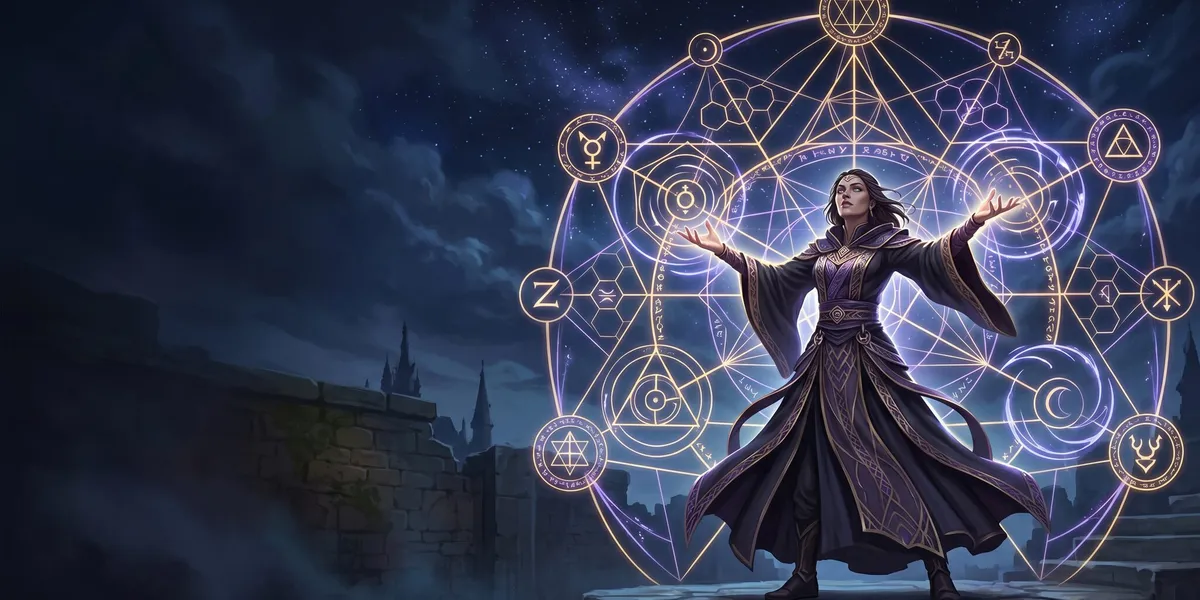
Hard magic system examples are everywhere in modern fantasy — from the metal-burning Allomancy of Mistborn to the elemental bending of Avatar: The Last Airbender. What makes these systems unforgettable is not the flashy powers. It is the rules.
In this guide, you’ll learn:
- What defines a hard magic system (and how it differs from soft magic)
- The 10 best hard magic system examples across books, TV, anime, and games
- What each system gets right about rules, costs, and limitations
- How to design your own hard magic system using these examples as models
Here are the hard magic systems every fantasy writer should study.
What Is a Hard Magic System?
Hard magic system — A magic system with clearly defined rules, costs, and limitations that both characters and readers understand before magic is used to resolve conflict.
The term comes from Brandon Sanderson’s First Law of Magic: “An author’s ability to solve conflict with magic is directly proportional to how well the reader understands said magic.” In a hard magic system, you know what a character can do, what it costs them, and where the boundaries are. When the hero uses magic to escape a trap, the solution feels earned — because you could have predicted it.
Hard magic sits on one end of a spectrum. On the other end is soft magic — mysterious, unexplained, and wondrous. Most fantasy falls somewhere in between. If you want to understand the full spectrum, read our guide on how to create a magic system that covers both approaches in depth.
How Hard Magic Systems Work
Every hard magic system shares three core components. Understanding these will help you recognize what makes the examples below tick — and apply the same principles when writing your own magic system.
Rules
Rules define what magic can do and how it operates. In a hard system, rules are explicit. The reader learns them alongside the characters.
The best rules are simple to state but complex in application. “You can push or pull on metals” is a simple rule. The creative ways characters exploit that rule across 6 books is where the depth lives.
Costs
Every use of magic must cost something. Cost creates tension. Without cost, magic becomes an unlimited problem-solver — and your story loses all stakes.
Costs can be physical (exhaustion, pain, lifespan), material (fuel that runs out), or social (forbidden, feared, punished). The best systems stack multiple costs.
Limitations
Limitations are even more important than powers. What a character cannot do with magic shapes every interesting decision in the story. Limitations force creativity. They force conflict. They prevent the deus ex machina that kills reader trust.
Sanderson puts it bluntly: “Limitations are more interesting than abilities.” Every example below proves him right.
10 Best Hard Magic System Examples
1. Allomancy — Mistborn by Brandon Sanderson
The rules: Allomancers swallow and “burn” specific metals to gain powers. Each metal grants exactly one ability. Steel lets you push on nearby metals. Iron lets you pull. Tin enhances senses. Pewter boosts physical strength. There are 16 metals total, each with a defined effect.
The cost: Metal is consumed when burned. Run out of steel, and you cannot push anymore. Some metals (like atium) are extraordinarily rare, adding economic stakes to the magical ones.
The limitation: Most Allomancers can only burn one metal (Mistings). Only a rare few — Mistborn — can burn all 16. You cannot burn a metal you have not ingested, and you cannot create metal from nothing.
Why it works: Allomancy is the gold standard of hard magic because the rules are learnable. Readers start predicting tactics. When Vin launches coins at enemies using steel, you understand the physics. When she burns pewter mid-fight, you feel the tactical shift. Sanderson turns every action sequence into a chess match.
What writers can learn: Simple, modular rules (one metal = one power) create enormous tactical depth without cognitive overload.
2. Bending — Avatar: The Last Airbender
The rules: Four nations, four elements. Waterbenders manipulate water. Earthbenders manipulate earth and stone. Firebenders generate and control flame. Airbenders control air currents. Each bending art has a distinct martial arts style tied to real-world traditions — tai chi for water, hung gar for earth, Northern Shaolin for fire, baguazhang for air.
The cost: Bending requires physical exertion and focus. Firebenders grow weaker during eclipses. Waterbenders draw strength from the moon. The physical demands mean an exhausted or injured bender is a weakened bender.
The limitation: You can only bend your native element — unless you are the Avatar. Even the Avatar must learn each element individually. Metalbending, bloodbending, and lightningbending exist as rare extensions that require extreme skill.
Why it works: The elemental restriction is brilliantly simple. You immediately understand every fight’s tactical landscape: an earthbender in the middle of an ocean is in trouble. A firebender in a wooden building is terrifying. The system generates conflict through geography and matchups alone.
What writers can learn: Tying magic to a physical discipline (martial arts, music, dance) grounds abstract powers in something the audience intuitively understands.
3. Sympathy — The Kingkiller Chronicle by Patrick Rothfuss
The rules: Sympathy works through creating a mental link between two objects. When you bind a coin to a larger piece of iron, pushing the coin pushes the iron — but the effect is weakened by the “slippage” between dissimilar objects. The more alike two objects are, the stronger the link. Energy is conserved and transferred.
The cost: Sympathy drains body heat. Push too much energy through a link, and your body temperature drops to dangerous levels. Splitting your mind to hold multiple bindings causes mental strain. It is essentially thermodynamics with willpower.
The limitation: You need a physical object to serve as a link. The objects must have some similarity. Distance weakens connections. And the energy has to come from somewhere — you cannot create force from nothing.
Why it works: Rothfuss grounds magic in physics. Sympathy feels like an alternate science rather than supernatural handwaving. Readers who enjoy puzzle-solving find it deeply satisfying because every magical act can be reverse-engineered.
What writers can learn: Basing your magic system on real scientific principles (thermodynamics, chemistry, physics) gives readers an intuitive framework to build on.
4. Alchemy — Fullmetal Alchemist
The rules: Alchemy follows one absolute law: equivalent exchange. To create something, you must provide raw materials of equal mass and composition. You cannot create matter from nothing. Transmutation circles channel the process — most alchemists need to draw a circle to perform alchemy.
The cost: The materials themselves are the cost. Want to make a wall of stone? You need stone. Attempt human transmutation — the ultimate taboo — and the cost is catastrophic. Edward Elric loses his arm and leg. Alphonse loses his entire body. The price is always proportional to the ambition.
The limitation: You cannot create something from nothing. You cannot bring back the dead (not truly). Each alchemist typically specializes — flame alchemy, ice alchemy, bio-alchemy — and cannot perform transmutations outside their expertise without preparation.
Why it works: Equivalent exchange is one of the most elegant rules in all of fiction. It is simple enough for a child to understand and devastating enough to drive an entire series of moral dilemmas. Every use of alchemy has weight because you always know what was sacrificed to make it happen.
What writers can learn: A single, deeply explored rule can do more storytelling work than a dozen complicated ones.
5. Surgebinding — The Stormlight Archive by Brandon Sanderson
The rules: Surgebinders bond with sentient magical spirits called spren. Each type of spren grants access to two of the ten Surges — fundamental forces like gravity, friction, transformation, and adhesion. A Windrunner can manipulate gravity (Lashing) and adhesion. An Edgedancer can manipulate friction and growth.
The cost: Stormlight is the fuel. Surgebinders must breathe in Stormlight — a luminous energy carried by highstorms — to power their abilities. Stormlight bleeds away over time. It is a limited, environmental resource.
The limitation: You need a spren willing to bond with you, and spren choose based on your adherence to specific ideals. Break your oaths, lose your powers. Each order of Knights Radiant has different ideals and different Surges, so no single character has access to all abilities.
Why it works: Surgebinding adds a moral dimension to hard magic. Your power is tied to your character growth. A Windrunner who stops protecting people loses their bond. The magic system and character development are inseparable.
What writers can learn: Tying magical power to moral commitments creates automatic character arcs. The magic forces growth.
6. Chromaturgy — Lightbringer Series by Brent Weeks
The rules: Drafters convert visible light into a physical substance called luxin. Each color of light produces a different type of luxin with distinct properties. Blue luxin is hard and crystalline. Red luxin is sticky and flammable. Green luxin is flexible and springy. You can only draft colors you can see — no light, no magic.
The cost: Every drafter has a finite amount of light they can process in their lifetime. Use too much, and you “break the halo” — your irises flood with luxin, and you go mad. Death or madness is the ultimate cost of overuse.
The limitation: Most drafters can only process one or two colors (monochromes and bichromes). Only rare “polychromes” draft multiple colors. A full-spectrum polychrome (the Prism) is a once-in-a-generation rarity. Your magic is literally limited by what your eyes can see.
Why it works: Chromaturgy turns light and color into a tactical resource. Fight scenes in the Lightbringer series feel like color-coded chess. Every environment matters — underground caves and dark rooms are death traps for drafters. Bright, sunny courtyards are arenas of power.
What writers can learn: Environmental dependency (needing light to draft) makes setting an active participant in every magical conflict.
7. Nen — Hunter x Hunter
The rules: Nen is life energy (aura) that surrounds every living body. Users learn to control aura flow through four basic techniques: Ten (shroud), Zetsu (suppress), Ren (amplify), and Hatsu (release). Each user falls into one of six Nen types — Enhancer, Transmuter, Conjurer, Emitter, Manipulator, Specialist — and creates a unique Hatsu ability based on their type.
The cost: Developing a powerful Hatsu requires setting Conditions and Limitations on yourself. The more restrictive your conditions, the more powerful the ability. Gon’s transformation in the Chimera Ant arc requires sacrificing his future potential. Kurapika’s chain abilities only work against the Phantom Troupe — but they are devastatingly effective against that specific target.
The limitation: Your Nen type determines what you are naturally best at. Trying abilities far from your type weakens them. Conditions are binding — break them, and you lose your ability or die. Every powerful technique demands a proportional sacrifice.
Why it works: Nen has a self-balancing mechanism built into its core: the stronger you want to be, the more you must restrict yourself. This creates an arms race of creativity. Every fight is a puzzle — figuring out the opponent’s conditions and exploiting their self-imposed weaknesses.
What writers can learn: Letting characters design their own limitations in exchange for power creates infinite variety while maintaining balance.
8. The One Power — The Wheel of Time by Robert Jordan
The rules: The One Power has two halves: saidin (male) and saidar (female). Channelers weave five elemental threads — Air, Water, Earth, Fire, and Spirit — into specific patterns to create effects. Different weaves produce different results. Men tend to be stronger in Fire and Earth; women in Air and Water. Spirit is roughly equal.
The cost: Channeling is physically taxing. Overdrawing brings “burnout” — permanent loss of the ability to channel. Men face an additional, existential cost: the male half of the source is tainted, and every male channeler goes insane and dies (until the taint is cleansed in later books).
The limitation: You cannot weave threads you are not strong in as effectively. Specific weaves require specific combinations — you cannot heal with Fire alone. Channelers have varying strength levels, and there is an absolute ceiling on how much power any individual can draw.
Why it works: Jordan’s system has the depth of a secondary physics. The gendered split creates political and social consequences that drive the entire 14-book series. The taint on saidin means every male channeler is a ticking time bomb — a magic system that shapes an entire civilization’s history.
What writers can learn: Your magic system’s social consequences can generate more plot than its combat applications. Think about how magic shapes law, politics, religion, and gender roles in your fantasy world.
9. Biochromatic Breath — Warbreaker by Brandon Sanderson
The rules: Every person is born with one Breath — a piece of their soul’s investiture. Breaths can be given away voluntarily. Accumulating many Breaths grants abilities called Heightenings: enhanced color perception, perfect pitch, the ability to sense life around you. Breaths can also be used to Awaken objects, giving them a single mental command to follow.
The cost: The Breath you give is gone. The person who gave it away becomes a “drab” — slightly dulled, less vital, subtly diminished. Awakening objects consumes Breath (though skilled Awakeners can recover it). The cost is always personal — a piece of your own life force.
The limitation: Awakening requires color — the object drains color from its surroundings when brought to life. You need verbal commands, and imprecise commands produce imprecise results. You cannot Awaken anything without enough stored Breath.
Why it works: The economic dimension of Biochromatic Breath is brilliant. Breath is a tradeable commodity. Rich people accumulate Breaths from the poor, becoming literally more alive while the poor become dulled. The magic system creates an entire social hierarchy and economy.
What writers can learn: When magic is a resource that can be traded, it generates political and economic storylines naturally.
10. The Force (Quantified) — Star Wars Expanded Universe
The rules: In the original films, the Force is soft magic — mysterious and spiritual. But the Expanded Universe (and prequel era) hardened it. Force abilities are categorized: telekinesis, mind tricks, Force speed, precognition, Force lightning. Jedi train specific abilities. The midi-chlorian count establishes a measurable ceiling on potential.
The cost: The dark side is faster and more powerful — but corrupts the user. Force use requires concentration and training. Untrained users risk losing control. Powerful techniques like Force projection (as seen in The Last Jedi) can be fatal.
The limitation: Your midi-chlorian count caps your potential. Not all Force users can learn all techniques. Jedi must maintain emotional control — anger and fear lead to the dark side. Distance and mental clarity affect effectiveness.
Why it works (and when it doesn’t): The Force is an interesting case study because it shows the tension between hard and soft magic. Fans debate whether quantifying the Force (midi-chlorians) enhanced or diminished its storytelling power. The answer depends on what story you are telling — mystery benefits from soft magic, while tactical combat benefits from hard magic.
What writers can learn: You can start soft and harden over time as your world develops. But be deliberate — audiences who fell in love with the mystery may resist rigid explanation.
What Makes a Hard Magic System Work?
Looking across all 10 examples, the best hard magic systems share four qualities:
1. Simple core rules with complex applications. Allomancy has 16 metals. Bending has 4 elements. Alchemy has one rule. Simplicity at the core enables complexity at the surface.
2. Meaningful costs that drive character decisions. Every example above forces characters to choose when to use magic — because using it always costs something. Cost is what turns magic into drama.
3. Limitations that generate conflict. A waterbender stuck in a desert. A drafter trapped in darkness. An alchemist who needs materials they do not have. Limitations are not weaknesses — they are story engines.
4. Social and cultural consequences. The best systems ripple outward. Magic does not just affect combat — it shapes governments, economies, religions, and social hierarchies. Your magic system should change how people live, not just how they fight.
If you want a step-by-step process for building your own system with these qualities, read our full guide on how to write a magic system with rules, costs, and limitations that serve your story.
How to Use Hard Magic System Examples in Your Own Writing
Studying these examples is useful only if you apply the patterns to your own work. Here is a practical framework:
Step 1: Choose your “source.” What fuels your magic? Metals, light, elements, life force, sound? Pick something concrete. Abstract sources lead to soft magic; concrete sources enable hard magic.
Step 2: Define 3-5 rules. What can the magic do? State each rule simply. If you cannot explain a rule in one sentence, it is too complicated.
Step 3: Stack costs. Give your magic at least two types of cost — one immediate (fuel runs out, pain, exhaustion) and one long-term (shortened lifespan, madness, social stigma).
Step 4: Set hard limitations. What can your magic absolutely not do? Write these down. They are more important than the powers themselves. They will generate your best plot twists and most satisfying character moments.
Step 5: Extrapolate socially. Ask: If this magic existed, how would society organize around it? Who would have power? Who would be oppressed? What laws would exist? This step transforms a cool power set into a living world. For deeper guidance on this step, explore our worldbuilding prompts to stress-test your system.
If you want AI-assisted help with worldbuilding — brainstorming magic rules, testing edge cases, or mapping societal consequences — tools like Chapter let you develop your system interactively while building your manuscript at the same time.
Hard Magic vs Soft Magic: When to Use Each
Not every story benefits from a hard magic system. The choice depends on what role magic plays in your narrative.
| Hard Magic | Soft Magic | |
|---|---|---|
| Best for | Tactical conflict, puzzle-solving, reader engagement | Mystery, atmosphere, wonder, thematic resonance |
| Reader experience | Strategic — readers predict and analyze | Emotional — readers feel awe and fear |
| Conflict resolution | Magic can solve problems directly | Magic should create problems, not solve them |
| Examples | Allomancy, Bending, Sympathy | Gandalf’s powers, A Song of Ice and Fire, Earthsea |
| Risk | Feels mechanical if poorly executed | Feels like a deus ex machina if overused |
| Character impact | Characters are tacticians | Characters are witnesses to something greater |
Most successful modern fantasy blends the two. Harry Potter has hard spells (Expelliarmus, Accio) and soft mystery (the power of love, ancient magic). Romantasy often uses hardened elemental magic for action sequences while keeping soft, mysterious magic for romantic or emotional beats.
The key insight from studying hard magic system examples: rules are not restrictions. Rules are what make magic meaningful. A character who can do anything has no stakes. A character who can push on metals, but only metals, and only while burning steel — that character has to be clever. And clever characters make better stories.
Can You Combine Hard and Soft Magic?
You can absolutely combine hard and soft magic systems in the same story — and most successful fantasy does exactly this. The key is knowing which parts of your magic are hard (explained, rule-governed) and which are soft (mysterious, unexplained).
Brandon Sanderson’s Second Law addresses this directly: limitations and costs are more interesting than powers. You can have a hard system that characters use tactically and a separate soft layer of ancient, mysterious magic that drives the larger plot.
For example, in The Stormlight Archive, Surgebinding is hard magic. The reader understands Lashing, adhesion, and Stormlight consumption. But the Unmade — ancient spren of destruction — operate as soft magic. Their powers are unpredictable and frightening. The combination gives Sanderson both tactical combat scenes and genuine moments of dread.
When building your own hybrid, keep the rule simple: hard magic for problems your characters solve, soft magic for problems your characters endure.
How Do You Create a Unique Hard Magic System?
Creating a unique hard magic system starts with avoiding what already exists. Do not build another elemental system unless you have a genuinely new angle. Instead, find your source material in unexpected places.
Mine unusual sciences. Rothfuss used thermodynamics. Brent Weeks used optics. What about acoustics, fermentation, geology, or genetics?
Borrow from non-Western traditions. Most popular hard magic systems draw from European or East Asian traditions. West African, Mesoamerican, Polynesian, and South Asian mythologies offer untapped frameworks.
Start with a limitation, not a power. Instead of asking “what can my magic do?” ask “what can my magic never do?” Then build the system around that constraint.
Use AI to stress-test your rules. Once you have a draft system, challenge its edges. Ask an AI tool to find loopholes, suggest societal consequences, or generate scenarios that test your rules. Chapter’s fiction writing tools are built for exactly this kind of iterative worldbuilding alongside your manuscript.
For a complete step-by-step walkthrough, read our guide on how to create a magic system from scratch.
Common Mistakes When Designing Hard Magic Systems
- Making rules too complex. If your magic system needs a glossary, you have gone too far. The best systems have 3-5 core rules with emergent complexity.
- Forgetting the cost. A hard magic system without meaningful cost becomes soft magic in disguise — characters just handwave their way through problems.
- Explaining everything at once. Reveal rules gradually. Let readers learn alongside the protagonist. Front-loading an info dump kills pacing.
- Ignoring social consequences. If your world has people who can shoot fire from their hands, society should look very different from ours. Think about how magic would affect law, war, labor, class, and religion.
- Copying Sanderson’s homework. Allomancy is brilliant — but your system should not be “Allomancy but with gemstones.” Study the principles behind great systems, not their surface-level mechanics.
FAQ
What is a hard magic system?
A hard magic system is a magic system with clearly defined rules, costs, and limitations that the reader understands. Hard magic lets characters solve problems with magic in ways that feel earned because the audience knows the rules. The term was popularized by Brandon Sanderson and his Laws of Magic.
What is the best example of a hard magic system?
The best example of a hard magic system is Allomancy from Brandon Sanderson’s Mistborn series. Allomancers burn specific metals to gain defined powers — steel for pushing metals, tin for enhanced senses, pewter for strength. The rules are clear, the costs are tangible (metals run out), and the limitations create tactical depth in every scene.
What is the difference between hard magic and soft magic?
The difference between hard magic and soft magic is how well the reader understands the rules. Hard magic has explicit rules, costs, and limitations that both reader and character know. Soft magic is mysterious and unexplained — think Gandalf’s undefined powers. Hard magic works best for problem-solving; soft magic works best for creating wonder and atmosphere.
Can a magic system be both hard and soft?
A magic system can be both hard and soft — and most great fantasy novels blend the two. The key is to use hard magic for conflicts characters solve and soft magic for forces characters endure. The Stormlight Archive combines hard Surgebinding with soft, mysterious Unmade. Harry Potter mixes hard spells with soft ancient magic.
How do you write a hard magic system?
You write a hard magic system by defining clear rules, meaningful costs, and firm limitations before writing your first scene. Start with a unique source (metals, light, sound), set 3-5 core rules, and ensure every use of magic costs something. Test for loopholes and extrapolate how magic shapes society. Read our full guide on how to write a magic system for the complete process.